Recent developments in the crypto market highlight Hyperliquid Strategies’ ambitious plans to expand its treasury by raising up to $1 billion. This move aims to acquire more tokens from the decentralized derivatives platform HYPE, which is gaining momentum amid increased demand for decentralized trading and decentralized perpetual futures. As crypto firms explore innovative ways to [...]Recent developments in the crypto market highlight Hyperliquid Strategies’ ambitious plans to expand its treasury by raising up to $1 billion. This move aims to acquire more tokens from the decentralized derivatives platform HYPE, which is gaining momentum amid increased demand for decentralized trading and decentralized perpetual futures. As crypto firms explore innovative ways to [...]

Hyperliquid Strategies secures $1B to expand HYPE acquisitions
For feedback or concerns regarding this content, please contact us at crypto.news@mexc.com
Hyperliquid Strategies Secures $1b To Expand Hype Acquisitions
Recent developments in the crypto market highlight Hyperliquid Strategies’ ambitious plans to expand its treasury by raising up to $1 billion. This move aims to acquire more tokens from the decentralized derivatives platform HYPE, which is gaining momentum amid increased demand for decentralized trading and decentralized perpetual futures. As crypto firms explore innovative ways to build their reserves, Hyperliquid’s strategy underscores the growing role of altcoins and DeFi in mainstream crypto expansion.
  • Hyperliquid Strategies files with the SEC to raise $1 billion through an offering of 160 million shares, aimed at purchasing more HYPE tokens.
  • The firm plans to leverage its merger with biotech company Sonnet BioTherapeutics and SPAC Rorschach I LLC, led by notable industry figures including David Schamis and Bob Diamond.
  • Post-merger, Hyperliquid will hold over 12.6 million HYPE tokens, worth nearly $470 million, making it the largest corporate holder of the token.
  • The move reflects a broader trend of companies diversifying into crypto treasuries beyond Bitcoin and Ethereum, although sustainability during market downturns remains uncertain.
  • Decentralized derivatives trading volume hit $1 trillion in October, driven by the rising popularity of perpetual futures and innovative crypto trading strategies.

Hyperliquid Strategies positions for growth with HYPE acquisitions

Hyperliquid Strategies is increasing its efforts to expand its crypto reserves through a significant capital raise, as detailed in its recent SEC filings. The company plans to issue up to 160 million shares of common stock, with proceeds allocated for further purchases of HYPE tokens, which power the decentralized derivatives platform. Serving as an advisor, Chardan Capital Markets is facilitating this offering.

Hyperliquid Strategies, a pending merger entity, is formed through the combination of Nasdaq-listed biotech firm Sonnet BioTherapeutics and the special purpose acquisition company Rorschach I LLC. The newly merged company will be led by CEO David Schamis, with Bob Diamond, former Barclays CEO, serving as chairman.

The strategic move appears to have spurred an almost 8% rally in the HYPE token, pushing its price to $37.73 over the past 24 hours, amid a broader market decline of 0.6%, according to data from CoinGecko.

Dominance in HYPE holdings signals strategic positioning

Following the merger, Hyperliquid Strategies is projected to hold over 12.6 million HYPE tokens—valued at close to $470 million—complemented by an additional $305 million in cash reserves. The firm intends to use these funds to buy more tokens, potentially reinforcing its position as the largest corporate holder of HYPE, data from CoinGecko shows.

This approach exemplifies a broader trend where firms accumulate crypto assets beyond Bitcoin and Ether, often to build resilient and diversified crypto treasuries. While such strategies have often initially inflated share prices, questions remain on their long-term viability during market downturns, as analysts warn against overexposure during periods of volatility.

Nevertheless, demand for HYPE and similar assets may endure due to their increasing popularity in decentralized perpetual futures trading—a sector that has surged recently, driven by the need for 24/7 trading, high leverage, and opportunities to profit from both rising and falling markets.

Decentralized perpetual futures trading hits new heights

The volume of decentralized derivatives trading has reached unprecedented levels, surpassing $1 trillion in October alone, according to DeFiLlama. In just the first 23 days of the month, trading volume has already exceeded September’s record of $772 billion. October 10 marked a daily trading record of $78 billion.
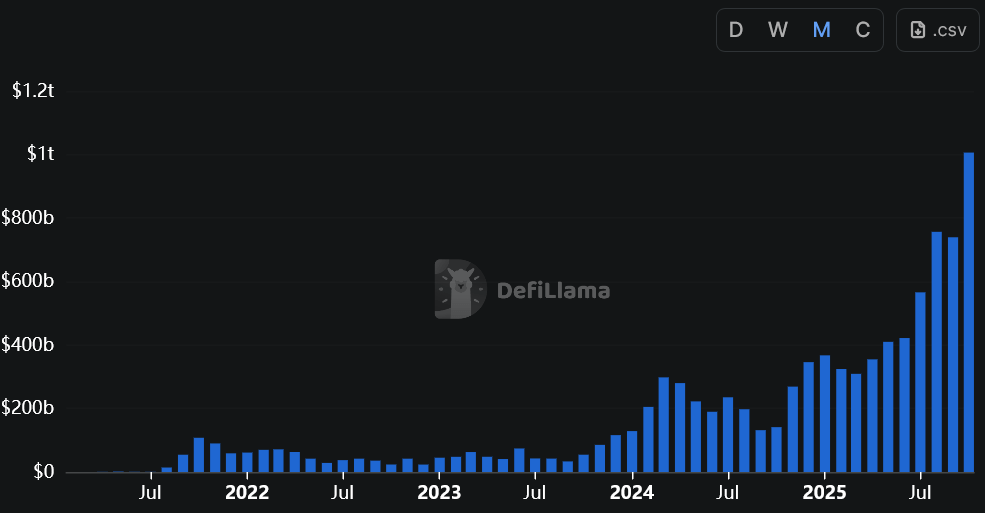
Change in monthly perps trading volume since February 2021. Source: DeFiLlama

Leading October’s trading volume is Hyperliquid, which has executed $317.6 billion in transactions this month, followed by Lighter, Aster, and edgeX, with $255.4 billion, $177.6 billion, and $60.6 billion respectively. This growth underscores the rising importance of decentralized derivatives in modern crypto markets, attracting both institutional and retail traders seeking innovative trading opportunities.

As decentralized derivatives trading continues to grow, it consolidates its position as a vital component of the expanding blockchain ecosystem, particularly in the context of crypto regulation and market resilience.

This article was originally published as Hyperliquid Strategies secures $1B to expand HYPE acquisitions on Crypto Breaking News – your trusted source for crypto news, Bitcoin news, and blockchain updates.


Market Opportunity
Hyperliquid Logo
Hyperliquid Price(HYPE)
$36.72
$36.72$36.72
+0.99%
USD
Hyperliquid (HYPE) Live Price Chart
Disclaimer: The articles reposted on this site are sourced from public platforms and are provided for informational purposes only. They do not necessarily reflect the views of MEXC. All rights remain with the original authors. If you believe any content infringes on third-party rights, please contact crypto.news@mexc.com for removal. MEXC makes no guarantees regarding the accuracy, completeness, or timeliness of the content and is not responsible for any actions taken based on the information provided. The content does not constitute financial, legal, or other professional advice, nor should it be considered a recommendation or endorsement by MEXC.

You May Also Like

[Finterest] How do you start saving with Pag-IBIG’s MP2 program?

[Finterest] How do you start saving with Pag-IBIG’s MP2 program?

MP2 may be right for you if you have a conservative risk appetite and an investment horizon of at least 5 years
Share
Rappler2026/03/12 13:05
XRP steadies near $1.38 as Bollinger squeeze hints at breakout before CPI

XRP steadies near $1.38 as Bollinger squeeze hints at breakout before CPI

Markets Share Share this article
Copy linkX (Twitter)LinkedInFacebookEmail
XRP steadies near $1.38 as Bollinger squeeze
Share
Coindesk2026/03/12 13:15
Google's AP2 protocol has been released. Does encrypted AI still have a chance?

Google's AP2 protocol has been released. Does encrypted AI still have a chance?

Following the MCP and A2A protocols, the AI Agent market has seen another blockbuster arrival: the Agent Payments Protocol (AP2), developed by Google. This will clearly further enhance AI Agents' autonomous multi-tasking capabilities, but the unfortunate reality is that it has little to do with web3AI. Let's take a closer look: What problem does AP2 solve? Simply put, the MCP protocol is like a universal hook, enabling AI agents to connect to various external tools and data sources; A2A is a team collaboration communication protocol that allows multiple AI agents to cooperate with each other to complete complex tasks; AP2 completes the last piece of the puzzle - payment capability. In other words, MCP opens up connectivity, A2A promotes collaboration efficiency, and AP2 achieves value exchange. The arrival of AP2 truly injects "soul" into the autonomous collaboration and task execution of Multi-Agents. Imagine AI Agents connecting Qunar, Meituan, and Didi to complete the booking of flights, hotels, and car rentals, but then getting stuck at the point of "self-payment." What's the point of all that multitasking? So, remember this: AP2 is an extension of MCP+A2A, solving the last mile problem of AI Agent automated execution. What are the technical highlights of AP2? The core innovation of AP2 is the Mandates mechanism, which is divided into real-time authorization mode and delegated authorization mode. Real-time authorization is easy to understand. The AI Agent finds the product and shows it to you. The operation can only be performed after the user signs. Delegated authorization requires the user to set rules in advance, such as only buying the iPhone 17 when the price drops to 5,000. The AI Agent monitors the trigger conditions and executes automatically. The implementation logic is cryptographically signed using Verifiable Credentials (VCs). Users can set complex commission conditions, including price ranges, time limits, and payment method priorities, forming a tamper-proof digital contract. Once signed, the AI Agent executes according to the conditions, with VCs ensuring auditability and security at every step. Of particular note is the "A2A x402" extension, a technical component developed by Google specifically for crypto payments, developed in collaboration with Coinbase and the Ethereum Foundation. This extension enables AI Agents to seamlessly process stablecoins, ETH, and other blockchain assets, supporting native payment scenarios within the Web3 ecosystem. What kind of imagination space can AP2 bring? After analyzing the technical principles, do you think that's it? Yes, in fact, the AP2 is boring when it is disassembled alone. Its real charm lies in connecting and opening up the "MCP+A2A+AP2" technology stack, completely opening up the complete link of AI Agent's autonomous analysis+execution+payment. From now on, AI Agents can open up many application scenarios. For example, AI Agents for stock investment and financial management can help us monitor the market 24/7 and conduct independent transactions. Enterprise procurement AI Agents can automatically replenish and renew without human intervention. AP2's complementary payment capabilities will further expand the penetration of the Agent-to-Agent economy into more scenarios. Google obviously understands that after the technical framework is established, the ecological implementation must be relied upon, so it has brought in more than 60 partners to develop it, almost covering the entire payment and business ecosystem. Interestingly, it also involves major Crypto players such as Ethereum, Coinbase, MetaMask, and Sui. Combined with the current trend of currency and stock integration, the imagination space has been doubled. Is web3 AI really dead? Not entirely. Google's AP2 looks complete, but it only achieves technical compatibility with Crypto payments. It can only be regarded as an extension of the traditional authorization framework and belongs to the category of automated execution. There is a "paradigm" difference between it and the autonomous asset management pursued by pure Crypto native solutions. The Crypto-native solutions under exploration are taking the "decentralized custody + on-chain verification" route, including AI Agent autonomous asset management, AI Agent autonomous transactions (DeFAI), AI Agent digital identity and on-chain reputation system (ERC-8004...), AI Agent on-chain governance DAO framework, AI Agent NPC and digital avatars, and many other interesting and fun directions. Ultimately, once users get used to AI Agent payments in traditional fields, their acceptance of AI Agents autonomously owning digital assets will also increase. And for those scenarios that AP2 cannot reach, such as anonymous transactions, censorship-resistant payments, and decentralized asset management, there will always be a time for crypto-native solutions to show their strength? The two are more likely to be complementary rather than competitive, but to be honest, the key technological advancements behind AI Agents currently all come from web2AI, and web3AI still needs to keep up the good work!
Share
PANews2025/09/18 07:00



