A class action lawsuit filed in the Southern District of New York accuses Meteora co-founder Benjamin Chow of orchestrating a systematic fraud scheme that weaponized celebrity endorsements from Melania Trump and Argentine President Javier Milei to defraud retail crypto investors of at least $57 million. The Second Amended Class Action Complaint alleges Chow and associates operated the Meteora-Kelsier Enterprise as a “fraud factory” disguised as decentralized finance, using the Meteora liquidity-pooling protocol on Solana as the core engine for multi-token pump-and-dump operations across $M3M3, $LIBRA, $MELANIA, $ENRON, and $TRUST. Plaintiffs Omar Hurlock, Anuj Mehta, and John Winslow claim that defendants exploited technical settings, like whitelists and freeze/thaw toggles, to acquire a majority of the token supplies at negligible cost before manufacturing artificial price spikes through undisclosed paid influencers. Forensic analysis identified a central coordinating wallet, prefixed 0xcEA, that repeatedly funded deployer wallets, creating tokens, seeding initial liquidity, and financing sniper wallets that captured early supply.Source: Court Listener The lawsuit seeks disgorgement of all profits, trebling of compensatory damages under RICO statutes, and appointment of a qualified independent receiver over Meteora’s upgradeable smart-contract programs. Six-Step Fraud Playbook Exploited Celebrity Endorsements The complaint details a systematic playbook used across all tokens. It begins with narrative invention using borrowed fame, then rigging supply through insider-funded accounts that execute opening-second orders, manufacturing hype through undisclosed paid Key Opinion Leaders, and engineering price spikes using Meteora’s pool controls to pause public trading until insider positions are secured. It also involves executing extraction by selling massive positions while draining liquidity, and reinventing the scheme with new themes but recycled tooling. The $LIBRA fraud exemplified this pattern when Argentine President Javier Milei’s verified social media account posted the contract address at the exact moment pools opened in February 2025, triggering a retail stampede. The campaign styled $LIBRA as a patriotic Argentine revival initiative promising to fund small businesses. Within hours of launch, the deployer wallet withdrew over $110 million in USDC stablecoin liquidity, stripping the token of its foundation and causing instant price collapse, coinciding with Milei’s post-retraction. The $MELANIA fraud marketed the token as the official meme coin of Melania Trump, with claimed vesting mechanisms to protect against dumping. Wallets connected to the Meteora-Kelsier cluster accumulated approximately one-third of the entire supply in minutes before the official launch. After orchestrated hype, insider wallets dumped tokens into the surge, with the price subsequently losing over 90% of market capitalization within days. Kelsier Ventures CEO Hayden Davis, who co-founded both $LIBRA and $MELANIA, stated in a YouTube interview that “we sniped our own coin to prevent snipers from sniping our own coin.“ Chow Resigned in February, Now Faces RICO Charges Back in February 2025, Ben Chow stepped down from Meteora following the $LIBRA controversy, with Jupiter co-founder Meow stating that, while confident in Chow’s character, he showed “a lack of judgment and care about some of the core aspects of the project.” A leaked video posted by SolanaFloor showed DeFiTuna founder Dhirk informing Chow about Davis’s misconduct, with Chow expressing visible shock and stating, “I feel so sick, because I gave him Melania. I fucked up because I enabled the guy that should not have been enabled.“ The lawsuit alleges that Chow maintained unique expertise in controlling technology, directing the configuration of liquidity pools, fee routing, trading parameters, and the ability to freeze or thaw trading selectively. Kelsier Labs secretly agreed to invest approximately $2 million into Meteora’s operations as a pay-to-play buy-in.Source: Court Listener Whistleblower communications confirm Hayden Davis acted under Chow’s instructions on more than fifteen token launches, establishing central command. The complaint asserts seven causes of action, including fraud, conspiracy to defraud, RICO violations for a pattern of racketeering activity consisting of thousands of wire fraud acts, deceptive practices under New York General Business Law, and unjust enrichment. The timing coincides with broader scrutiny of Trump family crypto ventures, which reportedly generated $1 billion in pre-tax gains over the past year. The $TRUMP and $MELANIA coins generated approximately $427 million, while both tokens experienced dramatic declines during the presidential inauguration, with $MELANIA’s market cap plummeting from $2 billion to $790 millionA class action lawsuit filed in the Southern District of New York accuses Meteora co-founder Benjamin Chow of orchestrating a systematic fraud scheme that weaponized celebrity endorsements from Melania Trump and Argentine President Javier Milei to defraud retail crypto investors of at least $57 million. The Second Amended Class Action Complaint alleges Chow and associates operated the Meteora-Kelsier Enterprise as a “fraud factory” disguised as decentralized finance, using the Meteora liquidity-pooling protocol on Solana as the core engine for multi-token pump-and-dump operations across $M3M3, $LIBRA, $MELANIA, $ENRON, and $TRUST. Plaintiffs Omar Hurlock, Anuj Mehta, and John Winslow claim that defendants exploited technical settings, like whitelists and freeze/thaw toggles, to acquire a majority of the token supplies at negligible cost before manufacturing artificial price spikes through undisclosed paid influencers. Forensic analysis identified a central coordinating wallet, prefixed 0xcEA, that repeatedly funded deployer wallets, creating tokens, seeding initial liquidity, and financing sniper wallets that captured early supply.Source: Court Listener The lawsuit seeks disgorgement of all profits, trebling of compensatory damages under RICO statutes, and appointment of a qualified independent receiver over Meteora’s upgradeable smart-contract programs. Six-Step Fraud Playbook Exploited Celebrity Endorsements The complaint details a systematic playbook used across all tokens. It begins with narrative invention using borrowed fame, then rigging supply through insider-funded accounts that execute opening-second orders, manufacturing hype through undisclosed paid Key Opinion Leaders, and engineering price spikes using Meteora’s pool controls to pause public trading until insider positions are secured. It also involves executing extraction by selling massive positions while draining liquidity, and reinventing the scheme with new themes but recycled tooling. The $LIBRA fraud exemplified this pattern when Argentine President Javier Milei’s verified social media account posted the contract address at the exact moment pools opened in February 2025, triggering a retail stampede. The campaign styled $LIBRA as a patriotic Argentine revival initiative promising to fund small businesses. Within hours of launch, the deployer wallet withdrew over $110 million in USDC stablecoin liquidity, stripping the token of its foundation and causing instant price collapse, coinciding with Milei’s post-retraction. The $MELANIA fraud marketed the token as the official meme coin of Melania Trump, with claimed vesting mechanisms to protect against dumping. Wallets connected to the Meteora-Kelsier cluster accumulated approximately one-third of the entire supply in minutes before the official launch. After orchestrated hype, insider wallets dumped tokens into the surge, with the price subsequently losing over 90% of market capitalization within days. Kelsier Ventures CEO Hayden Davis, who co-founded both $LIBRA and $MELANIA, stated in a YouTube interview that “we sniped our own coin to prevent snipers from sniping our own coin.“ Chow Resigned in February, Now Faces RICO Charges Back in February 2025, Ben Chow stepped down from Meteora following the $LIBRA controversy, with Jupiter co-founder Meow stating that, while confident in Chow’s character, he showed “a lack of judgment and care about some of the core aspects of the project.” A leaked video posted by SolanaFloor showed DeFiTuna founder Dhirk informing Chow about Davis’s misconduct, with Chow expressing visible shock and stating, “I feel so sick, because I gave him Melania. I fucked up because I enabled the guy that should not have been enabled.“ The lawsuit alleges that Chow maintained unique expertise in controlling technology, directing the configuration of liquidity pools, fee routing, trading parameters, and the ability to freeze or thaw trading selectively. Kelsier Labs secretly agreed to invest approximately $2 million into Meteora’s operations as a pay-to-play buy-in.Source: Court Listener Whistleblower communications confirm Hayden Davis acted under Chow’s instructions on more than fifteen token launches, establishing central command. The complaint asserts seven causes of action, including fraud, conspiracy to defraud, RICO violations for a pattern of racketeering activity consisting of thousands of wire fraud acts, deceptive practices under New York General Business Law, and unjust enrichment. The timing coincides with broader scrutiny of Trump family crypto ventures, which reportedly generated $1 billion in pre-tax gains over the past year. The $TRUMP and $MELANIA coins generated approximately $427 million, while both tokens experienced dramatic declines during the presidential inauguration, with $MELANIA’s market cap plummeting from $2 billion to $790 million

Meteora Founder Accused of Using Melania Trump, Milei for $57M Memecoin Scam

A class action lawsuit filed in the Southern District of New York accuses Meteora co-founder Benjamin Chow of orchestrating a systematic fraud scheme that weaponized celebrity endorsements from Melania Trump and Argentine President Javier Milei to defraud retail crypto investors of at least $57 million.

The Second Amended Class Action Complaint alleges Chow and associates operated the Meteora-Kelsier Enterprise as a “fraud factory” disguised as decentralized finance, using the Meteora liquidity-pooling protocol on Solana as the core engine for multi-token pump-and-dump operations across $M3M3, $LIBRA, $MELANIA, $ENRON, and $TRUST.

Plaintiffs Omar Hurlock, Anuj Mehta, and John Winslow claim that defendants exploited technical settings, like whitelists and freeze/thaw toggles, to acquire a majority of the token supplies at negligible cost before manufacturing artificial price spikes through undisclosed paid influencers.

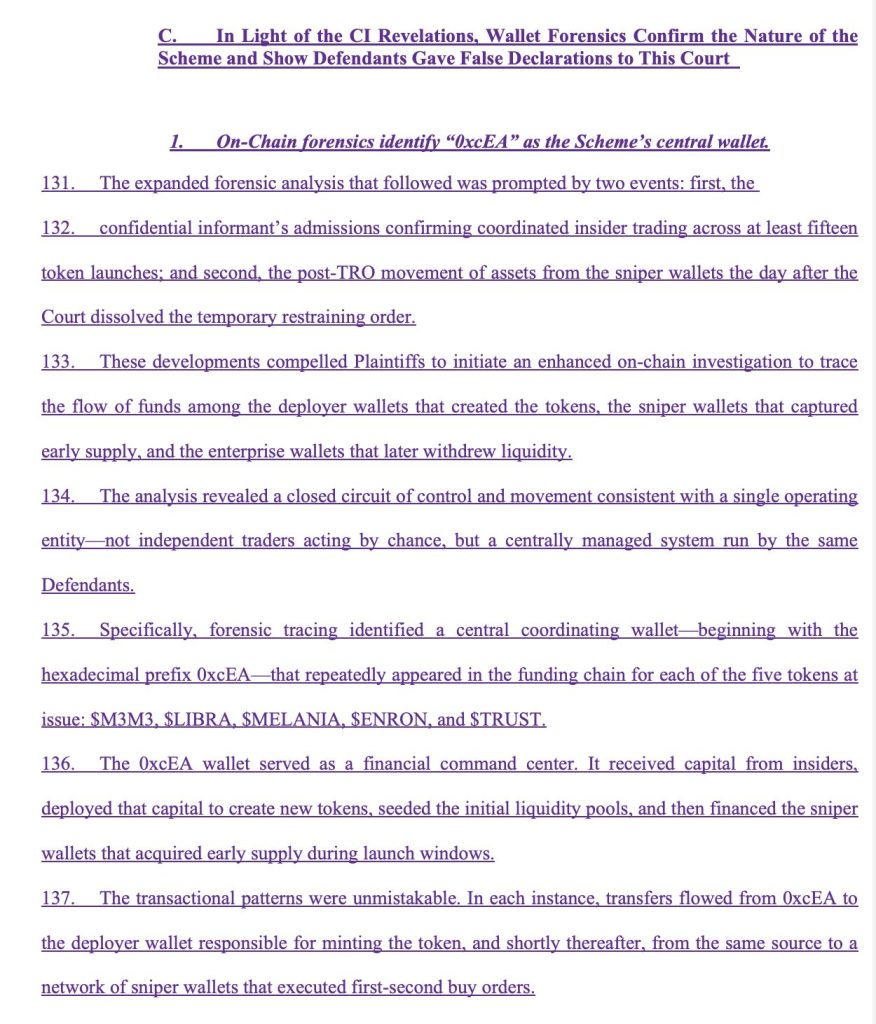
Forensic analysis identified a central coordinating wallet, prefixed 0xcEA, that repeatedly funded deployer wallets, creating tokens, seeding initial liquidity, and financing sniper wallets that captured early supply.
Meteora Founder Accused of Using Melania Trump, Milei for $57M Memecoin ScamSource: Court Listener

The lawsuit seeks disgorgement of all profits, trebling of compensatory damages under RICO statutes, and appointment of a qualified independent receiver over Meteora’s upgradeable smart-contract programs.

Six-Step Fraud Playbook Exploited Celebrity Endorsements

The complaint details a systematic playbook used across all tokens.

It begins with narrative invention using borrowed fame, then rigging supply through insider-funded accounts that execute opening-second orders, manufacturing hype through undisclosed paid Key Opinion Leaders, and engineering price spikes using Meteora’s pool controls to pause public trading until insider positions are secured.

It also involves executing extraction by selling massive positions while draining liquidity, and reinventing the scheme with new themes but recycled tooling.

The $LIBRA fraud exemplified this pattern when Argentine President Javier Milei’s verified social media account posted the contract address at the exact moment pools opened in February 2025, triggering a retail stampede.

The campaign styled $LIBRA as a patriotic Argentine revival initiative promising to fund small businesses.

Within hours of launch, the deployer wallet withdrew over $110 million in USDC stablecoin liquidity, stripping the token of its foundation and causing instant price collapse, coinciding with Milei’s post-retraction.

The $MELANIA fraud marketed the token as the official meme coin of Melania Trump, with claimed vesting mechanisms to protect against dumping.

Wallets connected to the Meteora-Kelsier cluster accumulated approximately one-third of the entire supply in minutes before the official launch.

After orchestrated hype, insider wallets dumped tokens into the surge, with the price subsequently losing over 90% of market capitalization within days.

Kelsier Ventures CEO Hayden Davis, who co-founded both $LIBRA and $MELANIA, stated in a YouTube interview that “we sniped our own coin to prevent snipers from sniping our own coin.

Chow Resigned in February, Now Faces RICO Charges

Back in February 2025, Ben Chow stepped down from Meteora following the $LIBRA controversy, with Jupiter co-founder Meow stating that, while confident in Chow’s character, he showed “a lack of judgment and care about some of the core aspects of the project.

A leaked video posted by SolanaFloor showed DeFiTuna founder Dhirk informing Chow about Davis’s misconduct, with Chow expressing visible shock and stating, “I feel so sick, because I gave him Melania. I fucked up because I enabled the guy that should not have been enabled.

The lawsuit alleges that Chow maintained unique expertise in controlling technology, directing the configuration of liquidity pools, fee routing, trading parameters, and the ability to freeze or thaw trading selectively.

Kelsier Labs secretly agreed to invest approximately $2 million into Meteora’s operations as a pay-to-play buy-in.

Meteora Founder Accused of Using Melania Trump, Milei for $57M Memecoin ScamSource: Court Listener

Whistleblower communications confirm Hayden Davis acted under Chow’s instructions on more than fifteen token launches, establishing central command.

The complaint asserts seven causes of action, including fraud, conspiracy to defraud, RICO violations for a pattern of racketeering activity consisting of thousands of wire fraud acts, deceptive practices under New York General Business Law, and unjust enrichment.

The timing coincides with broader scrutiny of Trump family crypto ventures, which reportedly generated $1 billion in pre-tax gains over the past year.

The $TRUMP and $MELANIA coins generated approximately $427 million, while both tokens experienced dramatic declines during the presidential inauguration, with $MELANIA’s market cap plummeting from $2 billion to $790 million.


Market Opportunity
Melania Meme Logo
Melania Meme Price(MELANIA)
$0.16439
$0.16439$0.16439
-5.08%
USD
Melania Meme (MELANIA) Live Price Chart
Disclaimer: The articles reposted on this site are sourced from public platforms and are provided for informational purposes only. They do not necessarily reflect the views of MEXC. All rights remain with the original authors. If you believe any content infringes on third-party rights, please contact service@support.mexc.com for removal. MEXC makes no guarantees regarding the accuracy, completeness, or timeliness of the content and is not responsible for any actions taken based on the information provided. The content does not constitute financial, legal, or other professional advice, nor should it be considered a recommendation or endorsement by MEXC.

You May Also Like

Polygon Tops RWA Rankings With $1.1B in Tokenized Assets

Polygon Tops RWA Rankings With $1.1B in Tokenized Assets

The post Polygon Tops RWA Rankings With $1.1B in Tokenized Assets appeared on BitcoinEthereumNews.com. Key Notes A new report from Dune and RWA.xyz highlights Polygon’s role in the growing RWA sector. Polygon PoS currently holds $1.13 billion in RWA Total Value Locked (TVL) across 269 assets. The network holds a 62% market share of tokenized global bonds, driven by European money market funds. The Polygon POL $0.25 24h volatility: 1.4% Market cap: $2.64 B Vol. 24h: $106.17 M network is securing a significant position in the rapidly growing tokenization space, now holding over $1.13 billion in total value locked (TVL) from Real World Assets (RWAs). This development comes as the network continues to evolve, recently deploying its major “Rio” upgrade on the Amoy testnet to enhance future scaling capabilities. This information comes from a new joint report on the state of the RWA market published on Sept. 17 by blockchain analytics firm Dune and data platform RWA.xyz. The focus on RWAs is intensifying across the industry, coinciding with events like the ongoing Real-World Asset Summit in New York. Sandeep Nailwal, CEO of the Polygon Foundation, highlighted the findings via a post on X, noting that the TVL is spread across 269 assets and 2,900 holders on the Polygon PoS chain. The Dune and https://t.co/W6WSFlHoQF report on RWA is out and it shows that RWA is happening on Polygon. Here are a few highlights: – Leading in Global Bonds: Polygon holds 62% share of tokenized global bonds (driven by Spiko’s euro MMF and Cashlink euro issues) – Spiko U.S.… — Sandeep | CEO, Polygon Foundation (※,※) (@sandeepnailwal) September 17, 2025 Key Trends From the 2025 RWA Report The joint publication, titled “RWA REPORT 2025,” offers a comprehensive look into the tokenized asset landscape, which it states has grown 224% since the start of 2024. The report identifies several key trends driving this expansion. According to…
Share
BitcoinEthereumNews2025/09/18 00:40
Vitalik Buterin Reveals Ethereum’s Long-Term Focus on Quantum Resistance

Vitalik Buterin Reveals Ethereum’s Long-Term Focus on Quantum Resistance

TLDR Ethereum focuses on quantum resistance to secure the blockchain’s future. Vitalik Buterin outlines Ethereum’s long-term development with security goals. Ethereum aims for improved transaction efficiency and layer-2 scalability. Ethereum maintains a strong market position with price stability above $4,000. Vitalik Buterin, the co-founder of Ethereum, has shared insights into the blockchain’s long-term development. During [...] The post Vitalik Buterin Reveals Ethereum’s Long-Term Focus on Quantum Resistance appeared first on CoinCentral.
Share
Coincentral2025/09/18 00:31
Academic Publishing and Fairness: A Game-Theoretic Model of Peer-Review Bias

Academic Publishing and Fairness: A Game-Theoretic Model of Peer-Review Bias

Exploring how biases in the peer-review system impact researchers' choices, showing how principles of fairness relate to the production of scientific knowledge based on topic importance and hardness.
Share
Hackernoon2025/09/17 23:15



