Mid-tier Bitcoin miners (Ciper Mining, Bitdeer and HIVE) are closing the gap on industry peers in realized hashrate since the halving.Mid-tier Bitcoin miners (Ciper Mining, Bitdeer and HIVE) are closing the gap on industry peers in realized hashrate since the halving.

Bitcoin miners Cipher, Bitdeer, and HIVE narrow hashrate divide

2025/10/26 21:00

Mid-tier Bitcoin miners are closing the gap on industry leaders in realized hashrate following the 2024 halving.

Summary
  • Mid-tier miners rapidly expanded after the 2024 halving, closing in on top players.
  • Public miners doubled their realized hashrate to 326 EH/s, a one-year record increase.
  • Mining sector debt surged to $12.7B amid heavy investment in rigs and AI ventures.

Cipher Mining, Bitdeer and HIVE Digital have quickly expanded their operations after years of infrastructure growth and narrowed the distance to top players like MARA Holdings, CleanSpark and Cango.

The change is a more level playing field in the mining sector. “Their ascent highlights how the middle tier of public miners — once trailing far behind — has rapidly scaled production since the 2024 halving,” The Miner Mag wrote in its latest Miner Weekly newsletter.

Top Bitcoin miners doubled realized hashrate

MARA, CleanSpark and Cango maintained their positions as the three largest public miners. Rivals including IREN, Cipher, Bitdeer and HIVE Digital posted strong year-over-year increases in realized hashrate.

The top public miners reached 326 exahashes per second (EH/s) of realized hashrate in September, more than double the level recorded a year earlier. Collectively, they now account for nearly one-third of Bitcoin’s (BTC) total network hashrate.
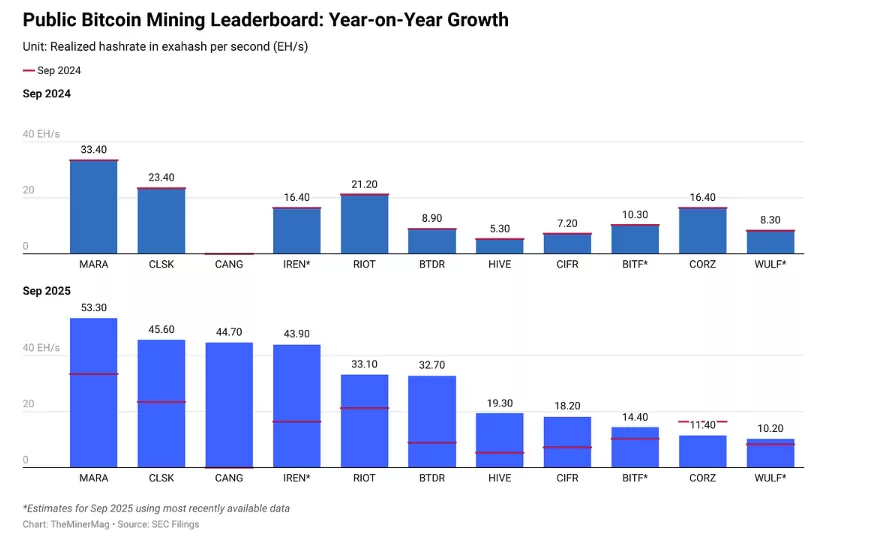
Bitcoin miners Cipher, Bitdeer, and HIVE narrow hashrate divide - 2

Hashrate measures the computational power miners contribute to securing the Bitcoin blockchain. Realized hashrate tracks actual onchain performance, or the rate at which valid blocks are successfully mined.

For publicly traded miners, realized hashrate is a closer indicator of operational efficiency and revenue potential. The metric has become a key measure ahead of third-quarter earnings season.

Mining debt surges to $12.7 billion

Bitcoin miners are taking on record debt levels and also expands into new mining rigs, artificial intelligence infrastructure and other capital-intensive ventures. Total debt across the sector has jumped to $12.7 billion, up from $2.1 billion just 12 months ago.

VanEck research noted that miners must continuously invest in next-generation hardware to maintain their share of Bitcoin’s total hashrate and avoid falling behind competitors.

Some mining companies have turned to AI and high-performance computing workloads to diversify revenue streams. The change comes after dropping margins following the 2024 Bitcoin halving, which reduced block rewards to 3.125 BTC.

The debt increase shows aggressive expansion plans across the industry. Mining companies face pressure to scale operations quickly or risk losing market share to better-capitalized rivals.


Disclaimer: The articles reposted on this site are sourced from public platforms and are provided for informational purposes only. They do not necessarily reflect the views of MEXC. All rights remain with the original authors. If you believe any content infringes on third-party rights, please contact service@support.mexc.com for removal. MEXC makes no guarantees regarding the accuracy, completeness, or timeliness of the content and is not responsible for any actions taken based on the information provided. The content does not constitute financial, legal, or other professional advice, nor should it be considered a recommendation or endorsement by MEXC.

You May Also Like

OFAC Designates Two Iranian Finance Facilitators For Crypto Shadow Banking

OFAC Designates Two Iranian Finance Facilitators For Crypto Shadow Banking

The Department of the Treasury’s Office of Foreign Assets Control (OFAC) sanctioned two Iranian financial facilitators for coordinating over $100 million worth of cryptocurrency in oil sales for the Iranian government, a September 16 press release shows. OFAC Sanctions Iranian Nationals According to the Tuesday press release, Iranian nationals Alireza Derakhshan and Arash Estaki Alivand “used a network of front companies in multiple foreign jurisdictions” to transfer the digital assets. OFAC alleges that Alivand and Derakhshan’s transfers also involved the sale of Iranian oil that benefited Iran’s Islamic Revolutionary Guard Corps-Qods Force (IRGC-QF) and the Ministry of Defense and Armed Forces Logistics (MODAFL). IRGC-QF and MODAFL then used the proceeds to support regional proxy terrorist organizations and strengthen their advanced weapons systems, including ballistic missiles. U.S. officials say the move targets shadow banking in the region, where illicit financial actors use overseas money laundering and digital assets to evade sanctions. “Iranian entities rely on shadow banking networks to evade sanctions and move millions through the international financial system,” said Under Secretary of the Treasury for Terrorism and Financial Intelligence John K. Hurley. “Under President Trump’s leadership, we will continue to disrupt these key financial streams that fund Iran’s weapons programs and malign activities in the Middle East and beyond,” he continued. Dozens Designated In Shadow Banking Scandal Both Alivand and Derakhshan have been designated “for having materially assisted, sponsored, or provided financial, material, or technological support for, or goods or services to or in support of the IRGC-QF.” In addition to Alivand and Derakhshan, OFAC has sanctioned more than a dozen Hong Kong and United Arab Emirates-based entities and individuals tied to the network. According to the press release, the sanctioned entities may face civil or criminal penalties imposed as a result
Share
CryptoNews2025/09/18 11:18



