Low-Rank Adaptation (LoRA) and its successor ReLoRA offer more efficient ways to fine-tune large AI models by reducing the computational and memory costs of traditional full-rank training. ReLoRA* extends this idea through zero-initialized layers and optimizer resets for even leaner adaptation—but its reliance on random initialization and limited singular value learning can cause slower convergence. The section sets the stage for Sparse Spectral Training (SST), which aims to resolve these bottlenecks and match full-rank performance with far lower resource demands.Low-Rank Adaptation (LoRA) and its successor ReLoRA offer more efficient ways to fine-tune large AI models by reducing the computational and memory costs of traditional full-rank training. ReLoRA* extends this idea through zero-initialized layers and optimizer resets for even leaner adaptation—but its reliance on random initialization and limited singular value learning can cause slower convergence. The section sets the stage for Sparse Spectral Training (SST), which aims to resolve these bottlenecks and match full-rank performance with far lower resource demands.

Breaking Down Low-Rank Adaptation and Its Next Evolution, ReLoRA

2025/10/29 17:10
3 min read
For feedback or concerns regarding this content, please contact us at crypto.news@mexc.com

Abstract and 1. Introduction

  1. Related Work

  2. Low Rank Adaptation

    3.1 LoRA and 3.2 Limitation of LoRA

    3.3 ReLoRA*

  3. Sparse Spectral Training

    4.1 Preliminaries and 4.2 Gradient Update of U, VT with Σ

    4.3 Why SVD Initialization is Important

    4.4 SST Balances Exploitation and Exploration

    4.5 Memory-Efficient Implementation for SST and 4.6 Sparsity of SST

  4. Experiments

    5.1 Machine Translation

    5.2 Natural Language Generation

    5.3 Hyperbolic Graph Neural Networks

  5. Conclusion and Discussion

  6. Broader Impacts and References

Supplementary Information

A. Algorithm of Sparse Spectral Training

B. Proof of Gradient of Sparse Spectral Layer

C. Proof of Decomposition of Gradient of Weight

D. Proof of Advantage of Enhanced Gradient over Default Gradient

E. Proof of Zero Distortion with SVD Initialization

F. Experiment Details

G. Singular Value Pruning

H. Evaluating SST and GaLore: Complementary Approaches to Memory Efficiency

I. Ablation Study

3 Low Rank Adaptation

This section introduces the fundamentals and limitations of Low-Rank Adaptation (LoRA) [4] and ReLoRA [5]. These limitations are addressed by Sparse Spectral Training (SST) in Section 4.

3.1 LoRA

3.2 Limitation of LoRA

3.3 ReLoRA*

\
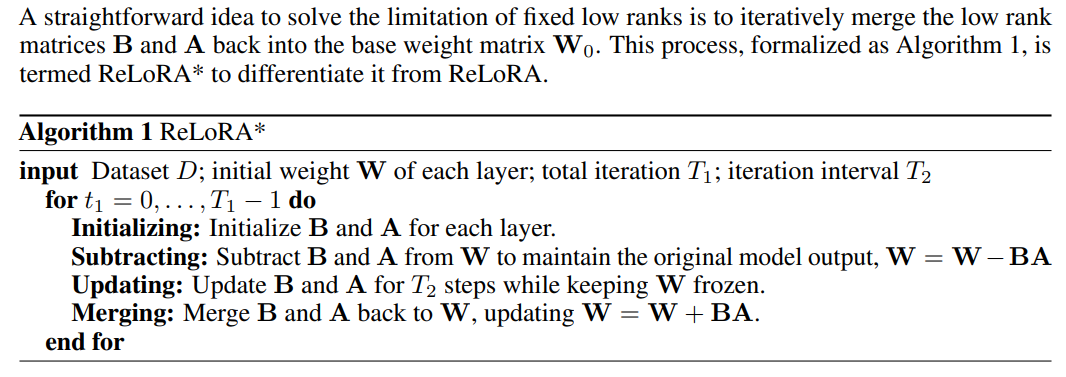
\ \ This improvement theoretically permits LoRA to transcend the limitations of a predetermined rank r. ReLoRA [5] and COLA [6] represent specific implementations of this strategy, where they employ LoRA’s initialization techniques—B initialized to zero and A with a Gaussian distribution [30]. The initial zero setting for B allows the subtracting step to be skipped. ReLoRA* thus serves as an end-to-end memory-efficient methodology, differing from ReLoRA, which incorporates a period of full-rank training initially. Notably, the optimizer states for B and A are reset after merging step (99% optimizer state is pruned in ReLoRA).

\ However, each iteration of ReLoRA* learns only a small subset of singular values. Additionally, its reliance on random initialization can lead to stucking at saddle points, as discussed in Section 4.3. These issues hinder ReLoRA* from achieving the convergence speed and training quality of full-rank training.

\

:::info Authors:

(1) Jialin Zhao, Center for Complex Network Intelligence (CCNI), Tsinghua Laboratory of Brain and Intelligence (THBI) and Department of Computer Science;

(2) Yingtao Zhang, Center for Complex Network Intelligence (CCNI), Tsinghua Laboratory of Brain and Intelligence (THBI) and Department of Computer Science;

(3) Xinghang Li, Department of Computer Science;

(4) Huaping Liu, Department of Computer Science;

(5) Carlo Vittorio Cannistraci, Center for Complex Network Intelligence (CCNI), Tsinghua Laboratory of Brain and Intelligence (THBI), Department of Computer Science, and Department of Biomedical Engineering Tsinghua University, Beijing, China.

:::


:::info This paper is available on arxiv under CC by 4.0 Deed (Attribution 4.0 International) license.

:::

\

Market Opportunity
Moonveil Logo
Moonveil Price(MORE)
$0.0001597
$0.0001597$0.0001597
+5.76%
USD
Moonveil (MORE) Live Price Chart
Disclaimer: The articles reposted on this site are sourced from public platforms and are provided for informational purposes only. They do not necessarily reflect the views of MEXC. All rights remain with the original authors. If you believe any content infringes on third-party rights, please contact crypto.news@mexc.com for removal. MEXC makes no guarantees regarding the accuracy, completeness, or timeliness of the content and is not responsible for any actions taken based on the information provided. The content does not constitute financial, legal, or other professional advice, nor should it be considered a recommendation or endorsement by MEXC.

You May Also Like

Top Low-Cost Cryptocurrencies Analysts Are Watching for 2027

Top Low-Cost Cryptocurrencies Analysts Are Watching for 2027

Investors are now hunting for projects that combine affordability with actual utility. While famous names still hold the spotlight, a new crypto era of decentralized
Share
Techbullion2026/03/14 10:49
Shiba Inu Price Forecast: Why This New Trending Meme Coin Is Being Dubbed The New PEPE After Record Presale

Shiba Inu Price Forecast: Why This New Trending Meme Coin Is Being Dubbed The New PEPE After Record Presale

While Shiba Inu (SHIB) continues to build its ecosystem and PEPE holds onto its viral roots, a new contender, Layer […] The post Shiba Inu Price Forecast: Why This New Trending Meme Coin Is Being Dubbed The New PEPE After Record Presale appeared first on Coindoo.
Share
Coindoo2025/09/18 01:13
EIGEN pumps to three-month high with boost from AI agents

EIGEN pumps to three-month high with boost from AI agents

The post EIGEN pumps to three-month high with boost from AI agents appeared on BitcoinEthereumNews.com. Eigen Cloud (EIGEN) pumped to a three-month high, boosted by its role as a data supplier to AI agents. EIGEN rallied by 33% for the past day, logging 67% gains for the past 90 days.  Eigen Cloud (EIGEN) was the latest breakout token during the current altcoin season. It gained 33.8% in the past day, to trade at a three-month peak of $2.03. The token attempted a recovery after its rebranding in June.  EIGEN broke out to a three-month peak, following its addition to Google’s AI agent payment framework. | Source: CoinGecko. EIGEN open interest also jumped to over $130M, the highest level in the past six months. The token still has limited positions on Hyperliquid, with just nine whales betting on its direction. Five of those positions are shorting EIGEN, and are carrying unrealized losses after the recent breakout. Eigen Cloud rallied after becoming part of Google’s AI agent payment initiative. As Cryptopolitan previously reported, Google opened a toolset for safe, verifiable payments coming directly from AI agents.  Google’s AP2 protocol included Eigen as a platform for safe, verified transactions originating with AI agents.  We’re excited to be a launch partner for @GoogleCloud‘s new Agent Payments Protocol (AP2), a standard that gives AI agents the ability to transact with trust and accountability. At EigenCloud, our focus is on verifiability. As our founder @sreeramkannan said: AP2 helps create… https://t.co/Fx90rTJuhm pic.twitter.com/0Vil6yLdkf — EigenCloud (@eigenlayer) September 16, 2025 The new use case for Eigen arrives as older Web3 and DeFi projects seek to pivot to new use cases. Other AP2 partners from the crypto space include Coinbase and the Ethereum Foundation. Most of the payment and e-commerce platforms offer fiat handling, while Eigen’s verifiable transaction data target crypto payments and transfers. The market for AI agent transactions is estimated at over $27B,…
Share
BitcoinEthereumNews2025/09/18 18:29