The post Second AWS Outage Reported In a Week – Is Your Crypto Safe? appeared on BitcoinEthereumNews.com. Amazon Web Services (AWS) has reportedly suffered another outage today, after its major disruption just 10 days ago on October 20. Many platforms relying on AWS have reported operational issues to some extent.  With these continuous disruptions, the crypto community is facing a critical concern. How secure are blockchain networks and digital assets if major servers go out and remain offline for a notable time?  Sponsored Sponsored AWS is Critical Web3 Plumbing — Even If People Forget That Despite “decentralization” being a core principle of blockchain, most of the Web3 stack is not fully decentralized.  The majority of critical infrastructure — RPC endpoints, APIs, exchange frontends, analytics dashboards, price feeds, even wallet services — run on centralized cloud providers, especially AWS US-East-1. Infura, Alchemy, QuickNode, Ankr, and many node-hosting services run large clusters on AWS. Many exchanges, custodians, and wallets depend on AWS for compute and data storage. Notably, the Ethereum mainnet itself remains decentralized. However, access to it (RPC gateways and APIs) often flows through centralized infrastructure. When AWS fails, as it did twice this month, it disrupts access layers, not the blockchain itself. But for everyday users, that’s indistinguishable from “the blockchain being down.” So, the networks remain secure, but user access becomes bottlenecked through centralized infrastructure points. Sponsored Sponsored Post-mortem reveals: Solana leads all major crypto networks in performance during the AWS outage, with no throughput impact Additionally, Solana is #1 in resilience with by far the lowest % of stake residing in AWS pic.twitter.com/KjFM8ei7jA — Solana (@solana) October 22, 2025 Crypto’s Biggest Fragility is Centralized Access to Decentralized Systems During the October 20 outage, MetaMask and Uniswap users experienced connectivity failures because RPC endpoints timed out. Also, NFT marketplaces and data oracles saw delayed updates. Some DeFi protocols couldn’t fetch price feeds or complete smart-contract calls… The post Second AWS Outage Reported In a Week – Is Your Crypto Safe? appeared on BitcoinEthereumNews.com. Amazon Web Services (AWS) has reportedly suffered another outage today, after its major disruption just 10 days ago on October 20. Many platforms relying on AWS have reported operational issues to some extent.  With these continuous disruptions, the crypto community is facing a critical concern. How secure are blockchain networks and digital assets if major servers go out and remain offline for a notable time?  Sponsored Sponsored AWS is Critical Web3 Plumbing — Even If People Forget That Despite “decentralization” being a core principle of blockchain, most of the Web3 stack is not fully decentralized.  The majority of critical infrastructure — RPC endpoints, APIs, exchange frontends, analytics dashboards, price feeds, even wallet services — run on centralized cloud providers, especially AWS US-East-1. Infura, Alchemy, QuickNode, Ankr, and many node-hosting services run large clusters on AWS. Many exchanges, custodians, and wallets depend on AWS for compute and data storage. Notably, the Ethereum mainnet itself remains decentralized. However, access to it (RPC gateways and APIs) often flows through centralized infrastructure. When AWS fails, as it did twice this month, it disrupts access layers, not the blockchain itself. But for everyday users, that’s indistinguishable from “the blockchain being down.” So, the networks remain secure, but user access becomes bottlenecked through centralized infrastructure points. Sponsored Sponsored Post-mortem reveals: Solana leads all major crypto networks in performance during the AWS outage, with no throughput impact Additionally, Solana is #1 in resilience with by far the lowest % of stake residing in AWS pic.twitter.com/KjFM8ei7jA — Solana (@solana) October 22, 2025 Crypto’s Biggest Fragility is Centralized Access to Decentralized Systems During the October 20 outage, MetaMask and Uniswap users experienced connectivity failures because RPC endpoints timed out. Also, NFT marketplaces and data oracles saw delayed updates. Some DeFi protocols couldn’t fetch price feeds or complete smart-contract calls…

Second AWS Outage Reported In a Week – Is Your Crypto Safe?

For feedback or concerns regarding this content, please contact us at crypto.news@mexc.com

Amazon Web Services (AWS) has reportedly suffered another outage today, after its major disruption just 10 days ago on October 20. Many platforms relying on AWS have reported operational issues to some extent. 

With these continuous disruptions, the crypto community is facing a critical concern. How secure are blockchain networks and digital assets if major servers go out and remain offline for a notable time? 

Sponsored

Sponsored

AWS is Critical Web3 Plumbing — Even If People Forget That

Despite “decentralization” being a core principle of blockchain, most of the Web3 stack is not fully decentralized. 

The majority of critical infrastructure — RPC endpoints, APIs, exchange frontends, analytics dashboards, price feeds, even wallet services — run on centralized cloud providers, especially AWS US-East-1.

Infura, Alchemy, QuickNode, Ankr, and many node-hosting services run large clusters on AWS. Many exchanges, custodians, and wallets depend on AWS for compute and data storage.

Notably, the Ethereum mainnet itself remains decentralized. However, access to it (RPC gateways and APIs) often flows through centralized infrastructure.

When AWS fails, as it did twice this month, it disrupts access layers, not the blockchain itself. But for everyday users, that’s indistinguishable from “the blockchain being down.”

So, the networks remain secure, but user access becomes bottlenecked through centralized infrastructure points.

Sponsored

Sponsored

Crypto’s Biggest Fragility is Centralized Access to Decentralized Systems

During the October 20 outage, MetaMask and Uniswap users experienced connectivity failures because RPC endpoints timed out.

Also, NFT marketplaces and data oracles saw delayed updates. Some DeFi protocols couldn’t fetch price feeds or complete smart-contract calls because their middleware APIs (running on AWS) were unreachable.

This illustrates a hidden systemic weakness: the “access layer” is centralised in a few hyperscale clouds. 

Sponsored

Sponsored

If AWS, Azure, or Google Cloud experience cascading failures, even “decentralized” ecosystems can temporarily stall.

It’s the digital equivalent of your decentralized house having a single, centralized door lock — and the key service going offline.

Can AWS Disruption Cause Real Crypto Loss?

Short term — yes, access disruption is possible. Users might be unable to trade, bridge, or verify transactions.

Also, custodians could experience delayed confirmations or reporting issues. Exchanges might have to pause withdrawals if their API nodes go down.

However, on-chain assets themselves remain secure. They live on globally distributed blockchain nodes that continue operating. The risk is not to the assets’ safety but to transactional continuity.

Sponsored

Sponsored

A more subtle risk is market reaction. If a major cloud outage hits during volatility, and exchanges or oracle feeds go dark, liquidity gaps and price slippage could amplify, causing flash crashes or arbitrage anomalies.

We’re watching “centralization at the edge” become a single point of failure for the decentralized world. 

If a future AWS-scale outage coincides with heavy on-chain activity — say, during a Bitcoin halving or ETF-driven rally — users could face frozen wallets, stuck swaps, or halted liquidity pools.

This is not hypothetical. Both the 2021 and 2025 AWS outages affected NFT marketplaces, wallet APIs, and several trading platforms.

Overall, AWS outages are a real, systemic risk for crypto access, not for crypto security. They reveal how deeply centralized the supposedly decentralized ecosystem still is. 

Source: https://beincrypto.com/second-aws-outage-crypto-blockchain-impact/

Market Opportunity
Safe Token Logo
Safe Token Price(SAFE)
$0.0808
$0.0808$0.0808
-0.36%
USD
Safe Token (SAFE) Live Price Chart

World Cup Combo: Aim for 200x

World Cup Combo: Aim for 200xWorld Cup Combo: Aim for 200x

Combine up to 20 World Cup matches in one order

Disclaimer: The articles reposted on this site are sourced from public platforms and are provided for informational purposes only. They do not necessarily reflect the views of MEXC. All rights remain with the original authors. If you believe any content infringes on third-party rights, please contact crypto.news@mexc.com for removal. MEXC makes no guarantees regarding the accuracy, completeness, or timeliness of the content and is not responsible for any actions taken based on the information provided. The content does not constitute financial, legal, or other professional advice, nor should it be considered a recommendation or endorsement by MEXC.

You May Also Like

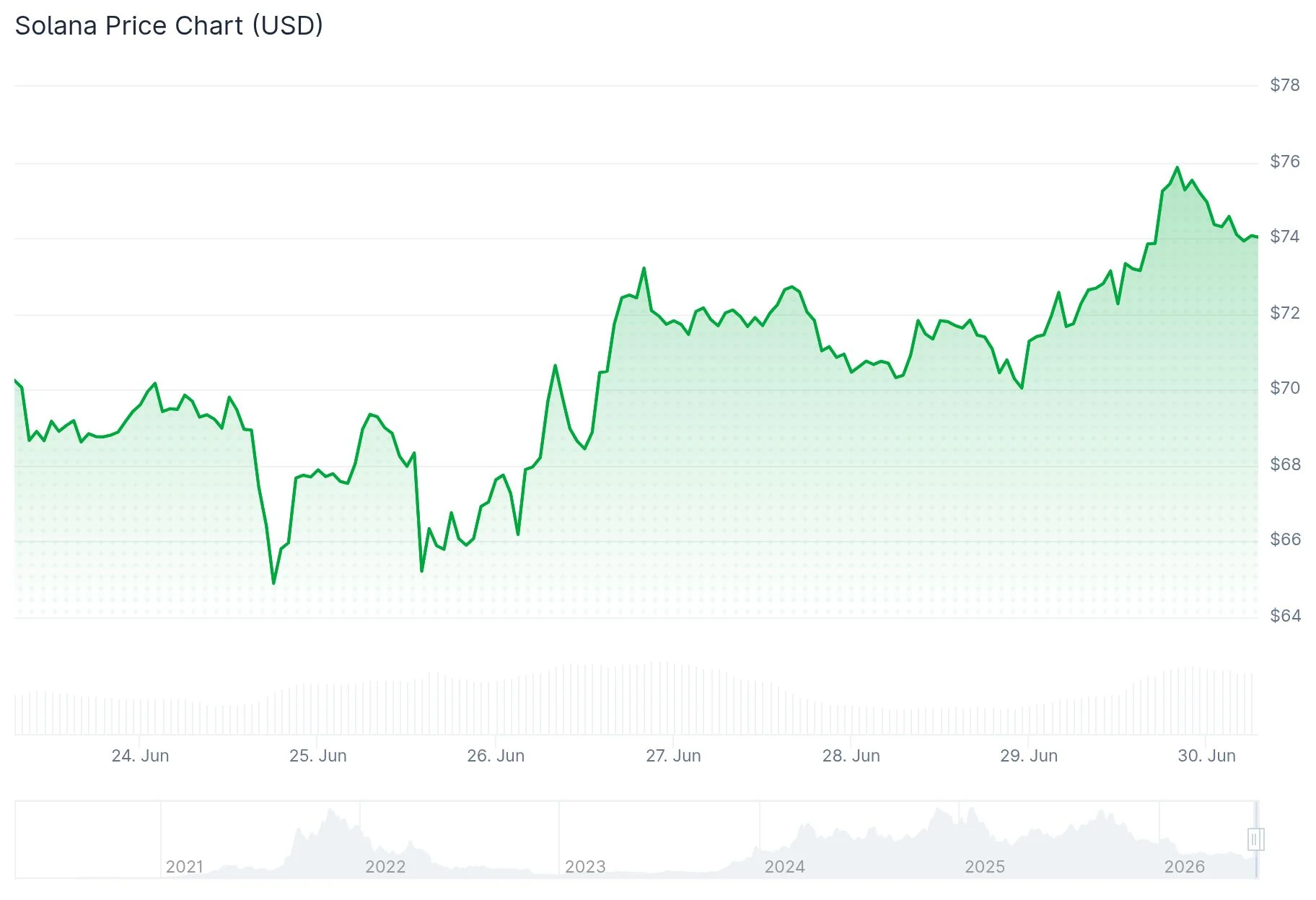
Solana (SOL) Daily Market Analysis 30 June 2026

Solana (SOL) Daily Market Analysis 30 June 2026

Solana (SOL) holds near $74 as institutional adoption and tokenized-asset activity accelerate – here's the latest: • SOL trades at $74.45, up 5.05% in 24 hours
Share
Coinstats2026/06/30 08:44
UK sets final crypto rules as firms face 2027 FCA authorization deadline

UK sets final crypto rules as firms face 2027 FCA authorization deadline

The UK’s financial regulator has published its crypto regulatory framework, setting the authorization deadline for cryptocurrency firms for February 2027.The UK
Share
Coinstats2026/06/30 07:01
CME Group to launch Solana and XRP futures options in October

CME Group to launch Solana and XRP futures options in October

The post CME Group to launch Solana and XRP futures options in October appeared on BitcoinEthereumNews.com. CME Group is preparing to launch options on SOL and XRP futures next month, giving traders new ways to manage exposure to the two assets.  The contracts are set to go live on October 13, pending regulatory approval, and will come in both standard and micro sizes with expiries offered daily, monthly and quarterly. The new listings mark a major step for CME, which first brought bitcoin futures to market in 2017 and added ether contracts in 2021. Solana and XRP futures have quickly gained traction since their debut earlier this year. CME says more than 540,000 Solana contracts (worth about $22.3 billion), and 370,000 XRP contracts (worth $16.2 billion), have already been traded. Both products hit record trading activity and open interest in August. Market makers including Cumberland and FalconX plan to support the new contracts, arguing that institutional investors want hedging tools beyond bitcoin and ether. CME’s move also highlights the growing demand for regulated ways to access a broader set of digital assets. The launch, which still needs the green light from regulators, follows the end of XRP’s years-long legal fight with the US Securities and Exchange Commission. A federal court ruling in 2023 found that institutional sales of XRP violated securities laws, but programmatic exchange sales did not. The case officially closed in August 2025 after Ripple agreed to pay a $125 million fine, removing one of the biggest uncertainties hanging over the token. This is a developing story. This article was generated with the assistance of AI and reviewed by editor Jeffrey Albus before publication. Get the news in your inbox. Explore Blockworks newsletters: Source: https://blockworks.co/news/cme-group-solana-xrp-futures
Share
BitcoinEthereumNews2025/09/17 23:55