The crypto market is down today, with the total cryptocurrency market capitalization falling by 3.0% to $3.78 trillion, according to data from CoinMarketCap. Meanwhile, the 24-hour trading volume sits at $192 billion, reflecting reduced activity as major cryptocurrencies turn red. TLDR: The global crypto market cap fell 3.0% to $3.78T; 8 of the top 10 coins and most majors in the red; BTC dropped 3.5% to $109,373, while ETH slid 3.6% to $3,868; The Fed’s 25 bps rate cut and the end of quantitative tightening in December signal returning liquidity; Fear & Greed Index fell to 34 (Fear); BTC ETFs saw $470.7M outflows; ETH ETFs posted $81.44M outflows; AUSTRAC fined CryptoLink A$56,340 (US$37,085) for AML compliance failures. Crypto Winners & Losers At the time of writing, 8 of the top 10 cryptocurrencies by market capitalization have declined over the past 24 hours. Bitcoin (BTC) fell 3.5%, now trading at $109,373, maintaining a market cap of over $2.18 trillion. Ethereum (ETH) slipped 3.6% to $3,868, while BNB (BNB) dropped 0.5% to $1,107. XRP (XRP) recorded a 4.4% decline to $2.54, and Solana (SOL) lost 3.9%, now priced at $190.92. The biggest drop among the top 10 came from Dogecoin (DOGE), which fell 4.4% to $0.1872. Despite the broader downturn, a few altcoins posted impressive gains. Aurora (AURORA) surged 65.1% to $0.08555, while Jelly-My-Jelly (JMJ) and Anvil (ANVL) rose 50.6% and 44.0%, respectively. In contrast, PepeNode (PNODE) and BlockchainFX (BFX) topped the list of trending tokens despite declines of 19.7% and 5.7%, showing strong retail interest amid market volatility. Meanwhile, Swiss-based asset manager 21Shares has filed with the US Securities and Exchange Commission (SEC) to launch a Hyperliquid (HYPE) exchange-traded fund (ETF) amid growing institutional appetite for altcoin-linked investment products. The move came just weeks after Bitwise filed for a similar Hyperliquid ETF, underscoring intensifying competition among asset managers to capture investor demand for exposure to decentralized trading ecosystems. The HYPE token powers Hyperliquid’s decentralized exchange, offering users fee discounts and serving as the gas token for its blockchain. Bitcoin Holds Strong as Altcoins Lag Despite Fed Rate Cut and End of QT The US Federal Reserve’s latest 25 basis-point rate cut unfolded as expected, sending Bitcoin briefly down to $109K. However, the real market mover was the Fed’s confirmation that quantitative tightening (QT) will end in December, signaling the return of liquidity that could fuel risk assets. Analysts say this could set the stage for an “alt season,” though past patterns show such optimism often fades quickly. In 2024, the first rate cut triggered a strong rally, but it fizzled by September, only to be reignited by Trump’s election victory later that year. Despite those bursts of momentum, most altcoins have failed to reclaim their 2021 highs, while Bitcoin remains the only asset consistently trending upward. Major tokens like ETH, SOL, and XRP remain more than 40% below their peaks, showing a market still in a consolidation phase. Analysts view the current market as a reset rather than a crash, where liquidity is shifting rather than expanding. Solana and XRP both appear to be stabilizing, with record futures open interest near $3 billion each on CME. Levels & Events to Watch Next At the time of writing, Bitcoin trades at $109,295, down 0.68% on the day. The coin has been consolidating after failing to sustain momentum above $112,000 earlier this week. For now, BTC’s intraday range sits between $108,800 and $110,200, suggesting a cautious market tone. A breakout above $111,800 could trigger a move toward $114,500 and potentially $118,000, where previous resistance zones lie. On the downside, failure to hold current support could open the door to $107,500, followed by a stronger support area around $105,000. Meanwhile, Ethereum trades at $3,865, down 0.99% in the past 24 hours. The coin has been hovering near the $3,850–$3,900 zone after slipping from its weekly high near $4,100. If ETH breaks above $3,950, it could attempt to retest $4,200 and then $4,400, where selling pressure has repeatedly capped rallies. However, a drop below $3,800 may lead to a deeper pullback toward $3,650–$3,700 in the short term. Meanwhile, market sentiment has tilted slightly more bearish, with the Crypto Fear and Greed Index falling to 34, signaling “Fear.” The index was at 39 yesterday and 43 a month ago, indicating a steady decline in confidence as traders remain cautious amid price volatility. The shift reflects ongoing uncertainty in the market, with participants holding back from aggressive positions while awaiting clearer signals from macroeconomic developments. The US Bitcoin spot exchange-traded funds (ETFs) saw a sharp reversal on Wednesday, recording $470.7 million in outflows, according to data from SoSoValue. The total cumulative net inflow now stands at $61.87 billion, with total net assets valued at $149.98 billion, representing 6.75% of Bitcoin’s market capitalization. Among the funds, Fidelity’s FBTC led the outflows with $164.36 million, followed by Ark & 21Shares (ARKB) with $143.8 million, and BlackRock’s IBIT with $88.08 million. Grayscale’s GBTC also saw $65.01 million leave the fund. The US Ethereum spot ETFs also recorded $81.44 million in outflows on Wednesday. The total cumulative net inflow now stands at $14.65 billion, while total net assets are valued at $26.60 billion, representing 5.58% of Ethereum’s market capitalization. Among the nine ETFs, BlackRock’s ETHA was the only major fund to post gains, taking in $21.36 million. In contrast, Fidelity’s FETH saw the largest outflow at $69.49 million, followed by Grayscale’s ETHE with $12.83 million and Grayscale’s ETH with $16.18 million. In contrast, the US Solana spot ETFs recorded $47.94 million in net inflows on Wednesday. The total cumulative net inflow now stands at $117.40 million, with total net assets reaching $432.29 million, representing 0.40% of Solana’s market capitalization. Among the two listed ETFs, Bitwise’s BSOL led with $46.54 million in inflows, while Grayscale’s GSOL added $1.40 million. Total trading volume across both funds was $79.50 million for the day. Meanwhile, Australian financial intelligence agency, AUSTRAC, slapped a AU$56,340 fine (US$37,085) on crypto ATM operator CryptoLink on Thursday. The action comes after the regulator’s Crypto Taskforce, established last year, found late reporting of large cash transactions and “weaknesses” in CryptoLink’s AML rulesThe crypto market is down today, with the total cryptocurrency market capitalization falling by 3.0% to $3.78 trillion, according to data from CoinMarketCap. Meanwhile, the 24-hour trading volume sits at $192 billion, reflecting reduced activity as major cryptocurrencies turn red. TLDR: The global crypto market cap fell 3.0% to $3.78T; 8 of the top 10 coins and most majors in the red; BTC dropped 3.5% to $109,373, while ETH slid 3.6% to $3,868; The Fed’s 25 bps rate cut and the end of quantitative tightening in December signal returning liquidity; Fear & Greed Index fell to 34 (Fear); BTC ETFs saw $470.7M outflows; ETH ETFs posted $81.44M outflows; AUSTRAC fined CryptoLink A$56,340 (US$37,085) for AML compliance failures. Crypto Winners & Losers At the time of writing, 8 of the top 10 cryptocurrencies by market capitalization have declined over the past 24 hours. Bitcoin (BTC) fell 3.5%, now trading at $109,373, maintaining a market cap of over $2.18 trillion. Ethereum (ETH) slipped 3.6% to $3,868, while BNB (BNB) dropped 0.5% to $1,107. XRP (XRP) recorded a 4.4% decline to $2.54, and Solana (SOL) lost 3.9%, now priced at $190.92. The biggest drop among the top 10 came from Dogecoin (DOGE), which fell 4.4% to $0.1872. Despite the broader downturn, a few altcoins posted impressive gains. Aurora (AURORA) surged 65.1% to $0.08555, while Jelly-My-Jelly (JMJ) and Anvil (ANVL) rose 50.6% and 44.0%, respectively. In contrast, PepeNode (PNODE) and BlockchainFX (BFX) topped the list of trending tokens despite declines of 19.7% and 5.7%, showing strong retail interest amid market volatility. Meanwhile, Swiss-based asset manager 21Shares has filed with the US Securities and Exchange Commission (SEC) to launch a Hyperliquid (HYPE) exchange-traded fund (ETF) amid growing institutional appetite for altcoin-linked investment products. The move came just weeks after Bitwise filed for a similar Hyperliquid ETF, underscoring intensifying competition among asset managers to capture investor demand for exposure to decentralized trading ecosystems. The HYPE token powers Hyperliquid’s decentralized exchange, offering users fee discounts and serving as the gas token for its blockchain. Bitcoin Holds Strong as Altcoins Lag Despite Fed Rate Cut and End of QT The US Federal Reserve’s latest 25 basis-point rate cut unfolded as expected, sending Bitcoin briefly down to $109K. However, the real market mover was the Fed’s confirmation that quantitative tightening (QT) will end in December, signaling the return of liquidity that could fuel risk assets. Analysts say this could set the stage for an “alt season,” though past patterns show such optimism often fades quickly. In 2024, the first rate cut triggered a strong rally, but it fizzled by September, only to be reignited by Trump’s election victory later that year. Despite those bursts of momentum, most altcoins have failed to reclaim their 2021 highs, while Bitcoin remains the only asset consistently trending upward. Major tokens like ETH, SOL, and XRP remain more than 40% below their peaks, showing a market still in a consolidation phase. Analysts view the current market as a reset rather than a crash, where liquidity is shifting rather than expanding. Solana and XRP both appear to be stabilizing, with record futures open interest near $3 billion each on CME. Levels & Events to Watch Next At the time of writing, Bitcoin trades at $109,295, down 0.68% on the day. The coin has been consolidating after failing to sustain momentum above $112,000 earlier this week. For now, BTC’s intraday range sits between $108,800 and $110,200, suggesting a cautious market tone. A breakout above $111,800 could trigger a move toward $114,500 and potentially $118,000, where previous resistance zones lie. On the downside, failure to hold current support could open the door to $107,500, followed by a stronger support area around $105,000. Meanwhile, Ethereum trades at $3,865, down 0.99% in the past 24 hours. The coin has been hovering near the $3,850–$3,900 zone after slipping from its weekly high near $4,100. If ETH breaks above $3,950, it could attempt to retest $4,200 and then $4,400, where selling pressure has repeatedly capped rallies. However, a drop below $3,800 may lead to a deeper pullback toward $3,650–$3,700 in the short term. Meanwhile, market sentiment has tilted slightly more bearish, with the Crypto Fear and Greed Index falling to 34, signaling “Fear.” The index was at 39 yesterday and 43 a month ago, indicating a steady decline in confidence as traders remain cautious amid price volatility. The shift reflects ongoing uncertainty in the market, with participants holding back from aggressive positions while awaiting clearer signals from macroeconomic developments. The US Bitcoin spot exchange-traded funds (ETFs) saw a sharp reversal on Wednesday, recording $470.7 million in outflows, according to data from SoSoValue. The total cumulative net inflow now stands at $61.87 billion, with total net assets valued at $149.98 billion, representing 6.75% of Bitcoin’s market capitalization. Among the funds, Fidelity’s FBTC led the outflows with $164.36 million, followed by Ark & 21Shares (ARKB) with $143.8 million, and BlackRock’s IBIT with $88.08 million. Grayscale’s GBTC also saw $65.01 million leave the fund. The US Ethereum spot ETFs also recorded $81.44 million in outflows on Wednesday. The total cumulative net inflow now stands at $14.65 billion, while total net assets are valued at $26.60 billion, representing 5.58% of Ethereum’s market capitalization. Among the nine ETFs, BlackRock’s ETHA was the only major fund to post gains, taking in $21.36 million. In contrast, Fidelity’s FETH saw the largest outflow at $69.49 million, followed by Grayscale’s ETHE with $12.83 million and Grayscale’s ETH with $16.18 million. In contrast, the US Solana spot ETFs recorded $47.94 million in net inflows on Wednesday. The total cumulative net inflow now stands at $117.40 million, with total net assets reaching $432.29 million, representing 0.40% of Solana’s market capitalization. Among the two listed ETFs, Bitwise’s BSOL led with $46.54 million in inflows, while Grayscale’s GSOL added $1.40 million. Total trading volume across both funds was $79.50 million for the day. Meanwhile, Australian financial intelligence agency, AUSTRAC, slapped a AU$56,340 fine (US$37,085) on crypto ATM operator CryptoLink on Thursday. The action comes after the regulator’s Crypto Taskforce, established last year, found late reporting of large cash transactions and “weaknesses” in CryptoLink’s AML rules

Why Is Crypto Down Today? – October 30, 2025

2025/10/30 23:12
6 min read
For feedback or concerns regarding this content, please contact us at crypto.news@mexc.com

The crypto market is down today, with the total cryptocurrency market capitalization falling by 3.0% to $3.78 trillion, according to data from CoinMarketCap. Meanwhile, the 24-hour trading volume sits at $192 billion, reflecting reduced activity as major cryptocurrencies turn red.

TLDR:

  • The global crypto market cap fell 3.0% to $3.78T;
  • 8 of the top 10 coins and most majors in the red;
  • BTC dropped 3.5% to $109,373, while ETH slid 3.6% to $3,868;
  • The Fed’s 25 bps rate cut and the end of quantitative tightening in December signal returning liquidity;
  • Fear & Greed Index fell to 34 (Fear);
  • BTC ETFs saw $470.7M outflows;
  • ETH ETFs posted $81.44M outflows;
  • AUSTRAC fined CryptoLink A$56,340 (US$37,085) for AML compliance failures.

Crypto Winners & Losers

At the time of writing, 8 of the top 10 cryptocurrencies by market capitalization have declined over the past 24 hours.

Bitcoin (BTC) fell 3.5%, now trading at $109,373, maintaining a market cap of over $2.18 trillion.
Ethereum (ETH) slipped 3.6% to $3,868, while BNB (BNB) dropped 0.5% to $1,107.

XRP (XRP) recorded a 4.4% decline to $2.54, and Solana (SOL) lost 3.9%, now priced at $190.92.

The biggest drop among the top 10 came from Dogecoin (DOGE), which fell 4.4% to $0.1872.

Despite the broader downturn, a few altcoins posted impressive gains. Aurora (AURORA) surged 65.1% to $0.08555, while Jelly-My-Jelly (JMJ) and Anvil (ANVL) rose 50.6% and 44.0%, respectively.

In contrast, PepeNode (PNODE) and BlockchainFX (BFX) topped the list of trending tokens despite declines of 19.7% and 5.7%, showing strong retail interest amid market volatility.

Meanwhile, Swiss-based asset manager 21Shares has filed with the US Securities and Exchange Commission (SEC) to launch a Hyperliquid (HYPE) exchange-traded fund (ETF) amid growing institutional appetite for altcoin-linked investment products.

The move came just weeks after Bitwise filed for a similar Hyperliquid ETF, underscoring intensifying competition among asset managers to capture investor demand for exposure to decentralized trading ecosystems.

The HYPE token powers Hyperliquid’s decentralized exchange, offering users fee discounts and serving as the gas token for its blockchain.

Bitcoin Holds Strong as Altcoins Lag Despite Fed Rate Cut and End of QT

The US Federal Reserve’s latest 25 basis-point rate cut unfolded as expected, sending Bitcoin briefly down to $109K.

However, the real market mover was the Fed’s confirmation that quantitative tightening (QT) will end in December, signaling the return of liquidity that could fuel risk assets. Analysts say this could set the stage for an “alt season,” though past patterns show such optimism often fades quickly.

In 2024, the first rate cut triggered a strong rally, but it fizzled by September, only to be reignited by Trump’s election victory later that year.

Despite those bursts of momentum, most altcoins have failed to reclaim their 2021 highs, while Bitcoin remains the only asset consistently trending upward.

Major tokens like ETH, SOL, and XRP remain more than 40% below their peaks, showing a market still in a consolidation phase.

Analysts view the current market as a reset rather than a crash, where liquidity is shifting rather than expanding. Solana and XRP both appear to be stabilizing, with record futures open interest near $3 billion each on CME.

Levels & Events to Watch Next

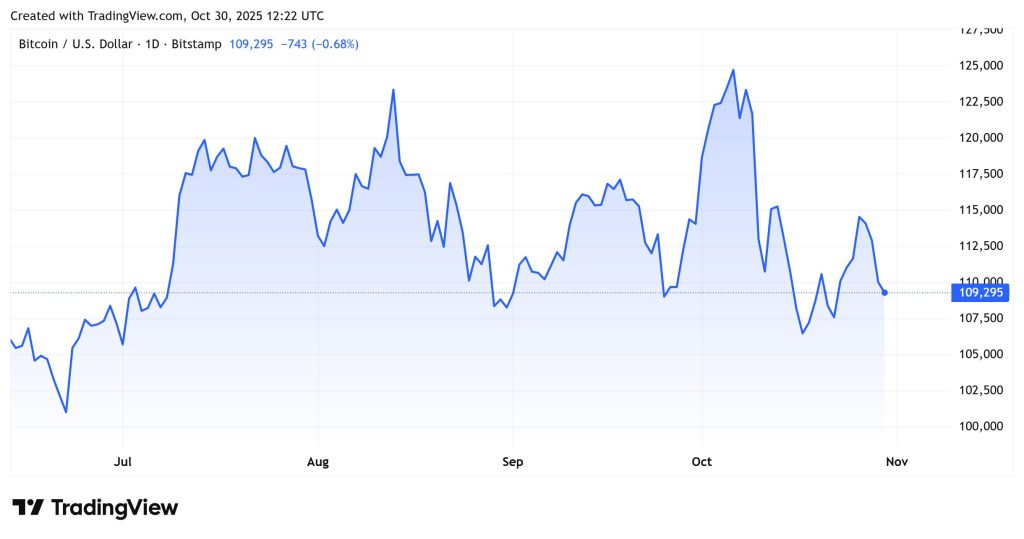
At the time of writing, Bitcoin trades at $109,295, down 0.68% on the day. The coin has been consolidating after failing to sustain momentum above $112,000 earlier this week. For now, BTC’s intraday range sits between $108,800 and $110,200, suggesting a cautious market tone.

A breakout above $111,800 could trigger a move toward $114,500 and potentially $118,000, where previous resistance zones lie. On the downside, failure to hold current support could open the door to $107,500, followed by a stronger support area around $105,000.

Meanwhile, Ethereum trades at $3,865, down 0.99% in the past 24 hours. The coin has been hovering near the $3,850–$3,900 zone after slipping from its weekly high near $4,100.

If ETH breaks above $3,950, it could attempt to retest $4,200 and then $4,400, where selling pressure has repeatedly capped rallies. However, a drop below $3,800 may lead to a deeper pullback toward $3,650–$3,700 in the short term.

Meanwhile, market sentiment has tilted slightly more bearish, with the Crypto Fear and Greed Index falling to 34, signaling “Fear.”

The index was at 39 yesterday and 43 a month ago, indicating a steady decline in confidence as traders remain cautious amid price volatility. The shift reflects ongoing uncertainty in the market, with participants holding back from aggressive positions while awaiting clearer signals from macroeconomic developments.

The US Bitcoin spot exchange-traded funds (ETFs) saw a sharp reversal on Wednesday, recording $470.7 million in outflows, according to data from SoSoValue.

The total cumulative net inflow now stands at $61.87 billion, with total net assets valued at $149.98 billion, representing 6.75% of Bitcoin’s market capitalization.

Among the funds, Fidelity’s FBTC led the outflows with $164.36 million, followed by Ark & 21Shares (ARKB) with $143.8 million, and BlackRock’s IBIT with $88.08 million. Grayscale’s GBTC also saw $65.01 million leave the fund.

The US Ethereum spot ETFs also recorded $81.44 million in outflows on Wednesday. The total cumulative net inflow now stands at $14.65 billion, while total net assets are valued at $26.60 billion, representing 5.58% of Ethereum’s market capitalization.

Among the nine ETFs, BlackRock’s ETHA was the only major fund to post gains, taking in $21.36 million. In contrast, Fidelity’s FETH saw the largest outflow at $69.49 million, followed by Grayscale’s ETHE with $12.83 million and Grayscale’s ETH with $16.18 million.

In contrast, the US Solana spot ETFs recorded $47.94 million in net inflows on Wednesday. The total cumulative net inflow now stands at $117.40 million, with total net assets reaching $432.29 million, representing 0.40% of Solana’s market capitalization.

Among the two listed ETFs, Bitwise’s BSOL led with $46.54 million in inflows, while Grayscale’s GSOL added $1.40 million. Total trading volume across both funds was $79.50 million for the day.

Meanwhile, Australian financial intelligence agency, AUSTRAC, slapped a AU$56,340 fine (US$37,085) on crypto ATM operator CryptoLink on Thursday.

The action comes after the regulator’s Crypto Taskforce, established last year, found late reporting of large cash transactions and “weaknesses” in CryptoLink’s AML rules.


Disclaimer: The articles reposted on this site are sourced from public platforms and are provided for informational purposes only. They do not necessarily reflect the views of MEXC. All rights remain with the original authors. If you believe any content infringes on third-party rights, please contact crypto.news@mexc.com for removal. MEXC makes no guarantees regarding the accuracy, completeness, or timeliness of the content and is not responsible for any actions taken based on the information provided. The content does not constitute financial, legal, or other professional advice, nor should it be considered a recommendation or endorsement by MEXC.

You May Also Like

SOL Moves Sideways While Ozak AI Token Targets Life-Changing Gains for Presale Investors

SOL Moves Sideways While Ozak AI Token Targets Life-Changing Gains for Presale Investors

The post SOL Moves Sideways While Ozak AI Token Targets Life-Changing Gains for Presale Investors appeared on BitcoinEthereumNews.com. In the world of crypto, two tokens are making waves, albeit with different trajectories. While Solana (SOL) continues to move sideways, the Ozak AI token is gaining significant momentum with impressive presale results. With Ozak AI’s presale showing growth of over 1,100%, investors are eyeing substantial returns as the presale progresses. Ozak AI Presale Performance: Rapid Growth and Strong Fundamentals The Ozak AI token is in Phase 6 of its presale, with the price fixed at $0.012. The project has made remarkable strides, seeing its token grow by more than 1,100% since the beginning of the event. Over 905 million tokens have been sold, raising over $3.2 million. As the presale moves forward, the next price increase will take the token to $0.014, requiring a minimum investment of $100. Ozak AI has a total supply of 10 billion tokens, with 30% allocated to presale. Other allocations include ecosystem incentives, reserves, liquidity, and the project team. The distributions support both growth and sustainability, ensuring a balanced supply for adoption and development. Key Features and Partnerships Supporting Ozak AI’s Growth Ozak AI offers significant value beyond just speculation. The platform utilizes machine learning with decentralized networks to provide predictive analytics for financial markets. Ozak AI offers real-time data feeds, customizable prediction agents, and decentralized applications (dApps) to users. The integration of the Ozak AI Rewards Hub adds a unique feature to the platform, where users can participate in staking, governance, and rewards. This initiative also raises awareness about the presale success. Ozak AI has partnered with various leading platforms. Pyth Network enhances the reliability of its predictive models and provides accurate financial data across blockchains. Additionally, Dex3’s liquidity solutions improve the platform’s trading experience, enabling seamless transactions. The integration of Weblume’s no-code tools and the SINT protocol for one-click AI upgrades makes…
Share
BitcoinEthereumNews2025/09/18 23:49
Tim Draper’s Stark Prediction As Fiat Trust Plummets

Tim Draper’s Stark Prediction As Fiat Trust Plummets

The post Tim Draper’s Stark Prediction As Fiat Trust Plummets appeared on BitcoinEthereumNews.com. Bitcoin Adoption: Tim Draper’s Stark Prediction As Fiat Trust
Share
BitcoinEthereumNews2026/03/14 14:57
Chorus One and MEV Zone Team Up to Boost Avalanche Staking Rewards

Chorus One and MEV Zone Team Up to Boost Avalanche Staking Rewards

The post Chorus One and MEV Zone Team Up to Boost Avalanche Staking Rewards appeared on BitcoinEthereumNews.com. Through the partnership with MEV Zone, Chorus One users will earn extra yield automatically. The Chorus One Avalanche node has a total stake of over 1.7 million, valued at around $55 million. This collaboration will introduce MEV Zone to both public nodes and Validator-as-a-Service. The Avalanche network stands to benefit from fairer and more efficient markets due to enhanced transparency. Chorus One, a highly decorated institutional-grade staking provider, has inked a strategic partnership with MEV Zone to enhance yield generation on the Avalanche (AVAX) network. The Chorus One partnered with MEV Zone to increase the AVAX staking yields, while simultaneously contributing to the general growth of the Avalanche network. “At Chorus One, we see this as an important step in our ongoing journey to provide robust infrastructure and innovative yield strategies for our partners and clients,” the announcement noted.  Why Did Chorus One Partner With MEV Zone? The Chorus One platform has grown to a top-tier institutional-grade staking ecosystem, with more than 40 blockchains, since 2018. In a bid to evolve with the needs of crypto investors and the supported blockchains, Chorus One has inked several strategic partnerships in the recent past, including MEV Zone. In the recent past, MEV Zone has specialized in addressing the Maximal Extractable Value (MEV) challenges on the Avalanche network. The MEV Zone will help Chorus One’s AVAX node validator to use Proposer-Builder Separation (PBS). As such, Chorus One’s AVAX node will seamlessly select certain transactions that are more profitable when making blocks. For instance, MEV Zone will help Chorus One’s AVAX node validator to capture arbitrage and liquidation transactions more often since they are more profitable.  How will Chorus One’s AVAX Stakers Benefit Via This Partnership? The Chorus One AVAX node has grown over the years to more than 1.77 million coins staked, valued…
Share
BitcoinEthereumNews2025/09/18 03:19