

Michael Saylor’s Unbelievable Bitcoin Timeline: From $150,000 To $20 Million
In a CNBC Crypto World interview recorded at Money20/20 in Las Vegas on October 29, Michael Saylor laid out one of his most aggressive public Bitcoin roadmaps to date, putting explicit numbers on what he believes comes next for the asset. “Our expectation right now is end of the year it should be about $150,000,” said Saylor, executive chairman of Strategy. He stressed that this is not just his internal target, but “the consensus of the equity analysts that cover our company and the Bitcoin industry right now.”
Saylor’s Bitcoin Price Prediction
Strategy’s executive chairman described the near-term move as orderly rather than euphoric. He argued that Bitcoin is entering a phase where traditional market infrastructure is muting extreme downside and smoothing price action.
“Bitcoin is going to continue to grind up,” he said. In his view, the asset is stabilizing as institutional liquidity deepens: “The volatility is coming off of it as the industry becomes more structured with more derivatives and more ways to hedge it.” That framing flips the usual Bitcoin story. For Saylor, the driver of the next leg is not retail mania, macro panic, or Fed speculation. It is market plumbing.
From there, he escalated. Saylor said he expects Bitcoin to reach one million dollars per coin on a medium-term horizon and gave a specific timeline. “I don’t know why it won’t grind up to a million dollars a coin over the next four to eight years,” he said. “I would think not less than four, not more than eight.” The language was deliberate: “grind up,” not “blow off.” He is arguing for structural appreciation, not a single mania candle.
Then he extended the arc even further, out past a single cycle and into what he framed as a 20-year monetary realignment. “My long-term forecast is it goes up about 30% a year for the next 20 years, and we’re headed toward $20 million Bitcoin.”
That is not a short-term hype line. It’s a compounding claim. Saylor’s math implies a world in which Bitcoin behaves like a yield-bearing, collateralizable capital instrument and scales gradually across the balance sheets of banks, corporations, financial products, and—crucially in his view—non-human economic agents.
What Will Drive The BTC Price?
Saylor repeatedly tied these price levels to a broader shift: Bitcoin moving from speculative commodity to base-layer collateral for the modern financial system. He argued that the traditional choke points that once capped Bitcoin’s adoption—custody restrictions, lack of bank credit, regulatory hostility—are breaking at the same time.
He said that a year ago, “you couldn’t get a loan against Bitcoin or a loan against wrapped Bitcoin like an ETF like IBIT…from any major bank in the nation.” Today, he claimed, “Bank of America, JP Morgan, Wells Fargo, BNY Mellon… are all beginning to embrace this asset class,” and discussions have started around issuing credit directly against Bitcoin. He projected that by 2026 “major banks like Citi” and BNY Mellon would custody Bitcoin, while firms like JP Morgan would actively lend against it.
He also argued that the political and regulatory front, once the existential overhang for the industry, has flipped into outright sponsorship. “The entire administration has been…very, very positive toward digital assets consistently for the past 12 months,” he said.
He portrayed alignment across multiple agencies and power centers. According to Saylor, “the White House [has been] endorsing Bitcoin as digital gold,” the SEC is saying “we expect that securities will be tokenized on chain and we’re going to support it,” and the Treasury Department is openly backing stablecoins as the future of the US dollar “to be tokenized and exported to the world.” He called the last year “probably the best 12 months in the history of the industry.”
DAT’s And The AI RevolutionIn addition to the price path, Saylor delivered headline statements meant to signal scale. He said the corporate balance sheet model he pioneered—what he called digital asset treasury or “DAT”—is no longer exotic. “We were the first in 2020,” he said. “Then there were 10, then 20, then 60, then 120, and now we’re exploding to 250.” He didn’t present that as saturation.
Related Reading: Germany’s Poll-Leading Party Goes Full Pro-Bitcoin
Saylor presented it as the beginning of a structural migration. “We’re going to see 500 companies, then a thousand, then 2,000, then 5,000,” he said. In his view, “every forward-thinking company” will put digital assets on its balance sheet. His analogy was blunt: this will look, in hindsight, like the moment corporations first got electricity, or first launched websites.
He also tied Bitcoin’s long-run demand to machine-scale economic activity. Saylor said we are moving toward an environment where “a billion AIs…are going to want to do business with a billion AIs representing you and me and 8 billion people and 400 million companies.” Those agents, he argued, will not tolerate legacy banking rails.
“They’re not going to have any patience for 20th century techniques…they’re not going to want to wait for a week for a wire to be transferred.” In that world, he said, US dollar stablecoins have become the medium of exchange and will “explode from…a hundred billion…to 250 billion to 500 to a trillion to two trillion…Eventually, I think there’ll be 10 trillion worth of stablecoin moving at the speed of light.”
Bitcoin, in that same model, is not the medium of exchange. It is the treasury asset that underwrites it. “If you want to release something in cyberspace and have it live forever, how are you going to capitalize it? You’re going to load it up with some Bitcoin.”
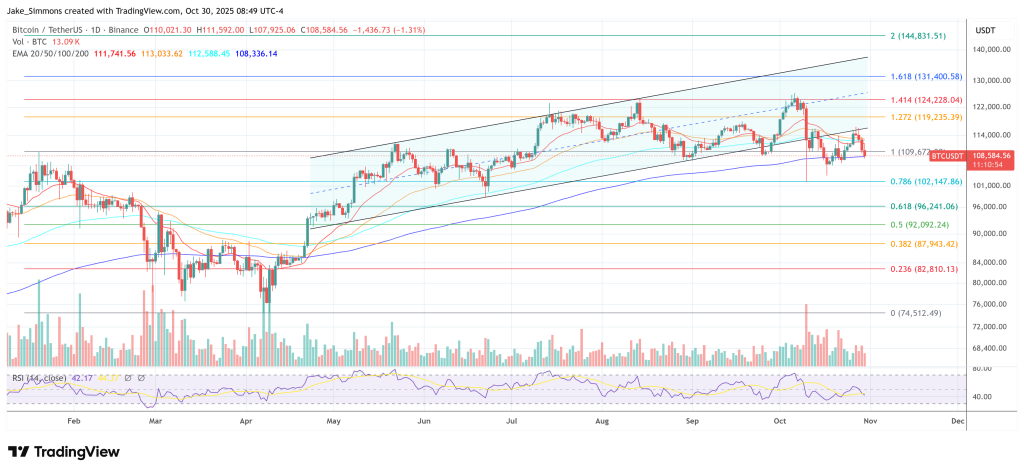
At press time, BTC traded at $108,584.


You May Also Like

XRP In a Level Playing Field With FedNow and ISO 20022, Says Researcher With Proof

Crypto Market Drops as Fear Grows and Major Assets Decline




