Bitcoin reached a record in computing power, but rising block difficulty continues to hurt miners' profits.Bitcoin reached a record in computing power, but rising block difficulty continues to hurt miners' profits.

Bitcoin mining hashrate hits record in October, profits lag

2025/11/04 06:30
2 min read

Bitcoin reached a record in computing power, but rising block difficulty continues to hurt miners’ profits.

Summary
  • Bitcoin mining hashrate reached a record 1.13 Zh/s in October.
  • Geographically, this expansion was driven by Kazakhstan and the Middle East
  • Still, mining profitability fell 7% due to increasing block difficulty

Bitcoin miners found themselves under pressure from all sides in October. The sector posted a record 1.13 Zh/s hashrate in October, which indicates increased participation in Bitcoin mining. Still, increased mining difficulty, rising energy prices, and record $19B in liquidations cut into miners’ profits.
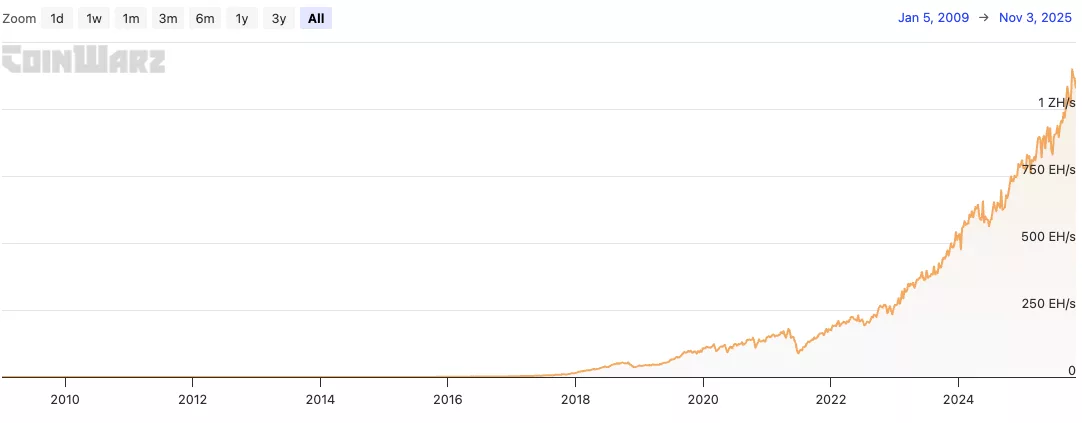
Bitcoin hashrate since its launch

Hashrate refers to the amount of computational power that participates in Bitcoin mining. This is crucial for decentralization and security, as a high hashrate makes attacks against the network more difficult. However, the metric does not automatically translate into more mining profits.

Notably, daily revenue per exahash per second (EH/s) dropped 7% compared to September, from $52,000 to $48,000. What is more, the declining Bitcoin price cut into miners’ rewards, with the hashprice falling nearly 12% month-to-date.

Bitcoin miners struggle to stay afloat

Falling Bitcoin prices also coincided with a rise in energy costs. The increase in oil and gas prices affected miners not tied to the electrical grid. In some regions, especially in Europe and the U.S., miners also had to deal with power curtailment. For this reason, the hashrate will likely fall in the near future.


Market Opportunity
Blockstreet Logo
Blockstreet Price(BLOCK)
$0.006032
$0.006032$0.006032
-2.66%
USD
Blockstreet (BLOCK) Live Price Chart
Disclaimer: The articles reposted on this site are sourced from public platforms and are provided for informational purposes only. They do not necessarily reflect the views of MEXC. All rights remain with the original authors. If you believe any content infringes on third-party rights, please contact crypto.news@mexc.com for removal. MEXC makes no guarantees regarding the accuracy, completeness, or timeliness of the content and is not responsible for any actions taken based on the information provided. The content does not constitute financial, legal, or other professional advice, nor should it be considered a recommendation or endorsement by MEXC.

You May Also Like

Siren Token Sheds 16.4% After 54% Retreat From All-Time High

Siren Token Sheds 16.4% After 54% Retreat From All-Time High

Siren token experienced a sharp 16.4% decline in the past 24 hours, trading at $0.247 as the market cap contracted by $34.4 million. Our analysis of on-chain metrics
Share
Blockchainmagazine2026/03/02 05:03
Privacy is ‘Constant Battle’ Between Blockchain Stakeholders and State

Privacy is ‘Constant Battle’ Between Blockchain Stakeholders and State

The post Privacy is ‘Constant Battle’ Between Blockchain Stakeholders and State appeared on BitcoinEthereumNews.com. Blockchain industry participants and regulators continue wrangling over privacy rights as the European Union’s sweeping Anti-Money Laundering (AML) rules look set to ban privacy-preserving tokens and anonymous crypto accounts starting in 2027. Credit institutions, financial institutions and crypto asset service providers (CASPs) will be prohibited from maintaining anonymous accounts or handling privacy-preserving cryptocurrencies under the EU’s new Anti-Money Laundering Regulation (AMLR) that will go into effect in 2027, Cointelegraph reported in May. Maintaining the right to access privacy-preserving coins like Monero (XMR) has been a “constant battle” between blockchain industry stakeholders and regulators, according to Anja Blaj, an independent legal consultant and policy expert at the European Crypto Initiative. “Once you think of how the states want to play out their policies, they want to establish control. They want to understand who the parties are that transact among themselves,” said Blaj, speaking during Cointelegraph’s daily live X spaces show on Sept. 3. “[The state] wants to understand that to be able to prevent whatever crime and scamming is happening, and we want to enforce the policies that we create as a society.” Her comments came as the EU ramped up its regulatory oversight of the crypto industry, building on the bloc’s Markets in Crypto-Assets Regulation (MiCA). Related: Swiss banks complete first blockchain-based legally binding payment Room for negotiation remains While the AML framework is final, regulatory experts still see potential for negotiation until it rolls out in 2027. Policymaking is a “continuous conversation,” meaning that “nothing is set in stone, even if the regulation is already out,” said Blaj. “There are still ways to either talk to the regulators, see how it’s going to play out, how it’s going to be enforced.” While there’s always room for negotiations with policymakers, the regulation concerning privacy-preserving cryptocurrencies and accounts is becoming “more…
Share
BitcoinEthereumNews2025/09/18 12:45
Santander’s Openbank Enables Bitcoin, Litecoin, POL, Ethereum, and Altcoin Trading for German Customers

Santander’s Openbank Enables Bitcoin, Litecoin, POL, Ethereum, and Altcoin Trading for German Customers

Santander’s digital bank has launched crypto trading in Germany, letting customers buy, sell, and hold these assets. At launch, Openbank customers in Germany can get their hands on Bitcoin, Ethereum, Cardano, Litecoin, and Polygon. Openbank, the digital arm of Banco Santander, has just rolled out a new crypto trading service for its retail customers in [...]]]>
Share
Crypto News Flash2025/09/18 04:00