Ethereum nears key support as analysts track a possible move to $8K. Technical charts and on-chain data show mixed short-term signals.Ethereum nears key support as analysts track a possible move to $8K. Technical charts and on-chain data show mixed short-term signals.

Can Ethereum (ETH) Indeed Surge to $8K? Here’s What Analysts Say

Ethereum (ETH) is trading at around $3,700 at press time, down over 4% in 24 hours and nearly 11% on the week.

While near-term momentum has turned bearish, several analysts are looking at this zone as a possible springboard for a broader move.

Analysts Watch $3,800 as Key Level

Ali Martinez outlined what he called the “dream scenario” for Ethereum. In this view, ETH would hold above $3,800, break through resistance near $4,900, and continue toward $8,000. His chart shows a step-by-step path higher, with pauses near $5,600, $6,400, and $7,200.

He stated,

This move would require a clear break above the $4,900 area, which previously acted as a cap. That level remains a focus for market participants watching for signs of trend reversal.
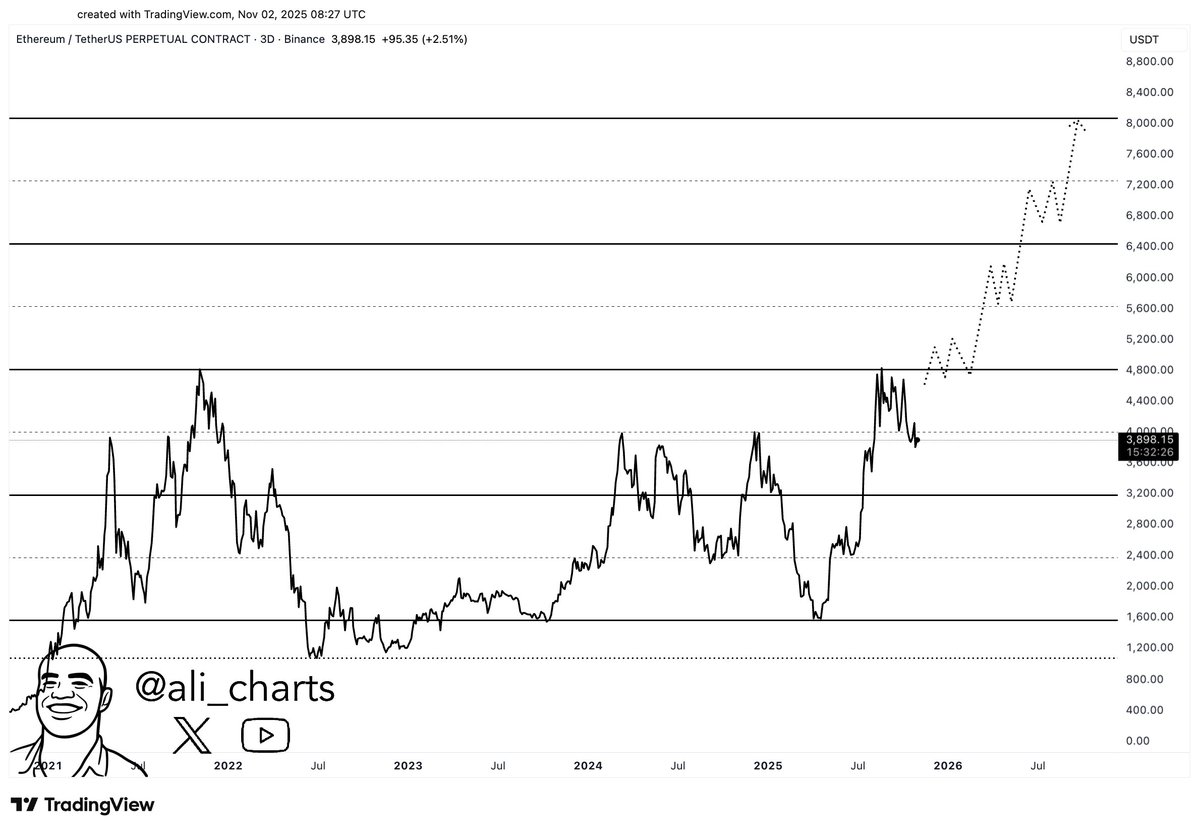
Ethereum (ETH) price chartSource: Ali Martinez/X

Short-Term Signals Show Weakness

While longer-term setups remain in play, shorter timeframes show pressure building. The daily RSI is at 39, pointing to a lack of buying strength. The MACD also shows the trend leaning bearish, with the signal and MACD lines both in negative territory.
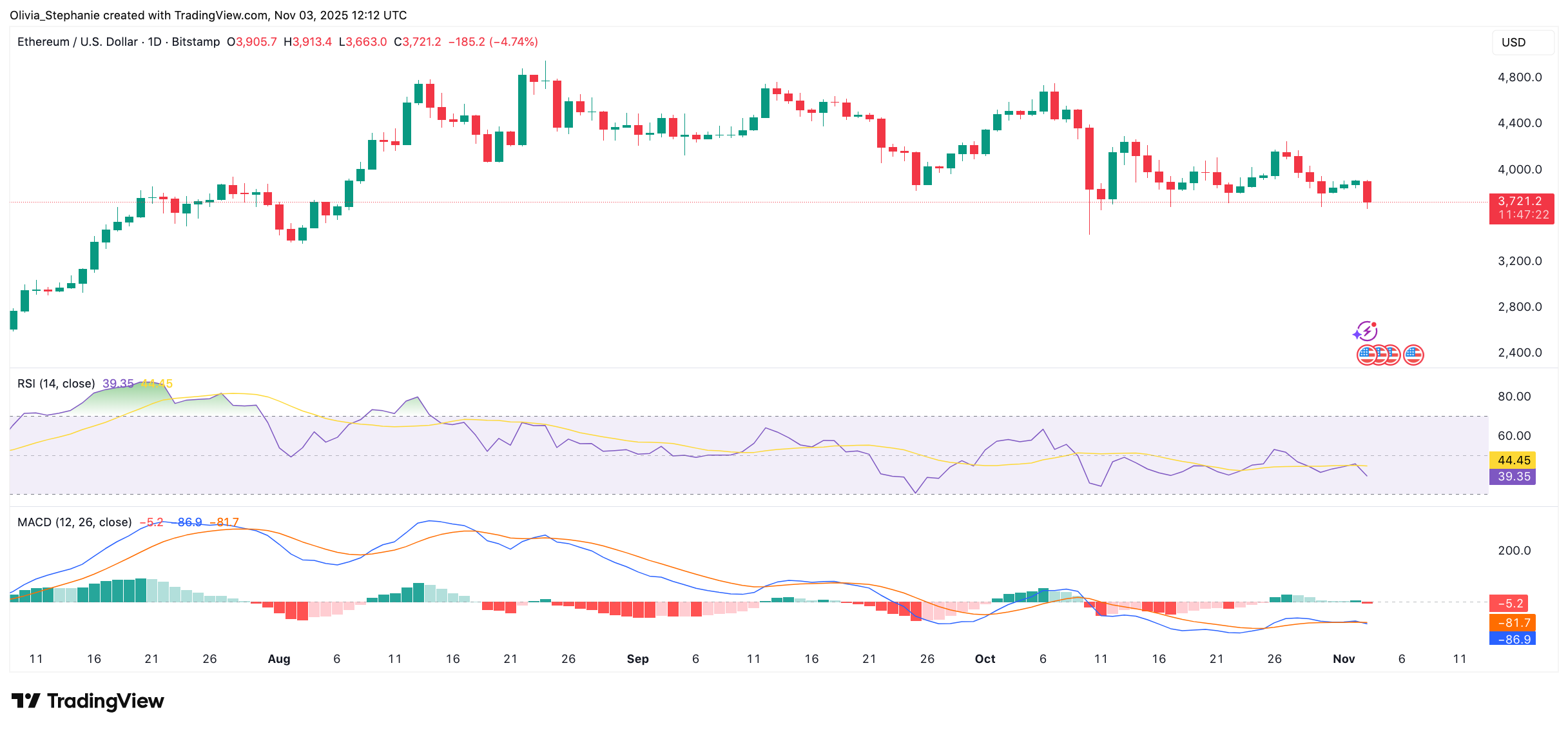
Source: TradingView

Ted noted that Ethereum is at a make-or-break zone.

On the ETH/BTC chart, market watchers continue to monitor key support zones that have historically acted as strong foundations during previous cycles. In earlier commentary, Michaël van de Poppe referred to this broader area as an “ideal zone for buys.

Broader Market Setup Remains Intact

Chart watchers are also pointing to larger structures still in place. Trader Tardigrade described a falling wedge pattern on the weekly ETH chart, saying it remains valid and could lead to a move. Merlijn The Trader compared ETH’s setup to a previous Bitcoin cycle.

Crypto Patel noted that ETH remains in a wide trading range between $2,560 and $5,760. He highlighted that the MVRV ratio is currently at 1.5, which reflects a neutral zone historically seen before major price moves. He described this period as “the calm before every big move in past cycles.

On-chain activity supports this, with Crypto Rand reporting that ETH stablecoin transfer volume hit $2.82 trillion in October, a new record and a 45% rise from September.

The post Can Ethereum (ETH) Indeed Surge to $8K? Here’s What Analysts Say appeared first on CryptoPotato.


Market Opportunity
Ethereum Logo
Ethereum Price(ETH)
$3,088.26
$3,088.26$3,088.26
-0.77%
USD
Ethereum (ETH) Live Price Chart
Disclaimer: The articles reposted on this site are sourced from public platforms and are provided for informational purposes only. They do not necessarily reflect the views of MEXC. All rights remain with the original authors. If you believe any content infringes on third-party rights, please contact service@support.mexc.com for removal. MEXC makes no guarantees regarding the accuracy, completeness, or timeliness of the content and is not responsible for any actions taken based on the information provided. The content does not constitute financial, legal, or other professional advice, nor should it be considered a recommendation or endorsement by MEXC.

You May Also Like

FBI says North Korea’s Kimsuky APT uses malicious QR codes to spearphish U.S. entities

FBI says North Korea’s Kimsuky APT uses malicious QR codes to spearphish U.S. entities

The post FBI says North Korea’s Kimsuky APT uses malicious QR codes to spearphish U.S. entities appeared on BitcoinEthereumNews.com. The FBI says Kimsuky APT, a
Share
BitcoinEthereumNews2026/01/10 02:55
a16z targets AI and crypto after $15B fundraising year in 2025

a16z targets AI and crypto after $15B fundraising year in 2025

The post a16z targets AI and crypto after $15B fundraising year in 2025 appeared on BitcoinEthereumNews.com. Andreessen Horowitz (a16z) secured over $15 billion
Share
BitcoinEthereumNews2026/01/10 03:13
Stablecoin Market: Urgent Warning of a Zero-Sum Future

Stablecoin Market: Urgent Warning of a Zero-Sum Future

BitcoinWorld Stablecoin Market: Urgent Warning of a Zero-Sum Future A significant warning has emerged from financial giant JPMorgan, signaling a potentially challenging future for the stablecoin market. This isn’t just a minor blip; it’s a stark reminder that the booming world of digital assets faces a critical juncture, especially for those relying on the stability of stablecoins. JPMorgan’s recent research note suggests that unless the broader cryptocurrency market expands dramatically, stablecoin issuers are heading towards a fierce ‘zero-sum game’ scenario. The Alarming Truth About the Stablecoin Market What exactly does a ‘zero-sum game’ mean for the stablecoin market? Essentially, it implies that for one stablecoin to gain market share, another must lose it. This isn’t about overall growth where everyone benefits; it’s about a fixed pie where new entrants only succeed by taking a slice from existing players. JPMorgan analysts point to a rapidly increasing number of new stablecoin projects vying for attention. Tether recently announced its unregulated stablecoin, USAT. Hyperliquid plans to launch USDH, aiming to reduce its dependence on Circle’s USDC. Even traditional fintech powerhouses like Robinhood and Revolut are developing their own stablecoins. This surge of new issuers intensifies competition significantly. While the overall stablecoin market capitalization has reached an impressive $278 billion, its share of the total crypto market has remained stagnant, averaging below 8% since 2020. This stagnation, according to JPMorgan, is a key indicator of the brewing zero-sum challenge. Why is the Stablecoin Market Becoming So Crowded? The influx of new players into the stablecoin market isn’t accidental; it’s driven by various strategic motivations. Many projects aim to gain greater control over their financial infrastructure and reduce reliance on third-party stablecoins. For instance, Hyperliquid’s move to USDH is a clear example of a platform seeking self-sufficiency and potentially lower operational costs. Furthermore, established fintech firms like Robinhood and Revolut see stablecoins as a natural extension of their existing services. They can integrate these digital assets into their platforms, offering new functionalities and potentially attracting a broader user base. However, this expansion comes with a caveat: if the overall crypto market doesn’t grow proportionally, these new offerings will merely fragment the existing demand, making profitability and widespread adoption harder to achieve for all. The core challenge remains the limited expansion of the total crypto market relative to the growing supply of stablecoins. This dynamic creates an environment where innovation must go hand-in-hand with genuine market expansion, not just internal competition. Navigating the Competitive Stablecoin Market Landscape So, what does this intense competition mean for users and the broader crypto ecosystem? For one, it could lead to increased innovation as issuers strive to differentiate their offerings through better features, lower fees, or enhanced security. However, it also presents potential risks, particularly if some stablecoins fail to gain traction or face liquidity issues in a highly competitive environment. Users should exercise caution and conduct thorough due diligence when choosing stablecoins. For existing giants like USDC, the entry of new competitors means they must continue to innovate and maintain their market leadership. Regulatory clarity also plays a crucial role here. As more entities enter the space, the demand for clear, consistent regulations will only grow, potentially shaping the future landscape of the stablecoin market significantly. Ultimately, the long-term health of the stablecoin ecosystem hinges on the ability of the entire cryptocurrency market to attract new capital and users. Without this broader expansion, JPMorgan’s warning of a zero-sum game could become a stark reality. In conclusion, JPMorgan’s recent warning serves as a potent reminder of the escalating competition within the stablecoin market. While innovation and new entrants are exciting, the core challenge lies in the stagnant growth of the broader crypto market. For stablecoins to truly thrive beyond a zero-sum dynamic, a significant influx of new capital and users into the entire cryptocurrency ecosystem is paramount. The future success of these digital anchors depends on collective market expansion, not just internal rivalry. Frequently Asked Questions About the Stablecoin Market Q1: What is a ‘zero-sum game’ in the context of the stablecoin market? A1: A ‘zero-sum game’ means that for one stablecoin to gain market share, another stablecoin must lose an equivalent amount. It implies that the overall market size for stablecoins is not growing, forcing issuers to compete for a fixed pool of users and capital. Q2: Why is JPMorgan concerned about the stablecoin market? A2: JPMorgan is concerned because despite the stablecoin market’s growth in total value, its share of the overall crypto market capitalization has stagnated. With many new entrants, they believe competition will intensify, leading to a zero-sum dynamic unless the broader crypto market significantly expands. Q3: Which new stablecoin issuers are mentioned in the warning? A3: The warning highlights new entrants such as Tether’s unregulated stablecoin USAT, Hyperliquid’s planned USDH, and stablecoins being developed by fintech firms Robinhood and Revolut. Q4: What could be the implications for users of stablecoins? A4: For users, increased competition could lead to more innovative features, potentially lower fees, and better services. However, it also means a greater need for due diligence to assess the stability and reliability of various stablecoins, especially if some struggle in a crowded market. Q5: How can the stablecoin market avoid a zero-sum outcome? A5: According to JPMorgan, avoiding a zero-sum outcome requires significant expansion of the broader cryptocurrency market. This means attracting new capital and users into the entire crypto ecosystem, thereby growing the ‘pie’ rather than just re-dividing existing slices. Did JPMorgan’s warning about the stablecoin market catch your attention? Share this crucial insight with your network and join the conversation about the future of digital assets. Your thoughts and perspectives are invaluable! To learn more about the latest stablecoin market trends, explore our article on key developments shaping stablecoin market institutional adoption. This post Stablecoin Market: Urgent Warning of a Zero-Sum Future first appeared on BitcoinWorld.
Share
Coinstats2025/09/19 15:45