Ethereum co-founder Vitalik Buterin has proposed eliminating a key blockchain feature he originally invented, claiming it severely hampers the network’s scaling efforts. The modular exponentiation precompile, known as modexp, creates verification bottlenecks up to 50 times worse than average blocks when generating zero-knowledge proofs, according to Buterin’s recent statement on X. The proposal arrives as Ethereum intensifies its push toward a privacy-first infrastructure, while simultaneously addressing technical obstacles that impede the adoption of the zero-knowledge Ethereum Virtual Machine. Buterin acknowledged his role in creating the problematic feature, stating he “bows his head in shame” while advocating for its replacement with computationally equivalent code that would increase gas costs but dramatically reduce proof generation complexity. The Technical Burden Holding Back Ethereum’s ZK Ambitions Zero-knowledge EVMs generate cryptographic proofs validating Ethereum computations off-chain, enabling faster transaction processing without compromising security. The prover component responsible for creating these proofs encounters exceptional difficulty with modexp operations, which are primarily used in RSA encryption and signing functions employed by minimal applications. Buterin explained that modexp’s computational intensity creates disproportionate delays in proof generation, directly slowing rollups and layer-2 solutions designed to accelerate Ethereum. The feature’s complexity also introduces consensus failure risks through potential edge cases and bugs that threaten network stability. Rather than investing optimization resources into a feature affecting 0.01% of users, Buterin suggested replacing the precompile with standard EVM bytecode that achieves identical results at higher gas costs.Source: Ethereum Magician Applications requiring modular exponentiation (modexp) functionality could instead wrap operations in SNARKs, an alternative cryptographic proof system that mitigates inefficiency. This tradeoff prioritizes ecosystem stability and scaling progress over maintaining legacy features with narrow use cases, particularly as Ethereum faces more urgent performance challenges. The proposed Ethereum Improvement Proposal would fundamentally change how the network handles cryptographic operations that prove burdensome for zero-knowledge proof systems. Institutional Gateway Opens as Privacy Solutions Mature In late October, the Ethereum Foundation launched “Ethereum for Institutions”, providing enterprises and financial organizations with structured pathways for blockchain adoption. The initiative employs zero-knowledge proofs, fully homomorphic encryption, and trusted execution environments to enable compliant, audit-ready applications on public networks. Projects including Chainlink, RAILGUN, Aztec Network, and Zama pioneer privacy-preserving smart contracts that secure counterparty information and business logic without sacrificing transparency or composability. These production-ready solutions address institutional requirements for balancing compliance mandates with secure, programmable finance. Ethereum dominates real-world asset and stablecoin sectors, hosting over 75% of tokenized RWAs and 60% of global stablecoin supply. Major financial firms, including BlackRock, Securitize, and Ondo Finance, deploy tokenized instruments that offer 24/7 settlement, transparency, and composability. Layer-2 networks, like Base, Scroll, and Unichain, now secure over $50 billion in value, delivering throughput and cost efficiency for global-scale applications. Privacy Infrastructure Accelerates Alongside Technical Refinements The Ethereum Foundation launched its 47-member Privacy Cluster in October, under the coordination of Blockscout founder Igor Barinov, expanding work initiated in 2018 through the Privacy and Scaling Explorations team. The cluster addresses critical areas around surveillance, private data verification, selective identity disclosure, user experience improvements, and institutional adoption support. This initiative follows the September rebranding of the Privacy and Scaling Explorations team to Privacy Stewards for Ethereum, shifting the focus from theoretical research to practical solutions. The foundation warned that without robust privacy protections, Ethereum risks becoming “the backbone of global surveillance rather than global freedom,” potentially driving institutions and users toward alternative platforms. Last month, Vitalik also detailed GKR, a cryptographic technique that verifies calculations ten times faster than traditional methods while enabling zero-knowledge proofs that confirm computational accuracy without exposing underlying data. The protocol processes 2 million calculations per second on standard laptops. It validates entire Ethereum transactions using just fifty consumer-grade graphics cards, compared to traditional methods requiring 100 times more computational work than the original calculations. The breakthrough is significant because it enables faster verification, resulting in cheaper transactions and enhanced privacy across the networkEthereum co-founder Vitalik Buterin has proposed eliminating a key blockchain feature he originally invented, claiming it severely hampers the network’s scaling efforts. The modular exponentiation precompile, known as modexp, creates verification bottlenecks up to 50 times worse than average blocks when generating zero-knowledge proofs, according to Buterin’s recent statement on X. The proposal arrives as Ethereum intensifies its push toward a privacy-first infrastructure, while simultaneously addressing technical obstacles that impede the adoption of the zero-knowledge Ethereum Virtual Machine. Buterin acknowledged his role in creating the problematic feature, stating he “bows his head in shame” while advocating for its replacement with computationally equivalent code that would increase gas costs but dramatically reduce proof generation complexity. The Technical Burden Holding Back Ethereum’s ZK Ambitions Zero-knowledge EVMs generate cryptographic proofs validating Ethereum computations off-chain, enabling faster transaction processing without compromising security. The prover component responsible for creating these proofs encounters exceptional difficulty with modexp operations, which are primarily used in RSA encryption and signing functions employed by minimal applications. Buterin explained that modexp’s computational intensity creates disproportionate delays in proof generation, directly slowing rollups and layer-2 solutions designed to accelerate Ethereum. The feature’s complexity also introduces consensus failure risks through potential edge cases and bugs that threaten network stability. Rather than investing optimization resources into a feature affecting 0.01% of users, Buterin suggested replacing the precompile with standard EVM bytecode that achieves identical results at higher gas costs.Source: Ethereum Magician Applications requiring modular exponentiation (modexp) functionality could instead wrap operations in SNARKs, an alternative cryptographic proof system that mitigates inefficiency. This tradeoff prioritizes ecosystem stability and scaling progress over maintaining legacy features with narrow use cases, particularly as Ethereum faces more urgent performance challenges. The proposed Ethereum Improvement Proposal would fundamentally change how the network handles cryptographic operations that prove burdensome for zero-knowledge proof systems. Institutional Gateway Opens as Privacy Solutions Mature In late October, the Ethereum Foundation launched “Ethereum for Institutions”, providing enterprises and financial organizations with structured pathways for blockchain adoption. The initiative employs zero-knowledge proofs, fully homomorphic encryption, and trusted execution environments to enable compliant, audit-ready applications on public networks. Projects including Chainlink, RAILGUN, Aztec Network, and Zama pioneer privacy-preserving smart contracts that secure counterparty information and business logic without sacrificing transparency or composability. These production-ready solutions address institutional requirements for balancing compliance mandates with secure, programmable finance. Ethereum dominates real-world asset and stablecoin sectors, hosting over 75% of tokenized RWAs and 60% of global stablecoin supply. Major financial firms, including BlackRock, Securitize, and Ondo Finance, deploy tokenized instruments that offer 24/7 settlement, transparency, and composability. Layer-2 networks, like Base, Scroll, and Unichain, now secure over $50 billion in value, delivering throughput and cost efficiency for global-scale applications. Privacy Infrastructure Accelerates Alongside Technical Refinements The Ethereum Foundation launched its 47-member Privacy Cluster in October, under the coordination of Blockscout founder Igor Barinov, expanding work initiated in 2018 through the Privacy and Scaling Explorations team. The cluster addresses critical areas around surveillance, private data verification, selective identity disclosure, user experience improvements, and institutional adoption support. This initiative follows the September rebranding of the Privacy and Scaling Explorations team to Privacy Stewards for Ethereum, shifting the focus from theoretical research to practical solutions. The foundation warned that without robust privacy protections, Ethereum risks becoming “the backbone of global surveillance rather than global freedom,” potentially driving institutions and users toward alternative platforms. Last month, Vitalik also detailed GKR, a cryptographic technique that verifies calculations ten times faster than traditional methods while enabling zero-knowledge proofs that confirm computational accuracy without exposing underlying data. The protocol processes 2 million calculations per second on standard laptops. It validates entire Ethereum transactions using just fifty consumer-grade graphics cards, compared to traditional methods requiring 100 times more computational work than the original calculations. The breakthrough is significant because it enables faster verification, resulting in cheaper transactions and enhanced privacy across the network

Vitalik Buterin Calls for Scrapping Ethereum’s ‘Most ZK-Unfriendly’ Feature

2025/11/04 18:41
4 min read
For feedback or concerns regarding this content, please contact us at crypto.news@mexc.com

Ethereum co-founder Vitalik Buterin has proposed eliminating a key blockchain feature he originally invented, claiming it severely hampers the network’s scaling efforts.

The modular exponentiation precompile, known as modexp, creates verification bottlenecks up to 50 times worse than average blocks when generating zero-knowledge proofs, according to Buterin’s recent statement on X.

The proposal arrives as Ethereum intensifies its push toward a privacy-first infrastructure, while simultaneously addressing technical obstacles that impede the adoption of the zero-knowledge Ethereum Virtual Machine.

Buterin acknowledged his role in creating the problematic feature, stating he “bows his head in shame” while advocating for its replacement with computationally equivalent code that would increase gas costs but dramatically reduce proof generation complexity.

The Technical Burden Holding Back Ethereum’s ZK Ambitions

Zero-knowledge EVMs generate cryptographic proofs validating Ethereum computations off-chain, enabling faster transaction processing without compromising security.

The prover component responsible for creating these proofs encounters exceptional difficulty with modexp operations, which are primarily used in RSA encryption and signing functions employed by minimal applications.

Buterin explained that modexp’s computational intensity creates disproportionate delays in proof generation, directly slowing rollups and layer-2 solutions designed to accelerate Ethereum.

The feature’s complexity also introduces consensus failure risks through potential edge cases and bugs that threaten network stability.

Rather than investing optimization resources into a feature affecting 0.01% of users, Buterin suggested replacing the precompile with standard EVM bytecode that achieves identical results at higher gas costs.
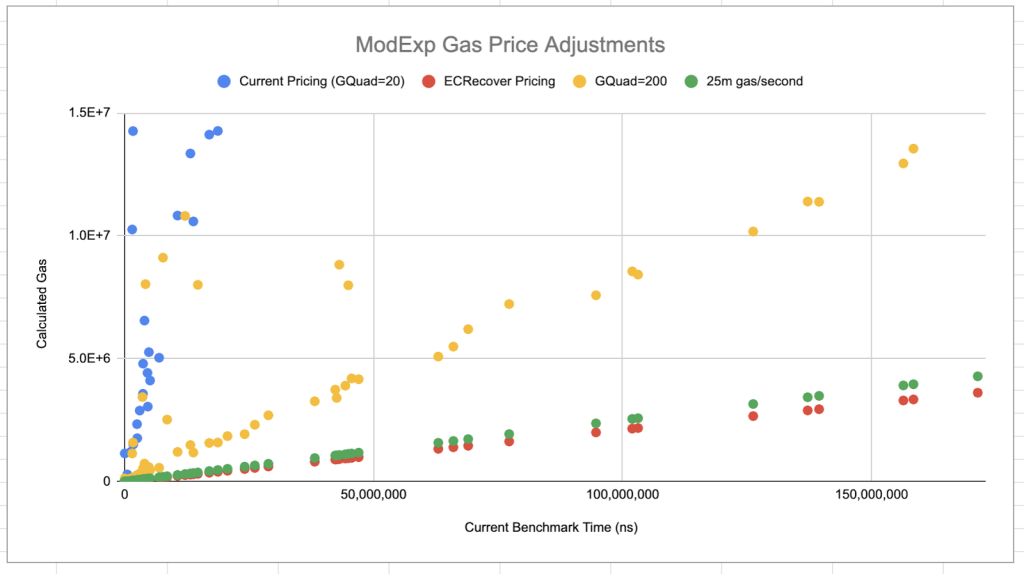
Source: Ethereum Magician

Applications requiring modular exponentiation (modexp) functionality could instead wrap operations in SNARKs, an alternative cryptographic proof system that mitigates inefficiency.

This tradeoff prioritizes ecosystem stability and scaling progress over maintaining legacy features with narrow use cases, particularly as Ethereum faces more urgent performance challenges.

The proposed Ethereum Improvement Proposal would fundamentally change how the network handles cryptographic operations that prove burdensome for zero-knowledge proof systems.

Institutional Gateway Opens as Privacy Solutions Mature

In late October, the Ethereum Foundation launched “Ethereum for Institutions”, providing enterprises and financial organizations with structured pathways for blockchain adoption.

The initiative employs zero-knowledge proofs, fully homomorphic encryption, and trusted execution environments to enable compliant, audit-ready applications on public networks.

Projects including Chainlink, RAILGUN, Aztec Network, and Zama pioneer privacy-preserving smart contracts that secure counterparty information and business logic without sacrificing transparency or composability.

These production-ready solutions address institutional requirements for balancing compliance mandates with secure, programmable finance.

Ethereum dominates real-world asset and stablecoin sectors, hosting over 75% of tokenized RWAs and 60% of global stablecoin supply.

Major financial firms, including BlackRock, Securitize, and Ondo Finance, deploy tokenized instruments that offer 24/7 settlement, transparency, and composability.

Layer-2 networks, like Base, Scroll, and Unichain, now secure over $50 billion in value, delivering throughput and cost efficiency for global-scale applications.

Privacy Infrastructure Accelerates Alongside Technical Refinements

The Ethereum Foundation launched its 47-member Privacy Cluster in October, under the coordination of Blockscout founder Igor Barinov, expanding work initiated in 2018 through the Privacy and Scaling Explorations team.

The cluster addresses critical areas around surveillance, private data verification, selective identity disclosure, user experience improvements, and institutional adoption support.

This initiative follows the September rebranding of the Privacy and Scaling Explorations team to Privacy Stewards for Ethereum, shifting the focus from theoretical research to practical solutions.

The foundation warned that without robust privacy protections, Ethereum risks becoming “the backbone of global surveillance rather than global freedom,” potentially driving institutions and users toward alternative platforms.

Last month, Vitalik also detailed GKR, a cryptographic technique that verifies calculations ten times faster than traditional methods while enabling zero-knowledge proofs that confirm computational accuracy without exposing underlying data.

The protocol processes 2 million calculations per second on standard laptops. It validates entire Ethereum transactions using just fifty consumer-grade graphics cards, compared to traditional methods requiring 100 times more computational work than the original calculations.

The breakthrough is significant because it enables faster verification, resulting in cheaper transactions and enhanced privacy across the network.


Market Opportunity
ZKsync Logo
ZKsync Price(ZK)
$0.01958
$0.01958$0.01958
+1.76%
USD
ZKsync (ZK) Live Price Chart
Disclaimer: The articles reposted on this site are sourced from public platforms and are provided for informational purposes only. They do not necessarily reflect the views of MEXC. All rights remain with the original authors. If you believe any content infringes on third-party rights, please contact crypto.news@mexc.com for removal. MEXC makes no guarantees regarding the accuracy, completeness, or timeliness of the content and is not responsible for any actions taken based on the information provided. The content does not constitute financial, legal, or other professional advice, nor should it be considered a recommendation or endorsement by MEXC.

You May Also Like

Ethereum unveils roadmap focusing on scaling, interoperability, and security at Japan Dev Conference

Ethereum unveils roadmap focusing on scaling, interoperability, and security at Japan Dev Conference

The post Ethereum unveils roadmap focusing on scaling, interoperability, and security at Japan Dev Conference appeared on BitcoinEthereumNews.com. Key Takeaways Ethereum’s new roadmap was presented by Vitalik Buterin at the Japan Dev Conference. Short-term priorities include Layer 1 scaling and raising gas limits to enhance transaction throughput. Vitalik Buterin presented Ethereum’s development roadmap at the Japan Dev Conference today, outlining the blockchain platform’s priorities across multiple timeframes. The short-term goals focus on scaling solutions and increasing Layer 1 gas limits to improve transaction capacity. Mid-term objectives target enhanced cross-Layer 2 interoperability and faster network responsiveness to create a more seamless user experience across different scaling solutions. The long-term vision emphasizes building a secure, simple, quantum-resistant, and formally verified minimalist Ethereum network. This approach aims to future-proof the platform against emerging technological threats while maintaining its core functionality. The roadmap presentation comes as Ethereum continues to compete with other blockchain platforms for market share in the smart contract and decentralized application space. Source: https://cryptobriefing.com/ethereum-roadmap-scaling-interoperability-security-japan/
Share
BitcoinEthereumNews2025/09/18 00:25
ETH broke through $2200, with a daily increase of 5.12%.

ETH broke through $2200, with a daily increase of 5.12%.

PANews reported on March 16 that, according to OKX market data, ETH has just broken through $2,200 and is currently trading at $2,201.00 per coin, a daily increase
Share
PANews2026/03/16 07:09
EUR/USD Exchange Rate Struggles Below 1.1450 Amid Escalating Middle East Tensions

EUR/USD Exchange Rate Struggles Below 1.1450 Amid Escalating Middle East Tensions

BitcoinWorld EUR/USD Exchange Rate Struggles Below 1.1450 Amid Escalating Middle East Tensions The EUR/USD currency pair continues trading defensively below the
Share
bitcoinworld2026/03/16 07:45