Balancer, a major DeFi protocol, has suffered a significant exploit, with approximately $116 million drained from protocol vaults. On-chain data shows large, unusual outflows from Balancer’s “0xBA1…BF2C8” address to an external wallet, including 6,587 WETH (~$24.5M), 6,851 osETH (~$26.9M), and 4,260 wstETH (~$19.3M). The scale and nature of the transfers point to a coordinated attack involving high-value assets across multiple vaults. Balancer has since confirmed the breach, stating that “around 7:48 AM UTC, an exploit affected Balancer V2 Composable Stable Pools.” According to the team, these pools have been live for several years, and some were outside the pause window, leaving them vulnerable. Pools that could be paused have been halted and are now in recovery mode, with the exploit confirmed to be isolated to V2 Composable Stable Pools. Balancer V3 and all other pools remain unaffected. The protocol says it is working with leading security researchers and legal teams to investigate and will release a full post-mortem. Balancer also warned users about fraudulent communications circulating in the aftermath, emphasizing that official updates will only come through its verified X account and official Discord. This incident marks one of the largest DeFi exploits of the year and has heightened security concerns across the sector. Related Reading: Whale Piles Into ASTER Shorts After CZ’s Comment – $52.8M On the Line Hacker Offloads Stolen Tokens Into ETH as Crypto Markets Face Broad Selloff According to Lookonchain, the Balancer exploiter has begun swapping the stolen assets for ETH, accelerating concerns that the attacker intends to consolidate and move value quickly before defenses or recovery mechanisms can engage. Converting large amounts of liquid-staking tokens and wrapped assets into ETH not only solidifies the hacker’s control over the stolen funds but also signals an intent to exit positions entirely rather than negotiate or return funds — a troubling sign for victims and the protocol. This development is unfolding during one of the sharpest pullbacks the market has seen in recent months. Ethereum has fallen below $3,500, a key psychological and technical level, while Bitcoin has broken under the $105,000 support, intensifying fears of deeper downside as liquidity thins and sentiment deteriorates. Altcoins, already under pressure from macro-driven derisking, are bleeding heavily, with capital rotation stalling and speculative flows evaporating. For Balancer, the timing compounds the severity of the crisis. A major security breach during a fragile market period magnifies losses, erodes confidence, and increases the risk of liquidity dislocations. The DeFi ecosystem is now closely watching both the hacker’s next moves and Balancer’s recovery plan as the sector navigates heightened stress on both technical and sentiment fronts. Related Reading: Balancer Protocol Sees $70M Exit In Suspected Crypto Exploit BAL Breaks Down Further As Market Selloff Drives Heavy Pressure BAL has entered another phase of sustained weakness, with the weekly chart showing a clear downtrend that has now intensified following the confirmed exploit. After trading near the $1 region for months, the token has broken lower, currently hovering around $0.80 and showing a sharp weekly decline. The chart reflects heavy selling volume, suggesting that the security breach accelerated an already fragile market structure. Technically, BAL remains below the 50-week and 200-week moving averages, reinforcing a long-term bearish trend with no immediate signs of reversal. Each attempt to establish support has been met with lower highs and breakdowns, indicating persistent distribution and a lack of sustained buyer interest. The recent spike in volume during the selloff confirms capitulation behavior rather than accumulation, as fear spreads across the DeFi sector. Related Reading: Bitmine Buys 44,036 Ethereum Worth $166M During Market Dip – Details Market sentiment around BAL has deteriorated further given the exploit’s timing. With Ethereum trading below $3,500, Bitcoin losing key support near $105,000, and altcoins bleeding across the board, risk appetite is at a low point. For BAL to show recovery signals, it would need to reclaim psychological support near $1 and stabilize volume flows. Until then, price action remains vulnerable, and further downside cannot be ruled out as confidence rebuilds slowly. Featured image from ChatGPT, chart from TradingView.comBalancer, a major DeFi protocol, has suffered a significant exploit, with approximately $116 million drained from protocol vaults. On-chain data shows large, unusual outflows from Balancer’s “0xBA1…BF2C8” address to an external wallet, including 6,587 WETH (~$24.5M), 6,851 osETH (~$26.9M), and 4,260 wstETH (~$19.3M). The scale and nature of the transfers point to a coordinated attack involving high-value assets across multiple vaults. Balancer has since confirmed the breach, stating that “around 7:48 AM UTC, an exploit affected Balancer V2 Composable Stable Pools.” According to the team, these pools have been live for several years, and some were outside the pause window, leaving them vulnerable. Pools that could be paused have been halted and are now in recovery mode, with the exploit confirmed to be isolated to V2 Composable Stable Pools. Balancer V3 and all other pools remain unaffected. The protocol says it is working with leading security researchers and legal teams to investigate and will release a full post-mortem. Balancer also warned users about fraudulent communications circulating in the aftermath, emphasizing that official updates will only come through its verified X account and official Discord. This incident marks one of the largest DeFi exploits of the year and has heightened security concerns across the sector. Related Reading: Whale Piles Into ASTER Shorts After CZ’s Comment – $52.8M On the Line Hacker Offloads Stolen Tokens Into ETH as Crypto Markets Face Broad Selloff According to Lookonchain, the Balancer exploiter has begun swapping the stolen assets for ETH, accelerating concerns that the attacker intends to consolidate and move value quickly before defenses or recovery mechanisms can engage. Converting large amounts of liquid-staking tokens and wrapped assets into ETH not only solidifies the hacker’s control over the stolen funds but also signals an intent to exit positions entirely rather than negotiate or return funds — a troubling sign for victims and the protocol. This development is unfolding during one of the sharpest pullbacks the market has seen in recent months. Ethereum has fallen below $3,500, a key psychological and technical level, while Bitcoin has broken under the $105,000 support, intensifying fears of deeper downside as liquidity thins and sentiment deteriorates. Altcoins, already under pressure from macro-driven derisking, are bleeding heavily, with capital rotation stalling and speculative flows evaporating. For Balancer, the timing compounds the severity of the crisis. A major security breach during a fragile market period magnifies losses, erodes confidence, and increases the risk of liquidity dislocations. The DeFi ecosystem is now closely watching both the hacker’s next moves and Balancer’s recovery plan as the sector navigates heightened stress on both technical and sentiment fronts. Related Reading: Balancer Protocol Sees $70M Exit In Suspected Crypto Exploit BAL Breaks Down Further As Market Selloff Drives Heavy Pressure BAL has entered another phase of sustained weakness, with the weekly chart showing a clear downtrend that has now intensified following the confirmed exploit. After trading near the $1 region for months, the token has broken lower, currently hovering around $0.80 and showing a sharp weekly decline. The chart reflects heavy selling volume, suggesting that the security breach accelerated an already fragile market structure. Technically, BAL remains below the 50-week and 200-week moving averages, reinforcing a long-term bearish trend with no immediate signs of reversal. Each attempt to establish support has been met with lower highs and breakdowns, indicating persistent distribution and a lack of sustained buyer interest. The recent spike in volume during the selloff confirms capitulation behavior rather than accumulation, as fear spreads across the DeFi sector. Related Reading: Bitmine Buys 44,036 Ethereum Worth $166M During Market Dip – Details Market sentiment around BAL has deteriorated further given the exploit’s timing. With Ethereum trading below $3,500, Bitcoin losing key support near $105,000, and altcoins bleeding across the board, risk appetite is at a low point. For BAL to show recovery signals, it would need to reclaim psychological support near $1 and stabilize volume flows. Until then, price action remains vulnerable, and further downside cannot be ruled out as confidence rebuilds slowly. Featured image from ChatGPT, chart from TradingView.com

Balancer Hacker Now Converting Loot to Ethereum: Stolen Funds Surge To $116.6M

2025/11/05 00:00

Balancer, a major DeFi protocol, has suffered a significant exploit, with approximately $116 million drained from protocol vaults. On-chain data shows large, unusual outflows from Balancer’s “0xBA1…BF2C8” address to an external wallet, including 6,587 WETH (~$24.5M), 6,851 osETH (~$26.9M), and 4,260 wstETH (~$19.3M). The scale and nature of the transfers point to a coordinated attack involving high-value assets across multiple vaults.

Balancer Hacker Portfolio | Source: Lookonchain

Balancer has since confirmed the breach, stating that “around 7:48 AM UTC, an exploit affected Balancer V2 Composable Stable Pools.” According to the team, these pools have been live for several years, and some were outside the pause window, leaving them vulnerable. Pools that could be paused have been halted and are now in recovery mode, with the exploit confirmed to be isolated to V2 Composable Stable Pools. Balancer V3 and all other pools remain unaffected.

The protocol says it is working with leading security researchers and legal teams to investigate and will release a full post-mortem. Balancer also warned users about fraudulent communications circulating in the aftermath, emphasizing that official updates will only come through its verified X account and official Discord.

This incident marks one of the largest DeFi exploits of the year and has heightened security concerns across the sector.

Hacker Offloads Stolen Tokens Into ETH as Crypto Markets Face Broad Selloff

According to Lookonchain, the Balancer exploiter has begun swapping the stolen assets for ETH, accelerating concerns that the attacker intends to consolidate and move value quickly before defenses or recovery mechanisms can engage. Converting large amounts of liquid-staking tokens and wrapped assets into ETH not only solidifies the hacker’s control over the stolen funds but also signals an intent to exit positions entirely rather than negotiate or return funds — a troubling sign for victims and the protocol.
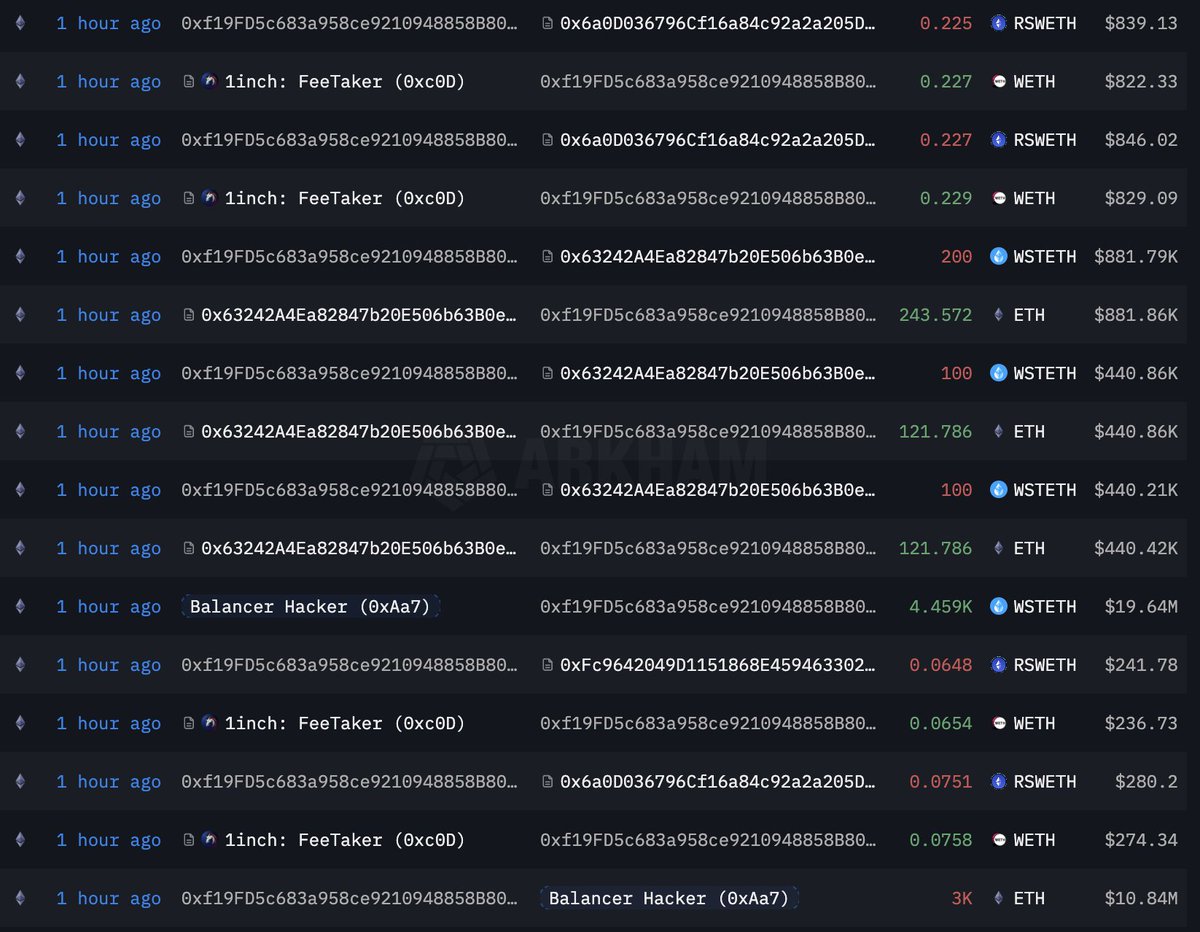
Balancer Hacker Swapping Stolen Assets | Source: Lookonchain

This development is unfolding during one of the sharpest pullbacks the market has seen in recent months. Ethereum has fallen below $3,500, a key psychological and technical level, while Bitcoin has broken under the $105,000 support, intensifying fears of deeper downside as liquidity thins and sentiment deteriorates. Altcoins, already under pressure from macro-driven derisking, are bleeding heavily, with capital rotation stalling and speculative flows evaporating.

For Balancer, the timing compounds the severity of the crisis. A major security breach during a fragile market period magnifies losses, erodes confidence, and increases the risk of liquidity dislocations. The DeFi ecosystem is now closely watching both the hacker’s next moves and Balancer’s recovery plan as the sector navigates heightened stress on both technical and sentiment fronts.

BAL Breaks Down Further As Market Selloff Drives Heavy Pressure

BAL has entered another phase of sustained weakness, with the weekly chart showing a clear downtrend that has now intensified following the confirmed exploit. After trading near the $1 region for months, the token has broken lower, currently hovering around $0.80 and showing a sharp weekly decline. The chart reflects heavy selling volume, suggesting that the security breach accelerated an already fragile market structure.
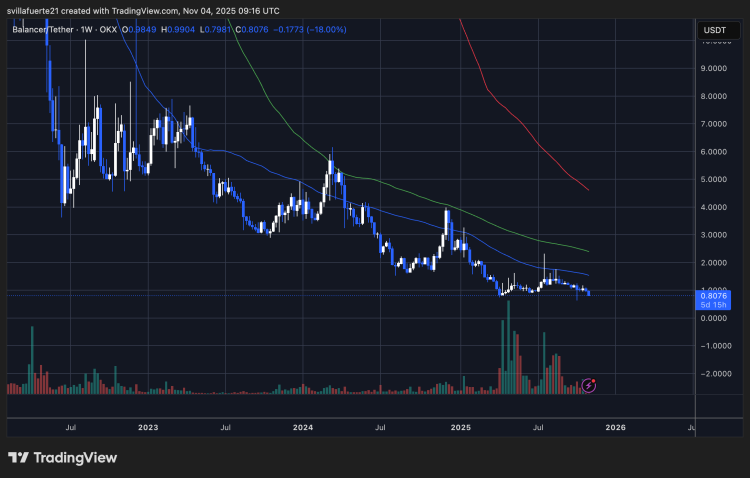
BAL downtrend continuation | Source: BALUSDT chart on TradingView

Technically, BAL remains below the 50-week and 200-week moving averages, reinforcing a long-term bearish trend with no immediate signs of reversal. Each attempt to establish support has been met with lower highs and breakdowns, indicating persistent distribution and a lack of sustained buyer interest. The recent spike in volume during the selloff confirms capitulation behavior rather than accumulation, as fear spreads across the DeFi sector.

Market sentiment around BAL has deteriorated further given the exploit’s timing. With Ethereum trading below $3,500, Bitcoin losing key support near $105,000, and altcoins bleeding across the board, risk appetite is at a low point. For BAL to show recovery signals, it would need to reclaim psychological support near $1 and stabilize volume flows. Until then, price action remains vulnerable, and further downside cannot be ruled out as confidence rebuilds slowly.

Featured image from ChatGPT, chart from TradingView.com

Market Opportunity
Nowchain Logo
Nowchain Price(NOW)
$0.00199
$0.00199$0.00199
-5.23%
USD
Nowchain (NOW) Live Price Chart
Disclaimer: The articles reposted on this site are sourced from public platforms and are provided for informational purposes only. They do not necessarily reflect the views of MEXC. All rights remain with the original authors. If you believe any content infringes on third-party rights, please contact service@support.mexc.com for removal. MEXC makes no guarantees regarding the accuracy, completeness, or timeliness of the content and is not responsible for any actions taken based on the information provided. The content does not constitute financial, legal, or other professional advice, nor should it be considered a recommendation or endorsement by MEXC.

You May Also Like

WTO report: Artificial intelligence could drive nearly 40% of global trade growth by 2040

WTO report: Artificial intelligence could drive nearly 40% of global trade growth by 2040

PANews reported on December 21 that, according to Jinshi, the World Trade Organization's "World Trade Report 2025" indicates that, with supporting policies in place
Share
PANews2025/12/21 11:40
Bitcoin 8% Gains Already Make September 2025 Its Second Best

Bitcoin 8% Gains Already Make September 2025 Its Second Best

The post Bitcoin 8% Gains Already Make September 2025 Its Second Best appeared on BitcoinEthereumNews.com. Key points: Bitcoin is bucking seasonality trends by adding 8%, making this September its best since 2012. September 2025 would need to see 20% upside to become Bitcoin’s strongest ever. BTC price volatility is at levels rarely seen before in an unusual bull cycle. Bitcoin (BTC) has gained more this September than any year since 2012, a new bull market record. Historical price data from CoinGlass and BiTBO confirms that at 8%, Bitcoin’s September 2025 upside is its second-best ever. Bitcoin avoiding “Rektember” with 8% gains September is traditionally Bitcoin’s weakest month, with average losses of around 8%. BTC/USD monthly returns (screenshot). Source: CoinGlass This year, the stakes are high for BTC price seasonality, as historical patterns demand the next bull market peak and other risk assets set repeated new all-time highs. While both gold and the S&P 500 are in price discovery, BTC/USD has coiled throughout September after setting new highs of its own the month prior. Even at “just” 8%, however, this September’s performance is currently enough to make it Bitcoin’s strongest in 13 years. The only time that the ninth month of the year was more profitable for Bitcoin bulls was in 2012, when BTC/USD gained about 19.8%. Last year, upside topped out at 7.3%. BTC/USD monthly returns. Source: BiTBO BTC price volatility vanishes The figures underscore a highly unusual bull market peak year for Bitcoin. Related: BTC ‘pricing in’ what’s coming: 5 things to know in Bitcoin this week Unlike previous bull markets, BTC price volatility has died off in 2025, against the expectations of longtime market participants based on prior performance. CoinGlass data shows volatility dropping to levels not seen in over a decade, with a particularly sharp drop from April onward. Bitcoin historical volatility (screenshot). Source: CoinGlass Onchain analytics firm Glassnode, meanwhile, highlights the…
Share
BitcoinEthereumNews2025/09/18 11:09
Dragonfly Capital has deposited 6 million MNT tokens into Bybit in the past 7 days, worth $6.95 million.

Dragonfly Capital has deposited 6 million MNT tokens into Bybit in the past 7 days, worth $6.95 million.

PANews reported on December 21 that Dragonfly Capital continues to deposit MNT into Bybit. Over the past seven days, it has deposited a total of 6 million MNT (
Share
PANews2025/12/21 11:16