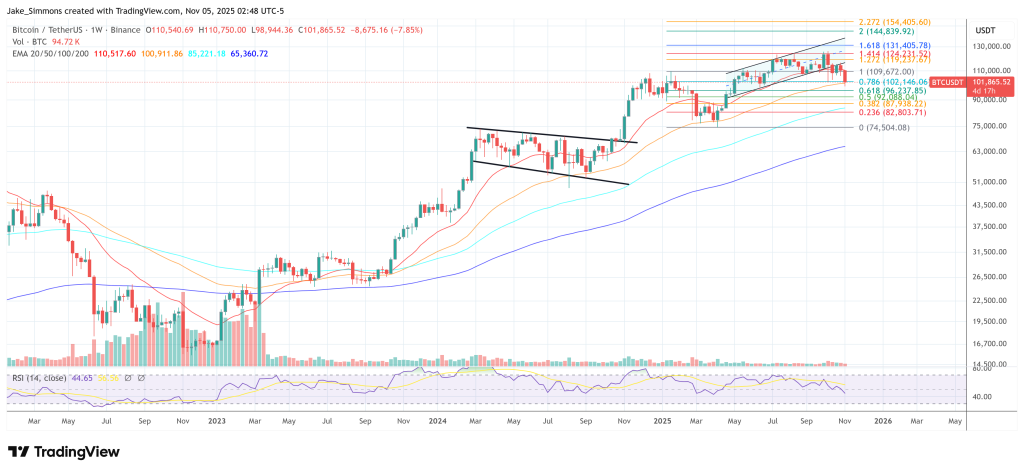
Bitcoin endured one of its sharpest selloffs of the year on Tuesday, knifing below the six-figure threshold and printing lows around the $99,000 area on major composites before rebounding. At press time, bitcoin (BTC) hovered near $101,700 after an intraday trough just above $99,000 on widely used benchmarks, marking a fall of roughly 6% day-over-day and the lowest print since June. The slide came as US equities limped into mid-week, with the Nasdaq up 20.9% year-to-date and the S&P 500 up 15.1% as of Tuesday’s close—gains that underscore how much bitcoin has lagged other risk assets during long stretches of 2025. That divergence, together with a growing body of ETF-flow data showing several straight sessions of net outflows from US spot bitcoin funds into early November, provided the macro backdrop for a fragile crypto tape. Independent tallies from Farside/SoSoValue and multiple outlets point to a roughly $1.3–$1.4 billion cumulative bleed over four trading days into November 3–4, led by BlackRock’s IBIT. Why Is Bitcoin Price Down? Into that context, Joe Consorti—Head of Growth at Horizon (Theya, YC)—argues the selloff is less a loss of conviction than a structural handoff of supply. In a video analysis posted late November 4 US time, he framed the day’s move as “one of its roughest days of the year, down more than 6 percent, falling to $99,000 for the first time since June,” adding that while equities would call that “the start of a bear market… for Bitcoin, though, this is typical of a bull market drawdown.” He noted that “we’ve already weathered two separate 30 percent drawdowns during this bull run,” and characterized the present action as “a transfer of Bitcoin’s ownership base from the old guard to the new guard.” Related Reading: CryptoQuant Head Reveals Reason Behind Bearish Bitcoin Trend Consorti anchored his thesis to a now-viral framework from macro investor Jordi Visser: bitcoin’s “silent IPO.” In Visser’s Substack essay—shared widely since the weekend—he posits that 2025’s rangebound price belies an orderly, IPO-like distribution as early-era holders access the deepest liquidity the asset has ever had through ETFs, institutional custodians and corporate balance sheets. “Early-stage investors… need liquidity. They need an exit. They need to diversify,” Visser wrote, arguing that methodical selling “results [in] a sideways grind that drives everyone crazy.” Consorti adopted the frame bluntly: “This isn’t panic selling, it’s the natural evolution of an asset that’s reached maturity… a transfer of ownership from concentrated hands to distributed ones.” Evidence for that churn has been visible on-chain. Multiple instances of Satoshi-era wallets and miner addresses reanimating this quarter—some after 14 years—have been documented, including July’s duo of 10,000-BTC wallets and late-October movement from a 4,000-BTC miner address. While not dispositive that coins are being market-sold, the pattern is consistent with supply redistributing from early concentrates to broader, regulated channels. Technically, Consorti cast the drop as part of “digestion,” not exhaustion. “The RSI tells us Bitcoin is at its most oversold level since April, when the last leg of the bull run began. Every drawdown this cycle, 30%, 35%, and now 20%, has built support rather than destroyed it.” He added a key conditional: “If we spend too much time below $100,000, that could suggest the distribution isn’t done… perhaps we’re in for a bull-market reversal into a bear market.” Macro, however, is intruding. The Federal Reserve cut rates by 25 bps on October 29 to a 3.75%–4.00% target range, but Chair Jerome Powell carefully pushed back on the idea of an automatic December cut, citing “strongly differing views” inside the FOMC and a “data fog” from the ongoing government shutdown. Markets promptly tempered their odds for further near-term easing. Consorti’s warning that bitcoin “is extremely correlated” to risk-asset drawdowns therefore looms large: if equities lurch meaningfully lower or funding stress reappears, crypto will feel it. Related Reading: Bitcoin Bull Run: Over Or Just Paused? CryptoQuant CEO Presents The Data If Visser’s “silent IPO” is right, ETFs are both symptom and salve. They have delivered the two-sided depth to absorb legacy supply but also introduced a new, faster-moving cohort whose redemptions can amplify downdrafts. That dynamic showed up again this week in the four-day string of net outflows concentrated in IBIT, even as longer-term assets under management remain enormous by historical standards. Consorti’s conclusion was starkly patient, not euphoric. “For every seller looking to liquidate their position, there’s a new participant stepping in for the long haul… It’s slow, it’s uneven, and it’s psychologically draining, but once it’s finished, it unlocks the next leg higher. Because the marginal seller is gone, and what’s left is a base of holders who don’t need to sell.” Whether Tuesday’s pierce of the six-figure floor proves the climactic flush—or merely another chapter in a months-long ownership transfer—will hinge on how quickly price reclaims and bases above $100,000, how ETF flows stabilize, and whether the Fed’s path from here restores risk appetite or starves it. For now, the most important story in bitcoin may be happening under the surface, not on the chart. At press time, BTC traded at $101,865. Featured image created with DALL.E, chart from TradingView.comBitcoin endured one of its sharpest selloffs of the year on Tuesday, knifing below the six-figure threshold and printing lows around the $99,000 area on major composites before rebounding. At press time, bitcoin (BTC) hovered near $101,700 after an intraday trough just above $99,000 on widely used benchmarks, marking a fall of roughly 6% day-over-day and the lowest print since June. The slide came as US equities limped into mid-week, with the Nasdaq up 20.9% year-to-date and the S&P 500 up 15.1% as of Tuesday’s close—gains that underscore how much bitcoin has lagged other risk assets during long stretches of 2025. That divergence, together with a growing body of ETF-flow data showing several straight sessions of net outflows from US spot bitcoin funds into early November, provided the macro backdrop for a fragile crypto tape. Independent tallies from Farside/SoSoValue and multiple outlets point to a roughly $1.3–$1.4 billion cumulative bleed over four trading days into November 3–4, led by BlackRock’s IBIT. Why Is Bitcoin Price Down? Into that context, Joe Consorti—Head of Growth at Horizon (Theya, YC)—argues the selloff is less a loss of conviction than a structural handoff of supply. In a video analysis posted late November 4 US time, he framed the day’s move as “one of its roughest days of the year, down more than 6 percent, falling to $99,000 for the first time since June,” adding that while equities would call that “the start of a bear market… for Bitcoin, though, this is typical of a bull market drawdown.” He noted that “we’ve already weathered two separate 30 percent drawdowns during this bull run,” and characterized the present action as “a transfer of Bitcoin’s ownership base from the old guard to the new guard.” Related Reading: CryptoQuant Head Reveals Reason Behind Bearish Bitcoin Trend Consorti anchored his thesis to a now-viral framework from macro investor Jordi Visser: bitcoin’s “silent IPO.” In Visser’s Substack essay—shared widely since the weekend—he posits that 2025’s rangebound price belies an orderly, IPO-like distribution as early-era holders access the deepest liquidity the asset has ever had through ETFs, institutional custodians and corporate balance sheets. “Early-stage investors… need liquidity. They need an exit. They need to diversify,” Visser wrote, arguing that methodical selling “results [in] a sideways grind that drives everyone crazy.” Consorti adopted the frame bluntly: “This isn’t panic selling, it’s the natural evolution of an asset that’s reached maturity… a transfer of ownership from concentrated hands to distributed ones.” Evidence for that churn has been visible on-chain. Multiple instances of Satoshi-era wallets and miner addresses reanimating this quarter—some after 14 years—have been documented, including July’s duo of 10,000-BTC wallets and late-October movement from a 4,000-BTC miner address. While not dispositive that coins are being market-sold, the pattern is consistent with supply redistributing from early concentrates to broader, regulated channels. Technically, Consorti cast the drop as part of “digestion,” not exhaustion. “The RSI tells us Bitcoin is at its most oversold level since April, when the last leg of the bull run began. Every drawdown this cycle, 30%, 35%, and now 20%, has built support rather than destroyed it.” He added a key conditional: “If we spend too much time below $100,000, that could suggest the distribution isn’t done… perhaps we’re in for a bull-market reversal into a bear market.” Macro, however, is intruding. The Federal Reserve cut rates by 25 bps on October 29 to a 3.75%–4.00% target range, but Chair Jerome Powell carefully pushed back on the idea of an automatic December cut, citing “strongly differing views” inside the FOMC and a “data fog” from the ongoing government shutdown. Markets promptly tempered their odds for further near-term easing. Consorti’s warning that bitcoin “is extremely correlated” to risk-asset drawdowns therefore looms large: if equities lurch meaningfully lower or funding stress reappears, crypto will feel it. Related Reading: Bitcoin Bull Run: Over Or Just Paused? CryptoQuant CEO Presents The Data If Visser’s “silent IPO” is right, ETFs are both symptom and salve. They have delivered the two-sided depth to absorb legacy supply but also introduced a new, faster-moving cohort whose redemptions can amplify downdrafts. That dynamic showed up again this week in the four-day string of net outflows concentrated in IBIT, even as longer-term assets under management remain enormous by historical standards. Consorti’s conclusion was starkly patient, not euphoric. “For every seller looking to liquidate their position, there’s a new participant stepping in for the long haul… It’s slow, it’s uneven, and it’s psychologically draining, but once it’s finished, it unlocks the next leg higher. Because the marginal seller is gone, and what’s left is a base of holders who don’t need to sell.” Whether Tuesday’s pierce of the six-figure floor proves the climactic flush—or merely another chapter in a months-long ownership transfer—will hinge on how quickly price reclaims and bases above $100,000, how ETF flows stabilize, and whether the Fed’s path from here restores risk appetite or starves it. For now, the most important story in bitcoin may be happening under the surface, not on the chart. At press time, BTC traded at $101,865. Featured image created with DALL.E, chart from TradingView.com

Bitcoin Price Crashes Below $99,000: Expert Breaks Down Why

2025/11/05 16:00

Bitcoin endured one of its sharpest selloffs of the year on Tuesday, knifing below the six-figure threshold and printing lows around the $99,000 area on major composites before rebounding. At press time, bitcoin (BTC) hovered near $101,700 after an intraday trough just above $99,000 on widely used benchmarks, marking a fall of roughly 6% day-over-day and the lowest print since June.

The slide came as US equities limped into mid-week, with the Nasdaq up 20.9% year-to-date and the S&P 500 up 15.1% as of Tuesday’s close—gains that underscore how much bitcoin has lagged other risk assets during long stretches of 2025. That divergence, together with a growing body of ETF-flow data showing several straight sessions of net outflows from US spot bitcoin funds into early November, provided the macro backdrop for a fragile crypto tape. Independent tallies from Farside/SoSoValue and multiple outlets point to a roughly $1.3–$1.4 billion cumulative bleed over four trading days into November 3–4, led by BlackRock’s IBIT.

Why Is Bitcoin Price Down?

Into that context, Joe Consorti—Head of Growth at Horizon (Theya, YC)—argues the selloff is less a loss of conviction than a structural handoff of supply. In a video analysis posted late November 4 US time, he framed the day’s move as “one of its roughest days of the year, down more than 6 percent, falling to $99,000 for the first time since June,” adding that while equities would call that “the start of a bear market… for Bitcoin, though, this is typical of a bull market drawdown.” He noted that “we’ve already weathered two separate 30 percent drawdowns during this bull run,” and characterized the present action as “a transfer of Bitcoin’s ownership base from the old guard to the new guard.”

Consorti anchored his thesis to a now-viral framework from macro investor Jordi Visser: bitcoin’s “silent IPO.” In Visser’s Substack essay—shared widely since the weekend—he posits that 2025’s rangebound price belies an orderly, IPO-like distribution as early-era holders access the deepest liquidity the asset has ever had through ETFs, institutional custodians and corporate balance sheets.

“Early-stage investors… need liquidity. They need an exit. They need to diversify,” Visser wrote, arguing that methodical selling “results [in] a sideways grind that drives everyone crazy.” Consorti adopted the frame bluntly: “This isn’t panic selling, it’s the natural evolution of an asset that’s reached maturity… a transfer of ownership from concentrated hands to distributed ones.”

Evidence for that churn has been visible on-chain. Multiple instances of Satoshi-era wallets and miner addresses reanimating this quarter—some after 14 years—have been documented, including July’s duo of 10,000-BTC wallets and late-October movement from a 4,000-BTC miner address. While not dispositive that coins are being market-sold, the pattern is consistent with supply redistributing from early concentrates to broader, regulated channels.

Technically, Consorti cast the drop as part of “digestion,” not exhaustion. “The RSI tells us Bitcoin is at its most oversold level since April, when the last leg of the bull run began. Every drawdown this cycle, 30%, 35%, and now 20%, has built support rather than destroyed it.” He added a key conditional: “If we spend too much time below $100,000, that could suggest the distribution isn’t done… perhaps we’re in for a bull-market reversal into a bear market.”

Macro, however, is intruding. The Federal Reserve cut rates by 25 bps on October 29 to a 3.75%–4.00% target range, but Chair Jerome Powell carefully pushed back on the idea of an automatic December cut, citing “strongly differing views” inside the FOMC and a “data fog” from the ongoing government shutdown. Markets promptly tempered their odds for further near-term easing. Consorti’s warning that bitcoin “is extremely correlated” to risk-asset drawdowns therefore looms large: if equities lurch meaningfully lower or funding stress reappears, crypto will feel it.

If Visser’s “silent IPO” is right, ETFs are both symptom and salve. They have delivered the two-sided depth to absorb legacy supply but also introduced a new, faster-moving cohort whose redemptions can amplify downdrafts. That dynamic showed up again this week in the four-day string of net outflows concentrated in IBIT, even as longer-term assets under management remain enormous by historical standards.

Consorti’s conclusion was starkly patient, not euphoric. “For every seller looking to liquidate their position, there’s a new participant stepping in for the long haul… It’s slow, it’s uneven, and it’s psychologically draining, but once it’s finished, it unlocks the next leg higher. Because the marginal seller is gone, and what’s left is a base of holders who don’t need to sell.”

Whether Tuesday’s pierce of the six-figure floor proves the climactic flush—or merely another chapter in a months-long ownership transfer—will hinge on how quickly price reclaims and bases above $100,000, how ETF flows stabilize, and whether the Fed’s path from here restores risk appetite or starves it. For now, the most important story in bitcoin may be happening under the surface, not on the chart.

At press time, BTC traded at $101,865.

Bitcoin price
Market Opportunity
WHY Logo
WHY Price(WHY)
$0.00000001529
$0.00000001529$0.00000001529
0.00%
USD
WHY (WHY) Live Price Chart
Disclaimer: The articles reposted on this site are sourced from public platforms and are provided for informational purposes only. They do not necessarily reflect the views of MEXC. All rights remain with the original authors. If you believe any content infringes on third-party rights, please contact service@support.mexc.com for removal. MEXC makes no guarantees regarding the accuracy, completeness, or timeliness of the content and is not responsible for any actions taken based on the information provided. The content does not constitute financial, legal, or other professional advice, nor should it be considered a recommendation or endorsement by MEXC.

You May Also Like

Solana Treasury Stocks: Why Are These Companies Buying Up SOL?

Solana Treasury Stocks: Why Are These Companies Buying Up SOL?

The post Solana Treasury Stocks: Why Are These Companies Buying Up SOL? appeared on BitcoinEthereumNews.com. In 2020, everyone watched Strategy (called Microstrategy back then) scoop up Bitcoin and turn corporate crypto treasuries into a mainstream story. Now, a new wave is forming. And it’s centered on Solana. Dozens of companies are holding SOL as a bet on price. Except they’re not just holding. They’re building what’s being called Solana treasuries or Digital Asset Treasuries (DATs). These aren’t passive vaults. They’re active strategies that stake, earn yield, and tie into the fast-growing Solana ecosystem. Forward Industries, a Nasdaq-listed firm, recently bought more than 6.8 million SOL, making it the world’s largest Solana treasury company. Others like Helius Medical, Upexi, and DeFi Development are following a similar playbook, turning SOL into a centerpiece of their balance sheets. The trend is clear: Solana treasury stocks are emerging as a new class of crypto-exposed equities. And for investors, the question isn’t just who’s buying but why this strategy is spreading so fast. Key highlights: Solana treasuries (DATs) are corporate reserves of SOL designed to earn yield through staking and DeFi. Companies like Forward Industries, Helius Medical, Upexi, and DeFi Development Corp now hold millions of SOL. Public firms collectively own 17.1M SOL (≈$4B), which makes Solana one of the most adopted treasuries. Unlike Bitcoin treasuries, Solana holdings generate 6–8% annual rewards. It makes reserves into productive assets Solana treasury stocks are emerging as a new way for investors to gain indirect exposure to SOL. Risks remain: volatility, regulation, and concentrated holdings. But corporate adoption is growing fast. What is a Solana treasury (DAT)? A Solana treasury, sometimes called a Digital Asset Treasury (DAT), is when a company holds SOL as part of its balance sheet. But unlike Bitcoin treasuries, these usually aren’t just static reserves sitting in cold storage.  The key difference is productivity. SOL can be staked directly…
Share
BitcoinEthereumNews2025/09/21 06:09
Unstoppable: Why No Public Company Can Ever Catch MicroStrategy’s Massive Bitcoin Holdings

Unstoppable: Why No Public Company Can Ever Catch MicroStrategy’s Massive Bitcoin Holdings

BitcoinWorld Unstoppable: Why No Public Company Can Ever Catch MicroStrategy’s Massive Bitcoin Holdings Imagine trying to build a mountain of gold, only to discover
Share
bitcoinworld2025/12/17 14:30
Little Pepe soars from presale to market spotlight

Little Pepe soars from presale to market spotlight

The post Little Pepe soars from presale to market spotlight appeared on BitcoinEthereumNews.com. Disclosure: This article does not represent investment advice. The content and materials featured on this page are for educational purposes only. Early investors often capture the biggest rewards in crypto, and Little Pepe, priced under $0.005, is emerging as a memecoin that could rival big players. Summary LILPEPE has sold over 15 billion tokens in its presale, raising $25.4 million. The project’s community has grown to more than 41,000 holders and 30,000 Telegram members. Analysts suggest the token could see gains of up to 55x in two years and 100x by 2030. Crypto enthusiasts are aware that early investors tend to benefit the most from the market. Ripple (XRP) and Solana (SOL) are popular tokens that have profited traders. Little Pepe (LILPEPE), valued at less than $0.005, might produce more profit. LILPEPE is swiftly gaining popularity despite its recent introduction. Little Pepe: The market-changing memecoin Little Pepe has surprised everyone with its quick surge in cryptocurrencies. LILPEPE is becoming a popular meme currency. Its presale price is below $0.003. Strong foundations, a distinct market presence, and a developing and enthusiastic community distinguish it from other meme tokens. Many meme currencies use hype to attract investors, but LILPEPE’s rarity, community support, and distinctive roadmap have effectively drawn them in. Currently in its 13th presale stage, more than 15 billion tokens have been sold, generating over $25.4 million and sparking considerable interest. As the token approaches official listing, enthusiasm is growing, and many people believe it could be one of the following major memecoin success stories. LILPEPE’s growing community drives growth The strong community surrounding LILPEPE is a primary reason for its success. LILPEPE has built a loyal following of over 41,000 holders and about 30,000 active members on Telegram. Its rise is being fueled by this. The support of its community…
Share
BitcoinEthereumNews2025/09/19 15:12