This article introduces a novel Knowledge Consolidation strategy for IIL that utilizes Exponential Moving Average to transfer learned knowledge from the student to the teacher model.This article introduces a novel Knowledge Consolidation strategy for IIL that utilizes Exponential Moving Average to transfer learned knowledge from the student to the teacher model.

Model Promotion: Using EMA to Balance Learning and Forgetting in IIL

Abstract and 1 Introduction

  1. Related works

  2. Problem setting

  3. Methodology

    4.1. Decision boundary-aware distillation

    4.2. Knowledge consolidation

  4. Experimental results and 5.1. Experiment Setup

    5.2. Comparison with SOTA methods

    5.3. Ablation study

  5. Conclusion and future work and References

    \

Supplementary Material

  1. Details of the theoretical analysis on KCEMA mechanism in IIL
  2. Algorithm overview
  3. Dataset details
  4. Implementation details
  5. Visualization of dusted input images
  6. More experimental results

4.2. Knowledge consolidation

Different from existing IIL methods that only focus on the student model, we propose to consolidate knowledge from student to teacher for better balance between learning and forgetting. The consolidation is not implemented through learning but through model exponential moving average (EMA). Model EMA was initially introduced by Tarvainen et al. [28] to enhance the generalizability of models. In the vanilla model EMA, the model is trained from scratch, and EMA is applied after every iteration. The underlying mechanism of model EMA is not thoroughly explained before. In this work, we leverage model EMA for knowledge consolidation (KC) in the context of IIL task and explain the mechanism theoretically. According to our theoretical analysis, we propose a new KC-EMA for knowledge consolidation. Mathematically, the model EMA can be formulated as

\
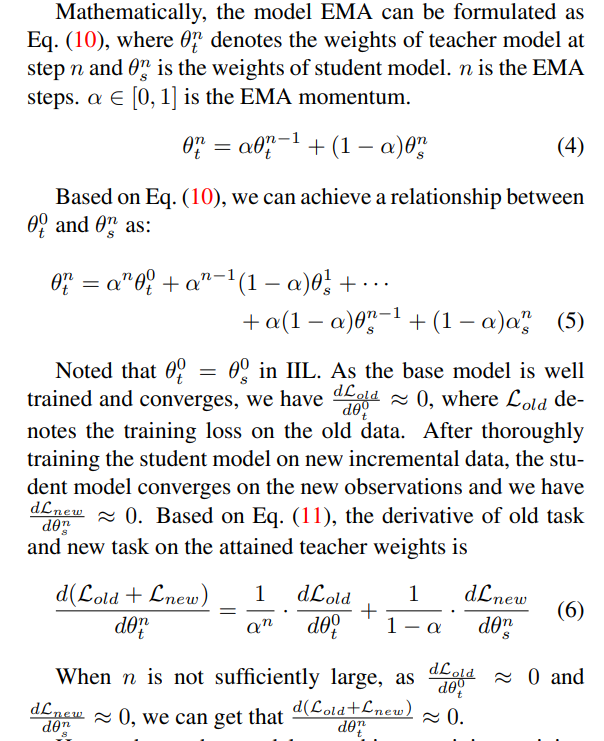
\ Hence, the teacher model can achieve a minima training loss on both the old task and the new task, which indicates improved generalization on both the old data and new observations. This has been verified by our experiments in Sec. 5. However, since α < 1, it is noteworthy that the gradient of the teacher model, whether on the old task or the new task, is larger than the initial gradient on the old task or the final gradient of the student model on the new task. That is, the obtained teacher model sacrifices some unilateral performance on either the old data or the new data in order to achieve better generalization on both. From this perspective, the mechanism of vanilla EMA could also be partially explained. In vanilla EMA, where the model starts from scratch and only the new task is considered, we only need to focus on the second term in Equation 13. Since the teacher model has larger gradient on the training data than the student model, it is less possible to overfit to the training data. As a result, the teacher model has better generalization as Tarvainen et al. [28] observed.

\

\

\

:::info Authors:

(1) Qiang Nie, Hong Kong University of Science and Technology (Guangzhou);

(2) Weifu Fu, Tencent Youtu Lab;

(3) Yuhuan Lin, Tencent Youtu Lab;

(4) Jialin Li, Tencent Youtu Lab;

(5) Yifeng Zhou, Tencent Youtu Lab;

(6) Yong Liu, Tencent Youtu Lab;

(7) Qiang Nie, Hong Kong University of Science and Technology (Guangzhou);

(8) Chengjie Wang, Tencent Youtu Lab.

:::


:::info This paper is available on arxiv under CC BY-NC-ND 4.0 Deed (Attribution-Noncommercial-Noderivs 4.0 International) license.

:::

\

Disclaimer: The articles reposted on this site are sourced from public platforms and are provided for informational purposes only. They do not necessarily reflect the views of MEXC. All rights remain with the original authors. If you believe any content infringes on third-party rights, please contact service@support.mexc.com for removal. MEXC makes no guarantees regarding the accuracy, completeness, or timeliness of the content and is not responsible for any actions taken based on the information provided. The content does not constitute financial, legal, or other professional advice, nor should it be considered a recommendation or endorsement by MEXC.

You May Also Like

The Channel Factories We’ve Been Waiting For

The Channel Factories We’ve Been Waiting For

The post The Channel Factories We’ve Been Waiting For appeared on BitcoinEthereumNews.com. Visions of future technology are often prescient about the broad strokes while flubbing the details. The tablets in “2001: A Space Odyssey” do indeed look like iPads, but you never see the astronauts paying for subscriptions or wasting hours on Candy Crush.  Channel factories are one vision that arose early in the history of the Lightning Network to address some challenges that Lightning has faced from the beginning. Despite having grown to become Bitcoin’s most successful layer-2 scaling solution, with instant and low-fee payments, Lightning’s scale is limited by its reliance on payment channels. Although Lightning shifts most transactions off-chain, each payment channel still requires an on-chain transaction to open and (usually) another to close. As adoption grows, pressure on the blockchain grows with it. The need for a more scalable approach to managing channels is clear. Channel factories were supposed to meet this need, but where are they? In 2025, subnetworks are emerging that revive the impetus of channel factories with some new details that vastly increase their potential. They are natively interoperable with Lightning and achieve greater scale by allowing a group of participants to open a shared multisig UTXO and create multiple bilateral channels, which reduces the number of on-chain transactions and improves capital efficiency. Achieving greater scale by reducing complexity, Ark and Spark perform the same function as traditional channel factories with new designs and additional capabilities based on shared UTXOs.  Channel Factories 101 Channel factories have been around since the inception of Lightning. A factory is a multiparty contract where multiple users (not just two, as in a Dryja-Poon channel) cooperatively lock funds in a single multisig UTXO. They can open, close and update channels off-chain without updating the blockchain for each operation. Only when participants leave or the factory dissolves is an on-chain transaction…
Share
BitcoinEthereumNews2025/09/18 00:09
How ZKP’s Daily Presale Auction Is Creating a New Standard for 1,000x Returns

How ZKP’s Daily Presale Auction Is Creating a New Standard for 1,000x Returns

The post How ZKP’s Daily Presale Auction Is Creating a New Standard for 1,000x Returns appeared on BitcoinEthereumNews.com. Disclaimer: This article is a sponsored
Share
BitcoinEthereumNews2026/01/16 09:02
Lighter drops 14% after losing $2 support – More pain ahead for LIT?

Lighter drops 14% after losing $2 support – More pain ahead for LIT?

The post Lighter drops 14% after losing $2 support – More pain ahead for LIT? appeared on BitcoinEthereumNews.com. Since it touched a high of $4.5, Lighter has
Share
BitcoinEthereumNews2026/01/16 08:46







