The question dominating crypto desks this week is whether the cycle is intact, and when the bull run will return. Two widely followed macro commentators sketched the same causal chain from public-sector cash management to crypto asset beta, arguing that the current drawdown is a liquidity story first and a sentiment story second—and that its reversal hinges on the mechanics of the US Treasury General Account (TGA), Federal Reserve balance-sheet policy, and the timing of Washington’s reopening. Crypto Market Awaits US Government Shutdown Resolution Macro analyst @plur_daddy on X summarizes the current state bluntly: “We are seeing the contraction in liquidity flowing through into risk markets. Naturally it first showed up in BTC and market internals within equities, and now is finally hitting the broader indices.” He describes a textbook quality rotation underway—speculative thematics “such as quantum, nuclear, drones, and alt energy have been getting destroyed,” while flows consolidate into the megacap cohort and earnings-backed momentum, notably the AI capex complex. The underlying plumbing, in his reading, is starved of bank reserves as cash piles into the TGA and quantitative tightening (QT) continues to shrink the Fed’s balance sheet. “Monetary liquidity is drawing down as the TGA has become overfilled beyond the Treasury Dept’s $850bn cap, due to mechanical factors around higher issuance, timing of specific payments, and the government shutdown. There is a broader lack of bank reserves which continues to fall below the key $3trn threshold.” His conclusion is conditional but clear: these stresses “will precipitate actions to calm market plumbing but it will take time.” Related Reading: Caution In The Crypto Market: Expert Warns Of Bearish Phase Unfolding This November On the dollar and cross-asset risk, he points to a crucial level: “The DXY has been rallying and is now approaching a key level at 101, which would be a logical point for it to top. I continue to believe the Trump administration wants a lower dollar.” The path to a crypto bottom, in his cadence, is explicitly tied to policy milestones: “The government reopening provides a clear catalyst to mark the bottom in liquidity conditions. Then, we get QT unwinding Dec 1 and then potentially more Fed actions (such as hints on bills repurchases) on Dec 10. The fiscal deficit will expand significantly starting Jan 1 as the OBBBA will fully kick in.” He characterizes Bitcoin’s behavior as resilient—“BTC has held in well despite tremendous OG selling, the aftermath of 10/10, and the factors above”—and describes his own playbook accordingly: “I currently have a sizable cash position and plan to aggressively add equities (especially the memory trade) and BTC once the government reopening looks imminent.” Hours later he added, “Bought some BTC. Seeing progress being made towards government reopening and signs that liquidity headwinds have peaked. Risk/reward here is strong with sentiment bombed out.” When The Liquidity Returns Raoul Pal, whose framework centers almost entirely on the global liquidity cycle, pushes the same thesis to its logical macro conclusion. “If global liquidity is the single most dominant macro factor then we MUST focus on that,” he writes, before distilling the next year of market structure into a single constraint: “REMEMBER — THE ONLY GAME IN TOWN IS ROLLING $10TRN IN DEBT. EVERYTHING ELSE IS A SIDESHOW. THIS IS THE GAME OF THE NEXT 12 MONTHS.” In Pal’s telling, the shutdown’s effect is immediate and mechanical—“the gov shutdown has forced a sharp tightening of liquidity as the TGA builds up with no where to spend it. This is not offset by the ability to drain the Reverse Repo (it is drained). And QT drains it further”—and crypto, as the highest-beta liquidity asset, takes the brunt. The pivot, he argues, is likewise mechanical once fiscal operations restart: “As soon as the gov shutdown ends, the Treasury begins spending $250bn to $350bn in a couple of months. QT ends and the balance sheet technically expands. The Dollar will likely begin to weaken again as liquidity begins to flow.” Related Reading: Crypto Isn’t Topping Yet: Arthur Hayes Says Stealth QE Is Near He layers on prospective policy and regulatory catalysts—“SLR changes free up more of the banks balance sheets allowing for credit expansion. The CLARITY Act will get passed, giving the crypto regs so desperately needed for large scale adoption by banks, asset managers and businesses overall. The Big Beautiful Bill then kicks in to goose the economy into the midterms”—and frames the global backdrop as additive, with China’s balance-sheet expansion and Japan’s policy mix supporting a broader risk rally. His tactical advice is to accept bull-market volatility without over-reacting: “Always remember the Dont Fuck This Up rules… and wait out the volatility. Drawdowns like this are common place in bull markets and their job is to test your faith. BTFD if you can.” The punchline comes down to a single indicator within his dashboard: “td:dr — When this number goes up, all numbers go up.” The through-line across both perspectives is the primacy of dollar liquidity—specifically, the interaction of Treasury cash balances, Fed asset purchases or run-off, and the available stock of bank reserves after the Reverse Repo Program has largely normalized. When the TGA rises without offset, it functions as a suction pump on aggregate reserves; when it falls as the Treasury spends, reserves rebuild, the marginal cost of leverage eases, and high-beta assets—crypto first—tend to outperform. Where does that leave the timing question implied by every red candle on crypto Twitter? Neither source offers a date, but both tether the next leg higher to the same sequence: a resolution in Washington that flips the TGA from hoarding to spending, visible easing in reserve scarcity as QT pauses or is unwound, a swerve lower in the dollar from resistance, and renewed fiscal impulse that re-steepens the growth impulse into 2026. At press time, the total crypto market cap stood at $3.38 trillion. Featured image created with DALL.E, chart from TradingView.comThe question dominating crypto desks this week is whether the cycle is intact, and when the bull run will return. Two widely followed macro commentators sketched the same causal chain from public-sector cash management to crypto asset beta, arguing that the current drawdown is a liquidity story first and a sentiment story second—and that its reversal hinges on the mechanics of the US Treasury General Account (TGA), Federal Reserve balance-sheet policy, and the timing of Washington’s reopening. Crypto Market Awaits US Government Shutdown Resolution Macro analyst @plur_daddy on X summarizes the current state bluntly: “We are seeing the contraction in liquidity flowing through into risk markets. Naturally it first showed up in BTC and market internals within equities, and now is finally hitting the broader indices.” He describes a textbook quality rotation underway—speculative thematics “such as quantum, nuclear, drones, and alt energy have been getting destroyed,” while flows consolidate into the megacap cohort and earnings-backed momentum, notably the AI capex complex. The underlying plumbing, in his reading, is starved of bank reserves as cash piles into the TGA and quantitative tightening (QT) continues to shrink the Fed’s balance sheet. “Monetary liquidity is drawing down as the TGA has become overfilled beyond the Treasury Dept’s $850bn cap, due to mechanical factors around higher issuance, timing of specific payments, and the government shutdown. There is a broader lack of bank reserves which continues to fall below the key $3trn threshold.” His conclusion is conditional but clear: these stresses “will precipitate actions to calm market plumbing but it will take time.” Related Reading: Caution In The Crypto Market: Expert Warns Of Bearish Phase Unfolding This November On the dollar and cross-asset risk, he points to a crucial level: “The DXY has been rallying and is now approaching a key level at 101, which would be a logical point for it to top. I continue to believe the Trump administration wants a lower dollar.” The path to a crypto bottom, in his cadence, is explicitly tied to policy milestones: “The government reopening provides a clear catalyst to mark the bottom in liquidity conditions. Then, we get QT unwinding Dec 1 and then potentially more Fed actions (such as hints on bills repurchases) on Dec 10. The fiscal deficit will expand significantly starting Jan 1 as the OBBBA will fully kick in.” He characterizes Bitcoin’s behavior as resilient—“BTC has held in well despite tremendous OG selling, the aftermath of 10/10, and the factors above”—and describes his own playbook accordingly: “I currently have a sizable cash position and plan to aggressively add equities (especially the memory trade) and BTC once the government reopening looks imminent.” Hours later he added, “Bought some BTC. Seeing progress being made towards government reopening and signs that liquidity headwinds have peaked. Risk/reward here is strong with sentiment bombed out.” When The Liquidity Returns Raoul Pal, whose framework centers almost entirely on the global liquidity cycle, pushes the same thesis to its logical macro conclusion. “If global liquidity is the single most dominant macro factor then we MUST focus on that,” he writes, before distilling the next year of market structure into a single constraint: “REMEMBER — THE ONLY GAME IN TOWN IS ROLLING $10TRN IN DEBT. EVERYTHING ELSE IS A SIDESHOW. THIS IS THE GAME OF THE NEXT 12 MONTHS.” In Pal’s telling, the shutdown’s effect is immediate and mechanical—“the gov shutdown has forced a sharp tightening of liquidity as the TGA builds up with no where to spend it. This is not offset by the ability to drain the Reverse Repo (it is drained). And QT drains it further”—and crypto, as the highest-beta liquidity asset, takes the brunt. The pivot, he argues, is likewise mechanical once fiscal operations restart: “As soon as the gov shutdown ends, the Treasury begins spending $250bn to $350bn in a couple of months. QT ends and the balance sheet technically expands. The Dollar will likely begin to weaken again as liquidity begins to flow.” Related Reading: Crypto Isn’t Topping Yet: Arthur Hayes Says Stealth QE Is Near He layers on prospective policy and regulatory catalysts—“SLR changes free up more of the banks balance sheets allowing for credit expansion. The CLARITY Act will get passed, giving the crypto regs so desperately needed for large scale adoption by banks, asset managers and businesses overall. The Big Beautiful Bill then kicks in to goose the economy into the midterms”—and frames the global backdrop as additive, with China’s balance-sheet expansion and Japan’s policy mix supporting a broader risk rally. His tactical advice is to accept bull-market volatility without over-reacting: “Always remember the Dont Fuck This Up rules… and wait out the volatility. Drawdowns like this are common place in bull markets and their job is to test your faith. BTFD if you can.” The punchline comes down to a single indicator within his dashboard: “td:dr — When this number goes up, all numbers go up.” The through-line across both perspectives is the primacy of dollar liquidity—specifically, the interaction of Treasury cash balances, Fed asset purchases or run-off, and the available stock of bank reserves after the Reverse Repo Program has largely normalized. When the TGA rises without offset, it functions as a suction pump on aggregate reserves; when it falls as the Treasury spends, reserves rebuild, the marginal cost of leverage eases, and high-beta assets—crypto first—tend to outperform. Where does that leave the timing question implied by every red candle on crypto Twitter? Neither source offers a date, but both tether the next leg higher to the same sequence: a resolution in Washington that flips the TGA from hoarding to spending, visible easing in reserve scarcity as QT pauses or is unwound, a swerve lower in the dollar from resistance, and renewed fiscal impulse that re-steepens the growth impulse into 2026. At press time, the total crypto market cap stood at $3.38 trillion. Featured image created with DALL.E, chart from TradingView.com

When Will The Crypto Market Surge Again? Experts Predict The Timeline

2025/11/06 10:00

The question dominating crypto desks this week is whether the cycle is intact, and when the bull run will return. Two widely followed macro commentators sketched the same causal chain from public-sector cash management to crypto asset beta, arguing that the current drawdown is a liquidity story first and a sentiment story second—and that its reversal hinges on the mechanics of the US Treasury General Account (TGA), Federal Reserve balance-sheet policy, and the timing of Washington’s reopening.

Crypto Market Awaits US Government Shutdown Resolution

Macro analyst @plur_daddy on X summarizes the current state bluntly: “We are seeing the contraction in liquidity flowing through into risk markets. Naturally it first showed up in BTC and market internals within equities, and now is finally hitting the broader indices.” He describes a textbook quality rotation underway—speculative thematics “such as quantum, nuclear, drones, and alt energy have been getting destroyed,” while flows consolidate into the megacap cohort and earnings-backed momentum, notably the AI capex complex.

The underlying plumbing, in his reading, is starved of bank reserves as cash piles into the TGA and quantitative tightening (QT) continues to shrink the Fed’s balance sheet. “Monetary liquidity is drawing down as the TGA has become overfilled beyond the Treasury Dept’s $850bn cap, due to mechanical factors around higher issuance, timing of specific payments, and the government shutdown. There is a broader lack of bank reserves which continues to fall below the key $3trn threshold.” His conclusion is conditional but clear: these stresses “will precipitate actions to calm market plumbing but it will take time.”

On the dollar and cross-asset risk, he points to a crucial level: “The DXY has been rallying and is now approaching a key level at 101, which would be a logical point for it to top. I continue to believe the Trump administration wants a lower dollar.” The path to a crypto bottom, in his cadence, is explicitly tied to policy milestones: “The government reopening provides a clear catalyst to mark the bottom in liquidity conditions. Then, we get QT unwinding Dec 1 and then potentially more Fed actions (such as hints on bills repurchases) on Dec 10. The fiscal deficit will expand significantly starting Jan 1 as the OBBBA will fully kick in.”

He characterizes Bitcoin’s behavior as resilient—“BTC has held in well despite tremendous OG selling, the aftermath of 10/10, and the factors above”—and describes his own playbook accordingly: “I currently have a sizable cash position and plan to aggressively add equities (especially the memory trade) and BTC once the government reopening looks imminent.” Hours later he added, “Bought some BTC. Seeing progress being made towards government reopening and signs that liquidity headwinds have peaked. Risk/reward here is strong with sentiment bombed out.”

When The Liquidity Returns

Raoul Pal, whose framework centers almost entirely on the global liquidity cycle, pushes the same thesis to its logical macro conclusion. “If global liquidity is the single most dominant macro factor then we MUST focus on that,” he writes, before distilling the next year of market structure into a single constraint: “REMEMBER — THE ONLY GAME IN TOWN IS ROLLING $10TRN IN DEBT. EVERYTHING ELSE IS A SIDESHOW. THIS IS THE GAME OF THE NEXT 12 MONTHS.”

In Pal’s telling, the shutdown’s effect is immediate and mechanical—“the gov shutdown has forced a sharp tightening of liquidity as the TGA builds up with no where to spend it. This is not offset by the ability to drain the Reverse Repo (it is drained). And QT drains it further”—and crypto, as the highest-beta liquidity asset, takes the brunt.

The pivot, he argues, is likewise mechanical once fiscal operations restart: “As soon as the gov shutdown ends, the Treasury begins spending $250bn to $350bn in a couple of months. QT ends and the balance sheet technically expands. The Dollar will likely begin to weaken again as liquidity begins to flow.”

He layers on prospective policy and regulatory catalysts—“SLR changes free up more of the banks balance sheets allowing for credit expansion. The CLARITY Act will get passed, giving the crypto regs so desperately needed for large scale adoption by banks, asset managers and businesses overall. The Big Beautiful Bill then kicks in to goose the economy into the midterms”—and frames the global backdrop as additive, with China’s balance-sheet expansion and Japan’s policy mix supporting a broader risk rally.

His tactical advice is to accept bull-market volatility without over-reacting: “Always remember the Dont Fuck This Up rules… and wait out the volatility. Drawdowns like this are common place in bull markets and their job is to test your faith. BTFD if you can.” The punchline comes down to a single indicator within his dashboard: “td:dr — When this number goes up, all numbers go up.”
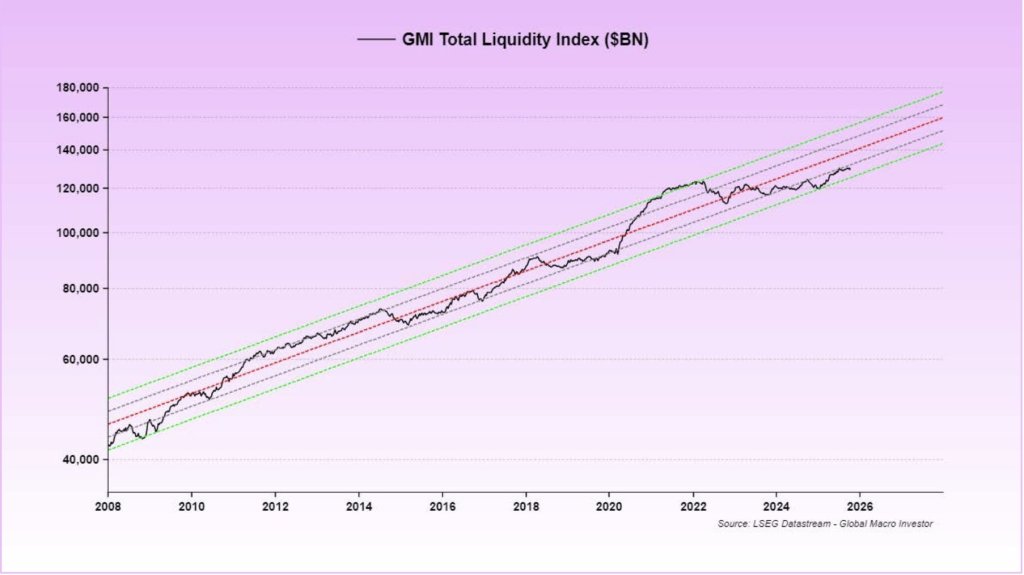
GMI Global Liquidity Index

The through-line across both perspectives is the primacy of dollar liquidity—specifically, the interaction of Treasury cash balances, Fed asset purchases or run-off, and the available stock of bank reserves after the Reverse Repo Program has largely normalized. When the TGA rises without offset, it functions as a suction pump on aggregate reserves; when it falls as the Treasury spends, reserves rebuild, the marginal cost of leverage eases, and high-beta assets—crypto first—tend to outperform.

Where does that leave the timing question implied by every red candle on crypto Twitter? Neither source offers a date, but both tether the next leg higher to the same sequence: a resolution in Washington that flips the TGA from hoarding to spending, visible easing in reserve scarcity as QT pauses or is unwound, a swerve lower in the dollar from resistance, and renewed fiscal impulse that re-steepens the growth impulse into 2026.

At press time, the total crypto market cap stood at $3.38 trillion.
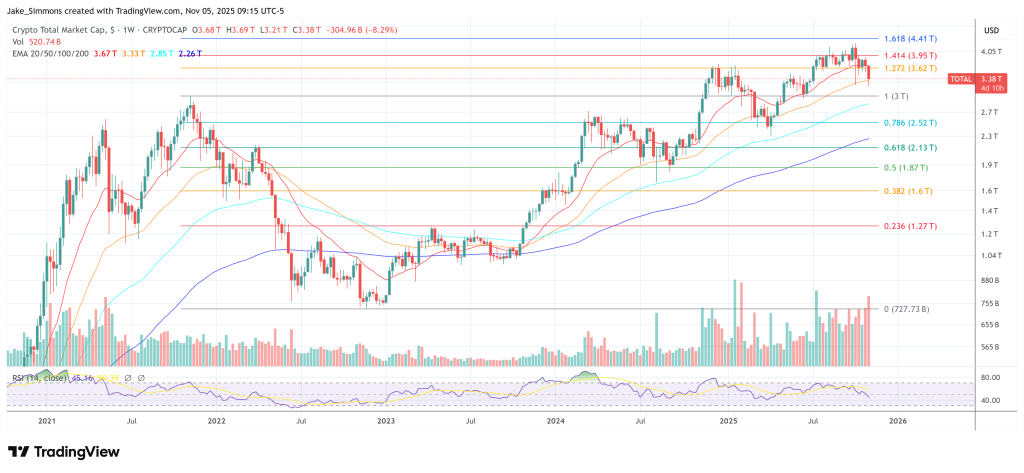
Total crypto market cap
Market Opportunity
Tron Bull Logo
Tron Bull Price(BULL)
$0.00115
$0.00115$0.00115
-5.27%
USD
Tron Bull (BULL) Live Price Chart
Disclaimer: The articles reposted on this site are sourced from public platforms and are provided for informational purposes only. They do not necessarily reflect the views of MEXC. All rights remain with the original authors. If you believe any content infringes on third-party rights, please contact service@support.mexc.com for removal. MEXC makes no guarantees regarding the accuracy, completeness, or timeliness of the content and is not responsible for any actions taken based on the information provided. The content does not constitute financial, legal, or other professional advice, nor should it be considered a recommendation or endorsement by MEXC.

You May Also Like

Will US Banks Soon Accept Stablecoin Interest?

Will US Banks Soon Accept Stablecoin Interest?

The post Will US Banks Soon Accept Stablecoin Interest? appeared on BitcoinEthereumNews.com. Coinbase CEO Brian Armstrong predicts US banks will reverse their stance
Share
BitcoinEthereumNews2025/12/27 22:36
Bitcoin Mining Crash: Bitmain Slashes Hardware Costs To Stay Afloat

Bitcoin Mining Crash: Bitmain Slashes Hardware Costs To Stay Afloat

Based on reports from industry outlets and internal pricing lists, Bitmain has sharply reduced the asking prices for several of its Bitcoin ASIC models, a move
Share
Bitcoinist2025/12/27 21:00
BlackRock boosts AI and US equity exposure in $185 billion models

BlackRock boosts AI and US equity exposure in $185 billion models

The post BlackRock boosts AI and US equity exposure in $185 billion models appeared on BitcoinEthereumNews.com. BlackRock is steering $185 billion worth of model portfolios deeper into US stocks and artificial intelligence. The decision came this week as the asset manager adjusted its entire model suite, increasing its equity allocation and dumping exposure to international developed markets. The firm now sits 2% overweight on stocks, after money moved between several of its biggest exchange-traded funds. This wasn’t a slow shuffle. Billions flowed across multiple ETFs on Tuesday as BlackRock executed the realignment. The iShares S&P 100 ETF (OEF) alone brought in $3.4 billion, the largest single-day haul in its history. The iShares Core S&P 500 ETF (IVV) collected $2.3 billion, while the iShares US Equity Factor Rotation Active ETF (DYNF) added nearly $2 billion. The rebalancing triggered swift inflows and outflows that realigned investor exposure on the back of performance data and macroeconomic outlooks. BlackRock raises equities on strong US earnings The model updates come as BlackRock backs the rally in American stocks, fueled by strong earnings and optimism around rate cuts. In an investment letter obtained by Bloomberg, the firm said US companies have delivered 11% earnings growth since the third quarter of 2024. Meanwhile, earnings across other developed markets barely touched 2%. That gap helped push the decision to drop international holdings in favor of American ones. Michael Gates, lead portfolio manager for BlackRock’s Target Allocation ETF model portfolio suite, said the US market is the only one showing consistency in sales growth, profit delivery, and revisions in analyst forecasts. “The US equity market continues to stand alone in terms of earnings delivery, sales growth and sustainable trends in analyst estimates and revisions,” Michael wrote. He added that non-US developed markets lagged far behind, especially when it came to sales. This week’s changes reflect that position. The move was made ahead of the Federal…
Share
BitcoinEthereumNews2025/09/18 01:44