Circle, the issuer of the world’s second-largest stablecoin, USDC, has reversed a controversial policy that prohibited firearm purchases, following weeks of political pressure and public criticism from gun rights groups and Republican lawmakers. The company confirmed that it has updated its terms of service to permit lawful transactions involving firearms, after the National Shooting Sports Foundation (NSSF), a major firearms trade association, challenged what it described as “financial discrimination” against lawful commerce. “Circle has clarified our Terms to reflect that USDC may be used for the lawful purchase and sale of firearms, as protected under the Second Amendment,” a Circle spokesperson told the NSSF. “We have not and will not deny the use of USDC for legally permissible transactions involving firearms.”Source: NSSF Circle Aligns USDC Policy With GENIUS Act Stablecoin Framework The reversal comes after Americans for Tax Reform (ATR), a conservative advocacy group, published a report last month revealing that Circle’s terms prohibited transactions involving “weapons of any kind, including firearms, ammunition, knives, or explosives.” ATR argued that the ban highlighted the risk of private financial intermediaries restricting lawful transactions based on political bias. The group also pointed to campaign donations made by Circle CEO Jeremy Allaire to Democratic politicians, including Rep. Jake Auchincloss (D-MA), who has sponsored gun control legislation. The clause, which went largely unnoticed until recently, stated that using USDC for “weapons of any kind” violated the company’s prohibited transactions policy. Circle reserved the right to monitor and block such activity, potentially suspending accounts that violated the terms. Following ATR’s report, the NSSF accused Circle of engaging in “ideological enforcement” against gun owners and retailers. “Freedom cannot survive if your financial tools are turned against you and your Second Amendment rights,” the organization said in a statement. The group compared Circle’s actions to historical “Operation Choke Point”-style practices, in which U.S. regulators were accused of pressuring banks to deny services to politically disfavored industries. The policy quickly drew attention in Washington, with several Republican lawmakers citing it as evidence of “financial weaponization.” Senator Bill Hagerty (R-TN), author of the recently enacted GENIUS Act stablecoin framework, said the reversal marked “a victory against Choke Point-inspired mechanisms to achieve partisan goals.” “America will no longer tolerate discrimination against citizens who are exercising their constitutional rights.” Senator Cynthia Lummis (R-WY), another co-sponsor of the GENIUS Act, praised Circle’s decision, saying it “aligns its terms of service with existing legal requirements and ensures financial systems cannot be used against law-abiding gun owners.” Circle’s Policy U-Turn Exposes a Key Stablecoin Dilemma Circle’s update, which now only prohibits weapons purchases “in contravention of applicable laws,” comes at a time when stablecoins are gaining unprecedented influence in the U.S. financial system. With USDC’s market capitalization hovering around $75 billion, Circle has become one of the most significant players in digital finance. The company went public in June, raising over $1 billion through its initial public offering on the New York Stock Exchange.Source: DefiLlama Stablecoins have also surged in mainstream adoption since President Donald Trump signed the GENIUS Act into law in July, establishing a federal framework for their issuance and oversight. The law’s passage triggered a wave of new stablecoin initiatives from major financial institutions, including Bank of America, Morgan Stanley, and Robinhood. Yet Circle’s controversy has drawn parallels to the same issues critics have raised about government-backed digital currencies. ATR’s report compared Circle’s original restrictions to potential central bank digital currency (CBDC) controls, warning that private firms could similarly “monitor and censor” transactions under political influence. The NSSF called Circle’s reversal “a welcome sign” that private companies are beginning to recognize the dangers of financial biasCircle, the issuer of the world’s second-largest stablecoin, USDC, has reversed a controversial policy that prohibited firearm purchases, following weeks of political pressure and public criticism from gun rights groups and Republican lawmakers. The company confirmed that it has updated its terms of service to permit lawful transactions involving firearms, after the National Shooting Sports Foundation (NSSF), a major firearms trade association, challenged what it described as “financial discrimination” against lawful commerce. “Circle has clarified our Terms to reflect that USDC may be used for the lawful purchase and sale of firearms, as protected under the Second Amendment,” a Circle spokesperson told the NSSF. “We have not and will not deny the use of USDC for legally permissible transactions involving firearms.”Source: NSSF Circle Aligns USDC Policy With GENIUS Act Stablecoin Framework The reversal comes after Americans for Tax Reform (ATR), a conservative advocacy group, published a report last month revealing that Circle’s terms prohibited transactions involving “weapons of any kind, including firearms, ammunition, knives, or explosives.” ATR argued that the ban highlighted the risk of private financial intermediaries restricting lawful transactions based on political bias. The group also pointed to campaign donations made by Circle CEO Jeremy Allaire to Democratic politicians, including Rep. Jake Auchincloss (D-MA), who has sponsored gun control legislation. The clause, which went largely unnoticed until recently, stated that using USDC for “weapons of any kind” violated the company’s prohibited transactions policy. Circle reserved the right to monitor and block such activity, potentially suspending accounts that violated the terms. Following ATR’s report, the NSSF accused Circle of engaging in “ideological enforcement” against gun owners and retailers. “Freedom cannot survive if your financial tools are turned against you and your Second Amendment rights,” the organization said in a statement. The group compared Circle’s actions to historical “Operation Choke Point”-style practices, in which U.S. regulators were accused of pressuring banks to deny services to politically disfavored industries. The policy quickly drew attention in Washington, with several Republican lawmakers citing it as evidence of “financial weaponization.” Senator Bill Hagerty (R-TN), author of the recently enacted GENIUS Act stablecoin framework, said the reversal marked “a victory against Choke Point-inspired mechanisms to achieve partisan goals.” “America will no longer tolerate discrimination against citizens who are exercising their constitutional rights.” Senator Cynthia Lummis (R-WY), another co-sponsor of the GENIUS Act, praised Circle’s decision, saying it “aligns its terms of service with existing legal requirements and ensures financial systems cannot be used against law-abiding gun owners.” Circle’s Policy U-Turn Exposes a Key Stablecoin Dilemma Circle’s update, which now only prohibits weapons purchases “in contravention of applicable laws,” comes at a time when stablecoins are gaining unprecedented influence in the U.S. financial system. With USDC’s market capitalization hovering around $75 billion, Circle has become one of the most significant players in digital finance. The company went public in June, raising over $1 billion through its initial public offering on the New York Stock Exchange.Source: DefiLlama Stablecoins have also surged in mainstream adoption since President Donald Trump signed the GENIUS Act into law in July, establishing a federal framework for their issuance and oversight. The law’s passage triggered a wave of new stablecoin initiatives from major financial institutions, including Bank of America, Morgan Stanley, and Robinhood. Yet Circle’s controversy has drawn parallels to the same issues critics have raised about government-backed digital currencies. ATR’s report compared Circle’s original restrictions to potential central bank digital currency (CBDC) controls, warning that private firms could similarly “monitor and censor” transactions under political influence. The NSSF called Circle’s reversal “a welcome sign” that private companies are beginning to recognize the dangers of financial bias

Circle Caves to Political Pressure, Reverses USDC Gun Purchasing Ban

Circle, the issuer of the world’s second-largest stablecoin, USDC, has reversed a controversial policy that prohibited firearm purchases, following weeks of political pressure and public criticism from gun rights groups and Republican lawmakers.

The company confirmed that it has updated its terms of service to permit lawful transactions involving firearms, after the National Shooting Sports Foundation (NSSF), a major firearms trade association, challenged what it described as “financial discrimination” against lawful commerce.

“Circle has clarified our Terms to reflect that USDC may be used for the lawful purchase and sale of firearms, as protected under the Second Amendment,” a Circle spokesperson told the NSSF. “We have not and will not deny the use of USDC for legally permissible transactions involving firearms.”
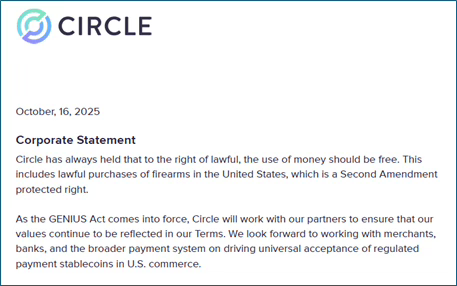
Source: NSSF

Circle Aligns USDC Policy With GENIUS Act Stablecoin Framework

The reversal comes after Americans for Tax Reform (ATR), a conservative advocacy group, published a report last month revealing that Circle’s terms prohibited transactions involving “weapons of any kind, including firearms, ammunition, knives, or explosives.”

ATR argued that the ban highlighted the risk of private financial intermediaries restricting lawful transactions based on political bias. The group also pointed to campaign donations made by Circle CEO Jeremy Allaire to Democratic politicians, including Rep. Jake Auchincloss (D-MA), who has sponsored gun control legislation.

The clause, which went largely unnoticed until recently, stated that using USDC for “weapons of any kind” violated the company’s prohibited transactions policy.

Circle reserved the right to monitor and block such activity, potentially suspending accounts that violated the terms.

Following ATR’s report, the NSSF accused Circle of engaging in “ideological enforcement” against gun owners and retailers. “Freedom cannot survive if your financial tools are turned against you and your Second Amendment rights,” the organization said in a statement.

The group compared Circle’s actions to historical “Operation Choke Point”-style practices, in which U.S. regulators were accused of pressuring banks to deny services to politically disfavored industries.

The policy quickly drew attention in Washington, with several Republican lawmakers citing it as evidence of “financial weaponization.”

Senator Bill Hagerty (R-TN), author of the recently enacted GENIUS Act stablecoin framework, said the reversal marked “a victory against Choke Point-inspired mechanisms to achieve partisan goals.”

“America will no longer tolerate discrimination against citizens who are exercising their constitutional rights.”

Senator Cynthia Lummis (R-WY), another co-sponsor of the GENIUS Act, praised Circle’s decision, saying it “aligns its terms of service with existing legal requirements and ensures financial systems cannot be used against law-abiding gun owners.”

Circle’s Policy U-Turn Exposes a Key Stablecoin Dilemma

Circle’s update, which now only prohibits weapons purchases “in contravention of applicable laws,” comes at a time when stablecoins are gaining unprecedented influence in the U.S. financial system.

With USDC’s market capitalization hovering around $75 billion, Circle has become one of the most significant players in digital finance. The company went public in June, raising over $1 billion through its initial public offering on the New York Stock Exchange.

Source: DefiLlama

Stablecoins have also surged in mainstream adoption since President Donald Trump signed the GENIUS Act into law in July, establishing a federal framework for their issuance and oversight.

The law’s passage triggered a wave of new stablecoin initiatives from major financial institutions, including Bank of America, Morgan Stanley, and Robinhood.

Yet Circle’s controversy has drawn parallels to the same issues critics have raised about government-backed digital currencies.

ATR’s report compared Circle’s original restrictions to potential central bank digital currency (CBDC) controls, warning that private firms could similarly “monitor and censor” transactions under political influence.

The NSSF called Circle’s reversal “a welcome sign” that private companies are beginning to recognize the dangers of financial bias.


Market Opportunity
USDCoin Logo
USDCoin Price(USDC)
$0.9998
$0.9998$0.9998
-0.01%
USD
USDCoin (USDC) Live Price Chart
Disclaimer: The articles reposted on this site are sourced from public platforms and are provided for informational purposes only. They do not necessarily reflect the views of MEXC. All rights remain with the original authors. If you believe any content infringes on third-party rights, please contact service@support.mexc.com for removal. MEXC makes no guarantees regarding the accuracy, completeness, or timeliness of the content and is not responsible for any actions taken based on the information provided. The content does not constitute financial, legal, or other professional advice, nor should it be considered a recommendation or endorsement by MEXC.

You May Also Like

Why It Could Outperform Pepe Coin And Tron With Over $7m Already Raised

Why It Could Outperform Pepe Coin And Tron With Over $7m Already Raised

The post Why It Could Outperform Pepe Coin And Tron With Over $7m Already Raised appeared on BitcoinEthereumNews.com. Crypto News 17 September 2025 | 20:26 While meme tokens like Pepe Coin and established networks such as Tron attract headlines, many investors are now searching for projects that combine innovation, revenue-sharing and real-world utility. BlockchainFX ($BFX), currently in presale at $0.024 ahead of an expected $0.05 launch, is quickly becoming one of the best cryptos to buy today. With $7m already secured and a unique model spanning multiple asset classes, it is positioning itself as a decentralised super app and a contender to surpass older altcoins. Early Presale Pricing Creates A Rare Entry Point BlockchainFX’s presale pricing structure has been designed to reward early participants. At $0.024, buyers secure a lower entry price than later rounds, locking in a cost basis more than 50% below the projected $0.05 launch price. As sales continue to climb beyond $7m, each new stage automatically increases the token price. This built-in mechanism creates a clear advantage for early investors and explains why the project is increasingly cited in “best presales to buy now” discussions across the crypto space. High-Yield Staking Model Shares Platform Revenue Beyond its presale appeal, BlockchainFX is creating a high-yield staking model that gives holders a direct share of platform revenue. Every time a trade occurs on its platform, 70% of trading fees flow back into the $BFX ecosystem: 50% of collected fees are automatically distributed to stakers in both BFX and USDT. 20% is allocated to daily buybacks of $BFX, adding demand and price support. Half of the bought-back tokens are permanently burned, steadily reducing supply. Rewards are based on the size of each member’s BFX holdings and capped at $25,000 USDT per day to ensure sustainability. This structure transforms token ownership from a speculative bet into an income-generating position, a rare feature among today’s altcoins. A Multi-Asset Platform…
Share
BitcoinEthereumNews2025/09/18 03:35
FCA komt in 2026 met aangepaste cryptoregels voor Britse markt

FCA komt in 2026 met aangepaste cryptoregels voor Britse markt

De Britse financiële waakhond, de FCA, komt in 2026 met nieuwe regels speciaal voor crypto bedrijven. Wat direct opvalt: de toezichthouder laat enkele klassieke financiële verplichtingen los om beter aan te sluiten op de snelle en grillige wereld van digitale activa. Tegelijkertijd wordt er extra nadruk gelegd op digitale beveiliging,... Het bericht FCA komt in 2026 met aangepaste cryptoregels voor Britse markt verscheen het eerst op Blockchain Stories.
Share
Coinstats2025/09/18 00:33
Sui price on edge as its mainnet goes through a network stall

Sui price on edge as its mainnet goes through a network stall

Sui Coin (SUI) was trading at $1.8510, up by ~40% above the lowest level this year, and is hovering near the highest point since November.
Share
Crypto.news2026/01/15 02:44



