JPMorgan has put a numerical marker under this Bitcoin cycle, telling clients that the market’s “pain threshold” now sits near $94,000 — a level the bank frames as both a mining-economics floor and an answer to the question of how low spot can realistically trade before fundamentals start to bite. According to reporting by The Block, the analyst team led by Nikolaos Panigirtzoglou argues that “Bitcoin’s downside from current levels appears to be ‘very limited,’” because they “see its support price at around $94,000.” How Low Can Bitcoin Go? The core of the call is JPMorgan’s updated estimate of Bitcoin’s production cost. In their latest note, cited by The Block, the analysts say the all-in cost to mine one bitcoin has risen from about $92,000 to roughly $94,000 as network difficulty has surged over recent months. That jump in difficulty forces miners to deploy more hashpower per block, lifting the marginal cost per coin. The team reiterates a framework they have used in prior cycles, stressing that “the bitcoin production cost has empirically acted as a floor for bitcoin,” so a higher cost mechanically pulls the support zone higher as well. Related Reading: Bitcoin Death Cross Is Coming: Don’t Be Fooled By The Name On JPMorgan’s numbers, the ratio of spot price to production cost now sits just above 1.0, close to the lower end of its historical range. That implies miners’ operating margin is thin and that there is limited room for an extended move far below the modeled cost without triggering stress in the mining sector. From that perspective, the bank’s $94,000 level is not presented as a precise line in the sand, but as a statistically grounded region where downside risk becomes compressed because miners’ incentives to keep selling into weakness deteriorate. The same note keeps a much more optimistic medium-term scenario in place. JPMorgan reiterates a 6–12 month upside case around $170,000 per bitcoin, derived from a volatility-adjusted comparison with gold. As summarized by The Block, the analysts estimate that Bitcoin currently “consumes” around 1.8 times more risk capital than gold, yet still has a smaller market capitalization — roughly $2.1 trillion versus about $6.2 trillion in private-sector gold investment via ETFs, bars and coins. To close that gap on a volatility-adjusted basis, they calculate Bitcoin’s market cap would need to rise by about 67%, “implying a theoretical bitcoin price of close to $170,000.” Related Reading: Bitcoin Crashes To $98,000 As HODLer Selling Accelerates The Block also highlights how this view fits into JPMorgan’s recent track record of calls. In an earlier note last month, the same team argued that Bitcoin looked significantly undervalued relative to gold, implying upside toward about $165,000 by year-end. Panigirtzoglou has since dialed back the timing, telling The Block that, “it would not be realistic to expect this price target by year’s end,” given recent liquidations and very weak sentiment, and reframing $170,000 as a 6–12 month scenario rather than a near-term objective. The note further recalls an August projection around $126,000 by year-end; Bitcoin later printed an all-time high above $126,200 on Oct. 6 before a record liquidation event on Oct. 10 abruptly reset positioning. Those earlier pieces of research are consistent with a broader framework JPMorgan has been articulating publicly. In a separate analysis earlier this month, also led by Panigirtzoglou and reported by MarketWatch, the bank argued that post-October deleveraging left Bitcoin “very cheap to gold” on a volatility-adjusted basis and concluded that “this mechanical exercise thus implies significant upside for bitcoin over the next 6–12 months,” with fair value again clustering near $170,000. What the new note, as relayed by The Block, adds is a more explicit downside anchor: as long as network difficulty and energy-input assumptions keep the estimated production cost around $94,000, JPMorgan sees that level as the effective floor that answers how low Bitcoin can go before mining economics force the market to confront its constraints. At press time, BTC traded at $97,505. Featured image created with DALL.E, chart from TradingView.comJPMorgan has put a numerical marker under this Bitcoin cycle, telling clients that the market’s “pain threshold” now sits near $94,000 — a level the bank frames as both a mining-economics floor and an answer to the question of how low spot can realistically trade before fundamentals start to bite. According to reporting by The Block, the analyst team led by Nikolaos Panigirtzoglou argues that “Bitcoin’s downside from current levels appears to be ‘very limited,’” because they “see its support price at around $94,000.” How Low Can Bitcoin Go? The core of the call is JPMorgan’s updated estimate of Bitcoin’s production cost. In their latest note, cited by The Block, the analysts say the all-in cost to mine one bitcoin has risen from about $92,000 to roughly $94,000 as network difficulty has surged over recent months. That jump in difficulty forces miners to deploy more hashpower per block, lifting the marginal cost per coin. The team reiterates a framework they have used in prior cycles, stressing that “the bitcoin production cost has empirically acted as a floor for bitcoin,” so a higher cost mechanically pulls the support zone higher as well. Related Reading: Bitcoin Death Cross Is Coming: Don’t Be Fooled By The Name On JPMorgan’s numbers, the ratio of spot price to production cost now sits just above 1.0, close to the lower end of its historical range. That implies miners’ operating margin is thin and that there is limited room for an extended move far below the modeled cost without triggering stress in the mining sector. From that perspective, the bank’s $94,000 level is not presented as a precise line in the sand, but as a statistically grounded region where downside risk becomes compressed because miners’ incentives to keep selling into weakness deteriorate. The same note keeps a much more optimistic medium-term scenario in place. JPMorgan reiterates a 6–12 month upside case around $170,000 per bitcoin, derived from a volatility-adjusted comparison with gold. As summarized by The Block, the analysts estimate that Bitcoin currently “consumes” around 1.8 times more risk capital than gold, yet still has a smaller market capitalization — roughly $2.1 trillion versus about $6.2 trillion in private-sector gold investment via ETFs, bars and coins. To close that gap on a volatility-adjusted basis, they calculate Bitcoin’s market cap would need to rise by about 67%, “implying a theoretical bitcoin price of close to $170,000.” Related Reading: Bitcoin Crashes To $98,000 As HODLer Selling Accelerates The Block also highlights how this view fits into JPMorgan’s recent track record of calls. In an earlier note last month, the same team argued that Bitcoin looked significantly undervalued relative to gold, implying upside toward about $165,000 by year-end. Panigirtzoglou has since dialed back the timing, telling The Block that, “it would not be realistic to expect this price target by year’s end,” given recent liquidations and very weak sentiment, and reframing $170,000 as a 6–12 month scenario rather than a near-term objective. The note further recalls an August projection around $126,000 by year-end; Bitcoin later printed an all-time high above $126,200 on Oct. 6 before a record liquidation event on Oct. 10 abruptly reset positioning. Those earlier pieces of research are consistent with a broader framework JPMorgan has been articulating publicly. In a separate analysis earlier this month, also led by Panigirtzoglou and reported by MarketWatch, the bank argued that post-October deleveraging left Bitcoin “very cheap to gold” on a volatility-adjusted basis and concluded that “this mechanical exercise thus implies significant upside for bitcoin over the next 6–12 months,” with fair value again clustering near $170,000. What the new note, as relayed by The Block, adds is a more explicit downside anchor: as long as network difficulty and energy-input assumptions keep the estimated production cost around $94,000, JPMorgan sees that level as the effective floor that answers how low Bitcoin can go before mining economics force the market to confront its constraints. At press time, BTC traded at $97,505. Featured image created with DALL.E, chart from TradingView.com

How Low Can Bitcoin Price Go? JPMorgan Points To A Key Threshold

2025/11/14 18:00
4 min read
For feedback or concerns regarding this content, please contact us at crypto.news@mexc.com

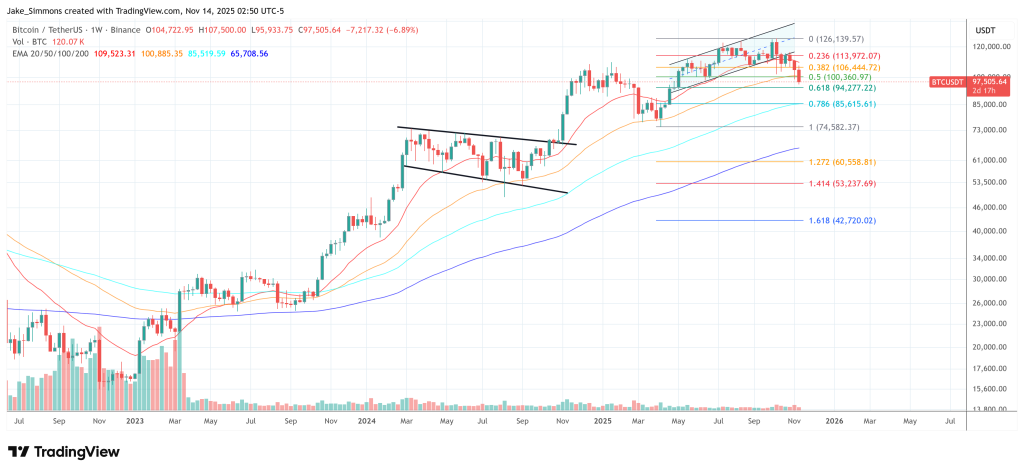
JPMorgan has put a numerical marker under this Bitcoin cycle, telling clients that the market’s “pain threshold” now sits near $94,000 — a level the bank frames as both a mining-economics floor and an answer to the question of how low spot can realistically trade before fundamentals start to bite. According to reporting by The Block, the analyst team led by Nikolaos Panigirtzoglou argues that “Bitcoin’s downside from current levels appears to be ‘very limited,’” because they “see its support price at around $94,000.”

How Low Can Bitcoin Go?

The core of the call is JPMorgan’s updated estimate of Bitcoin’s production cost. In their latest note, cited by The Block, the analysts say the all-in cost to mine one bitcoin has risen from about $92,000 to roughly $94,000 as network difficulty has surged over recent months. That jump in difficulty forces miners to deploy more hashpower per block, lifting the marginal cost per coin. The team reiterates a framework they have used in prior cycles, stressing that “the bitcoin production cost has empirically acted as a floor for bitcoin,” so a higher cost mechanically pulls the support zone higher as well.

On JPMorgan’s numbers, the ratio of spot price to production cost now sits just above 1.0, close to the lower end of its historical range. That implies miners’ operating margin is thin and that there is limited room for an extended move far below the modeled cost without triggering stress in the mining sector. From that perspective, the bank’s $94,000 level is not presented as a precise line in the sand, but as a statistically grounded region where downside risk becomes compressed because miners’ incentives to keep selling into weakness deteriorate.

The same note keeps a much more optimistic medium-term scenario in place. JPMorgan reiterates a 6–12 month upside case around $170,000 per bitcoin, derived from a volatility-adjusted comparison with gold. As summarized by The Block, the analysts estimate that Bitcoin currently “consumes” around 1.8 times more risk capital than gold, yet still has a smaller market capitalization — roughly $2.1 trillion versus about $6.2 trillion in private-sector gold investment via ETFs, bars and coins. To close that gap on a volatility-adjusted basis, they calculate Bitcoin’s market cap would need to rise by about 67%, “implying a theoretical bitcoin price of close to $170,000.”

The Block also highlights how this view fits into JPMorgan’s recent track record of calls. In an earlier note last month, the same team argued that Bitcoin looked significantly undervalued relative to gold, implying upside toward about $165,000 by year-end. Panigirtzoglou has since dialed back the timing, telling The Block that, “it would not be realistic to expect this price target by year’s end,” given recent liquidations and very weak sentiment, and reframing $170,000 as a 6–12 month scenario rather than a near-term objective. The note further recalls an August projection around $126,000 by year-end; Bitcoin later printed an all-time high above $126,200 on Oct. 6 before a record liquidation event on Oct. 10 abruptly reset positioning.

Those earlier pieces of research are consistent with a broader framework JPMorgan has been articulating publicly. In a separate analysis earlier this month, also led by Panigirtzoglou and reported by MarketWatch, the bank argued that post-October deleveraging left Bitcoin “very cheap to gold” on a volatility-adjusted basis and concluded that “this mechanical exercise thus implies significant upside for bitcoin over the next 6–12 months,” with fair value again clustering near $170,000.

What the new note, as relayed by The Block, adds is a more explicit downside anchor: as long as network difficulty and energy-input assumptions keep the estimated production cost around $94,000, JPMorgan sees that level as the effective floor that answers how low Bitcoin can go before mining economics force the market to confront its constraints.

At press time, BTC traded at $97,505.

Bitcoin price
Disclaimer: The articles reposted on this site are sourced from public platforms and are provided for informational purposes only. They do not necessarily reflect the views of MEXC. All rights remain with the original authors. If you believe any content infringes on third-party rights, please contact crypto.news@mexc.com for removal. MEXC makes no guarantees regarding the accuracy, completeness, or timeliness of the content and is not responsible for any actions taken based on the information provided. The content does not constitute financial, legal, or other professional advice, nor should it be considered a recommendation or endorsement by MEXC.

You May Also Like

Tether CEO Delivers Rare Bitcoin Price Comment

Tether CEO Delivers Rare Bitcoin Price Comment

Bitcoin price receives rare acknowledgement from Tether CEO Ardoino
Share
Coinstats2025/09/17 23:39
CEO Sandeep Nailwal Shared Highlights About RWA on Polygon

CEO Sandeep Nailwal Shared Highlights About RWA on Polygon

The post CEO Sandeep Nailwal Shared Highlights About RWA on Polygon appeared on BitcoinEthereumNews.com. Polygon CEO Sandeep Nailwal highlighted Polygon’s lead in global bonds, Spiko US T-Bill, and Spiko Euro T-Bill. Polygon published an X post to share that its roadmap to GigaGas was still scaling. Sentiments around POL price were last seen to be bearish. Polygon CEO Sandeep Nailwal shared key pointers from the Dune and RWA.xyz report. These pertain to highlights about RWA on Polygon. Simultaneously, Polygon underlined its roadmap towards GigaGas. Sentiments around POL price were last seen fumbling under bearish emotions. Polygon CEO Sandeep Nailwal on Polygon RWA CEO Sandeep Nailwal highlighted three key points from the Dune and RWA.xyz report. The Chief Executive of Polygon maintained that Polygon PoS was hosting RWA TVL worth $1.13 billion across 269 assets plus 2,900 holders. Nailwal confirmed from the report that RWA was happening on Polygon. The Dune and https://t.co/W6WSFlHoQF report on RWA is out and it shows that RWA is happening on Polygon. Here are a few highlights: – Leading in Global Bonds: Polygon holds 62% share of tokenized global bonds (driven by Spiko’s euro MMF and Cashlink euro issues) – Spiko U.S.… — Sandeep | CEO, Polygon Foundation (※,※) (@sandeepnailwal) September 17, 2025 The X post published by Polygon CEO Sandeep Nailwal underlined that the ecosystem was leading in global bonds by holding a 62% share of tokenized global bonds. He further highlighted that Polygon was leading with Spiko US T-Bill at approximately 29% share of TVL along with Ethereum, adding that the ecosystem had more than 50% share in the number of holders. Finally, Sandeep highlighted from the report that there was a strong adoption for Spiko Euro T-Bill with 38% share of TVL. He added that 68% of returns were on Polygon across all the chains. Polygon Roadmap to GigaGas In a different update from Polygon, the community…
Share
BitcoinEthereumNews2025/09/18 01:10
T7X Launches Regulated Launchpad for Tokenized Real-World Asset Securities

T7X Launches Regulated Launchpad for Tokenized Real-World Asset Securities

SHERIDAN, Wyo., March  18, 2026  (GLOBE NEWSWIRE) -- T7X announces the launch of the T7X Launchpad, a digital issuance platform designed to support the crea
Share
CryptoReporter2026/03/18 20:49