After years in the wilderness, Zcash (ZEC) has staged a roughly 740% price “pump” this year, with analysts linking the move to surging demand for on-chain privacy and a cluster of high-profile endorsements. The speed and timing of the rally have ignited a heated debate on X: is Zcash’s resurgence driven by coordinated paid promotion, or by genuine improvements in its technology and monetary design? The flashpoint came from infrastructure founder Mert Mumtaz (@0xMert_), who mocked the idea that a single “mega-whale” is paying off every visible supporter. “There’s a person in crypto so rich that they are simultaneously paying off Cobie, Naval Ravikant, Balaji Srinivasan, me, Tim Ferris, [Arthur] Hayes, Gainzy, path, Ansem, the Winklevoss Twins, Toly [Yakovenko] and more. (all of whom require just one final OTC KOL deal to finally make it). Either that or I’m retarded.” there’s a person in crypto so rich that they are simultaneously paying off cobie, naval, balaji, me, tim ferris, hayes, gainzy, path, ansem, the winklevoss twins, toly and more (all of whom require just one final OTC KOL deal to finally make it) either that or I’m retarded — mert | helius.dev (@0xMert_) November 16, 2025 In a follow-up, he argued the real story is investor psychology, writing that “people would rather believe the above than admit that they sidelined themselves due to poor thinking and emotion.” Why Is Zcash Surging Now? Mert then laid out why, in his view, Zcash is rallying now: a more favorable political window for privacy coins in the US, issuance reduction, NEAR Intents that turn ZEC into a “shielded swiss vault” for one-click cross-chain payments, the default-shielding Zashi wallet with “100x better UX,” the 100x-scaling ambitions of Project Tachyon. Related Reading: Winklevoss Twins Back Zcash (ZEC) Treasury Company With $58M Investment On the long list of arguments he added the disillusionment with an increasingly institutional Bitcoin, Europe’s tightening surveillance regime, maturing zero-knowledge tech, fatigue with supply-controlled coins that were “dumped” on retail, and the broader “debasement trade” pushing investors toward alternative stores of value. He closed: “you combine all of the above with a little spark and the fire spreads fast. There is no conspiracy, just think. This is not a trade.” Skeptics see the same facts very differently. One user complained that Jordan Fish [@Cobie), a prominent UK-based crypto investor and trader, had become a “paid zcash shill,” and asked whether “all the big KOLs just randomly decided to just start shilling Zcash.” Cobie replied that his interest was not new at all: “Just started? I have been doing this almost 10 years (painfully),” resurfacing a 2017 tweet about buying ZEC if the price ever hit $0.3. When his critic apologized, Cobie turned to fundamentals: “Zcash has a lot of recent developments actually IMO. (1) One of the coolest things I have seen: Project Tachyon. (2) They fixed the brutal inflation that killed us. (3) Zcash + NEAR intents for permissionless cross-chain swaps seems to actually be working.” Zcash has a lot of recent developments actually IMO. (1) One of the coolest things I have seen: https://t.co/3wXNpugkna (2) They fixed the brutal inflation that killed us (3) Zcash + NEAR intents for permissionless cross-chain swaps seems to actually be working:… pic.twitter.com/JgVFh9Xg3T — Cobie (@cobie) November 16, 2025 Those developments are verifiable. Zcash’s engineering roadmap has advanced from experimental cryptography to production-grade systems. Project Tachyon, outlined by Zcash researcher Sean Bowe, proposes “oblivious synchronization,” a way for wallets to sync shielded notes without leaking metadata, drastically lowering latency and making large-scale shielded usage practical. Related Reading: Arthur Hayes Outlines Why Zcash Could Surge To $10,000–$20,000 Fast On the user side, the Zashi wallet has become the flagship interface, abstracting away complex shielding flows and steering users into private, shielded transactions by default. Research from Galaxy and other analysts notes that shielded supply has climbed from low single-digit percentages a few years ago to roughly a quarter of all circulating ZEC, with estimates around 30% of supply now parked in the shielded pool. Influencer activity undeniably amplifies this. Naval Ravikant’s October post, “Bitcoin is insurance against fiat. ZCash is insurance against Bitcoin,” was widely cited as an immediate catalyst for a sharp doubling in ZEC’s price and cemented the “privacy insurance” meme. The Zcash debate ultimately sits at the intersection of reflexive markets and real progress. Genuine upgrades in issuance, UX and scalability, plus a harsher global climate for financial privacy, have created a strong fundamental backdrop. Vocal advocates with large audiences have compressed years of re-rating into weeks, leaving sidelined traders searching for explanations. Whether one calls that paid promotion, organic momentum or a feedback loop of both, the current cycle shows how quickly a once-written-off privacy coin can become crypto’s latest battleground. At press time, ZEC traded at $682. Featured image created with DALL.E, chart from TradingView.comAfter years in the wilderness, Zcash (ZEC) has staged a roughly 740% price “pump” this year, with analysts linking the move to surging demand for on-chain privacy and a cluster of high-profile endorsements. The speed and timing of the rally have ignited a heated debate on X: is Zcash’s resurgence driven by coordinated paid promotion, or by genuine improvements in its technology and monetary design? The flashpoint came from infrastructure founder Mert Mumtaz (@0xMert_), who mocked the idea that a single “mega-whale” is paying off every visible supporter. “There’s a person in crypto so rich that they are simultaneously paying off Cobie, Naval Ravikant, Balaji Srinivasan, me, Tim Ferris, [Arthur] Hayes, Gainzy, path, Ansem, the Winklevoss Twins, Toly [Yakovenko] and more. (all of whom require just one final OTC KOL deal to finally make it). Either that or I’m retarded.” there’s a person in crypto so rich that they are simultaneously paying off cobie, naval, balaji, me, tim ferris, hayes, gainzy, path, ansem, the winklevoss twins, toly and more (all of whom require just one final OTC KOL deal to finally make it) either that or I’m retarded — mert | helius.dev (@0xMert_) November 16, 2025 In a follow-up, he argued the real story is investor psychology, writing that “people would rather believe the above than admit that they sidelined themselves due to poor thinking and emotion.” Why Is Zcash Surging Now? Mert then laid out why, in his view, Zcash is rallying now: a more favorable political window for privacy coins in the US, issuance reduction, NEAR Intents that turn ZEC into a “shielded swiss vault” for one-click cross-chain payments, the default-shielding Zashi wallet with “100x better UX,” the 100x-scaling ambitions of Project Tachyon. Related Reading: Winklevoss Twins Back Zcash (ZEC) Treasury Company With $58M Investment On the long list of arguments he added the disillusionment with an increasingly institutional Bitcoin, Europe’s tightening surveillance regime, maturing zero-knowledge tech, fatigue with supply-controlled coins that were “dumped” on retail, and the broader “debasement trade” pushing investors toward alternative stores of value. He closed: “you combine all of the above with a little spark and the fire spreads fast. There is no conspiracy, just think. This is not a trade.” Skeptics see the same facts very differently. One user complained that Jordan Fish [@Cobie), a prominent UK-based crypto investor and trader, had become a “paid zcash shill,” and asked whether “all the big KOLs just randomly decided to just start shilling Zcash.” Cobie replied that his interest was not new at all: “Just started? I have been doing this almost 10 years (painfully),” resurfacing a 2017 tweet about buying ZEC if the price ever hit $0.3. When his critic apologized, Cobie turned to fundamentals: “Zcash has a lot of recent developments actually IMO. (1) One of the coolest things I have seen: Project Tachyon. (2) They fixed the brutal inflation that killed us. (3) Zcash + NEAR intents for permissionless cross-chain swaps seems to actually be working.” Zcash has a lot of recent developments actually IMO. (1) One of the coolest things I have seen: https://t.co/3wXNpugkna (2) They fixed the brutal inflation that killed us (3) Zcash + NEAR intents for permissionless cross-chain swaps seems to actually be working:… pic.twitter.com/JgVFh9Xg3T — Cobie (@cobie) November 16, 2025 Those developments are verifiable. Zcash’s engineering roadmap has advanced from experimental cryptography to production-grade systems. Project Tachyon, outlined by Zcash researcher Sean Bowe, proposes “oblivious synchronization,” a way for wallets to sync shielded notes without leaking metadata, drastically lowering latency and making large-scale shielded usage practical. Related Reading: Arthur Hayes Outlines Why Zcash Could Surge To $10,000–$20,000 Fast On the user side, the Zashi wallet has become the flagship interface, abstracting away complex shielding flows and steering users into private, shielded transactions by default. Research from Galaxy and other analysts notes that shielded supply has climbed from low single-digit percentages a few years ago to roughly a quarter of all circulating ZEC, with estimates around 30% of supply now parked in the shielded pool. Influencer activity undeniably amplifies this. Naval Ravikant’s October post, “Bitcoin is insurance against fiat. ZCash is insurance against Bitcoin,” was widely cited as an immediate catalyst for a sharp doubling in ZEC’s price and cemented the “privacy insurance” meme. The Zcash debate ultimately sits at the intersection of reflexive markets and real progress. Genuine upgrades in issuance, UX and scalability, plus a harsher global climate for financial privacy, have created a strong fundamental backdrop. Vocal advocates with large audiences have compressed years of re-rating into weeks, leaving sidelined traders searching for explanations. Whether one calls that paid promotion, organic momentum or a feedback loop of both, the current cycle shows how quickly a once-written-off privacy coin can become crypto’s latest battleground. At press time, ZEC traded at $682. Featured image created with DALL.E, chart from TradingView.com
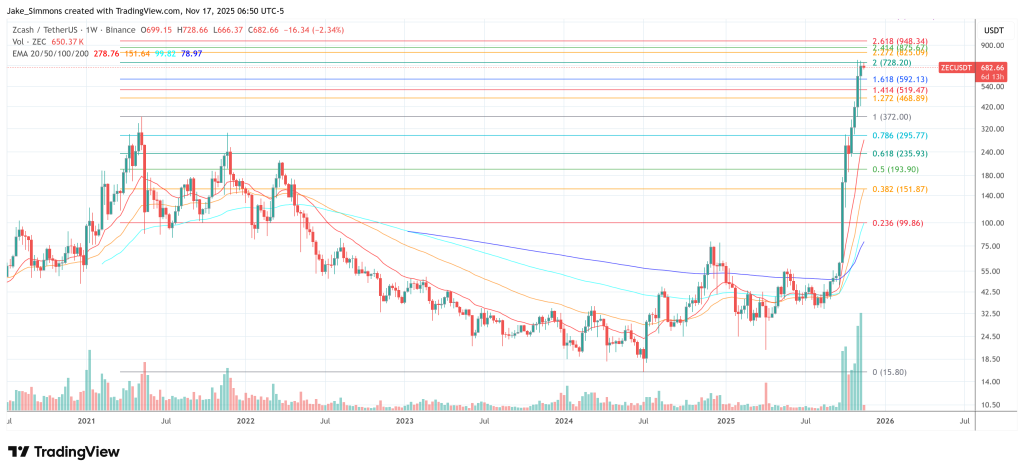
After years in the wilderness, Zcash (ZEC) has staged a roughly 740% price “pump” this year, with analysts linking the move to surging demand for on-chain privacy and a cluster of high-profile endorsements. The speed and timing of the rally have ignited a heated debate on X: is Zcash’s resurgence driven by coordinated paid promotion, or by genuine improvements in its technology and monetary design?
The flashpoint came from infrastructure founder Mert Mumtaz (@0xMert_), who mocked the idea that a single “mega-whale” is paying off every visible supporter. “There’s a person in crypto so rich that they are simultaneously paying off Cobie, Naval Ravikant, Balaji Srinivasan, me, Tim Ferris, [Arthur] Hayes, Gainzy, path, Ansem, the Winklevoss Twins, Toly [Yakovenko] and more. (all of whom require just one final OTC KOL deal to finally make it). Either that or I’m retarded.”
In a follow-up, he argued the real story is investor psychology, writing that “people would rather believe the above than admit that they sidelined themselves due to poor thinking and emotion.”
Why Is Zcash Surging Now?
Mert then laid out why, in his view, Zcash is rallying now: a more favorable political window for privacy coins in the US, issuance reduction, NEAR Intents that turn ZEC into a “shielded swiss vault” for one-click cross-chain payments, the default-shielding Zashi wallet with “100x better UX,” the 100x-scaling ambitions of Project Tachyon.
On the long list of arguments he added the disillusionment with an increasingly institutional Bitcoin, Europe’s tightening surveillance regime, maturing zero-knowledge tech, fatigue with supply-controlled coins that were “dumped” on retail, and the broader “debasement trade” pushing investors toward alternative stores of value. He closed: “you combine all of the above with a little spark and the fire spreads fast. There is no conspiracy, just think. This is not a trade.”
Skeptics see the same facts very differently. One user complained that Jordan Fish [@Cobie), a prominent UK-based crypto investor and trader, had become a “paid zcash shill,” and asked whether “all the big KOLs just randomly decided to just start shilling Zcash.”
Cobie replied that his interest was not new at all: “Just started? I have been doing this almost 10 years (painfully),” resurfacing a 2017 tweet about buying ZEC if the price ever hit $0.3. When his critic apologized, Cobie turned to fundamentals: “Zcash has a lot of recent developments actually IMO. (1) One of the coolest things I have seen: Project Tachyon. (2) They fixed the brutal inflation that killed us. (3) Zcash + NEAR intents for permissionless cross-chain swaps seems to actually be working.”
Those developments are verifiable. Zcash’s engineering roadmap has advanced from experimental cryptography to production-grade systems. Project Tachyon, outlined by Zcash researcher Sean Bowe, proposes “oblivious synchronization,” a way for wallets to sync shielded notes without leaking metadata, drastically lowering latency and making large-scale shielded usage practical.
On the user side, the Zashi wallet has become the flagship interface, abstracting away complex shielding flows and steering users into private, shielded transactions by default. Research from Galaxy and other analysts notes that shielded supply has climbed from low single-digit percentages a few years ago to roughly a quarter of all circulating ZEC, with estimates around 30% of supply now parked in the shielded pool.
Influencer activity undeniably amplifies this. Naval Ravikant’s October post, “Bitcoin is insurance against fiat. ZCash is insurance against Bitcoin,” was widely cited as an immediate catalyst for a sharp doubling in ZEC’s price and cemented the “privacy insurance” meme.
The Zcash debate ultimately sits at the intersection of reflexive markets and real progress. Genuine upgrades in issuance, UX and scalability, plus a harsher global climate for financial privacy, have created a strong fundamental backdrop.
Vocal advocates with large audiences have compressed years of re-rating into weeks, leaving sidelined traders searching for explanations. Whether one calls that paid promotion, organic momentum or a feedback loop of both, the current cycle shows how quickly a once-written-off privacy coin can become crypto’s latest battleground.
At press time, ZEC traded at $682.
Market Opportunity
RealLink (REAL) Live Price Chart
Disclaimer: The articles reposted on this site are sourced from public platforms and are provided for informational purposes only. They do not necessarily reflect the views of MEXC. All rights remain with the original authors. If you believe any content infringes on third-party rights, please contact
crypto.news@mexc.com for removal. MEXC makes no guarantees regarding the accuracy, completeness, or timeliness of the content and is not responsible for any actions taken based on the information provided. The content does not constitute financial, legal, or other professional advice, nor should it be considered a recommendation or endorsement by MEXC.