XRP is facing one of its most challenging moments in recent months as selling pressure accelerates and the broader crypto market slips into a risk-off environment. Bitcoin’s collapse below key psychological levels has dragged altcoins with it, and XRP has not been spared. Analysts are increasingly warning that the market may be entering a bear phase, pointing to tightening liquidity conditions, rising global economic uncertainty, and a sharp decline in investor appetite for risk assets. Related Reading: Ethereum Approaches Historical Accumulation Level – Just 8% Away From LTH Cost Basis What makes XRP’s situation more fragile is the growing number of holders sitting on unrealized losses. On-chain data reveals that many late buyers — particularly those who entered after the ETF announcement and during the previous rally — are now underwater as the price continues to slide. This top-heavy market structure is creating pressure on holders, amplifying sell-side momentum as fear spreads. The macro backdrop is adding fuel to the fire. With global markets adjusting to rate volatility, geopolitical tensions, and tightening dollar liquidity, capital is flowing out of speculative assets. XRP’s price is now caught at a crossroads: either it stabilizes at key support zones and absorbs the panic selling, or a deeper correction unfolds. XRP Supply in Profit Signals Structural Fragility According to new data from Glassnode, XRP’s market structure is weakening significantly as the latest sell-off unfolds. The share of XRP supply currently in profit has fallen to 58.5%, marking its lowest reading since November 2024, when XRP traded at just $0.53. Despite today’s far higher price — around $2.15, nearly four times last year’s level — an alarming 41.5% of the circulating supply remains at a loss. That represents roughly 26.5 billion XRP sitting underwater. This divergence highlights a critical issue: the market has become top-heavy, dominated by investors who entered late into the rally and bought at elevated price levels. These holders are now feeling acute pressure as prices retrace. Making the XRP supply distribution more fragile and increasing the probability of panic-driven selling. Historically, such setups often lead to accelerated downside movement unless strong demand steps in. The fact that so much supply is in the red even at current elevated prices suggests that speculative flows, rather than long-term conviction, fueled the previous surge. As these late buyers face losses, sell pressure can intensify, feeding into a vicious cycle of liquidation. Related Reading: $14B In Stablecoins Minted Since October Crash: Liquidity Returning To Crypto XRP Price Analysis: Testing Critical Support Levels XRP continues to struggle as selling pressure intensifies, with the chart showing a clear downtrend forming since early October. The price is now trading around $2.18, hovering just above a key horizontal support zone that has been tested multiple times throughout the year. Each bounce from this region has grown weaker, suggesting diminishing buyer strength and rising vulnerability to a deeper breakdown. The moving averages reinforce this weakening structure. XRP is trading below the 50-day, 100-day, and 200-day MAs, with all three beginning to curl downward. A classic sign of trend deterioration. The failed attempt to reclaim the 50-day MA in early November marked a significant shift, as sellers quickly regained control and pushed the price lower. Volume spikes during downswings further confirm that distribution is ongoing. Related Reading: Ethereum Whale Expands Position By 36,437 ETH – Bringing Total To $1.34B Additionally, the lower highs forming since the September peak signal that bulls are losing momentum. Each rally attempt is being sold into faster, and the wick rejections near the $2.50–$2.60 region highlight strong overhead resistance. If XRP loses the current support band, the next liquidity pocket sits near $1.70–$1.80, where buyers previously defended aggressively. Featured image from ChatGPT, chart from TradingView.comXRP is facing one of its most challenging moments in recent months as selling pressure accelerates and the broader crypto market slips into a risk-off environment. Bitcoin’s collapse below key psychological levels has dragged altcoins with it, and XRP has not been spared. Analysts are increasingly warning that the market may be entering a bear phase, pointing to tightening liquidity conditions, rising global economic uncertainty, and a sharp decline in investor appetite for risk assets. Related Reading: Ethereum Approaches Historical Accumulation Level – Just 8% Away From LTH Cost Basis What makes XRP’s situation more fragile is the growing number of holders sitting on unrealized losses. On-chain data reveals that many late buyers — particularly those who entered after the ETF announcement and during the previous rally — are now underwater as the price continues to slide. This top-heavy market structure is creating pressure on holders, amplifying sell-side momentum as fear spreads. The macro backdrop is adding fuel to the fire. With global markets adjusting to rate volatility, geopolitical tensions, and tightening dollar liquidity, capital is flowing out of speculative assets. XRP’s price is now caught at a crossroads: either it stabilizes at key support zones and absorbs the panic selling, or a deeper correction unfolds. XRP Supply in Profit Signals Structural Fragility According to new data from Glassnode, XRP’s market structure is weakening significantly as the latest sell-off unfolds. The share of XRP supply currently in profit has fallen to 58.5%, marking its lowest reading since November 2024, when XRP traded at just $0.53. Despite today’s far higher price — around $2.15, nearly four times last year’s level — an alarming 41.5% of the circulating supply remains at a loss. That represents roughly 26.5 billion XRP sitting underwater. This divergence highlights a critical issue: the market has become top-heavy, dominated by investors who entered late into the rally and bought at elevated price levels. These holders are now feeling acute pressure as prices retrace. Making the XRP supply distribution more fragile and increasing the probability of panic-driven selling. Historically, such setups often lead to accelerated downside movement unless strong demand steps in. The fact that so much supply is in the red even at current elevated prices suggests that speculative flows, rather than long-term conviction, fueled the previous surge. As these late buyers face losses, sell pressure can intensify, feeding into a vicious cycle of liquidation. Related Reading: $14B In Stablecoins Minted Since October Crash: Liquidity Returning To Crypto XRP Price Analysis: Testing Critical Support Levels XRP continues to struggle as selling pressure intensifies, with the chart showing a clear downtrend forming since early October. The price is now trading around $2.18, hovering just above a key horizontal support zone that has been tested multiple times throughout the year. Each bounce from this region has grown weaker, suggesting diminishing buyer strength and rising vulnerability to a deeper breakdown. The moving averages reinforce this weakening structure. XRP is trading below the 50-day, 100-day, and 200-day MAs, with all three beginning to curl downward. A classic sign of trend deterioration. The failed attempt to reclaim the 50-day MA in early November marked a significant shift, as sellers quickly regained control and pushed the price lower. Volume spikes during downswings further confirm that distribution is ongoing. Related Reading: Ethereum Whale Expands Position By 36,437 ETH – Bringing Total To $1.34B Additionally, the lower highs forming since the September peak signal that bulls are losing momentum. Each rally attempt is being sold into faster, and the wick rejections near the $2.50–$2.60 region highlight strong overhead resistance. If XRP loses the current support band, the next liquidity pocket sits near $1.70–$1.80, where buyers previously defended aggressively. Featured image from ChatGPT, chart from TradingView.com

XRP Supply In Profit Falls to 58.5% – Lowest Since 2024 Despite Higher Price

2025/11/19 06:00

XRP is facing one of its most challenging moments in recent months as selling pressure accelerates and the broader crypto market slips into a risk-off environment. Bitcoin’s collapse below key psychological levels has dragged altcoins with it, and XRP has not been spared. Analysts are increasingly warning that the market may be entering a bear phase, pointing to tightening liquidity conditions, rising global economic uncertainty, and a sharp decline in investor appetite for risk assets.

What makes XRP’s situation more fragile is the growing number of holders sitting on unrealized losses. On-chain data reveals that many late buyers — particularly those who entered after the ETF announcement and during the previous rally — are now underwater as the price continues to slide. This top-heavy market structure is creating pressure on holders, amplifying sell-side momentum as fear spreads.

The macro backdrop is adding fuel to the fire. With global markets adjusting to rate volatility, geopolitical tensions, and tightening dollar liquidity, capital is flowing out of speculative assets. XRP’s price is now caught at a crossroads: either it stabilizes at key support zones and absorbs the panic selling, or a deeper correction unfolds.

XRP Supply in Profit Signals Structural Fragility

According to new data from Glassnode, XRP’s market structure is weakening significantly as the latest sell-off unfolds. The share of XRP supply currently in profit has fallen to 58.5%, marking its lowest reading since November 2024, when XRP traded at just $0.53. Despite today’s far higher price — around $2.15, nearly four times last year’s level — an alarming 41.5% of the circulating supply remains at a loss. That represents roughly 26.5 billion XRP sitting underwater.
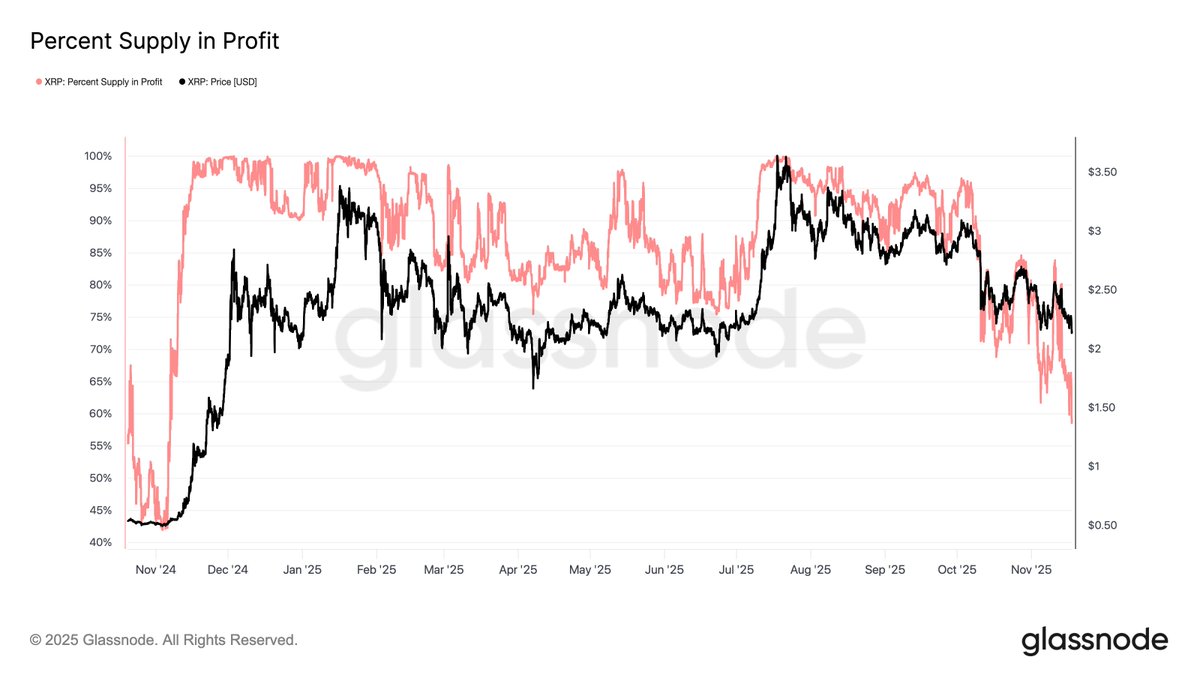
XRP Percent Supply in Profit | Source: Glassnode

This divergence highlights a critical issue: the market has become top-heavy, dominated by investors who entered late into the rally and bought at elevated price levels. These holders are now feeling acute pressure as prices retrace. Making the XRP supply distribution more fragile and increasing the probability of panic-driven selling. Historically, such setups often lead to accelerated downside movement unless strong demand steps in.

The fact that so much supply is in the red even at current elevated prices suggests that speculative flows, rather than long-term conviction, fueled the previous surge. As these late buyers face losses, sell pressure can intensify, feeding into a vicious cycle of liquidation.

XRP Price Analysis: Testing Critical Support Levels

XRP continues to struggle as selling pressure intensifies, with the chart showing a clear downtrend forming since early October. The price is now trading around $2.18, hovering just above a key horizontal support zone that has been tested multiple times throughout the year. Each bounce from this region has grown weaker, suggesting diminishing buyer strength and rising vulnerability to a deeper breakdown.

XRP testing critical demand level | Source: XRPUSDT chart on TradingView

The moving averages reinforce this weakening structure. XRP is trading below the 50-day, 100-day, and 200-day MAs, with all three beginning to curl downward. A classic sign of trend deterioration. The failed attempt to reclaim the 50-day MA in early November marked a significant shift, as sellers quickly regained control and pushed the price lower. Volume spikes during downswings further confirm that distribution is ongoing.

Additionally, the lower highs forming since the September peak signal that bulls are losing momentum. Each rally attempt is being sold into faster, and the wick rejections near the $2.50–$2.60 region highlight strong overhead resistance. If XRP loses the current support band, the next liquidity pocket sits near $1.70–$1.80, where buyers previously defended aggressively.

Featured image from ChatGPT, chart from TradingView.com

Market Opportunity
XRP Logo
XRP Price(XRP)
$2.0445
$2.0445$2.0445
+0.58%
USD
XRP (XRP) Live Price Chart
Disclaimer: The articles reposted on this site are sourced from public platforms and are provided for informational purposes only. They do not necessarily reflect the views of MEXC. All rights remain with the original authors. If you believe any content infringes on third-party rights, please contact service@support.mexc.com for removal. MEXC makes no guarantees regarding the accuracy, completeness, or timeliness of the content and is not responsible for any actions taken based on the information provided. The content does not constitute financial, legal, or other professional advice, nor should it be considered a recommendation or endorsement by MEXC.

You May Also Like

Shocking OpenVPP Partnership Claim Draws Urgent Scrutiny

Shocking OpenVPP Partnership Claim Draws Urgent Scrutiny

The post Shocking OpenVPP Partnership Claim Draws Urgent Scrutiny appeared on BitcoinEthereumNews.com. The cryptocurrency world is buzzing with a recent controversy surrounding a bold OpenVPP partnership claim. This week, OpenVPP (OVPP) announced what it presented as a significant collaboration with the U.S. government in the innovative field of energy tokenization. However, this claim quickly drew the sharp eye of on-chain analyst ZachXBT, who highlighted a swift and official rebuttal that has sent ripples through the digital asset community. What Sparked the OpenVPP Partnership Claim Controversy? The core of the issue revolves around OpenVPP’s assertion of a U.S. government partnership. This kind of collaboration would typically be a monumental endorsement for any private cryptocurrency project, especially given the current regulatory climate. Such a partnership could signify a new era of mainstream adoption and legitimacy for energy tokenization initiatives. OpenVPP initially claimed cooperation with the U.S. government. This alleged partnership was said to be in the domain of energy tokenization. The announcement generated considerable interest and discussion online. ZachXBT, known for his diligent on-chain investigations, was quick to flag the development. He brought attention to the fact that U.S. Securities and Exchange Commission (SEC) Commissioner Hester Peirce had directly addressed the OpenVPP partnership claim. Her response, delivered within hours, was unequivocal and starkly contradicted OpenVPP’s narrative. How Did Regulatory Authorities Respond to the OpenVPP Partnership Claim? Commissioner Hester Peirce’s statement was a crucial turning point in this unfolding story. She clearly stated that the SEC, as an agency, does not engage in partnerships with private cryptocurrency projects. This response effectively dismantled the credibility of OpenVPP’s initial announcement regarding their supposed government collaboration. Peirce’s swift clarification underscores a fundamental principle of regulatory bodies: maintaining impartiality and avoiding endorsements of private entities. Her statement serves as a vital reminder to the crypto community about the official stance of government agencies concerning private ventures. Moreover, ZachXBT’s analysis…
Share
BitcoinEthereumNews2025/09/18 02:13
LMAX Group Deepens Ripple Partnership With RLUSD Collateral Rollout

LMAX Group Deepens Ripple Partnership With RLUSD Collateral Rollout

LMAX Group has revealed a multi-year partnership with Ripple to integrate traditional finance with digital asset markets. As part of the agreement, LMAX will introduce
Share
Tronweekly2026/01/16 23:00
Pastor Involved in High-Stakes Crypto Fraud

Pastor Involved in High-Stakes Crypto Fraud

A gripping tale of deception has captured the media’s spotlight, especially in foreign outlets, centering on a cryptocurrency fraud case from Denver, Colorado. Eli Regalado, a pastor, alongside his wife Kaitlyn, was convicted, but what makes this case particularly intriguing is their unconventional defense.Continue Reading:Pastor Involved in High-Stakes Crypto Fraud
Share
Coinstats2025/09/18 00:38