Kohaku’s Key Role in Ethereum’s 2025 Privacy Revolution

Ethereum continues to push the boundaries of blockchain privacy, aiming to enhance user experience without sacrificing security or compliance. As the adoption of decentralized finance (DeFi) grows and more real-world assets are tokenized, the need for robust privacy tools on Ethereum becomes more urgent. The recent introduction of Kohaku marks a significant milestone in making privacy a core feature in everyday crypto transactions, bridging the gap between powerful cryptography and user-friendly wallets.
- Kohaku is Ethereum’s new privacy toolkit, offering modular, open-source solutions for wallets to enable private transactions and better security practices.
- Vitalik Buterin emphasizes privacy as a fundamental aspect of freedom, order, and progress in the blockchain ecosystem.
- The framework is designed to integrate seamlessly with existing Ethereum privacy tools like Railgun, aiming for a more cohesive wallet architecture.
- While Kohaku enhances privacy, it also raises important questions about regulation, attack surfaces, and user experience in crypto wallets.
- Major wallet providers and DeFi projects are expected to adopt Kohaku’s standards, making privacy a default setting for everyday users.
Ethereum’s privacy paradox
When Vitalik Buterin took the stage at Devcon 2025 to demo Kohaku, he summarized Ethereum’s ongoing dilemma: robust privacy and security exist on paper, yet everyday wallet experiences remain cumbersome.
Over the past decade, Ethereum has pioneered privacy research, integrating elliptic-curve precompiles in 2018 to facilitate zero-knowledge proofs and developing tools like Tornado Cash. The ecosystem has emphasized audit standards and multisignature wallets, transforming advanced cryptographic techniques into practical security measures.
However, in 2025, typical user experiences are still marred by seed phrases, specialized wallets, dependency on centralized exchanges for simplicity, and inconsistent privacy controls. Kohaku aims to resolve these issues.
Edit the caption here or remove the textDid you know? The Ethereum Foundation’s new Privacy Cluster now includes around 47 members, from protocol engineers to wallet teams, all committed to making “privacy by default” a standard across the ecosystem.
Why privacy is back on the front burner in 2025
So, why is Ethereum revisiting privacy as a primary concern rather than a niche feature?
In his April essay “Why I Support Privacy,” Buterin frames privacy as essential for freedom, order, and progress:
-
It offers freedom, allowing individuals to act without constant surveillance or judgment.
-
It sustains order by concealing sensitive social and economic data, which underpin many systems.
-
It drives progress by enabling data sharing for scientific and financial advancements without turning daily life into a surveillance feed.
The rise of tokenized assets, larger DeFi positions, and decentralized identities has increased transparency needs, but also vulnerabilities. Balances, donations, and transaction histories are easier to trace, underscoring the importance of better privacy solutions like Kohaku.
With cryptography already embedded in Ethereum, the platform now needs ways to make privacy both safe and regulation-compliant to promote mainstream adoption.
What is Kohaku, in layman’s terms?
Kohaku can be described as Ethereum’s new privacy and security toolkit for wallets.
It offers developers an open-source framework, including a flexible software development kit (SDK) and a reference wallet, to embed privacy features directly into the user experience. The SDK streamlines private transactions, cryptographically secure key management, and risk-based controls—eliminating the need for builders to develop these functions from scratch.
For end users, Kohaku’s first release is a browser extension wallet based on a fork of Ambire. It supports both private and public transactions, multiple accounts per decentralized application (DApp), peer-to-peer broadcasting, and tools to obscure IP addresses and other metadata, enhancing privacy during everyday transactions.
Under the hood, Kohaku integrates with existing Ethereum privacy protocols like Railgun and Privacy Pools rather than creating a new mixer or layer-2 solution, focusing instead on building a cohesive wallet architecture that prioritizes privacy, recovery, and security from the outset.
How Kohaku works
In practice, Kohaku resembles a set of Lego bricks for constructing secure, private wallets rather than a single monolithic application.
Wallet architecture
The SDK defines practices for multi-key management, risk-based approval flows, and recovery mechanisms that do not rely solely on seed phrases. For instance, transfers exceeding a certain threshold trigger extra checks, aligning with Buterin’s advocacy for risk-aware transactions.
Opt-in shielding
Users can choose between public and private modes for each transaction. Privacy mode routes transactions through protocols like Railgun, generating unlinkable addresses. It also includes built-in tools for flagging illicit activities without compromising overall privacy, balancing transparency and confidentiality.
Network privacy
The roadmap extends privacy beyond transaction data, supporting integration with mixnets for IP obfuscation and zero-knowledge-based browsers or RPC schemes. This ensures even reading wallet balances or interacting with DApps doesn’t reveal user identities or activities.
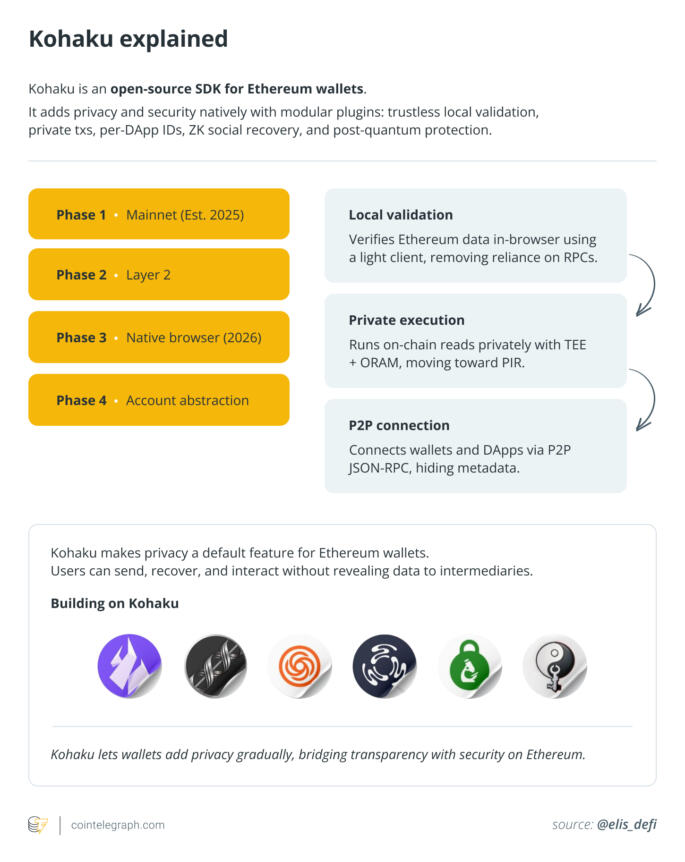 Kohaku explained
Kohaku and Ethereum’s 2025 privacy shift
Kohaku addresses a longstanding challenge: how to make everyday Ethereum use private without adding complexity.
While research has advanced cryptographic proofs, user interfaces, risk controls, and multi-signature support remain clunky, often pushing users toward centralized exchanges. Kohaku provides a shared, privacy-aware foundation for rollups and DApps, enabling consistent privacy patterns across Ethereum’s layered ecosystem.
Being core to Ethereum’s development, Kohaku’s standards could become the benchmark for wallet privacy, influencing how privacy is integrated across the network’s diverse applications.
Trade-offs, risks and open questions
Kohaku also prompts Ethereum and its community to confront several tough issues.
-
The first is the line between maximal privacy and responsible regulation. Features like association lists and auditable shielding could attract regulatory interest, but may also spark debates about privacy erosion and censorship.
-
There is a clear technical risk—managing multiple keys and controls expands the attack surface, necessitating regular audits and strict default settings.
-
User experience remains critical. If users cannot reliably distinguish private from public transactions or understand recovery options, enhanced privacy features might backfire, risking user errors or inadvertent leaks.
A new test case for privacy by design
For users, Kohaku signals that private Ethereum transactions should become straightforward rather than an optional feature.
The real challenge now is whether leading wallets will integrate Kohaku’s principles—clear privacy modes, simplified recovery, controls for large transfers—making privacy as seamless as toggling a setting.
Developers benefit from its shared infrastructure, reducing the need to rebuild cryptographic primitives and focus on enhancing decentralized application UX. Meanwhile, regulators can observe a practical implementation of privacy-by-design principles, balancing confidentiality with accountability in blockchain networks.
This article was originally published as Kohaku’s Key Role in Ethereum’s 2025 Privacy Revolution on Crypto Breaking News – your trusted source for crypto news, Bitcoin news, and blockchain updates.


You May Also Like

Data focus shifts to payrolls – Societe Generale

MEXC Chain Observation Daily Day 1