Bitcoin is trading at critical price levels as the market enters one of its most tense and uncertain stages of the year. The crypto market is showing clear signs of stress, and new data from CryptoQuant confirms that Bitcoin is now moving into one of the most severe short-term capitulation phases of this cycle. According to the latest on-chain metrics, short-term holders (STHs) are realizing losses at a scale typically seen only near major market turning points. Related Reading: XRP Supply In Profit Falls to 58.5% – Lowest Since 2024 Despite Higher Price The key indicator driving this analysis is STH-SOPR, which has plunged to deeply depressed readings around 0.97. This means STHs are selling coins at a clear loss, often driven by fear rather than strategy. Even more importantly, this metric has spent several consecutive weeks below the critical 1.0 threshold, forming what analysts refer to as a structural “capitulation band.” Historically, whenever STH-SOPR remained under 1.0 for extended periods, it signaled heavy emotional selling—typically from the most reactive and least informed market participants. These episodes have repeatedly aligned with late-stage corrections, market reversals, and shifts in long-term holder dominance. With Bitcoin now sitting at a crucial technical and psychological zone, the next phase could determine whether this becomes a deeper bear trend or a major reset before recovery. Short-Term Holders Under Extreme Stress as Capitulation Deepens According to XWIN Research on CryptoQuant, the current selloff is being amplified by the behavior of short-term holders, with the STH-MVRV ratio now sitting far below 1.0. This indicates that nearly all recent buyers are holding Bitcoin at a loss, placing short-term profitability in one of the weakest conditions in the entire dataset. Historically, these deep unrealized-loss phases are extremely rare and tend to compress selling pressure quickly, as weak hands eventually run out of coins to sell. This pattern is clearly visible in real market flows. A striking 65,200 BTC were recently sent to exchanges at a loss, showing that fear is not an abstract sentiment but is materializing in real, loss-driven capitulation. This kind of behavior aligns with classical capitulation structures: unrealized losses surge, panic selling intensifies, and eventually selling pressure becomes unsustainable. Once that happens, stronger hands begin absorbing supply quietly in the background. While this setup doesn’t guarantee an immediate rebound, the broader structure is shifting toward conditions that have historically preceded cyclical recoveries. STH losses remain at extreme levels, STH-SOPR is still below 1.0, and the pressure fueling exchange inflows is rooted in panic rather than fundamentals. Volatility is likely to persist, but the ongoing cleansing of weak hands is a process often seen near the end of major corrections — not at the start. Related Reading: Galaxy Digital Dumps 2,800 BTC as Bitcoin Crashes Below $90K Testing Weekly Support as Momentum Weakens Bitcoin’s weekly chart shows the market approaching a critical turning point as price trades just above $91,000 following a sharp multi-week decline. The recent breakdown from the $110,000–$105,000 range has confirmed a loss of bullish momentum, with sellers gaining control and pushing BTC toward its next major weekly support cluster near the 50-week moving average around $88,000–$90,000. This zone has historically acted as a key pivot level, often signaling whether a corrective phase deepens or stabilizes. Volume adds important context. The past several weekly candles show rising sell-side activity, reflecting panic-driven exits rather than orderly distribution. However, this surge in volume also indicates that the market may be approaching a capitulation threshold, where forced selling begins to exhaust itself — a setup often seen before stronger hands step in. Related Reading: Ethereum Approaches Historical Accumulation Level – Just 8% Away From LTH Cost Basis Structurally, Bitcoin is still trading above the 100-week and 200-week moving averages, both of which continue to trend upward. This suggests the aggressive downside move has not yet broken the broader macrotrend. But the loss of mid-term support levels and the sustained downward pressure highlight a market struggling to find confidence. Featured image from ChatGPT, chart from TradingView.comBitcoin is trading at critical price levels as the market enters one of its most tense and uncertain stages of the year. The crypto market is showing clear signs of stress, and new data from CryptoQuant confirms that Bitcoin is now moving into one of the most severe short-term capitulation phases of this cycle. According to the latest on-chain metrics, short-term holders (STHs) are realizing losses at a scale typically seen only near major market turning points. Related Reading: XRP Supply In Profit Falls to 58.5% – Lowest Since 2024 Despite Higher Price The key indicator driving this analysis is STH-SOPR, which has plunged to deeply depressed readings around 0.97. This means STHs are selling coins at a clear loss, often driven by fear rather than strategy. Even more importantly, this metric has spent several consecutive weeks below the critical 1.0 threshold, forming what analysts refer to as a structural “capitulation band.” Historically, whenever STH-SOPR remained under 1.0 for extended periods, it signaled heavy emotional selling—typically from the most reactive and least informed market participants. These episodes have repeatedly aligned with late-stage corrections, market reversals, and shifts in long-term holder dominance. With Bitcoin now sitting at a crucial technical and psychological zone, the next phase could determine whether this becomes a deeper bear trend or a major reset before recovery. Short-Term Holders Under Extreme Stress as Capitulation Deepens According to XWIN Research on CryptoQuant, the current selloff is being amplified by the behavior of short-term holders, with the STH-MVRV ratio now sitting far below 1.0. This indicates that nearly all recent buyers are holding Bitcoin at a loss, placing short-term profitability in one of the weakest conditions in the entire dataset. Historically, these deep unrealized-loss phases are extremely rare and tend to compress selling pressure quickly, as weak hands eventually run out of coins to sell. This pattern is clearly visible in real market flows. A striking 65,200 BTC were recently sent to exchanges at a loss, showing that fear is not an abstract sentiment but is materializing in real, loss-driven capitulation. This kind of behavior aligns with classical capitulation structures: unrealized losses surge, panic selling intensifies, and eventually selling pressure becomes unsustainable. Once that happens, stronger hands begin absorbing supply quietly in the background. While this setup doesn’t guarantee an immediate rebound, the broader structure is shifting toward conditions that have historically preceded cyclical recoveries. STH losses remain at extreme levels, STH-SOPR is still below 1.0, and the pressure fueling exchange inflows is rooted in panic rather than fundamentals. Volatility is likely to persist, but the ongoing cleansing of weak hands is a process often seen near the end of major corrections — not at the start. Related Reading: Galaxy Digital Dumps 2,800 BTC as Bitcoin Crashes Below $90K Testing Weekly Support as Momentum Weakens Bitcoin’s weekly chart shows the market approaching a critical turning point as price trades just above $91,000 following a sharp multi-week decline. The recent breakdown from the $110,000–$105,000 range has confirmed a loss of bullish momentum, with sellers gaining control and pushing BTC toward its next major weekly support cluster near the 50-week moving average around $88,000–$90,000. This zone has historically acted as a key pivot level, often signaling whether a corrective phase deepens or stabilizes. Volume adds important context. The past several weekly candles show rising sell-side activity, reflecting panic-driven exits rather than orderly distribution. However, this surge in volume also indicates that the market may be approaching a capitulation threshold, where forced selling begins to exhaust itself — a setup often seen before stronger hands step in. Related Reading: Ethereum Approaches Historical Accumulation Level – Just 8% Away From LTH Cost Basis Structurally, Bitcoin is still trading above the 100-week and 200-week moving averages, both of which continue to trend upward. This suggests the aggressive downside move has not yet broken the broader macrotrend. But the loss of mid-term support levels and the sustained downward pressure highlight a market struggling to find confidence. Featured image from ChatGPT, chart from TradingView.com

Bitcoin Capitulation Deepens Around $90K Level: Classic Late-Stage Fear Structure Emerging

2025/11/20 07:00

Bitcoin is trading at critical price levels as the market enters one of its most tense and uncertain stages of the year. The crypto market is showing clear signs of stress, and new data from CryptoQuant confirms that Bitcoin is now moving into one of the most severe short-term capitulation phases of this cycle. According to the latest on-chain metrics, short-term holders (STHs) are realizing losses at a scale typically seen only near major market turning points.

The key indicator driving this analysis is STH-SOPR, which has plunged to deeply depressed readings around 0.97. This means STHs are selling coins at a clear loss, often driven by fear rather than strategy. Even more importantly, this metric has spent several consecutive weeks below the critical 1.0 threshold, forming what analysts refer to as a structural “capitulation band.”

Historically, whenever STH-SOPR remained under 1.0 for extended periods, it signaled heavy emotional selling—typically from the most reactive and least informed market participants. These episodes have repeatedly aligned with late-stage corrections, market reversals, and shifts in long-term holder dominance. With Bitcoin now sitting at a crucial technical and psychological zone, the next phase could determine whether this becomes a deeper bear trend or a major reset before recovery.

Short-Term Holders Under Extreme Stress as Capitulation Deepens

According to XWIN Research on CryptoQuant, the current selloff is being amplified by the behavior of short-term holders, with the STH-MVRV ratio now sitting far below 1.0. This indicates that nearly all recent buyers are holding Bitcoin at a loss, placing short-term profitability in one of the weakest conditions in the entire dataset. Historically, these deep unrealized-loss phases are extremely rare and tend to compress selling pressure quickly, as weak hands eventually run out of coins to sell.

This pattern is clearly visible in real market flows. A striking 65,200 BTC were recently sent to exchanges at a loss, showing that fear is not an abstract sentiment but is materializing in real, loss-driven capitulation. This kind of behavior aligns with classical capitulation structures: unrealized losses surge, panic selling intensifies, and eventually selling pressure becomes unsustainable. Once that happens, stronger hands begin absorbing supply quietly in the background.

While this setup doesn’t guarantee an immediate rebound, the broader structure is shifting toward conditions that have historically preceded cyclical recoveries. STH losses remain at extreme levels, STH-SOPR is still below 1.0, and the pressure fueling exchange inflows is rooted in panic rather than fundamentals. Volatility is likely to persist, but the ongoing cleansing of weak hands is a process often seen near the end of major corrections — not at the start.

Bitcoin Short-Term Holder SOPR | Source: CryptoQuant

Testing Weekly Support as Momentum Weakens

Bitcoin’s weekly chart shows the market approaching a critical turning point as price trades just above $91,000 following a sharp multi-week decline. The recent breakdown from the $110,000–$105,000 range has confirmed a loss of bullish momentum, with sellers gaining control and pushing BTC toward its next major weekly support cluster near the 50-week moving average around $88,000–$90,000. This zone has historically acted as a key pivot level, often signaling whether a corrective phase deepens or stabilizes.
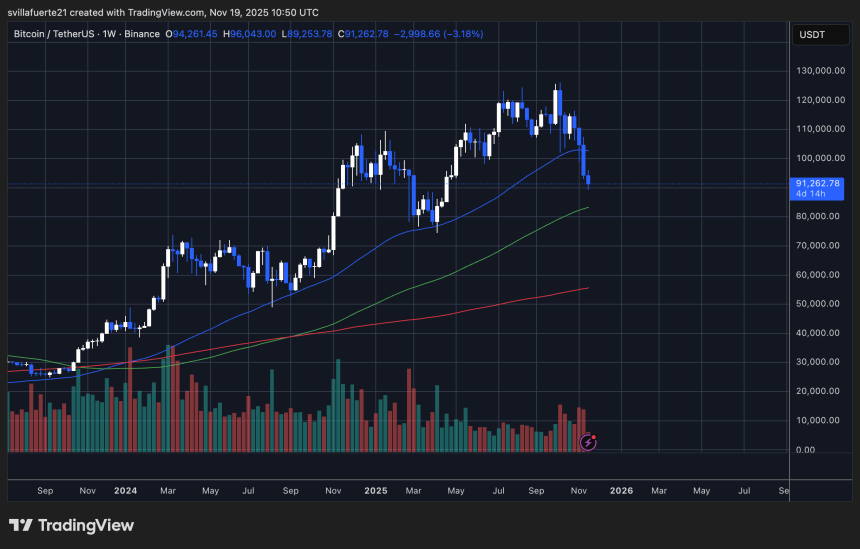
BTC testing key demand levels | Source: BTCUSDT chart on TradingView

Volume adds important context. The past several weekly candles show rising sell-side activity, reflecting panic-driven exits rather than orderly distribution. However, this surge in volume also indicates that the market may be approaching a capitulation threshold, where forced selling begins to exhaust itself — a setup often seen before stronger hands step in.

Structurally, Bitcoin is still trading above the 100-week and 200-week moving averages, both of which continue to trend upward. This suggests the aggressive downside move has not yet broken the broader macrotrend. But the loss of mid-term support levels and the sustained downward pressure highlight a market struggling to find confidence.

Featured image from ChatGPT, chart from TradingView.com

Market Opportunity
Everclear Logo
Everclear Price(CLEAR)
$0.00358
$0.00358$0.00358
-4.02%
USD
Everclear (CLEAR) Live Price Chart
Disclaimer: The articles reposted on this site are sourced from public platforms and are provided for informational purposes only. They do not necessarily reflect the views of MEXC. All rights remain with the original authors. If you believe any content infringes on third-party rights, please contact service@support.mexc.com for removal. MEXC makes no guarantees regarding the accuracy, completeness, or timeliness of the content and is not responsible for any actions taken based on the information provided. The content does not constitute financial, legal, or other professional advice, nor should it be considered a recommendation or endorsement by MEXC.

You May Also Like

Unstoppable: Why No Public Company Can Ever Catch MicroStrategy’s Massive Bitcoin Holdings

Unstoppable: Why No Public Company Can Ever Catch MicroStrategy’s Massive Bitcoin Holdings

BitcoinWorld Unstoppable: Why No Public Company Can Ever Catch MicroStrategy’s Massive Bitcoin Holdings Imagine trying to build a mountain of gold, only to discover
Share
bitcoinworld2025/12/17 14:30
Eric Trump Says Banks Tried to Shut Him Out – Turns to Bitcoin Instead

Eric Trump Says Banks Tried to Shut Him Out – Turns to Bitcoin Instead

The post Eric Trump Says Banks Tried to Shut Him Out – Turns to Bitcoin Instead appeared on BitcoinEthereumNews.com. Bitcoin 18 September 2025 | 10:05 Eric Trump, co-founder of American Bitcoin and son of U.S. President Donald Trump, has revealed that he holds a significant personal stake in the crypto company and has no intention of selling. Trump said his ownership amounts to roughly 7.5% of shares and emphasized that both he and the board are committed to keeping their holdings locked in for the long term. According to Trump, the move reflects not only loyalty to the firm but also resistance to pressure from traditional financial institutions. He claimed that major U.S. banks have repeatedly tried to restrict his access to financial services, including efforts by Capital One, JPMorgan, and Bank of America. “They tried to shut us out of the system,” he said, describing the experience as the turning point that convinced him of crypto’s advantages. Trump argued that blockchain-based systems allow transactions to be handled “faster, cheaper, and more transparently” than legacy banking. He framed his support for American Bitcoin as both a business decision and a statement against what he called an ongoing “de-banking” campaign targeting the Trump Organization and its affiliates. By underscoring his commitment, Trump signaled that he views cryptocurrency not just as a financial instrument but as a defense against the limitations of traditional finance. His comments also echo a broader narrative that digital assets are becoming an alternative for those who feel sidelined by conventional institutions. The information provided in this article is for educational purposes only and does not constitute financial, investment, or trading advice. Coindoo.com does not endorse or recommend any specific investment strategy or cryptocurrency. Always conduct your own research and consult with a licensed financial advisor before making any investment decisions. Author Alex is an experienced financial journalist and cryptocurrency enthusiast. With over 8 years of experience…
Share
BitcoinEthereumNews2025/09/18 15:08
How Crypto Could Reshape Finance, AI, and Privacy by 2026: A16z Crypto

How Crypto Could Reshape Finance, AI, and Privacy by 2026: A16z Crypto

The post How Crypto Could Reshape Finance, AI, and Privacy by 2026: A16z Crypto appeared on BitcoinEthereumNews.com. From stablecoin payments to AI-driven agents
Share
BitcoinEthereumNews2025/12/17 14:38




