Nearly two years after the inception of the Bitcoin ETF sector in the United States, these funds are currently grappling with significant challenges, exacerbated by mounting concerns regarding a potential bear market in the coming months.  This turmoil is exemplified by the BlackRock iShares Bitcoin Trust ETF (IBIT), which experienced its largest single-day withdrawal since launch, further contributing to the decline in Bitcoin’s price. Profit-Taking And Caution The recent outflows from BlackRock’s Bitcoin ETF highlight the severity of the current selloff within the Bitcoin market, which has experienced a substantial correction below the crucial $100,000 mark following a record high reached in October.  Related Reading: Kraken Achieves $20 Billion Valuation With $200 Million Investment From Citadel This downturn emphasizes the widespread pullback affecting various risk assets, while gold has notably remained resilient. Some analysts suggest that these developments indicate a trend of investors shifting their exposure from Bitcoin to gold. “The crypto market entered a hangover in August,” said Thomas Perfumo, Global Economist at Kraken, in a recent interview with Reuters, noting that much of the earlier demand for Bitcoin had been fueled by borrowed funds. He added, “Momentum seemingly peaked during the summer. But the truth is this hangover trend started months ago.” Analysts have also pointed to profit-taking behaviors among long-term holders and increasing caution among Bitcoin ETF funds and digital asset treasury (DAT) firms, which had previously ramped up their acquisitions throughout the year.  Brian Vieten, a research analyst at Siebert Financial, stated that Bitcoin treasury companies had collectively purchased nearly $50 billion worth of Bitcoin over the past year.  Recently, however, many of these firms have begun trading at a discount to their net asset value, which could dampen market expectations for new Bitcoin purchases in the near term. Bitcoin ETF Inflows Plummet This shift occurs amid rising concerns among heavyweight investors regarding inflated valuations across various asset classes. José Torres, a senior economist at Interactive Brokers, noted that “an ongoing lack of speculative spirits is weighing on Bitcoin.” Related Reading: Bitcoin Dips Below $90,000—Yet Altcoins Remain Unscathed: Here’s Why Despite managing over $73 billion in assets, IBIT has seen a decline of 19% in the current quarter. Data from SoSoValue indicates that spot Bitcoin ETF funds collectively have recorded $2.59 billion in outflows this month alone.  Leading the pack is BlackRock’s Bitcoin ETF, which has experienced $1.78 billion in outflows in November alone. The Fidelity Wise Origin Bitcoin Fund (FBTC) ranks second, with nearly $540 million in outflows. The turbulence isn’t limited to Bitcoin; the Ethereum exchange-traded fund sector also faced outflows, totaling approximately $74.2 million yesterday, with BlackRock selling off $165.1 million. On a more positive note, Solana spot ETFs reported net inflows of $30.09 million on Tuesday, primarily driven by Bitwise’s BSOL. This marks a major streak of 15 consecutive days of inflows for Solana. Featured image from DALL-E, chart from TradingView.comNearly two years after the inception of the Bitcoin ETF sector in the United States, these funds are currently grappling with significant challenges, exacerbated by mounting concerns regarding a potential bear market in the coming months.  This turmoil is exemplified by the BlackRock iShares Bitcoin Trust ETF (IBIT), which experienced its largest single-day withdrawal since launch, further contributing to the decline in Bitcoin’s price. Profit-Taking And Caution The recent outflows from BlackRock’s Bitcoin ETF highlight the severity of the current selloff within the Bitcoin market, which has experienced a substantial correction below the crucial $100,000 mark following a record high reached in October.  Related Reading: Kraken Achieves $20 Billion Valuation With $200 Million Investment From Citadel This downturn emphasizes the widespread pullback affecting various risk assets, while gold has notably remained resilient. Some analysts suggest that these developments indicate a trend of investors shifting their exposure from Bitcoin to gold. “The crypto market entered a hangover in August,” said Thomas Perfumo, Global Economist at Kraken, in a recent interview with Reuters, noting that much of the earlier demand for Bitcoin had been fueled by borrowed funds. He added, “Momentum seemingly peaked during the summer. But the truth is this hangover trend started months ago.” Analysts have also pointed to profit-taking behaviors among long-term holders and increasing caution among Bitcoin ETF funds and digital asset treasury (DAT) firms, which had previously ramped up their acquisitions throughout the year.  Brian Vieten, a research analyst at Siebert Financial, stated that Bitcoin treasury companies had collectively purchased nearly $50 billion worth of Bitcoin over the past year.  Recently, however, many of these firms have begun trading at a discount to their net asset value, which could dampen market expectations for new Bitcoin purchases in the near term. Bitcoin ETF Inflows Plummet This shift occurs amid rising concerns among heavyweight investors regarding inflated valuations across various asset classes. José Torres, a senior economist at Interactive Brokers, noted that “an ongoing lack of speculative spirits is weighing on Bitcoin.” Related Reading: Bitcoin Dips Below $90,000—Yet Altcoins Remain Unscathed: Here’s Why Despite managing over $73 billion in assets, IBIT has seen a decline of 19% in the current quarter. Data from SoSoValue indicates that spot Bitcoin ETF funds collectively have recorded $2.59 billion in outflows this month alone.  Leading the pack is BlackRock’s Bitcoin ETF, which has experienced $1.78 billion in outflows in November alone. The Fidelity Wise Origin Bitcoin Fund (FBTC) ranks second, with nearly $540 million in outflows. The turbulence isn’t limited to Bitcoin; the Ethereum exchange-traded fund sector also faced outflows, totaling approximately $74.2 million yesterday, with BlackRock selling off $165.1 million. On a more positive note, Solana spot ETFs reported net inflows of $30.09 million on Tuesday, primarily driven by Bitwise’s BSOL. This marks a major streak of 15 consecutive days of inflows for Solana. Featured image from DALL-E, chart from TradingView.com
BlackRock’s Bitcoin ETF Bleeds Over $500 Million In Its Biggest One-Day Outflow

2025/11/20 16:00

Nearly two years after the inception of the Bitcoin ETF sector in the United States, these funds are currently grappling with significant challenges, exacerbated by mounting concerns regarding a potential bear market in the coming months. 

This turmoil is exemplified by the BlackRock iShares Bitcoin Trust ETF (IBIT), which experienced its largest single-day withdrawal since launch, further contributing to the decline in Bitcoin’s price.

Profit-Taking And Caution

The recent outflows from BlackRock’s Bitcoin ETF highlight the severity of the current selloff within the Bitcoin market, which has experienced a substantial correction below the crucial $100,000 mark following a record high reached in October. 

This downturn emphasizes the widespread pullback affecting various risk assets, while gold has notably remained resilient. Some analysts suggest that these developments indicate a trend of investors shifting their exposure from Bitcoin to gold.

“The crypto market entered a hangover in August,” said Thomas Perfumo, Global Economist at Kraken, in a recent interview with Reuters, noting that much of the earlier demand for Bitcoin had been fueled by borrowed funds. He added, “Momentum seemingly peaked during the summer. But the truth is this hangover trend started months ago.”

Bitcoin ETF

Analysts have also pointed to profit-taking behaviors among long-term holders and increasing caution among Bitcoin ETF funds and digital asset treasury (DAT) firms, which had previously ramped up their acquisitions throughout the year. 

Brian Vieten, a research analyst at Siebert Financial, stated that Bitcoin treasury companies had collectively purchased nearly $50 billion worth of Bitcoin over the past year. 

Recently, however, many of these firms have begun trading at a discount to their net asset value, which could dampen market expectations for new Bitcoin purchases in the near term.

Bitcoin ETF Inflows Plummet

This shift occurs amid rising concerns among heavyweight investors regarding inflated valuations across various asset classes. José Torres, a senior economist at Interactive Brokers, noted that “an ongoing lack of speculative spirits is weighing on Bitcoin.”

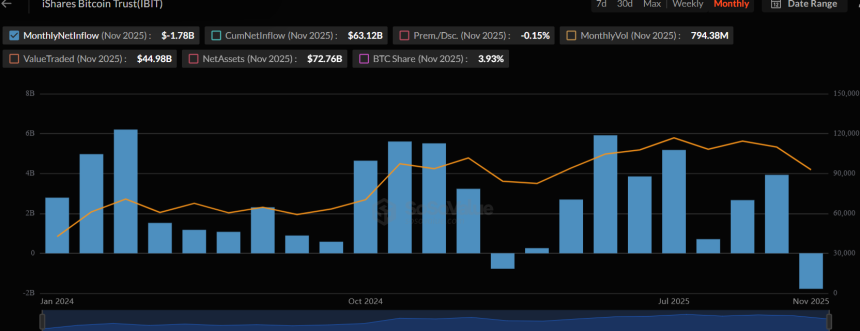
Despite managing over $73 billion in assets, IBIT has seen a decline of 19% in the current quarter. Data from SoSoValue indicates that spot Bitcoin ETF funds collectively have recorded $2.59 billion in outflows this month alone. 

Bitcoin ETF

Leading the pack is BlackRock’s Bitcoin ETF, which has experienced $1.78 billion in outflows in November alone. The Fidelity Wise Origin Bitcoin Fund (FBTC) ranks second, with nearly $540 million in outflows.

The turbulence isn’t limited to Bitcoin; the Ethereum exchange-traded fund sector also faced outflows, totaling approximately $74.2 million yesterday, with BlackRock selling off $165.1 million.

On a more positive note, Solana spot ETFs reported net inflows of $30.09 million on Tuesday, primarily driven by Bitwise’s BSOL. This marks a major streak of 15 consecutive days of inflows for Solana.

Featured image from DALL-E, chart from TradingView.com 

Market Opportunity
Intuition Logo
Intuition Price(TRUST)
$0.1098
$0.1098$0.1098
+2.04%
USD
Intuition (TRUST) Live Price Chart
Disclaimer: The articles reposted on this site are sourced from public platforms and are provided for informational purposes only. They do not necessarily reflect the views of MEXC. All rights remain with the original authors. If you believe any content infringes on third-party rights, please contact service@support.mexc.com for removal. MEXC makes no guarantees regarding the accuracy, completeness, or timeliness of the content and is not responsible for any actions taken based on the information provided. The content does not constitute financial, legal, or other professional advice, nor should it be considered a recommendation or endorsement by MEXC.

You May Also Like

CLARITY Act ‘Has a Long Way to Go‘

CLARITY Act ‘Has a Long Way to Go‘

The post CLARITY Act ‘Has a Long Way to Go‘ appeared on BitcoinEthereumNews.com. David Solomon, CEO of banking giant Goldman Sachs, has weighed in on the pending
Share
BitcoinEthereumNews2026/01/17 11:16
EUR/CHF slides as Euro struggles post-inflation data

EUR/CHF slides as Euro struggles post-inflation data

The post EUR/CHF slides as Euro struggles post-inflation data appeared on BitcoinEthereumNews.com. EUR/CHF weakens for a second straight session as the euro struggles to recover post-Eurozone inflation data. Eurozone core inflation steady at 2.3%, headline CPI eases to 2.0% in August. SNB maintains a flexible policy outlook ahead of its September 25 decision, with no immediate need for easing. The Euro (EUR) trades under pressure against the Swiss Franc (CHF) on Wednesday, with EUR/CHF extending losses for the second straight session as the common currency struggles to gain traction following Eurozone inflation data. At the time of writing, the cross is trading around 0.9320 during the American session. The latest inflation data from Eurostat showed that Eurozone price growth remained broadly stable in August, reinforcing the European Central Bank’s (ECB) cautious stance on monetary policy. The Core Harmonized Index of Consumer Prices (HICP), which excludes volatile items such as food and energy, rose 2.3% YoY, in line with both forecasts and the previous month’s reading. On a monthly basis, core inflation increased by 0.3%, unchanged from July, highlighting persistent underlying price pressures in the bloc. Meanwhile, headline inflation eased to 2.0% YoY in August, down from 2.1% in July and slightly below expectations. On a monthly basis, prices rose just 0.1%, missing forecasts for a 0.2% increase and decelerating from July’s 0.2% rise. The inflation release follows last week’s ECB policy decision, where the central bank kept all three key interest rates unchanged and signaled that policy is likely at its terminal level. While officials acknowledged progress in bringing inflation down, they reiterated a cautious, data-dependent approach going forward, emphasizing the need to maintain restrictive conditions for an extended period to ensure price stability. On the Swiss side, disinflation appears to be deepening. The Producer and Import Price Index dropped 0.6% in August, marking a sharp 1.8% annual decline. Broader inflation remains…
Share
BitcoinEthereumNews2025/09/18 03:08
Today’s Wordle #1673 Hints And Answer For Saturday, January 17

Today’s Wordle #1673 Hints And Answer For Saturday, January 17

The post Today’s Wordle #1673 Hints And Answer For Saturday, January 17 appeared on BitcoinEthereumNews.com. How to solve today’s Wordle. SOPA Images/LightRocket
Share
BitcoinEthereumNews2026/01/17 11:24