Aster price appears to be entering a potential early reversal phase, with fresh buybacks and a new listing shifting sentiment amid difficult week for the wider market. Aster traded at $1.25 at press time, down 4.2% over the past 24…Aster price appears to be entering a potential early reversal phase, with fresh buybacks and a new listing shifting sentiment amid difficult week for the wider market. Aster traded at $1.25 at press time, down 4.2% over the past 24…

Aster price forms early reversal pattern as $70M buyback and Coinbase listing boost sentiment

2025/11/21 15:31
3 min read

Aster price appears to be entering a potential early reversal phase, with fresh buybacks and a new listing shifting sentiment amid difficult week for the wider market.

Summary
  • A rounded bottom structure is forming as Aster rebounds from lower Bollinger levels.
  • Buyback and Coinbase listing news has improved confidence.
  • Technical indicators are largely constructive, but $1.50 remains the near-term test.

Aster traded at $1.25 at press time, down 4.2% over the past 24 hours but still holding a steady short-term structure that hints at an early reversal. The token has moved within a $1.02–$1.39 range over the last week, gaining 22% across seven days and 19% over the past month.

Trading activity has risen sharply, with $953 million in 24-hour volume, up 27%. Derivatives markets show a more cautious stance. Futures volume climbed to $2.4 billion, a 7% increase, but open interest slipped 6.6% to $552 million.

This likely suggests that traders are rotating out of older positions rather than adding fresh risk.

ASTER buybacks and Coinbase listing lift sentiment

Much of the recent optimism comes from a wave of activity that arrived on Nov. 20. Aster (ASTER) confirmed the completion of its Stage 3 buyback, acquiring 55.7 million ASTER and bringing the total to 155.7 million tokens. 

At current prices, the latest tranche represents roughly $70 million. Half of those tokens, 77.8 million ASTER, or around 1% of supply, will be burned on Dec. 5, with the rest locked for future airdrops. Stage 4 buybacks begin on Dec. 10. 60–90% of protocol fees have been allocated for continued purchases.

The same day, Coinbase launched ASTER trading, opening access to U.S. retail and institutional flows. Early trading pushed spot prices from roughly $1.14 to $1.37 before settling back into the current range.

Coinbase generated over $1 million in volume within hours, a move that helped soften market anxiety during a tense week for digital assets. The listing also carries symbolic weight, linking a BNB Chain project with Binance’s largest competitor.

Aster price technical analysis

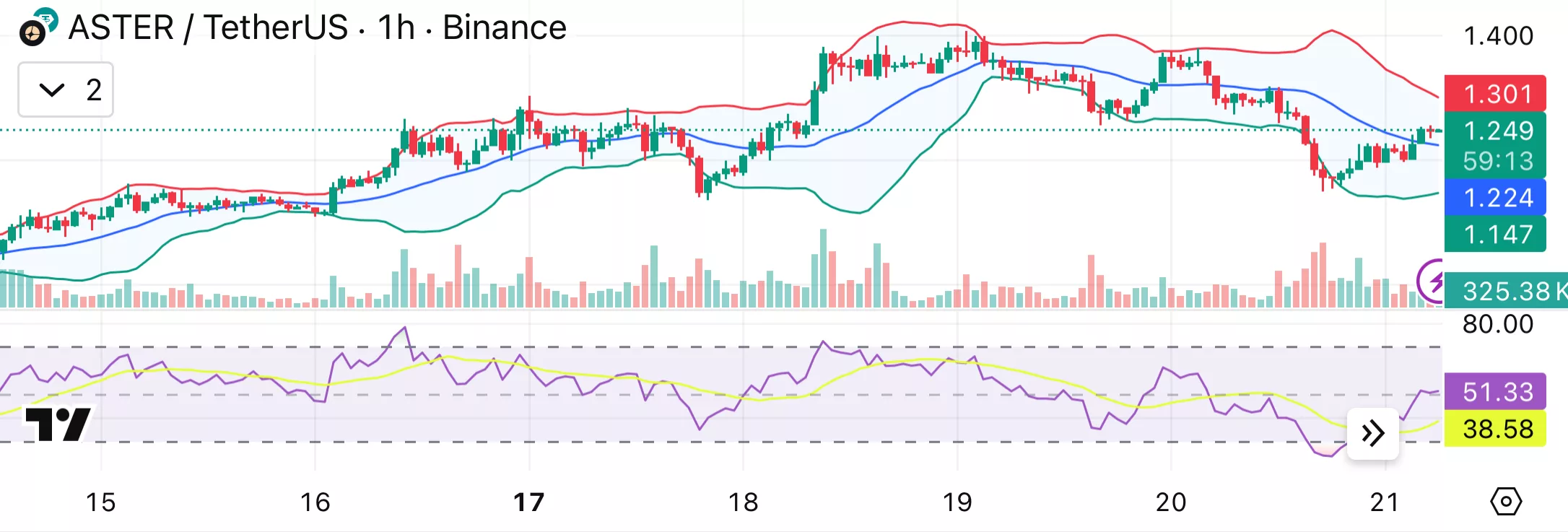
A developing rounded bottom is visible on the chart following a brief dip to the lower Bollinger Band. The price has levelled off, started to curve upward, and is now retreating towards the middle of the range.

This type of pattern often indicates that sellers are losing their hold on the market while buyers gradually return.
Aster price forms early reversal pattern as $70M buyback and Coinbase listing boost sentiment - 1

The relative strength index has bounced back sharply from oversold levels, forming a V-shaped recovery, and it’s now nearing neutral territory. Momentum indicators are showing a slight positive bias, though most oscillators are still neutral.

That said, there’s some upside potential, especially since both the MACD and short-term momentum have flashed buy signals. With the 10-, 20-, and 30-period moving averages all below the current price, Aster has a strong base if buyers keep defending the mid-range.

If the crypto market holds steady, the next target for a bullish move could be between $1.38 and $1.50. A breakout above that could push the price toward $2.

On the flip side, if the price falls below the $1.10–$1.15 support level, it would open the door to a lower range around $1.02, which would weaken the bullish setup and could signal a potential bearish turn.


Market Opportunity
Aster Logo
Aster Price(ASTER)
$0.6486
$0.6486$0.6486
+8.29%
USD
Aster (ASTER) Live Price Chart
Disclaimer: The articles reposted on this site are sourced from public platforms and are provided for informational purposes only. They do not necessarily reflect the views of MEXC. All rights remain with the original authors. If you believe any content infringes on third-party rights, please contact service@support.mexc.com for removal. MEXC makes no guarantees regarding the accuracy, completeness, or timeliness of the content and is not responsible for any actions taken based on the information provided. The content does not constitute financial, legal, or other professional advice, nor should it be considered a recommendation or endorsement by MEXC.

You May Also Like

Cashing In On University Patents Means Giving Up On Our Innovation Future

Cashing In On University Patents Means Giving Up On Our Innovation Future

The post Cashing In On University Patents Means Giving Up On Our Innovation Future appeared on BitcoinEthereumNews.com. “It’s a raid on American innovation that would deliver pennies to the Treasury while kneecapping the very engine of our economic and medical progress,” writes Pipes. Getty Images Washington is addicted to taxing success. Now, Commerce Secretary Howard Lutnick is floating a plan to skim half the patent earnings from inventions developed at universities with federal funding. It’s being sold as a way to shore up programs like Social Security. In reality, it’s a raid on American innovation that would deliver pennies to the Treasury while kneecapping the very engine of our economic and medical progress. Yes, taxpayer dollars support early-stage research. But the real payoff comes later—in the jobs created, cures discovered, and industries launched when universities and private industry turn those discoveries into real products. By comparison, the sums at stake in patent licensing are trivial. Universities collectively earn only about $3.6 billion annually in patent income—less than the federal government spends on Social Security in a single day. Even confiscating half would barely register against a $6 trillion federal budget. And yet the damage from such a policy would be anything but trivial. The true return on taxpayer investment isn’t in licensing checks sent to Washington, but in the downstream economic activity that federally supported research unleashes. Thanks to the bipartisan Bayh-Dole Act of 1980, universities and private industry have powerful incentives to translate early-stage discoveries into real-world products. Before Bayh-Dole, the government hoarded patents from federally funded research, and fewer than 5% were ever licensed. Once universities could own and license their own inventions, innovation exploded. The result has been one of the best returns on investment in government history. Since 1996, university research has added nearly $2 trillion to U.S. industrial output, supported 6.5 million jobs, and launched more than 19,000 startups. Those companies pay…
Share
BitcoinEthereumNews2025/09/18 03:26
VIRTUAL Bearish Analysis Feb 10

VIRTUAL Bearish Analysis Feb 10

The post VIRTUAL Bearish Analysis Feb 10 appeared on BitcoinEthereumNews.com. VIRTUAL is approaching a critical support test at the 0.55$ level, with RSI at 33
Share
BitcoinEthereumNews2026/02/10 15:15
XRPL Developer Says 100% Taking Profits on XRP at $10, $27

XRPL Developer Says 100% Taking Profits on XRP at $10, $27

An XRPL developer has stirred discussion around profit-taking levels well above today’s price, prompting mixed reactions from XRP holders who favor a never-sell
Share
Coinstats2026/02/10 15:11