Axelar’s integration with Hedera unlocks seamless cross-chain connectivity, enabling asset movement across 60+ blockchains in a unified Web3 ecosystem.]]>Axelar’s integration with Hedera unlocks seamless cross-chain connectivity, enabling asset movement across 60+ blockchains in a unified Web3 ecosystem.]]>

Hedera and Axelar Team Up to Open Access Across 60 Blockchains

For feedback or concerns regarding this content, please contact us at crypto.news@mexc.com
  • Axelar’s integration with Hedera enables seamless cross-chain asset transfers across more than 60 blockchains through the Interchain Amplifier framework.
  • The collaboration strengthens Hedera’s institutional DeFi potential by expanding liquidity access and connectivity to a wide multichain ecosystem.

The Axelar and Hedera integration is now officially live, opening access to cross-chain asset transfers across over 60 blockchains without the need for a complicated bridging process.

This development is all the more exciting as it comes amid HBAR price pressure, which is currently hitting a key demand area.

This combination of technical factors and ecosystem developments has revived the conversation around Hedera, despite the market’s unfriendly movements.

Connecting Hedera Seamlessly to a Broader and Faster Cross-Chain Network

Axelar is bringing the Interchain Amplifier as the core foundation of this integration. This tool allows networks like Hedera to connect without a complicated process, while also providing a natural pathway for assets from different chains to move in and out of the Hedera network.

For developers and institutions, this can save significant time, especially since Hedera is known for its fast infrastructure and stable transaction fees.

Furthermore, Hedera has a unique appeal through its hashgraph consensus, capable of handling thousands of transactions per second. This integration feels logical, especially as the multichain ecosystem becomes more crowded and the need for interoperability continues to grow.

However, although the network is now connected to dozens of chains, usage data is not yet fully visible.

Cross-chain transfer volumes have not been published in detail, so some analysts are still waiting for further developments to see whether this integration will be actively used immediately or will be gradual, following the pattern of institutional adoption.

On the other hand, the CNF previously reported that Hedera had joined the Digital Chamber’s State Network to strengthen the direction of digital asset policy in the United States.

This move underscores Hedera’s regulatory ambitions, something that has been relatively undisclosed but has implications for its long-term strategy.

Furthermore, last week, Hedera also announced a partnership with Google Cloud to provide institutional-grade data access. Through BigQuery, Hedera’s transaction activity can now be directly compared with other networks, opening up a broader analytical space for researchers and market participants.

HBAR Price Faces a Critical Weekly Demand Zone Test

Interestingly, this major development comes at a time when the HBAR price is in a quite sensitive area.

According to Crypto Pulse, HBAR is now right inside the weekly demand zone, an area that has previously triggered multiple price reversals.

This is where buyers typically begin to defend their positions, and as long as the price remains above it, there’s still a chance of a rebound towards $0.17–$0.19.
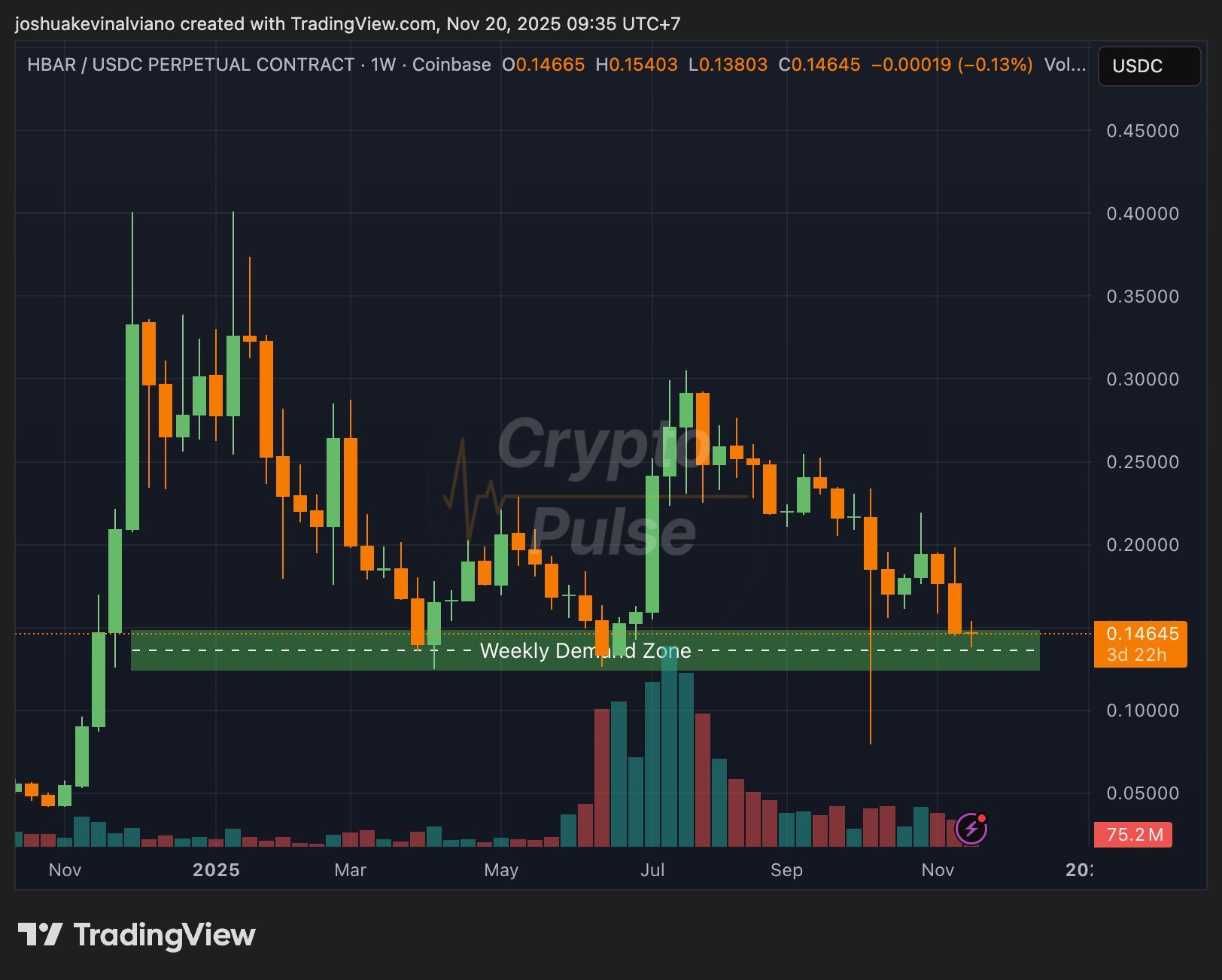
Hedera HBARSource: Crypto Pulse on X

However, short-term price conditions aren’t entirely comfortable. As of press time, HBAR is trading at about $0.132, down 2.78% in the last 4 hours and 10.41% in the last 24 hours.

Movements like this make the weekly demand zone even more crucial than usual. Crypto Pulse also warns that the bullish scenario could be invalidated if the weekly candle closes below $0.12, as this would change the market structure and allow for further declines.

]]>
Market Opportunity
OpenLedger Logo
OpenLedger Price(OPEN)
$0.15436
$0.15436$0.15436
+0.52%
USD
OpenLedger (OPEN) Live Price Chart
Disclaimer: The articles reposted on this site are sourced from public platforms and are provided for informational purposes only. They do not necessarily reflect the views of MEXC. All rights remain with the original authors. If you believe any content infringes on third-party rights, please contact crypto.news@mexc.com for removal. MEXC makes no guarantees regarding the accuracy, completeness, or timeliness of the content and is not responsible for any actions taken based on the information provided. The content does not constitute financial, legal, or other professional advice, nor should it be considered a recommendation or endorsement by MEXC.

You May Also Like

The Channel Factories We’ve Been Waiting For

The Channel Factories We’ve Been Waiting For

The post The Channel Factories We’ve Been Waiting For appeared on BitcoinEthereumNews.com. Visions of future technology are often prescient about the broad strokes while flubbing the details. The tablets in “2001: A Space Odyssey” do indeed look like iPads, but you never see the astronauts paying for subscriptions or wasting hours on Candy Crush.  Channel factories are one vision that arose early in the history of the Lightning Network to address some challenges that Lightning has faced from the beginning. Despite having grown to become Bitcoin’s most successful layer-2 scaling solution, with instant and low-fee payments, Lightning’s scale is limited by its reliance on payment channels. Although Lightning shifts most transactions off-chain, each payment channel still requires an on-chain transaction to open and (usually) another to close. As adoption grows, pressure on the blockchain grows with it. The need for a more scalable approach to managing channels is clear. Channel factories were supposed to meet this need, but where are they? In 2025, subnetworks are emerging that revive the impetus of channel factories with some new details that vastly increase their potential. They are natively interoperable with Lightning and achieve greater scale by allowing a group of participants to open a shared multisig UTXO and create multiple bilateral channels, which reduces the number of on-chain transactions and improves capital efficiency. Achieving greater scale by reducing complexity, Ark and Spark perform the same function as traditional channel factories with new designs and additional capabilities based on shared UTXOs.  Channel Factories 101 Channel factories have been around since the inception of Lightning. A factory is a multiparty contract where multiple users (not just two, as in a Dryja-Poon channel) cooperatively lock funds in a single multisig UTXO. They can open, close and update channels off-chain without updating the blockchain for each operation. Only when participants leave or the factory dissolves is an on-chain transaction…
Share
BitcoinEthereumNews2025/09/18 00:09
Top 3 Altcoins for the Next Bull Run Ethereum, Solana and Mutuum Finance

Top 3 Altcoins for the Next Bull Run Ethereum, Solana and Mutuum Finance

Ethereum and Solana already sit near the top of most serious altcoin watchlists, and Mutuum Finance is starting to enter that same conversation from a very different
Share
Techbullion2026/03/20 23:07
Trump: We want to negotiate with Iran, but we have no negotiating partner.

Trump: We want to negotiate with Iran, but we have no negotiating partner.

PANews reported on March 20 that US President Trump stated: "We want to negotiate with Iran, but we have no one to negotiate with. Nobody wants to be Iran's leader
Share
PANews2026/03/20 23:04