According to CryptoQuant data, Bitcoin has moved into what analysts are calling the most bearish phase of the last two years, sending prices down sharply and weighing on the broader crypto market. Related Reading: XRP Supply Shock Ahead? ETFs Could Consume It All, Analyst Predicts The coin slid from a peak above $126,000 on Oct. 6 to $83,790, a drop of around 34% that erased roughly $715 billion in market value. Bull Conditions Have Weakened Rapidly Reports have disclosed that CryptoQuant’s Bull Score Index fell to 20 out of 100 last week, driven by weak spot buying, negative price momentum, and a slowdown in stablecoin liquidity. Bitcoin also closed below its 365-day moving average, a long-run trendline that had held during earlier pullbacks in the current cycle that began in January 2023. Based on these signs, CryptoQuant views the market as clearly more bearish than it was in prior corrections. Trading desks and corporate treasuries have shifted behavior. Treasury companies that once supported prices have seen market values drop by 70% to more than 90% in recent months, limiting their ability to issue shares and buy more Bitcoin. Reports show Michael Saylor’s Strategy bought 8,178 BTC earlier this week but has slowed purchases as its stock market cap fell closer to the value of its holdings. ETF flows have also turned negative, with outflows totaling close to $3 billion so far this month, a dynamic that can force some institutions to sell spot holdings if spread trades are unwound. Technical Levels And Short-Term Signals Based on on-chain indicators, there are mixed signals for buyers. Glassnode reported the Mayer Multiple moving toward the bottom of its long-term range, which often signals a value-driven phase where buyers re-enter. Bitcoin’s Mayer Multiple has retraced toward the lower bound of its long-term range, signalling a slowdown in momentum. Historically, such compressions have aligned with value-driven phases where price consolidates and demand begins to step in. 📈https://t.co/QWQCUxgUoA pic.twitter.com/qufyp0opnr — glassnode (@glassnode) November 20, 2025 Some technical traders see oversold readings on daily and weekly RSI, a setup that could allow a bounce. Some analysts expect at least a short-term recovery, with price tests above $100,000 possible if buying returns. Still, the breakdown under the 365-day average changes the picture. CryptoQuant suggested resistance near $102,600 could prove heavy, and the support band between $90,000 and $92,000 will be closely watched. Historically, Bitcoin has produced rallies of 40% to 50% inside broader downtrends, so rapid reversals are not out of the question even in a bearish phase. Market Shock And Macro Factors Based on reports, the sharp sell-off that triggered the recent crash began on October 10 when a large leverage flush-out forced many positions to close. Market makers reduced liquidity and selling pressure intensified. A software fault tied to the Athena USDE stablecoin on Binance briefly pushed its peg to $0.65, triggering automated liquidations across platforms and accelerating losses. Related Reading: Trump’s WLFI Moves To Contain Wallet Breach While Federal Inquiry Looms Macro worries, including tighter liquidity and political uncertainty, added pressure and sent more traders to the exits. Some observers have linked parts of the 2024 and 2025 rallies to specific events. In 2024, US President Donald Trump’s election was one factor cited for pushing BTC above $100,000, and in 2025, a wave of corporate treasuries bought Bitcoin, helping lift prices above $120,000 in summer months. According to CryptoQuant, those catalysts have largely played out, and any new triggers may be priced in already. Featured image from Unsplash, chart from TradingViewAccording to CryptoQuant data, Bitcoin has moved into what analysts are calling the most bearish phase of the last two years, sending prices down sharply and weighing on the broader crypto market. Related Reading: XRP Supply Shock Ahead? ETFs Could Consume It All, Analyst Predicts The coin slid from a peak above $126,000 on Oct. 6 to $83,790, a drop of around 34% that erased roughly $715 billion in market value. Bull Conditions Have Weakened Rapidly Reports have disclosed that CryptoQuant’s Bull Score Index fell to 20 out of 100 last week, driven by weak spot buying, negative price momentum, and a slowdown in stablecoin liquidity. Bitcoin also closed below its 365-day moving average, a long-run trendline that had held during earlier pullbacks in the current cycle that began in January 2023. Based on these signs, CryptoQuant views the market as clearly more bearish than it was in prior corrections. Trading desks and corporate treasuries have shifted behavior. Treasury companies that once supported prices have seen market values drop by 70% to more than 90% in recent months, limiting their ability to issue shares and buy more Bitcoin. Reports show Michael Saylor’s Strategy bought 8,178 BTC earlier this week but has slowed purchases as its stock market cap fell closer to the value of its holdings. ETF flows have also turned negative, with outflows totaling close to $3 billion so far this month, a dynamic that can force some institutions to sell spot holdings if spread trades are unwound. Technical Levels And Short-Term Signals Based on on-chain indicators, there are mixed signals for buyers. Glassnode reported the Mayer Multiple moving toward the bottom of its long-term range, which often signals a value-driven phase where buyers re-enter. Bitcoin’s Mayer Multiple has retraced toward the lower bound of its long-term range, signalling a slowdown in momentum. Historically, such compressions have aligned with value-driven phases where price consolidates and demand begins to step in. 📈https://t.co/QWQCUxgUoA pic.twitter.com/qufyp0opnr — glassnode (@glassnode) November 20, 2025 Some technical traders see oversold readings on daily and weekly RSI, a setup that could allow a bounce. Some analysts expect at least a short-term recovery, with price tests above $100,000 possible if buying returns. Still, the breakdown under the 365-day average changes the picture. CryptoQuant suggested resistance near $102,600 could prove heavy, and the support band between $90,000 and $92,000 will be closely watched. Historically, Bitcoin has produced rallies of 40% to 50% inside broader downtrends, so rapid reversals are not out of the question even in a bearish phase. Market Shock And Macro Factors Based on reports, the sharp sell-off that triggered the recent crash began on October 10 when a large leverage flush-out forced many positions to close. Market makers reduced liquidity and selling pressure intensified. A software fault tied to the Athena USDE stablecoin on Binance briefly pushed its peg to $0.65, triggering automated liquidations across platforms and accelerating losses. Related Reading: Trump’s WLFI Moves To Contain Wallet Breach While Federal Inquiry Looms Macro worries, including tighter liquidity and political uncertainty, added pressure and sent more traders to the exits. Some observers have linked parts of the 2024 and 2025 rallies to specific events. In 2024, US President Donald Trump’s election was one factor cited for pushing BTC above $100,000, and in 2025, a wave of corporate treasuries bought Bitcoin, helping lift prices above $120,000 in summer months. According to CryptoQuant, those catalysts have largely played out, and any new triggers may be priced in already. Featured image from Unsplash, chart from TradingView

Data Rings Alarm: Bitcoin Hits 2-Year Bearish Extreme — Historically Bullish?

2025/11/22 01:00
3 min read
For feedback or concerns regarding this content, please contact us at crypto.news@mexc.com

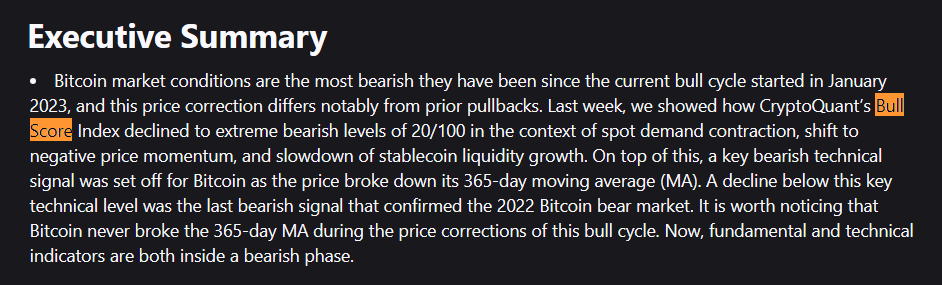
According to CryptoQuant data, Bitcoin has moved into what analysts are calling the most bearish phase of the last two years, sending prices down sharply and weighing on the broader crypto market.

The coin slid from a peak above $126,000 on Oct. 6 to $83,790, a drop of around 34% that erased roughly $715 billion in market value.

Bull Conditions Have Weakened Rapidly

Reports have disclosed that CryptoQuant’s Bull Score Index fell to 20 out of 100 last week, driven by weak spot buying, negative price momentum, and a slowdown in stablecoin liquidity.

Bitcoin also closed below its 365-day moving average, a long-run trendline that had held during earlier pullbacks in the current cycle that began in January 2023.

Based on these signs, CryptoQuant views the market as clearly more bearish than it was in prior corrections.
Trading desks and corporate treasuries have shifted behavior. Treasury companies that once supported prices have seen market values drop by 70% to more than 90% in recent months, limiting their ability to issue shares and buy more Bitcoin.

Reports show Michael Saylor’s Strategy bought 8,178 BTC earlier this week but has slowed purchases as its stock market cap fell closer to the value of its holdings.

ETF flows have also turned negative, with outflows totaling close to $3 billion so far this month, a dynamic that can force some institutions to sell spot holdings if spread trades are unwound.

Technical Levels And Short-Term Signals

Based on on-chain indicators, there are mixed signals for buyers. Glassnode reported the Mayer Multiple moving toward the bottom of its long-term range, which often signals a value-driven phase where buyers re-enter.

Some technical traders see oversold readings on daily and weekly RSI, a setup that could allow a bounce. Some analysts expect at least a short-term recovery, with price tests above $100,000 possible if buying returns.

Still, the breakdown under the 365-day average changes the picture. CryptoQuant suggested resistance near $102,600 could prove heavy, and the support band between $90,000 and $92,000 will be closely watched.

Historically, Bitcoin has produced rallies of 40% to 50% inside broader downtrends, so rapid reversals are not out of the question even in a bearish phase.

Market Shock And Macro Factors

Based on reports, the sharp sell-off that triggered the recent crash began on October 10 when a large leverage flush-out forced many positions to close.

Market makers reduced liquidity and selling pressure intensified. A software fault tied to the Athena USDE stablecoin on Binance briefly pushed its peg to $0.65, triggering automated liquidations across platforms and accelerating losses.

Macro worries, including tighter liquidity and political uncertainty, added pressure and sent more traders to the exits.

Some observers have linked parts of the 2024 and 2025 rallies to specific events. In 2024, US President Donald Trump’s election was one factor cited for pushing BTC above $100,000, and in 2025, a wave of corporate treasuries bought Bitcoin, helping lift prices above $120,000 in summer months.

According to CryptoQuant, those catalysts have largely played out, and any new triggers may be priced in already.

Featured image from Unsplash, chart from TradingView

Market Opportunity
Bullish Degen Logo
Bullish Degen Price(BULLISH)
$0.002407
$0.002407$0.002407
+2.81%
USD
Bullish Degen (BULLISH) Live Price Chart
Disclaimer: The articles reposted on this site are sourced from public platforms and are provided for informational purposes only. They do not necessarily reflect the views of MEXC. All rights remain with the original authors. If you believe any content infringes on third-party rights, please contact crypto.news@mexc.com for removal. MEXC makes no guarantees regarding the accuracy, completeness, or timeliness of the content and is not responsible for any actions taken based on the information provided. The content does not constitute financial, legal, or other professional advice, nor should it be considered a recommendation or endorsement by MEXC.

You May Also Like

American Bitcoin’s $5B Nasdaq Debut Puts Trump-Backed Miner in Crypto Spotlight

American Bitcoin’s $5B Nasdaq Debut Puts Trump-Backed Miner in Crypto Spotlight

The post American Bitcoin’s $5B Nasdaq Debut Puts Trump-Backed Miner in Crypto Spotlight appeared on BitcoinEthereumNews.com. Key Takeaways: American Bitcoin (ABTC) surged nearly 85% on its Nasdaq debut, briefly reaching a $5B valuation. The Trump family, alongside Hut 8 Mining, controls 98% of the newly merged crypto-mining entity. Eric Trump called Bitcoin “modern-day gold,” predicting it could reach $1 million per coin. American Bitcoin, a fast-rising crypto mining firm with strong political and institutional backing, has officially entered Wall Street. After merging with Gryphon Digital Mining, the company made its Nasdaq debut under the ticker ABTC, instantly drawing global attention to both its stock performance and its bold vision for Bitcoin’s future. Read More: Trump-Backed Crypto Firm Eyes Asia for Bold Bitcoin Expansion Nasdaq Debut: An Explosive First Day ABTC’s first day of trading proved as dramatic as expected. Shares surged almost 85% at the open, touching a peak of $14 before settling at lower levels by the close. That initial spike valued the company around $5 billion, positioning it as one of 2025’s most-watched listings. At the last session, ABTC has been trading at $7.28 per share, which is a small positive 2.97% per day. Although the price has decelerated since opening highs, analysts note that the company has been off to a strong start and early investor activity is a hard-to-find feat in a newly-launched crypto mining business. According to market watchers, the listing comes at a time of new momentum in the digital asset markets. With Bitcoin trading above $110,000 this quarter, American Bitcoin’s entry comes at a time when both institutional investors and retail traders are showing heightened interest in exposure to Bitcoin-linked equities. Ownership Structure: Trump Family and Hut 8 at the Helm Its management and ownership set up has increased the visibility of the company. The Trump family and the Canadian mining giant Hut 8 Mining jointly own 98 percent…
Share
BitcoinEthereumNews2025/09/18 01:33
U.S. Moves Grip on Crypto Regulation Intensifies

U.S. Moves Grip on Crypto Regulation Intensifies

The post U.S. Moves Grip on Crypto Regulation Intensifies appeared on BitcoinEthereumNews.com. The United States is contending with the intricacies of cryptocurrency regulation as newly enacted legislation stirs debate over centralized versus decentralized finance. The recent passage of the GENIUS Act under Bo Hines’ leadership is perceived to skew favor towards centralized entities, potentially disadvantaging decentralized innovations. Continue Reading:U.S. Moves Grip on Crypto Regulation Intensifies Source: https://en.bitcoinhaber.net/u-s-moves-grip-on-crypto-regulation-intensifies
Share
BitcoinEthereumNews2025/09/18 01:09
Evernorth’s $1B XRP Play Could Be the Blueprint for Corporate Adoption – Here’s Why

Evernorth’s $1B XRP Play Could Be the Blueprint for Corporate Adoption – Here’s Why

There’s been this massive development quietly sitting in an SEC filing that most people probably scrolled right past. Evernorth Holdings filed a Form S-4, and buried
Share
Captainaltcoin2026/03/21 05:00
