Ethereum has officially broken below key support levels, and market sentiment is rapidly deteriorating as major assets across the crypto landscape continue to slide. Analysts are increasingly calling for the arrival of a new bear market, noting that both Bitcoin and the leading altcoins have lost critical technical zones that previously held the broader structure together. ETH, now trading at multi-month lows, is feeling the full weight of cascading liquidations, strong sell-side volume, and evaporating investor confidence. Related Reading: Bitcoin OG Owen Gunden Deposits Final 2,499 BTC ($228M) to Kraken – Details Adding to the growing uncertainty, Lookonchain reports a striking development: in just 10 days, more than $61 million in profit has disappeared for a well-known market participant often referred to as the Anti-CZ Whale. This trader previously gained attention for aggressively opening shorts immediately after CZ purchased ASTER — a move that paid off handsomely until the recent violent downturn reversed his fortunes. The Anti-CZ Whale’s Unrealized Profit Collapse Adds Pressure According to Lookonchain, the trader known as the Anti-CZ Whale has taken a massive hit during the latest market downturn — and Ethereum sits at the center of the damage. Just 10 days ago, this whale had accumulated nearly $100 million in total profit on Hyperliquid, largely fueled by aggressive positions built during periods of high volatility. However, as the crypto market sharply corrected, his oversized ETH and XRP longs turned against him. The result has been a brutal drawdown: his total profit has now fallen to just $38.4 million, wiping out more than 60% of gains in less than two weeks. This dramatic reversal reflects more than one trader’s misfortune — it signals the extent of the pressure weighing on Ethereum. As ETH continues to decline and investor sentiment deteriorates, even the most seasoned actors are struggling to navigate the volatility. The whale’s rapid profit erosion highlights how quickly bullish conviction can shift when key support levels fail. For Ethereum, holding the current zone is crucial. Price action has already inflicted significant pain across longs, short-term holders, and leveraged players. If ETH loses this support decisively, the next wave of forced selling could deepen losses and accelerate the broader market capitulation. Related Reading: Bitcoin Mean Reversion Oscillator Prints First Green Oversold Bar in Months – A Classic Bull-Market Bottom Signal ETH Price Analysis: Testing a Major Weekly Support Zone Ethereum has entered a critical phase on the weekly timeframe, with price pulling back sharply toward the $2,680 region — a level that now acts as the last meaningful support before a deeper market breakdown. The chart shows a strong rejection from the $4,500 zone earlier this quarter, followed by a sustained series of lower highs and lower lows, confirming a medium-term downtrend. The 50-week moving average has been lost decisively, and ETH is now sitting directly on top of the 100-week MA, a level that has historically acted as a key pivot during major market corrections. Volume has expanded during the recent drop, highlighting an environment driven by fear and forced selling rather than controlled profit-taking. This aligns with broader market conditions, where liquidity is thin and volatility remains elevated across majors. A clean break below $2,650 would open the door for a retest of the $2,300–$2,400 zone, which served as strong accumulation during previous cycles. Related Reading: Bitcoin Capitulation Deepens Around $90K Level: Classic Late-Stage Fear Structure Emerging However, the weekly chart also shows that ETH is entering a historically oversold area, similar to mid-2022 and late-2023, where reversals eventually formed after weeks of compression. For now, Ethereum must hold above this weekly support to avoid a deeper retrace and preserve the structure needed for a potential recovery. Featured image from ChatGPT, chart from TradingView.comEthereum has officially broken below key support levels, and market sentiment is rapidly deteriorating as major assets across the crypto landscape continue to slide. Analysts are increasingly calling for the arrival of a new bear market, noting that both Bitcoin and the leading altcoins have lost critical technical zones that previously held the broader structure together. ETH, now trading at multi-month lows, is feeling the full weight of cascading liquidations, strong sell-side volume, and evaporating investor confidence. Related Reading: Bitcoin OG Owen Gunden Deposits Final 2,499 BTC ($228M) to Kraken – Details Adding to the growing uncertainty, Lookonchain reports a striking development: in just 10 days, more than $61 million in profit has disappeared for a well-known market participant often referred to as the Anti-CZ Whale. This trader previously gained attention for aggressively opening shorts immediately after CZ purchased ASTER — a move that paid off handsomely until the recent violent downturn reversed his fortunes. The Anti-CZ Whale’s Unrealized Profit Collapse Adds Pressure According to Lookonchain, the trader known as the Anti-CZ Whale has taken a massive hit during the latest market downturn — and Ethereum sits at the center of the damage. Just 10 days ago, this whale had accumulated nearly $100 million in total profit on Hyperliquid, largely fueled by aggressive positions built during periods of high volatility. However, as the crypto market sharply corrected, his oversized ETH and XRP longs turned against him. The result has been a brutal drawdown: his total profit has now fallen to just $38.4 million, wiping out more than 60% of gains in less than two weeks. This dramatic reversal reflects more than one trader’s misfortune — it signals the extent of the pressure weighing on Ethereum. As ETH continues to decline and investor sentiment deteriorates, even the most seasoned actors are struggling to navigate the volatility. The whale’s rapid profit erosion highlights how quickly bullish conviction can shift when key support levels fail. For Ethereum, holding the current zone is crucial. Price action has already inflicted significant pain across longs, short-term holders, and leveraged players. If ETH loses this support decisively, the next wave of forced selling could deepen losses and accelerate the broader market capitulation. Related Reading: Bitcoin Mean Reversion Oscillator Prints First Green Oversold Bar in Months – A Classic Bull-Market Bottom Signal ETH Price Analysis: Testing a Major Weekly Support Zone Ethereum has entered a critical phase on the weekly timeframe, with price pulling back sharply toward the $2,680 region — a level that now acts as the last meaningful support before a deeper market breakdown. The chart shows a strong rejection from the $4,500 zone earlier this quarter, followed by a sustained series of lower highs and lower lows, confirming a medium-term downtrend. The 50-week moving average has been lost decisively, and ETH is now sitting directly on top of the 100-week MA, a level that has historically acted as a key pivot during major market corrections. Volume has expanded during the recent drop, highlighting an environment driven by fear and forced selling rather than controlled profit-taking. This aligns with broader market conditions, where liquidity is thin and volatility remains elevated across majors. A clean break below $2,650 would open the door for a retest of the $2,300–$2,400 zone, which served as strong accumulation during previous cycles. Related Reading: Bitcoin Capitulation Deepens Around $90K Level: Classic Late-Stage Fear Structure Emerging However, the weekly chart also shows that ETH is entering a historically oversold area, similar to mid-2022 and late-2023, where reversals eventually formed after weeks of compression. For now, Ethereum must hold above this weekly support to avoid a deeper retrace and preserve the structure needed for a potential recovery. Featured image from ChatGPT, chart from TradingView.com

Anti-CZ Whale Loses Big: $61M in Profit Wiped Out As Ethereum and XRP Longs Collapse

2025/11/22 11:00

Ethereum has officially broken below key support levels, and market sentiment is rapidly deteriorating as major assets across the crypto landscape continue to slide. Analysts are increasingly calling for the arrival of a new bear market, noting that both Bitcoin and the leading altcoins have lost critical technical zones that previously held the broader structure together. ETH, now trading at multi-month lows, is feeling the full weight of cascading liquidations, strong sell-side volume, and evaporating investor confidence.

Adding to the growing uncertainty, Lookonchain reports a striking development: in just 10 days, more than $61 million in profit has disappeared for a well-known market participant often referred to as the Anti-CZ Whale.

This trader previously gained attention for aggressively opening shorts immediately after CZ purchased ASTER — a move that paid off handsomely until the recent violent downturn reversed his fortunes.

The Anti-CZ Whale’s Unrealized Profit Collapse Adds Pressure

According to Lookonchain, the trader known as the Anti-CZ Whale has taken a massive hit during the latest market downturn — and Ethereum sits at the center of the damage. Just 10 days ago, this whale had accumulated nearly $100 million in total profit on Hyperliquid, largely fueled by aggressive positions built during periods of high volatility.
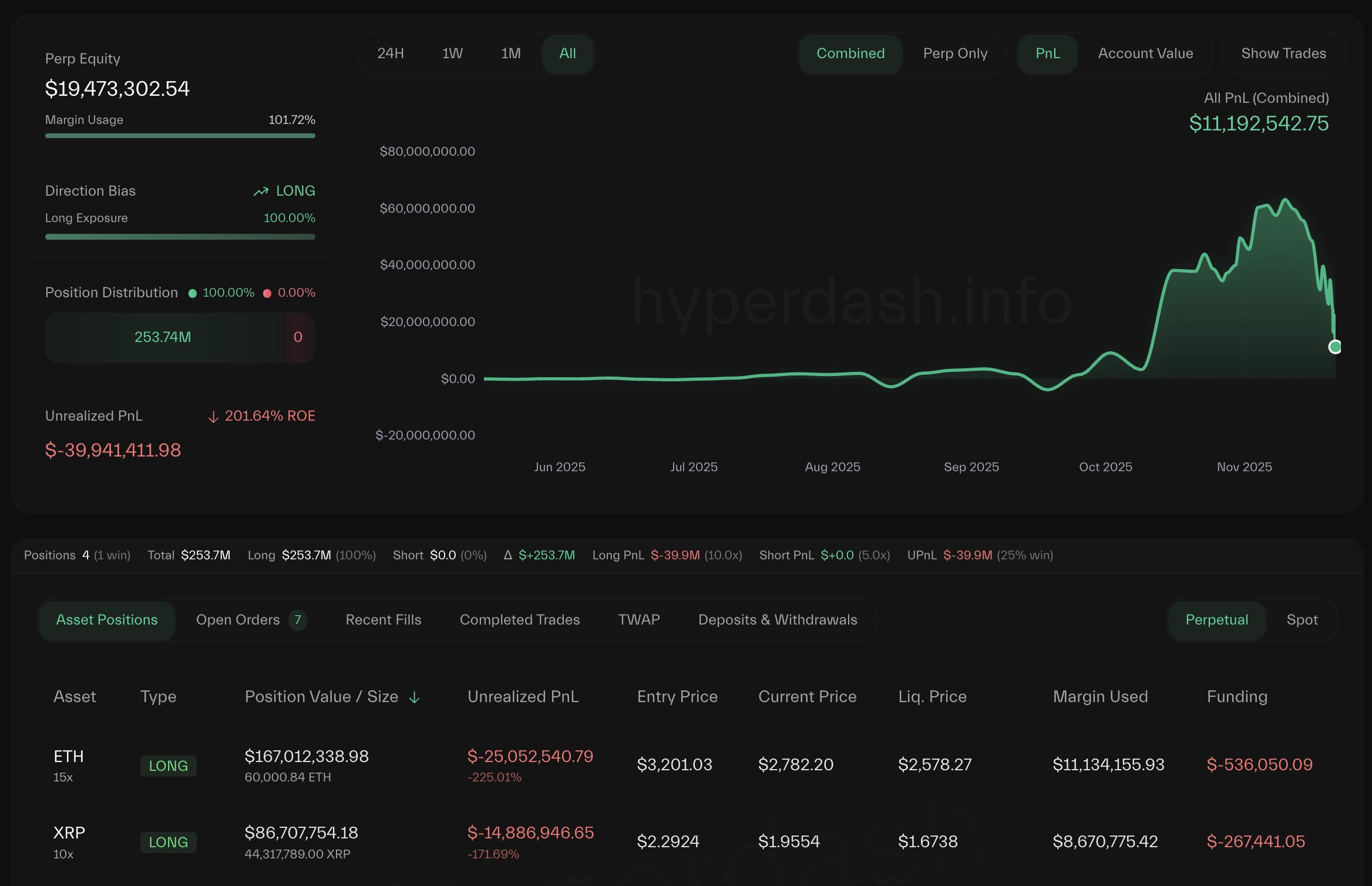
Anti-CZ Whale Ethereum and XRP Positions | Source: Lookonchain

However, as the crypto market sharply corrected, his oversized ETH and XRP longs turned against him. The result has been a brutal drawdown: his total profit has now fallen to just $38.4 million, wiping out more than 60% of gains in less than two weeks.

This dramatic reversal reflects more than one trader’s misfortune — it signals the extent of the pressure weighing on Ethereum. As ETH continues to decline and investor sentiment deteriorates, even the most seasoned actors are struggling to navigate the volatility. The whale’s rapid profit erosion highlights how quickly bullish conviction can shift when key support levels fail.

For Ethereum, holding the current zone is crucial. Price action has already inflicted significant pain across longs, short-term holders, and leveraged players. If ETH loses this support decisively, the next wave of forced selling could deepen losses and accelerate the broader market capitulation.

ETH Price Analysis: Testing a Major Weekly Support Zone

Ethereum has entered a critical phase on the weekly timeframe, with price pulling back sharply toward the $2,680 region — a level that now acts as the last meaningful support before a deeper market breakdown. The chart shows a strong rejection from the $4,500 zone earlier this quarter, followed by a sustained series of lower highs and lower lows, confirming a medium-term downtrend.

The 50-week moving average has been lost decisively, and ETH is now sitting directly on top of the 100-week MA, a level that has historically acted as a key pivot during major market corrections.
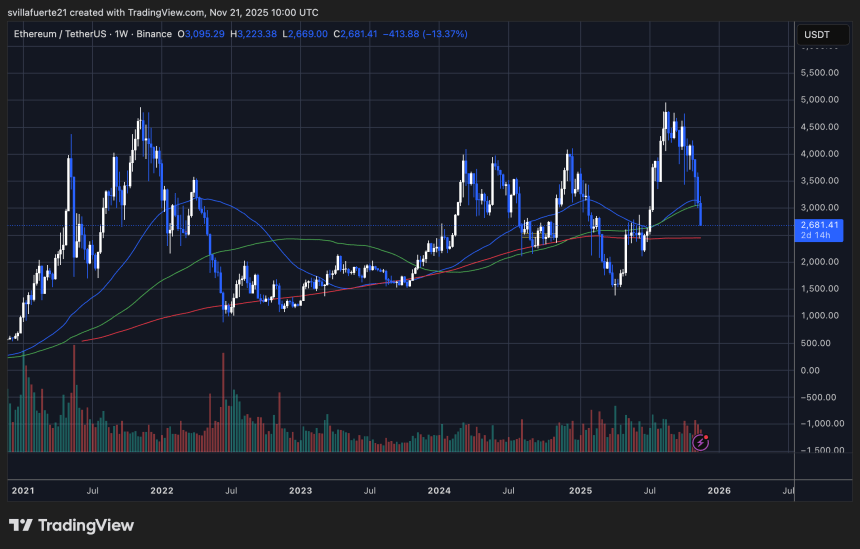
ETH setting fresh lows | Source: ETHUSDT chart on TradingView

Volume has expanded during the recent drop, highlighting an environment driven by fear and forced selling rather than controlled profit-taking. This aligns with broader market conditions, where liquidity is thin and volatility remains elevated across majors. A clean break below $2,650 would open the door for a retest of the $2,300–$2,400 zone, which served as strong accumulation during previous cycles.

However, the weekly chart also shows that ETH is entering a historically oversold area, similar to mid-2022 and late-2023, where reversals eventually formed after weeks of compression. For now, Ethereum must hold above this weekly support to avoid a deeper retrace and preserve the structure needed for a potential recovery.

Featured image from ChatGPT, chart from TradingView.com

Market Opportunity
XRP Logo
XRP Price(XRP)
$1.8641
$1.8641$1.8641
+0.04%
USD
XRP (XRP) Live Price Chart
Disclaimer: The articles reposted on this site are sourced from public platforms and are provided for informational purposes only. They do not necessarily reflect the views of MEXC. All rights remain with the original authors. If you believe any content infringes on third-party rights, please contact service@support.mexc.com for removal. MEXC makes no guarantees regarding the accuracy, completeness, or timeliness of the content and is not responsible for any actions taken based on the information provided. The content does not constitute financial, legal, or other professional advice, nor should it be considered a recommendation or endorsement by MEXC.

You May Also Like

Botanix launches stBTC to deliver Bitcoin-native yield

Botanix launches stBTC to deliver Bitcoin-native yield

The post Botanix launches stBTC to deliver Bitcoin-native yield appeared on BitcoinEthereumNews.com. Botanix Labs has launched stBTC, a liquid staking token designed to turn Bitcoin into a yield-bearing asset by redistributing network gas fees directly to users. The protocol will begin yield accrual later this week, with its Genesis Vault scheduled to open on Sept. 25, capped at 50 BTC. The initiative marks one of the first attempts to generate Bitcoin-native yield without relying on inflationary token models or centralized custodians. stBTC works by allowing users to deposit Bitcoin into Botanix’s permissionless smart contract, receiving stBTC tokens that represent their share of the staking vault. As transactions occur, 50% of Botanix network gas fees, paid in BTC, flow back to stBTC holders. Over time, the value of stBTC increases relative to BTC, enabling users to redeem their original deposit plus yield. Botanix estimates early returns could reach 20–50% annually before stabilizing around 6–8%, a level similar to Ethereum staking but fully denominated in Bitcoin. Botanix says that security audits have been completed by Spearbit and Sigma Prime, and the protocol is built on the EIP-4626 vault standard, which also underpins Ethereum-based staking products. The company’s Spiderchain architecture, operated by 16 independent entities including Galaxy, Alchemy, and Fireblocks, secures the network. If adoption grows, Botanix argues the system could make Bitcoin a productive, composable asset for decentralized finance, while reinforcing network consensus. This is a developing story. This article was generated with the assistance of AI and reviewed by editor Jeffrey Albus before publication. Get the news in your inbox. Explore Blockworks newsletters: Source: https://blockworks.co/news/botanix-launches-stbtc
Share
BitcoinEthereumNews2025/09/18 02:37
Bitcoin ETFs Surge with 20,685 BTC Inflows, Marking Strongest Week

Bitcoin ETFs Surge with 20,685 BTC Inflows, Marking Strongest Week

TLDR Bitcoin ETFs recorded their strongest weekly inflows since July, reaching 20,685 BTC. U.S. Bitcoin ETFs contributed nearly 97% of the total inflows last week. The surge in Bitcoin ETF inflows pushed holdings to a new high of 1.32 million BTC. Fidelity’s FBTC product accounted for 36% of the total inflows, marking an 18-month high. [...] The post Bitcoin ETFs Surge with 20,685 BTC Inflows, Marking Strongest Week appeared first on CoinCentral.
Share
Coincentral2025/09/18 02:30
Nvidia acquired Groq's assets for $20 billion, but officially stated that it did not acquire the entire company.

Nvidia acquired Groq's assets for $20 billion, but officially stated that it did not acquire the entire company.

PANews reported on December 25th that, according to CNBC, Nvidia has agreed to acquire all assets of AI chip startup Groq (excluding its GroqCloud business) for
Share
PANews2025/12/25 08:25