Bitcoin Magazine Bitcoin Defends $84K Support Like a Champ: Oversold Bounce Targets $94K This Week Bitcoin plunged to $80,000 but powerfully reclaimed the critical $84,000 support zone, closing the week at $86,850. With daily RSI deeply oversold, traders are eyeing a sharp move toward $91,400 and the $94,000 high-volume node this week. This post Bitcoin Defends $84K Support Like a Champ: Oversold Bounce Targets $94K This Week first appeared on Bitcoin Magazine and is written by Ethan Greene - Feral Analysis and Juan Galt.Bitcoin Magazine Bitcoin Defends $84K Support Like a Champ: Oversold Bounce Targets $94K This Week Bitcoin plunged to $80,000 but powerfully reclaimed the critical $84,000 support zone, closing the week at $86,850. With daily RSI deeply oversold, traders are eyeing a sharp move toward $91,400 and the $94,000 high-volume node this week. This post Bitcoin Defends $84K Support Like a Champ: Oversold Bounce Targets $94K This Week first appeared on Bitcoin Magazine and is written by Ethan Greene - Feral Analysis and Juan Galt.

Bitcoin Defends $84K Support Like a Champ: Oversold Bounce Targets $94K This Week

Bitcoin Magazine

Bitcoin Defends $84K Support Like a Champ: Oversold Bounce Targets $94K This Week

Bitcoin Bulls Stunned after Sellers Take Price All the Way Down to $80K

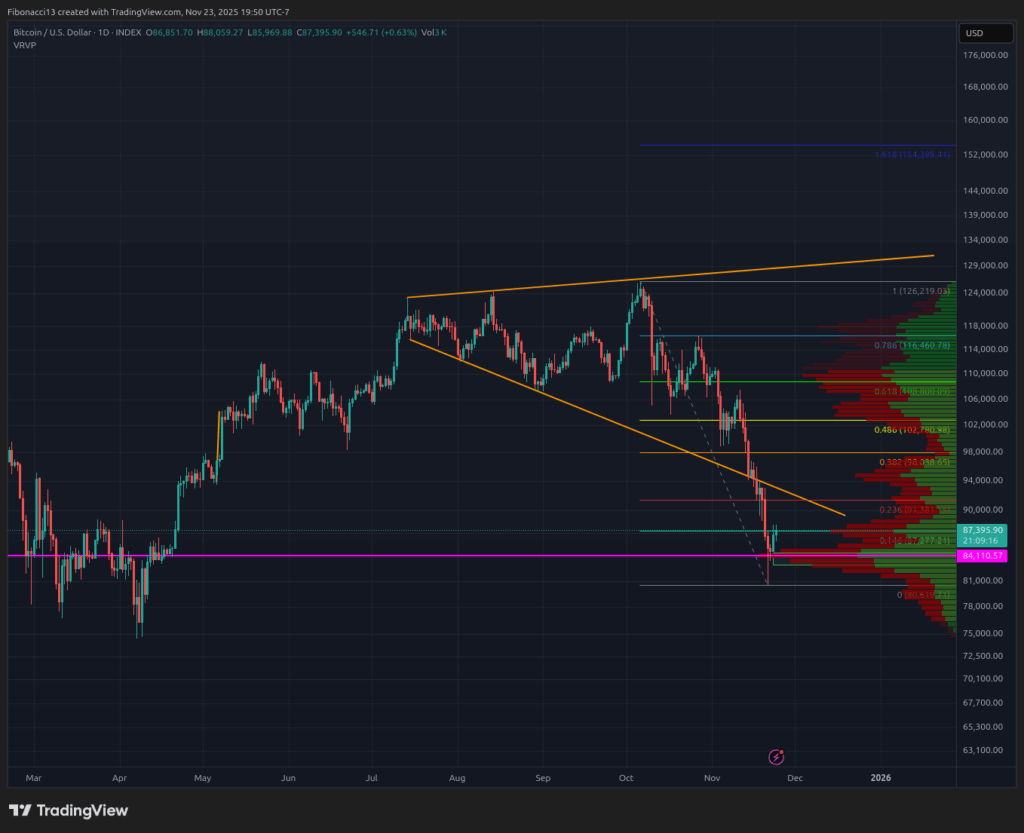
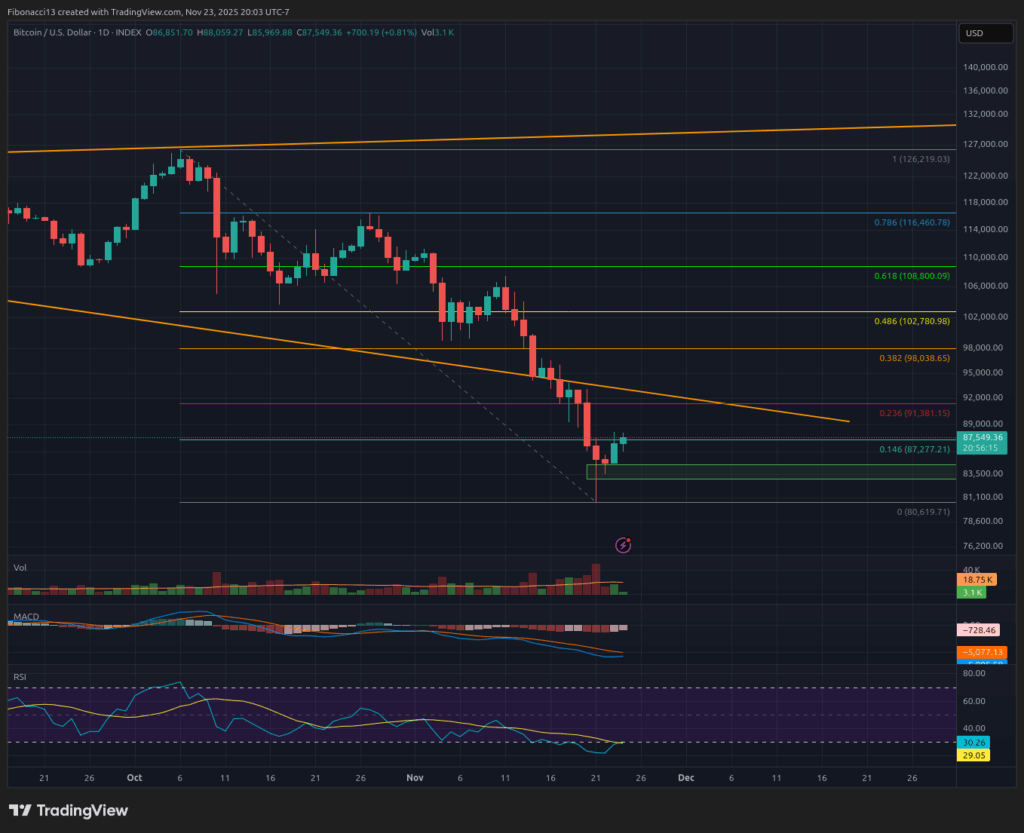
Last week, we identified the $84,000 area as the next major support for bitcoin, and that’s exactly where the price went. Bitcoin dropped to nearly $80,000 but managed to climb back above $84,000 support to close the week out at $86,850. Heading into this week, look for bears to let off the gas pedal a little bit as they sit comfortably in control of the price action. Daily oscillators were heavily oversold heading into this past weekend, so a bounce is in order at least into Monday, possibly a little further out.
Bitcoin Defends $84K Support Like a Champ: Oversold Bounce Targets $94K This Week

Key Support and Resistance Levels Now

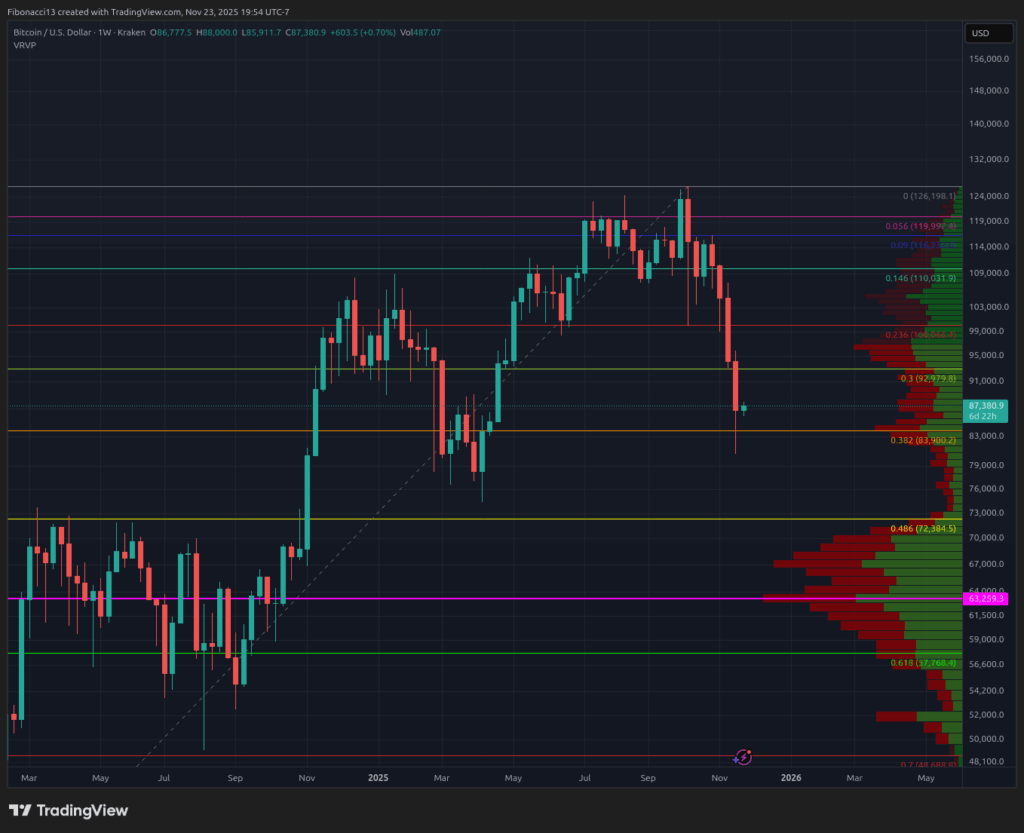
$84,000 Support held on the weekly close, so this is the level bulls will want to remain above into this week’s close. If $84,000 is lost, bulls look to $75,000, which likely won’t be too strong of a support level, and below there we’ve got a high volume support zone between $72,000 and $69,000. It’s difficult to see the price pushing below $70,000 too quickly, so expect some bounces from this area, even if it eventually fails to hold. Below here, we have the $58k gang support and 0.618 Fibonacci retracement at $57,700.

With last week’s price breakdown, resistance levels have now changed heading into this week. Bulls will look to take on the $91,400 resistance level at the 0.236 Fibonacci retracement first and foremost. Above here, we should see strong resistance at $94,000 now at the high volume node. If price can manage to grind through this zone, $98,000 sits above it as a final barrier to establish this high-volume node as support. If this occurs, there are still resistance levels at $103,000 and another at $109,000 at the 0.618 Fibonacci retracement. Finally,  $116,500 remains as the last layer of resistance preventing the price from achieving new highs.
Bitcoin Defends $84K Support Like a Champ: Oversold Bounce Targets $94K This Week

Outlook For This Week

Daily RSI hit very oversold levels on Friday last week, so it is not surprising that the price made a move up into the weekend from those lows. This week, look for the price to try to challenge the $91,400 resistance level and potentially $94,000 if it can climb above there. As long as the price can hold above $84,000, it should try to head for those target levels. With all the selling leading into last Friday, another big selloff should not be expected, but if the $80,000 low is lost, the price could drop to $75,000 this week.
Bitcoin Defends $84K Support Like a Champ: Oversold Bounce Targets $94K This Week

Market mood: Extremely Bearish – The bulls are down on the canvas. Little hope remains for any meaningful rally or new highs after losing major support levels.

The next few weeks
The broadening wedge pattern we were watching for so many weeks finally and definitively broke to the downside last week. The target for this pattern is right around $70,000, so even if we see a rally this week and into the next, the price should eventually roll back over and head down to test $70,000. The US government, getting back to work last week, did nothing to assist the markets. In the coming weeks, it may be difficult to predict when economic data may or may not be available since much of it was delayed due to the shutdown. The market is mixed on whether or not the Federal Reserve will reduce interest rates at the next meeting, and they themselves seem to be conflicted between balancing inflation concerns with labor market issues.

Terminology Guide:

Bulls/Bullish: Buyers or investors expecting the price to go higher.

Bears/Bearish: Sellers or investors expecting the price to go lower.

Support or support level: A level at which the price should hold for the asset, at least initially. The more touches on support, the weaker it gets and the more likely it is to fail to hold the price.

Resistance or resistance level: Opposite of support.  The level that is likely to reject the price, at least initially. The more touches at resistance, the weaker it gets and the more likely it is to fail to hold back the price.

Fibonacci Retracements and Extensions: Ratios based on what is known as the golden ratio, a universal ratio pertaining to growth and decay cycles in nature. The golden ratio is based on the constants Phi (1.618) and phi (0.618).

Volume Profile: An indicator that displays the total volume of buys and sells at specific price levels. The point of control (or POC) is a horizontal line on this indicator that shows us the price level at which the highest volume of transactions occurred.

High Volume Node: An area in the price where a large amount of buying and selling occurred. These are price areas that have had a high volume of transactions and we would expect them to act as support when price is above and resistance when price is below.

RSI Oscillator: The Relative Strength Index is a momentum oscillator that moves between 0 and 100. It measures the speed of the price and changes in the speed of the price movements. When RSI is over 70, it is considered to be overbought. When RSI is below 30, it is considered to be oversold.

Broadening Wedge: A chart pattern consisting of an upper trend line acting as resistance and a lower trend line acting as support. These trend lines must diverge away from each other in order to validate the pattern. This pattern is a result of expanding price volatility, typically resulting in higher highs and lower lows.

This post Bitcoin Defends $84K Support Like a Champ: Oversold Bounce Targets $94K This Week first appeared on Bitcoin Magazine and is written by Ethan Greene - Feral Analysis and Juan Galt.

Market Opportunity
Wink Logo
Wink Price(LIKE)
$0,003313
$0,003313$0,003313
-0,30%
USD
Wink (LIKE) Live Price Chart
Disclaimer: The articles reposted on this site are sourced from public platforms and are provided for informational purposes only. They do not necessarily reflect the views of MEXC. All rights remain with the original authors. If you believe any content infringes on third-party rights, please contact service@support.mexc.com for removal. MEXC makes no guarantees regarding the accuracy, completeness, or timeliness of the content and is not responsible for any actions taken based on the information provided. The content does not constitute financial, legal, or other professional advice, nor should it be considered a recommendation or endorsement by MEXC.

You May Also Like

XRP faces far more negative social media commentary than average

XRP faces far more negative social media commentary than average

The post XRP faces far more negative social media commentary than average appeared on BitcoinEthereumNews.com. XRP is drawing unusually high levels of negative
Share
BitcoinEthereumNews2025/12/23 19:23
Xcimer Energy Delivers Technical Update to U.S. Energy Sec. Chris Wright and U.S. Rep. Gabe Evans in Denver Laser Bay

Xcimer Energy Delivers Technical Update to U.S. Energy Sec. Chris Wright and U.S. Rep. Gabe Evans in Denver Laser Bay

High-level visit, also including Chancellor of Colorado State University System Dr. Tony Frank, comes after Xcimer begins testing of one of the highest-energy KrF
Share
AI Journal2025/12/23 19:16
Crucial US Stock Market Update: What Wednesday’s Mixed Close Reveals

Crucial US Stock Market Update: What Wednesday’s Mixed Close Reveals

BitcoinWorld Crucial US Stock Market Update: What Wednesday’s Mixed Close Reveals The financial world often keeps us on our toes, and Wednesday was no exception. Investors watched closely as the US stock market concluded the day with a mixed performance across its major indexes. This snapshot offers a crucial glimpse into current investor sentiment and economic undercurrents, prompting many to ask: what exactly happened? Understanding the Latest US Stock Market Movements On Wednesday, the closing bell brought a varied picture for the US stock market. While some indexes celebrated gains, others registered slight declines, creating a truly mixed bag for investors. The Dow Jones Industrial Average showed resilience, climbing by a notable 0.57%. This positive movement suggests strength in some of the larger, more established companies. Conversely, the S&P 500, a broader benchmark often seen as a barometer for the overall market, experienced a modest dip of 0.1%. The technology-heavy Nasdaq Composite also saw a slight retreat, sliding by 0.33%. This particular index often reflects investor sentiment towards growth stocks and the tech sector. These divergent outcomes highlight the complex dynamics currently at play within the American economy. It’s not simply a matter of “up” or “down” for the entire US stock market; rather, it’s a nuanced landscape where different sectors and company types are responding to unique pressures and opportunities. Why Did the US Stock Market See Mixed Results? When the US stock market delivers a mixed performance, it often points to a tug-of-war between various economic factors. Several elements could have contributed to Wednesday’s varied closings. For instance, positive corporate earnings reports from certain industries might have bolstered the Dow. At the same time, concerns over inflation, interest rate policies by the Federal Reserve, or even global economic uncertainties could have pressured growth stocks, affecting the S&P 500 and Nasdaq. Key considerations often include: Economic Data: Recent reports on employment, manufacturing, or consumer spending can sway market sentiment. Corporate Announcements: Strong or weak earnings forecasts from influential companies can significantly impact their respective sectors. Interest Rate Expectations: The prospect of higher or lower interest rates directly influences borrowing costs for businesses and consumer spending, affecting future profitability. Geopolitical Events: Global tensions or trade policies can introduce uncertainty, causing investors to become more cautious. Understanding these underlying drivers is crucial for anyone trying to make sense of daily market fluctuations in the US stock market. Navigating Volatility in the US Stock Market A mixed close, while not a dramatic downturn, serves as a reminder that market volatility is a constant companion for investors. For those involved in the US stock market, particularly individuals managing their portfolios, these days underscore the importance of a well-thought-out strategy. It’s important not to react impulsively to daily movements. Instead, consider these actionable insights: Diversification: Spreading investments across different sectors and asset classes can help mitigate risk when one area underperforms. Long-Term Perspective: Focusing on long-term financial goals rather than short-term gains can help weather daily market swings. Stay Informed: Keeping abreast of economic news and company fundamentals provides context for market behavior. Consult Experts: Financial advisors can offer personalized guidance based on individual risk tolerance and objectives. Even small movements in major indexes can signal shifts that require attention, guiding future investment decisions within the dynamic US stock market. What’s Next for the US Stock Market? Looking ahead, investors will be keenly watching for further economic indicators and corporate announcements to gauge the direction of the US stock market. Upcoming inflation data, statements from the Federal Reserve, and quarterly earnings reports will likely provide more clarity. The interplay of these factors will continue to shape investor confidence and, consequently, the performance of the Dow, S&P 500, and Nasdaq. Remaining informed and adaptive will be key to understanding the market’s trajectory. Conclusion: Wednesday’s mixed close in the US stock market highlights the intricate balance of forces influencing financial markets. While the Dow showed strength, the S&P 500 and Nasdaq experienced slight declines, reflecting a nuanced economic landscape. This reminds us that understanding the ‘why’ behind these movements is as important as the movements themselves. As always, a thoughtful, informed approach remains the best strategy for navigating the complexities of the market. Frequently Asked Questions (FAQs) Q1: What does a “mixed close” mean for the US stock market? A1: A mixed close indicates that while some major stock indexes advanced, others declined. It suggests that different sectors or types of companies within the US stock market are experiencing varying influences, rather than a uniform market movement. Q2: Which major indexes were affected on Wednesday? A2: On Wednesday, the Dow Jones Industrial Average gained 0.57%, while the S&P 500 edged down 0.1%, and the Nasdaq Composite slid 0.33%, illustrating the mixed performance across the US stock market. Q3: What factors contribute to a mixed stock market performance? A3: Mixed performances in the US stock market can be influenced by various factors, including specific corporate earnings, economic data releases, shifts in interest rate expectations, and broader geopolitical events that affect different market segments uniquely. Q4: How should investors react to mixed market signals? A4: Investors are generally advised to maintain a long-term perspective, diversify their portfolios, stay informed about economic news, and avoid impulsive decisions. Consulting a financial advisor can also provide personalized guidance for navigating the US stock market. Q5: What indicators should investors watch for future US stock market trends? A5: Key indicators to watch include upcoming inflation reports, statements from the Federal Reserve regarding monetary policy, and quarterly corporate earnings reports. These will offer insights into the future direction of the US stock market. Did you find this analysis of the US stock market helpful? Share this article with your network on social media to help others understand the nuances of current financial trends! To learn more about the latest stock market trends, explore our article on key developments shaping the US stock market‘s future performance. This post Crucial US Stock Market Update: What Wednesday’s Mixed Close Reveals first appeared on BitcoinWorld.
Share
Coinstats2025/09/18 05:30