

The smarter you are, the easier it is to get stuck. Intelligence creates hesitation, doubt, and perfectionism. Success comes from motion, visibility, and repetition. Not mastery. Confidence is built through exposure.The smarter you are, the easier it is to get stuck. Intelligence creates hesitation, doubt, and perfectionism. Success comes from motion, visibility, and repetition. Not mastery. Confidence is built through exposure.
Why Dumb People Outsmart You and Steal Your Success
For feedback or concerns regarding this content, please contact us at crypto.news@mexc.com
\
David Dunning
\ 
\
Overview
- The Intelligence Trap
- The Bias Toward Motion
- The Confidence Loop
- The Feedback Advantage
- Review
- Actions
\
The Intelligence Trap
- Paralysis — Most people aren’t losing because they’re dumb. They’re losing because they hesitate. Intelligence often works against you: the more aware you are of the risks, the more likely you are to freeze. Smart people convince themselves that hesitation is strategy, but it’s usually fear disguised as logic.
- Overthinking — You’ve probably talked yourself out of more opportunities than the world ever took from you. You tell yourself, I’m not ready yet, I need to learn a bit more, I’ll start when it feels right. But that feeling never comes. The people you call reckless started before they were ready, and that’s exactly why they learned faster than you did.
- False Standards — You believe there’s an invisible threshold where you finally become “qualified.” You picture a line where you’ll magically feel ready to start the podcast, pitch the client, post the video. That line doesn’t exist. There are no gatekeepers. The only permission slip is the one you sign yourself.
- Awareness — Intelligence creates self-doubt. The smarter you are, the more flaws you see. You’re painfully aware of how far you are from mastery, and that awareness becomes a weight you carry everywhere. You see the cracks in your own work and assume everyone else sees them too. The truth: they don’t. They’re too busy looking at their own.
- Comparison — You measure yourself against experts who have been at it for a decade, not beginners who just started. You scroll through polished results and forget how ugly the early versions were. Dumb people don’t have that problem, they compare themselves only to their previous attempt. That’s why they improve faster.
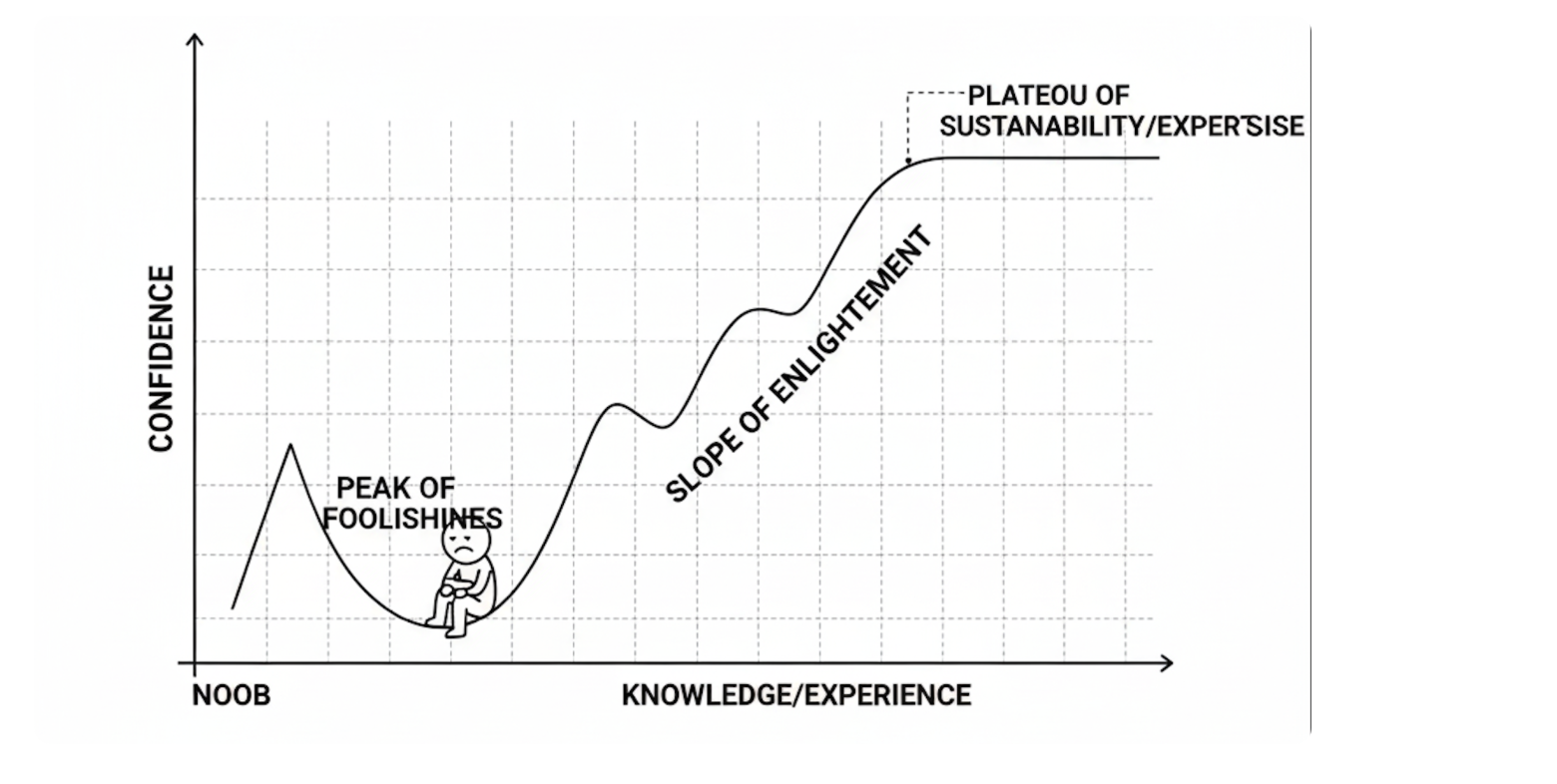
- Reversal — That’s the Dunning-Kruger effect in motion. People who know little overestimate themselves, and people who know a lot underestimate themselves. The irony is brutal: the ones least qualified feel most confident, while the most competent stay quiet and stuck.
- Punishment — The world doesn’t reward the most prepared, it rewards the most visible. You think you’ll be recognized for your potential, but potential isn’t marketable. Output is. Dumb people aren’t waiting to be discovered; they’re already posting, pitching, and promoting.
\
The Bias Toward Motion
- Ignorant Momentum — When you don’t know what can go wrong, you move without friction. Dumb people act out of blindness, not bravery. But that blindness becomes an edge. While you’re busy analyzing variables, they’re collecting data through action.
- Default Action — They act first and fix later. Their first launch flops, so they learn. Their second launch improves, so they grow. You, on the other hand, are still in version 0.1 of your plan, trying to predict outcomes instead of testing them. The market rewards motion, not forecasts.
- The Irony of Expertise — Real experts know enough to be cautious, which makes them slow. Amateurs move fast because they’re too naive to see the depth of the problem. By the time the expert takes the first step, the fool already owns the attention, the audience, and half the market share.
- Perception Beats Precision — People buy conviction before they buy correctness. They follow confidence, not IQ. If someone speaks with certainty, the brain equates that certainty with competence. That’s why fake gurus thrive and quiet professionals fade into the background.
- Visibility Law — In every domain (business, art, relationships) certainty is louder than skill. If you aren’t visible, you’re invisible, no matter how brilliant your work is. Dumb people are visible by accident; smart people remain invisible on purpose, and they call it humility. One of them gets paid. If you need to read that again, feel free.
- Isolation Cost — The smarter you are, the more likely you are to isolate. You tell yourself you’re “focusing,” but isolation kills feedback. Dumb people broadcast everything. They get data early. They learn in public. Every piece of feedback compounds their competence. Meanwhile, your silence compounds your doubt.
\
The Confidence Loop
- Reframe — Confidence isn’t something you earn after you succeed; it’s something you decide before you do. Stupid people don’t wait for proof: they move first. Confidence is not arrogance; it’s simply refusing to let uncertainty make your decisions.
- Loop Mechanics — Action → Evidence → Belief → More Action. Every move produces evidence that you’re capable. That evidence rewires your identity. Belief grows, and with it, your willingness to take bigger risks. The loop reinforces itself until movement becomes your default.
- Exposure Therapy — Each time you act while afraid, your nervous system learns that fear isn’t fatal. The discomfort fades faster than you expect. After enough reps, risk feels like home. That’s how confidence is built: through friction, not through affirmations. How did you learn to ride a bicycle?
- Failure Math — Dumb people don’t romanticize failure, they normalize it. They fail so often it stops meaning anything. That’s why they appear fearless. Their secret isn’t courage; it’s repetition. You can’t build thick skin by staying safe.
- Public Reps — Confidence doesn’t live in your head, it lives in the arena. Each visible action, every post, pitch, or project adds to your internal database of proof. The more you show up, the more solid your self-belief becomes. Private wins feel good, but public ones rewire your identity.
- Identity Shift — Eventually, you stop chasing confidence and start embodying it. You no longer need to feel ready because you’ve proven that readiness is irrelevant. You act first, refine later. That’s the loop dumb people enter by accident, but you can enter on purpose once you finish this training.
\
The Feedback Advantage
- Reversal — The Dunning-Kruger curve is a staircase more than it is an obstacle. Everyone climbs it: blind confidence, harsh reality, humble rebuilding, quiet mastery. The only difference is how long you stay stuck on each step.
- Permission Loop — Dumb people don’t wait for permission to publish, pitch, or sell. They give themselves permission through action. Smart people wait for validation that never comes. Confidence is self-issued; if you’re waiting for approval, you’re outsourcing your potential.
- Start Ugly — Your first version will suck. The second version will suck. That’s their job. It’s supposed to be clumsy. It’s supposed to be awkward and incomplete. You get to version 10 only by releasing versions 1 through 9. Perfection is just procrastination wearing expensive clothes.
- Visibility Pressure — Being seen creates accountability. When you put your work in public, you stop negotiating with yourself. You start refining faster because now the world is watching. That pressure is priceless because it forces evolution.
- Systems Over Feelings — Motivation is unreliable. Systems aren’t. Build structures that force movement even when you don’t feel like it. Post every day. Make five offers a week. Review what worked every Friday. You don’t need more discipline, you just need fewer decisions.
- Neural Truth — Action rewires the brain faster than belief. Each time you move, your brain logs a win and releases dopamine. And over time, you become chemically addicted to progress. Comfort starts to feel dangerous. Growth becomes the new baseline.
- Social Leverage — Stupid people use the crowd as a mirror. They get feedback early, adapt publicly, and earn trust through transparency. Smart people hide until they’re perfect. But perfection can’t be trusted, it’s too polished to be real. Authentic imperfection always wins attention.
\
Review
- Intelligence without motion becomes self-sabotage.
- The world rewards conviction before competence.
- Confidence is not found; it’s trained through exposure.
- Failure is a feedback system, not a verdict.
- Visibility compounds faster than skill.
- The people you call “dumb” or “stupid” are just willing to look stupid longer than you.
- The only qualification for success is movement.
Actions
- Start Now — Pick one uncomfortable action you’ve delayed and do it today. Post it. Ship it. Send it. The goal isn’t perfection. It’s participation.
- Volume Sprint — Run a 30-day experiment: produce something every day and publish it. Ignore metrics. Focus on the reps.
- Reframe Doubt — When fear shows up, remember: dumber people are already winning. Use that as proof that readiness is irrelevant.
- Audit Visibility — List the areas of your life or business where you’re invisible by choice. Visibility is leverage; stop hiding your value.
- Repeat Forever — Action → Feedback → Iteration → Identity. That’s the entire game.
\ Talk soon,
Benoit
Market Opportunity
ConstitutionDAO Price(PEOPLE)
$0,006675
$0,006675$0,006675
USD
ConstitutionDAO (PEOPLE) Live Price Chart
Disclaimer: The articles reposted on this site are sourced from public platforms and are provided for informational purposes only. They do not necessarily reflect the views of MEXC. All rights remain with the original authors. If you believe any content infringes on third-party rights, please contact crypto.news@mexc.com for removal. MEXC makes no guarantees regarding the accuracy, completeness, or timeliness of the content and is not responsible for any actions taken based on the information provided. The content does not constitute financial, legal, or other professional advice, nor should it be considered a recommendation or endorsement by MEXC.
You May Also Like

UK and US Seal $42 Billion Tech Pact Driving AI and Energy Future
The post UK and US Seal $42 Billion Tech Pact Driving AI and Energy Future appeared on BitcoinEthereumNews.com. Key Highlights Microsoft and Google pledge billions as part of UK US tech partnership Nvidia to deploy 120,000 GPUs with British firm Nscale in Project Stargate Deal positions UK as an innovation hub rivaling global tech powers UK and US Seal $42 Billion Tech Pact Driving AI and Energy Future The UK and the US have signed a “Technological Prosperity Agreement” that paves the way for joint projects in artificial intelligence, quantum computing, and nuclear energy, according to Reuters. Donald Trump and King Charles review the guard of honour at Windsor Castle, 17 September 2025. Image: Kirsty Wigglesworth/Reuters The agreement was unveiled ahead of U.S. President Donald Trump’s second state visit to the UK, marking a historic moment in transatlantic technology cooperation. Billions Flow Into the UK Tech Sector As part of the deal, major American corporations pledged to invest $42 billion in the UK. Microsoft leads with a $30 billion investment to expand cloud and AI infrastructure, including the construction of a new supercomputer in Loughton. Nvidia will deploy 120,000 GPUs, including up to 60,000 Grace Blackwell Ultra chips—in partnership with the British company Nscale as part of Project Stargate. Google is contributing $6.8 billion to build a data center in Waltham Cross and expand DeepMind research. Other companies are joining as well. CoreWeave announced a $3.4 billion investment in data centers, while Salesforce, Scale AI, BlackRock, Oracle, and AWS confirmed additional investments ranging from hundreds of millions to several billion dollars. UK Positions Itself as a Global Innovation Hub British Prime Minister Keir Starmer said the deal could impact millions of lives across the Atlantic. He stressed that the UK aims to position itself as an investment hub with lighter regulations than the European Union. Nvidia spokesman David Hogan noted the significance of the agreement, saying it would…
Share
BitcoinEthereumNews2025/09/18 02:22

Shiba Inu (SHIB) Sees Shorts Exit in 4 Hours While Price Eyes Recovery
The post Shiba Inu (SHIB) Sees Shorts Exit in 4 Hours While Price Eyes Recovery appeared on BitcoinEthereumNews.com. Shiba Inu reversed a three-day drop earlier
Share
BitcoinEthereumNews2026/03/22 16:25

Szabo Warns Developers Not to Break Bitcoin
The post Szabo Warns Developers Not to Break Bitcoin appeared on BitcoinEthereumNews.com. The nonviolent blockchain Is Bitcoin used as money? Legendary cryptographer
Share
BitcoinEthereumNews2026/03/22 16:37
