Bitcoin’s three-year advance may be rolling over, according to Chartered Market Technician Tony Severino, who argues that BTC has now completed a “triple bearish divergence” on higher timeframes – a structure he characterises as the trend “dying under the hood” even as price printed fresh highs. Bitcoin Has Hit A Triple Bearish Divergence In a video published on November 24 and shared on X, Severino says he had to go beyond standard references to formalise the pattern. “I really never heard that statement before,” he admits of the term triple negative divergence. “There wasn’t a lot of information on Google […] I turned to AI, turned to ChatGPT.” His working definition: “three successive higher highs on price and three successive lower highs on the technical indicator.” Related Reading: Bitcoin Local Bottom To Fall Between These Two Levels – Analyst A standard bearish divergence occurs when price makes a higher high while an oscillator such as RSI, MACD or Stochastic posts a lower high, signalling trend exhaustion. Extending that to three peaks, Severino says, amplifies the warning: “A triple negative or triple bearish divergence is basically the market screaming, price is still drifting higher, but under the hood, this trend is dying.” Later he adds, “A single divergence is already a warning. A triple divergence is like yellow, orange, flashing red.” Severino maps this pattern onto Bitcoin’s bull cycle using the monthly chart, anchored around three key highs. The first, he argues, came around the spot ETF launch and aligned with a wave-three impulse in his Elliott Wave count. “This was our ETF launch and it was during our wave three impulse […] everybody’s excited. We had the ETF launch […] strong volume, strong momentum,” he says, calling it the cycle’s momentum peak. The second high broke that level but on weaker internals. “Second high breaks the old high. The indicator’s high is weaker. This represents fewer aggressive buyers. Early participants start taking profits. This was me. I started taking profit here,” he notes. In his interpretation, that push represented a fifth wave. The third high, marginally above prior peaks near $126,000, is where he sees exhaustion. “On the third high, price index is higher. Marginal new high […] I sold around $105k […] we went to $126k, so I left only a very small amount on the table to not get caught up in what comes after all this,” he says. The oscillator, however, made yet another lower high: “Buyers are exhausted at this point. Shorts are covering, late FOMO buyers push it just a little bit higher. Pros use this zone to offload positions or start shorting.” He argues that sentiment at the top was complacent rather than euphoric. “I don’t think we were euphoric here. I think we were euphoric at this one […] but we were very complacent this whole time […] everybody just was like, it’s going up forever.” Related Reading: Is Bitcoin Yet To Top In This Cycle? What aSOPR Suggests Crucially, Severino insists the divergence is a setup, not a standalone trigger: “You want confirmation before acting.” He points to several. First, a break of the rising trendline connecting the major swing lows: “Here is our trend line and we are below. There is our confirmation.” Second, loss of key moving averages such as the 20 and 50 EMA that had supported the uptrend. Third, a regime shift in weekly RSI: during the bull, it repeatedly bounced in the 40–50 zone, but now, he says, “falling below it is confirmation that the trend is now no longer holding.” On volume, he warns against reading the recent spike on a down candle as capitulation. While the FTX bottom showed extreme, climactic volume, the latest breakout in selling may instead be “the breakout and start of a trend” to the downside, he suggests, especially given the declining volume into Bitcoin’s final highs. How Low Can Bitcoin Go? For potential downside, Severino overlays Fibonacci levels on the full advance and references guidance that triple divergences often resolve toward the 0.5–0.618 retracement between $44,100 and $34,409. In Bitcoin’s case, he marks a wide lower zone where an A-B-C structure could terminate, estimating “about like 60 something percent, maybe even closer to 70” from the top – “very par for the course for a Bitcoin bear market,” in his words. More ominously, he hints at a “bigger version of this” on even higher timeframes, suggesting a larger triple divergence may be forming with the recent structure nested inside it. “This could not be so great for the higher time frames Bitcoin,” he says. Still, he repeatedly stresses uncertainty and risk management. “I can’t say that this signal is the end-all be-all […] it doesn’t guarantee anything,” he says. “I definitely don’t want you to be like, hey, Tony, well, I believe you 100%. Immediately, I’m going to sell my coins. No, it’s not financial advice […] It’s more about how you manage risk.” At press time, Bitcoin traded at $87,658. Featured image created with DALL.E, chart from TradingView.comBitcoin’s three-year advance may be rolling over, according to Chartered Market Technician Tony Severino, who argues that BTC has now completed a “triple bearish divergence” on higher timeframes – a structure he characterises as the trend “dying under the hood” even as price printed fresh highs. Bitcoin Has Hit A Triple Bearish Divergence In a video published on November 24 and shared on X, Severino says he had to go beyond standard references to formalise the pattern. “I really never heard that statement before,” he admits of the term triple negative divergence. “There wasn’t a lot of information on Google […] I turned to AI, turned to ChatGPT.” His working definition: “three successive higher highs on price and three successive lower highs on the technical indicator.” Related Reading: Bitcoin Local Bottom To Fall Between These Two Levels – Analyst A standard bearish divergence occurs when price makes a higher high while an oscillator such as RSI, MACD or Stochastic posts a lower high, signalling trend exhaustion. Extending that to three peaks, Severino says, amplifies the warning: “A triple negative or triple bearish divergence is basically the market screaming, price is still drifting higher, but under the hood, this trend is dying.” Later he adds, “A single divergence is already a warning. A triple divergence is like yellow, orange, flashing red.” Severino maps this pattern onto Bitcoin’s bull cycle using the monthly chart, anchored around three key highs. The first, he argues, came around the spot ETF launch and aligned with a wave-three impulse in his Elliott Wave count. “This was our ETF launch and it was during our wave three impulse […] everybody’s excited. We had the ETF launch […] strong volume, strong momentum,” he says, calling it the cycle’s momentum peak. The second high broke that level but on weaker internals. “Second high breaks the old high. The indicator’s high is weaker. This represents fewer aggressive buyers. Early participants start taking profits. This was me. I started taking profit here,” he notes. In his interpretation, that push represented a fifth wave. The third high, marginally above prior peaks near $126,000, is where he sees exhaustion. “On the third high, price index is higher. Marginal new high […] I sold around $105k […] we went to $126k, so I left only a very small amount on the table to not get caught up in what comes after all this,” he says. The oscillator, however, made yet another lower high: “Buyers are exhausted at this point. Shorts are covering, late FOMO buyers push it just a little bit higher. Pros use this zone to offload positions or start shorting.” He argues that sentiment at the top was complacent rather than euphoric. “I don’t think we were euphoric here. I think we were euphoric at this one […] but we were very complacent this whole time […] everybody just was like, it’s going up forever.” Related Reading: Is Bitcoin Yet To Top In This Cycle? What aSOPR Suggests Crucially, Severino insists the divergence is a setup, not a standalone trigger: “You want confirmation before acting.” He points to several. First, a break of the rising trendline connecting the major swing lows: “Here is our trend line and we are below. There is our confirmation.” Second, loss of key moving averages such as the 20 and 50 EMA that had supported the uptrend. Third, a regime shift in weekly RSI: during the bull, it repeatedly bounced in the 40–50 zone, but now, he says, “falling below it is confirmation that the trend is now no longer holding.” On volume, he warns against reading the recent spike on a down candle as capitulation. While the FTX bottom showed extreme, climactic volume, the latest breakout in selling may instead be “the breakout and start of a trend” to the downside, he suggests, especially given the declining volume into Bitcoin’s final highs. How Low Can Bitcoin Go? For potential downside, Severino overlays Fibonacci levels on the full advance and references guidance that triple divergences often resolve toward the 0.5–0.618 retracement between $44,100 and $34,409. In Bitcoin’s case, he marks a wide lower zone where an A-B-C structure could terminate, estimating “about like 60 something percent, maybe even closer to 70” from the top – “very par for the course for a Bitcoin bear market,” in his words. More ominously, he hints at a “bigger version of this” on even higher timeframes, suggesting a larger triple divergence may be forming with the recent structure nested inside it. “This could not be so great for the higher time frames Bitcoin,” he says. Still, he repeatedly stresses uncertainty and risk management. “I can’t say that this signal is the end-all be-all […] it doesn’t guarantee anything,” he says. “I definitely don’t want you to be like, hey, Tony, well, I believe you 100%. Immediately, I’m going to sell my coins. No, it’s not financial advice […] It’s more about how you manage risk.” At press time, Bitcoin traded at $87,658. Featured image created with DALL.E, chart from TradingView.com

Bitcoin Flashes A Triple Bearish Divergence: CMT Sounds The Alarm

2025/11/25 21:00

Bitcoin’s three-year advance may be rolling over, according to Chartered Market Technician Tony Severino, who argues that BTC has now completed a “triple bearish divergence” on higher timeframes – a structure he characterises as the trend “dying under the hood” even as price printed fresh highs.

Bitcoin Has Hit A Triple Bearish Divergence

In a video published on November 24 and shared on X, Severino says he had to go beyond standard references to formalise the pattern. “I really never heard that statement before,” he admits of the term triple negative divergence. “There wasn’t a lot of information on Google […] I turned to AI, turned to ChatGPT.” His working definition: “three successive higher highs on price and three successive lower highs on the technical indicator.”

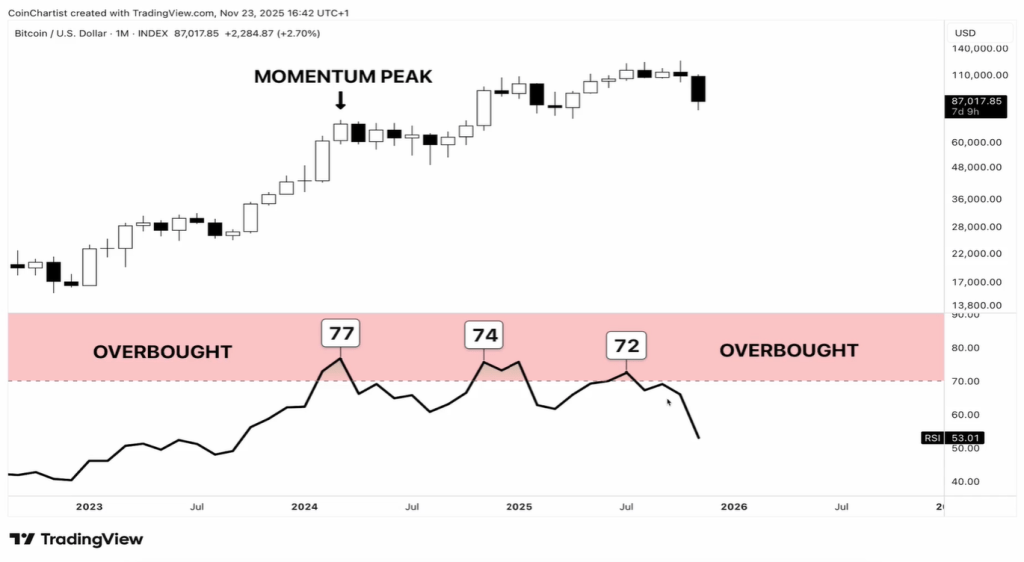
A standard bearish divergence occurs when price makes a higher high while an oscillator such as RSI, MACD or Stochastic posts a lower high, signalling trend exhaustion. Extending that to three peaks, Severino says, amplifies the warning: “A triple negative or triple bearish divergence is basically the market screaming, price is still drifting higher, but under the hood, this trend is dying.” Later he adds, “A single divergence is already a warning. A triple divergence is like yellow, orange, flashing red.”
Bitcoin triple bearish divergence

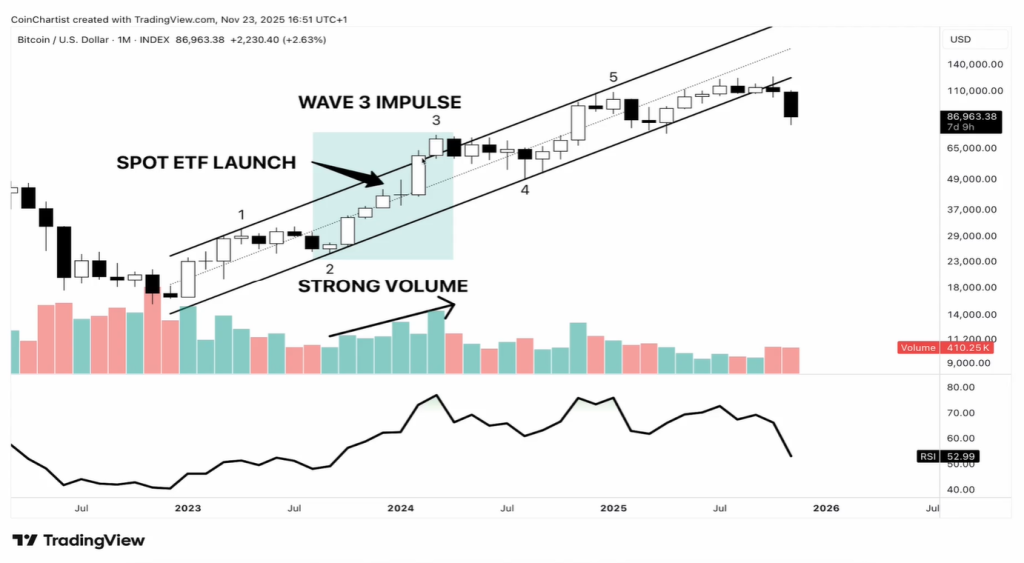
Severino maps this pattern onto Bitcoin’s bull cycle using the monthly chart, anchored around three key highs. The first, he argues, came around the spot ETF launch and aligned with a wave-three impulse in his Elliott Wave count. “This was our ETF launch and it was during our wave three impulse […] everybody’s excited. We had the ETF launch […] strong volume, strong momentum,” he says, calling it the cycle’s momentum peak.

The second high broke that level but on weaker internals. “Second high breaks the old high. The indicator’s high is weaker. This represents fewer aggressive buyers. Early participants start taking profits. This was me. I started taking profit here,” he notes. In his interpretation, that push represented a fifth wave.
Bitcoin Elliott wave analysis

The third high, marginally above prior peaks near $126,000, is where he sees exhaustion. “On the third high, price index is higher. Marginal new high […] I sold around $105k […] we went to $126k, so I left only a very small amount on the table to not get caught up in what comes after all this,” he says. The oscillator, however, made yet another lower high: “Buyers are exhausted at this point. Shorts are covering, late FOMO buyers push it just a little bit higher. Pros use this zone to offload positions or start shorting.”

He argues that sentiment at the top was complacent rather than euphoric. “I don’t think we were euphoric here. I think we were euphoric at this one […] but we were very complacent this whole time […] everybody just was like, it’s going up forever.”

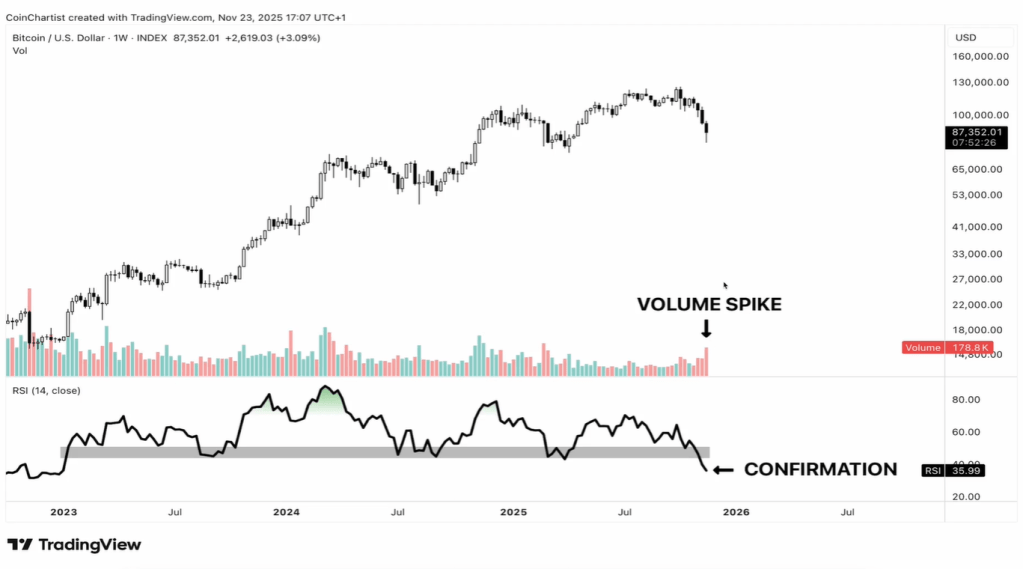
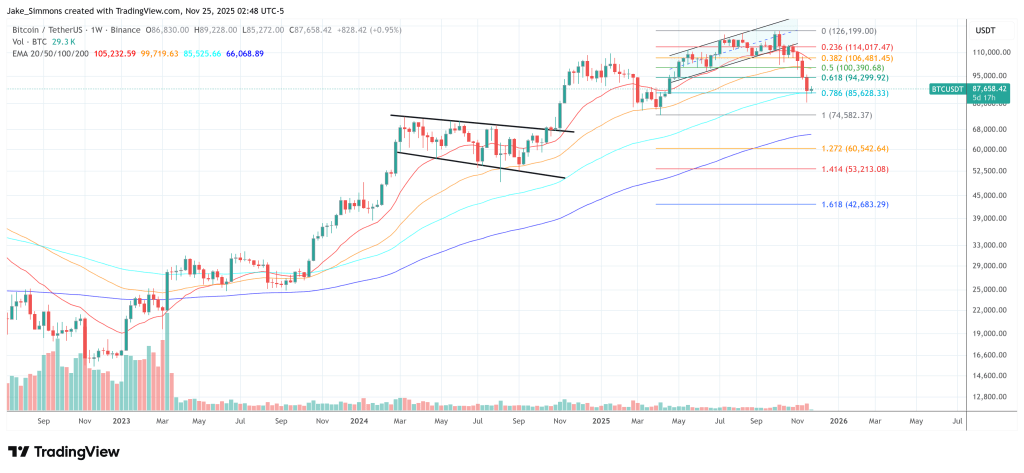
Crucially, Severino insists the divergence is a setup, not a standalone trigger: “You want confirmation before acting.” He points to several. First, a break of the rising trendline connecting the major swing lows: “Here is our trend line and we are below. There is our confirmation.” Second, loss of key moving averages such as the 20 and 50 EMA that had supported the uptrend. Third, a regime shift in weekly RSI: during the bull, it repeatedly bounced in the 40–50 zone, but now, he says, “falling below it is confirmation that the trend is now no longer holding.”
Bitcoin price analysis

On volume, he warns against reading the recent spike on a down candle as capitulation. While the FTX bottom showed extreme, climactic volume, the latest breakout in selling may instead be “the breakout and start of a trend” to the downside, he suggests, especially given the declining volume into Bitcoin’s final highs.

How Low Can Bitcoin Go?

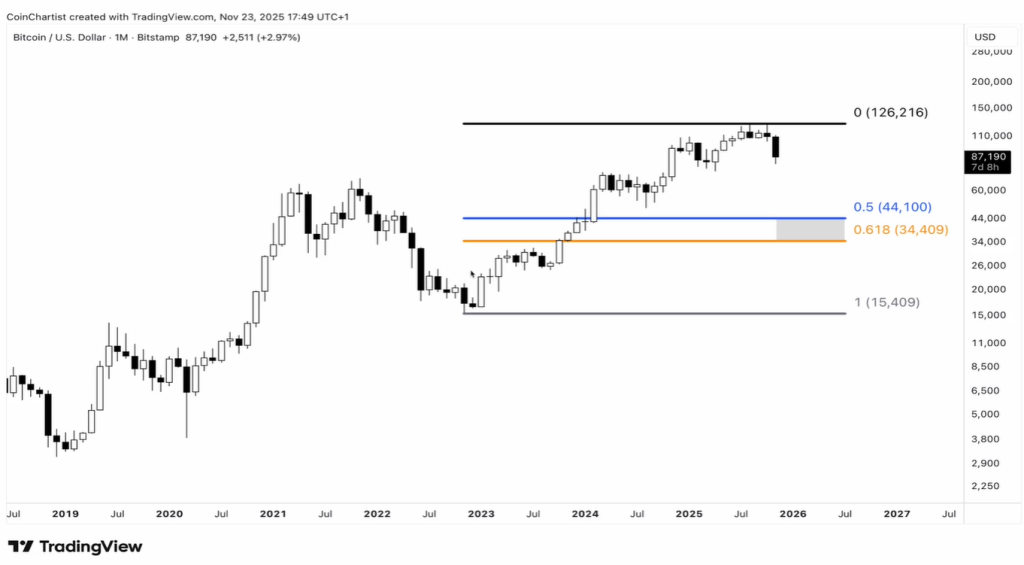
For potential downside, Severino overlays Fibonacci levels on the full advance and references guidance that triple divergences often resolve toward the 0.5–0.618 retracement between $44,100 and $34,409. In Bitcoin’s case, he marks a wide lower zone where an A-B-C structure could terminate, estimating “about like 60 something percent, maybe even closer to 70” from the top – “very par for the course for a Bitcoin bear market,” in his words.
Bitcoin Fibonacci retracement levels

More ominously, he hints at a “bigger version of this” on even higher timeframes, suggesting a larger triple divergence may be forming with the recent structure nested inside it. “This could not be so great for the higher time frames Bitcoin,” he says.

Still, he repeatedly stresses uncertainty and risk management. “I can’t say that this signal is the end-all be-all […] it doesn’t guarantee anything,” he says. “I definitely don’t want you to be like, hey, Tony, well, I believe you 100%. Immediately, I’m going to sell my coins. No, it’s not financial advice […] It’s more about how you manage risk.”

At press time, Bitcoin traded at $87,658.
Bitcoin price
Market Opportunity
Bitcoin Logo
Bitcoin Price(BTC)
$92,640.45
$92,640.45$92,640.45
-2.60%
USD
Bitcoin (BTC) Live Price Chart
Disclaimer: The articles reposted on this site are sourced from public platforms and are provided for informational purposes only. They do not necessarily reflect the views of MEXC. All rights remain with the original authors. If you believe any content infringes on third-party rights, please contact service@support.mexc.com for removal. MEXC makes no guarantees regarding the accuracy, completeness, or timeliness of the content and is not responsible for any actions taken based on the information provided. The content does not constitute financial, legal, or other professional advice, nor should it be considered a recommendation or endorsement by MEXC.

You May Also Like

The Stark Reality Of Post-Airdrop Market Dynamics

The Stark Reality Of Post-Airdrop Market Dynamics

The post The Stark Reality Of Post-Airdrop Market Dynamics appeared on BitcoinEthereumNews.com. Lighter Trading Volume Plummets: The Stark Reality Of Post-Airdrop
Share
BitcoinEthereumNews2026/01/19 13:16
Headwind Helps Best Wallet Token

Headwind Helps Best Wallet Token

The post Headwind Helps Best Wallet Token appeared on BitcoinEthereumNews.com. Google has announced the launch of a new open-source protocol called Agent Payments Protocol (AP2) in partnership with Coinbase, the Ethereum Foundation, and 60 other organizations. This allows AI agents to make payments on behalf of users using various methods such as real-time bank transfers, credit and debit cards, and, most importantly, stablecoins. Let’s explore in detail what this could mean for the broader cryptocurrency markets, and also highlight a presale crypto (Best Wallet Token) that could explode as a result of this development. Google’s Push for Stablecoins Agent Payments Protocol (AP2) uses digital contracts known as ‘Intent Mandates’ and ‘Verifiable Credentials’ to ensure that AI agents undertake only those payments authorized by the user. Mandates, by the way, are cryptographically signed, tamper-proof digital contracts that act as verifiable proof of a user’s instruction. For example, let’s say you instruct an AI agent to never spend more than $200 in a single transaction. This instruction is written into an Intent Mandate, which serves as a digital contract. Now, whenever the AI agent tries to make a payment, it must present this mandate as proof of authorization, which will then be verified via the AP2 protocol. Alongside this, Google has also launched the A2A x402 extension to accelerate support for the Web3 ecosystem. This production-ready solution enables agent-based crypto payments and will help reshape the growth of cryptocurrency integration within the AP2 protocol. Google’s inclusion of stablecoins in AP2 is a massive vote of confidence in dollar-pegged cryptocurrencies and a huge step toward making them a mainstream payment option. This widens stablecoin usage beyond trading and speculation, positioning them at the center of the consumption economy. The recent enactment of the GENIUS Act in the U.S. gives stablecoins more structure and legal support. Imagine paying for things like data crawls, per-task…
Share
BitcoinEthereumNews2025/09/18 01:27
Nasdaq Company Adds 7,500 BTC in Bold Treasury Move

Nasdaq Company Adds 7,500 BTC in Bold Treasury Move

The live-streaming and e-commerce company has struck a deal to acquire 7,500 BTC, instantly becoming one of the largest public […] The post Nasdaq Company Adds 7,500 BTC in Bold Treasury Move appeared first on Coindoo.
Share
Coindoo2025/09/18 02:15
