Thailand has ordered Sam Altman’s World project to suspend operations and permanently delete iris scans collected from 1.2 million people, escalating Thailand has ordered Sam Altman’s World project to suspend operations and permanently delete iris scans collected from 1.2 million people, escalating

Thailand Orders Sam Altman’s World to Wipe 1.2M Iris Scans Or Face Prison

2025/11/27 01:52
4 min read
For feedback or concerns regarding this content, please contact us at crypto.news@mexc.com

Thailand has ordered Sam Altman’s World project to suspend operations and permanently delete iris scans collected from 1.2 million people, escalating a growing confrontation between regulators and one of the world’s most controversial digital identity systems.

The decision, announced on Monday by the Ministry of Digital Economy and Society (MDES), follows a formal directive from the National Economic and Social Development Board (NESDB), which determined that the project’s iris-for-token model violated the country’s Personal Data Protection Act (PDPA).

Source: MDES

Thailand Tightens Grip on Worldcoin, Citing Illegal Biometric Data Practices

The announcement came after a high-level meeting led by Minister of Digital Economy and Society Chaichanok Chidchob.

Senior officials from the Personal Data Protection Committee (PDPC) and the Electronic Transactions Development Agency (ETDA) joined the briefing, where authorities outlined why World’s practices were deemed unlawful.

According to the statement, the system of scanning users’ irises in exchange for WLD tokens breached PDPA rules governing the collection, storage, and disclosure of sensitive biometric information.

The enforcement move marks the sharpest action Thailand has taken against the project to date, following a raid in October on a World-linked iris scanning center in Bangkok.

That operation, conducted by the Securities and Exchange Commission (SEC) and the Cyber Crime Investigation Bureau, resulted in arrests tied to an unlicensed digital asset exchange said to be handling WLD token transactions.

Investigators found that operators were offering exchange services without approval under Thailand’s Digital Asset Business Emergency Decree, thereby exposing users to risks of fraud and money laundering.

Authorities stated that the incident reflected broader concerns about unregulated cryptocurrency activity tied to the world’s rapidly expanding identity network.

In response to the latest order, World Thailand said it had paused all verifications and removed the country from its list of active Orb locations.

The company described the directive as unexpected and insisted it had complied with local regulations throughout its rollout. It warned that millions of Thai users who joined the program for protection against scams, identity theft, and AI-driven fraud would be affected.

The company said it intends to continue engaging with MDES and the PDPC to find a resolution.

Regulators Across Continents Target Worldcoin’s Oversensitive Iris Data Handling

Thailand’s enforcement adds the country to a growing list of nations that have halted or restricted the project.

Since launching in 2023 under its previous name, Worldcoin, the initiative has faced scrutiny in Kenya, Spain, Portugal, Indonesia, Hong Kong, Brazil, and Colombia, each citing concerns about the handling of biometric data.

In several cases, regulators objected to the project’s model of offering financial incentives to users, arguing that such rewards undermine genuine consent for handing over permanent identifiers.

Courts and data agencies in multiple jurisdictions have ordered temporary suspensions, data deletions, or full operational bans as investigations continue.

Authorities around the world have pointed out similar issues. They point to the sensitivity of iris data, which cannot be changed if compromised, and carries long-term privacy implications.

In Europe, regulators determined that even the anonymized iris codes qualify as personal data under GDPR, requiring stricter compliance than the project initially demonstrated.

As enforcement actions mounted, World’s developers introduced new privacy tools intended to ease global concerns.

The company has begun migrating to a Secure Multi-Party Computation system that divides and encrypts biometric information across multiple locations.

It has also released a redesigned Orb device with enhanced transparency features and launched a non-biometric verification method using passports and NFC technology.

Developers say older iris codes are being deleted as part of an ongoing privacy upgrade and stress that no raw biometric data is stored on the Orb itself.

Despite the regulatory pressure, the project’s global footprint continues to grow. The project recently launched its World ID service in the United States and the Philippines. Additionally, the World App has more than 37 million users, and the company reports more than 100 million verifications completed across 160 countries.

Disclaimer: The articles reposted on this site are sourced from public platforms and are provided for informational purposes only. They do not necessarily reflect the views of MEXC. All rights remain with the original authors. If you believe any content infringes on third-party rights, please contact crypto.news@mexc.com for removal. MEXC makes no guarantees regarding the accuracy, completeness, or timeliness of the content and is not responsible for any actions taken based on the information provided. The content does not constitute financial, legal, or other professional advice, nor should it be considered a recommendation or endorsement by MEXC.

You May Also Like

Shocking OpenVPP Partnership Claim Draws Urgent Scrutiny

Shocking OpenVPP Partnership Claim Draws Urgent Scrutiny

The post Shocking OpenVPP Partnership Claim Draws Urgent Scrutiny appeared on BitcoinEthereumNews.com. The cryptocurrency world is buzzing with a recent controversy surrounding a bold OpenVPP partnership claim. This week, OpenVPP (OVPP) announced what it presented as a significant collaboration with the U.S. government in the innovative field of energy tokenization. However, this claim quickly drew the sharp eye of on-chain analyst ZachXBT, who highlighted a swift and official rebuttal that has sent ripples through the digital asset community. What Sparked the OpenVPP Partnership Claim Controversy? The core of the issue revolves around OpenVPP’s assertion of a U.S. government partnership. This kind of collaboration would typically be a monumental endorsement for any private cryptocurrency project, especially given the current regulatory climate. Such a partnership could signify a new era of mainstream adoption and legitimacy for energy tokenization initiatives. OpenVPP initially claimed cooperation with the U.S. government. This alleged partnership was said to be in the domain of energy tokenization. The announcement generated considerable interest and discussion online. ZachXBT, known for his diligent on-chain investigations, was quick to flag the development. He brought attention to the fact that U.S. Securities and Exchange Commission (SEC) Commissioner Hester Peirce had directly addressed the OpenVPP partnership claim. Her response, delivered within hours, was unequivocal and starkly contradicted OpenVPP’s narrative. How Did Regulatory Authorities Respond to the OpenVPP Partnership Claim? Commissioner Hester Peirce’s statement was a crucial turning point in this unfolding story. She clearly stated that the SEC, as an agency, does not engage in partnerships with private cryptocurrency projects. This response effectively dismantled the credibility of OpenVPP’s initial announcement regarding their supposed government collaboration. Peirce’s swift clarification underscores a fundamental principle of regulatory bodies: maintaining impartiality and avoiding endorsements of private entities. Her statement serves as a vital reminder to the crypto community about the official stance of government agencies concerning private ventures. Moreover, ZachXBT’s analysis…
Share
BitcoinEthereumNews2025/09/18 02:13
A Netflix ‘KPop Demon Hunters’ Short Film Has Been Rated For Release
A Netflix ‘KPop Demon Hunters’ Short Film Has Been Rated For Release

The post A Netflix ‘KPop Demon Hunters’ Short Film Has Been Rated For Release appeared on BitcoinEthereumNews.com. KPop Demon Hunters Netflix Everyone has wondered what may be the next step for KPop Demon Hunters as an IP, given its record-breaking success on Netflix. Now, the answer may be something exactly no one predicted. According to a new filing with the MPA, something called Debut: A KPop Demon Hunters Story has been rated PG by the ratings body. It’s listed alongside some other films, and this is obviously something that has not been publicly announced. A short film could be well, very short, a few minutes, and likely no more than ten. Even that might be pushing it. Using say, Pixar shorts as a reference, most are between 4 and 8 minutes. The original movie is an hour and 36 minutes. The “Debut” in the title indicates some sort of flashback, perhaps to when HUNTR/X first arrived on the scene before they blew up. Previously, director Maggie Kang has commented about how there were more backstory components that were supposed to be in the film that were cut, but hinted those could be explored in a sequel. But perhaps some may be put into a short here. I very much doubt those scenes were fully produced and simply cut, but perhaps they were finished up for this short film here. When would Debut: KPop Demon Hunters theoretically arrive? I’m not sure the other films on the list are much help. Dead of Winter is out in less than two weeks. Mother Mary does not have a release date. Ne Zha 2 came out earlier this year. I’ve only seen news stories saying The Perfect Gamble was supposed to come out in Q1 2025, but I’ve seen no evidence that it actually has. KPop Demon Hunters Netflix It could be sooner rather than later as Netflix looks to capitalize…
Share
BitcoinEthereumNews2025/09/18 02:23
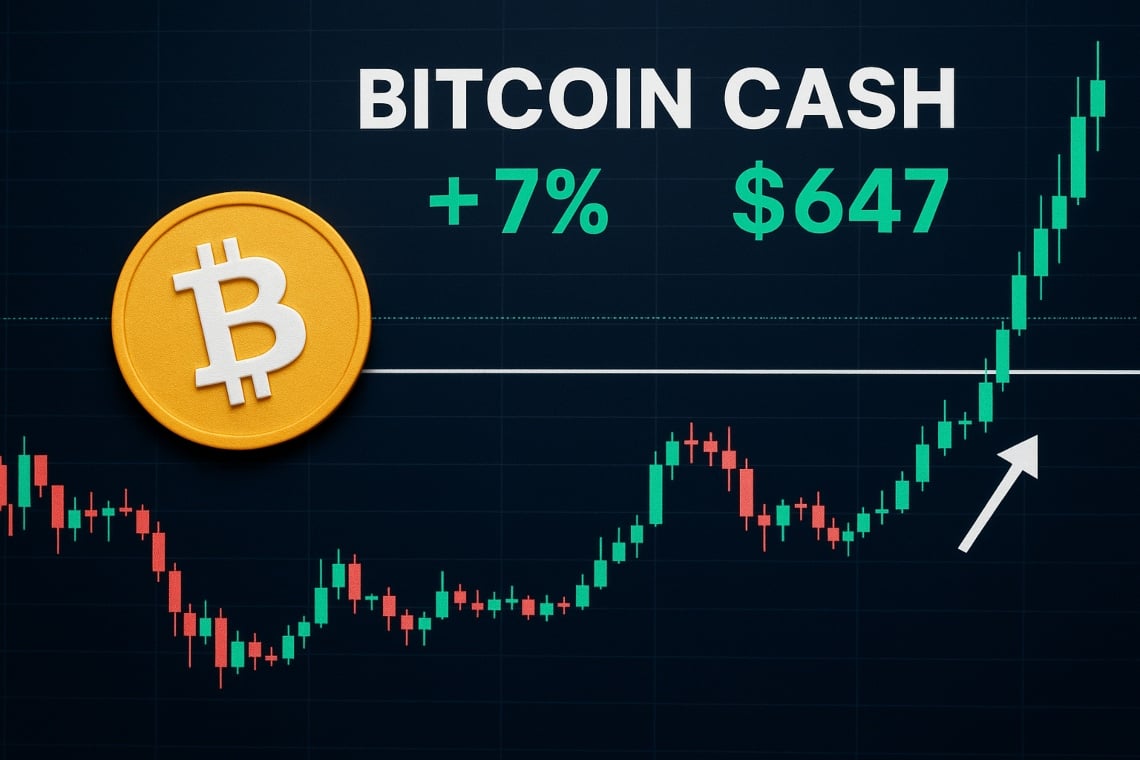
Bitcoin Cash: price +7% at $647, breakout and key levels (09/18/2025)

Bitcoin Cash: price +7% at $647, breakout and key levels (09/18/2025)

Bitcoin Cash gains 7% and reaches $647, hitting highs not seen since last April: the movement fits into a risk-on climate.
Share
The Cryptonomist2025/09/18 21:47
