

India’s Grahaa Space Prepares for First Orbital Nano-Satellite Mission
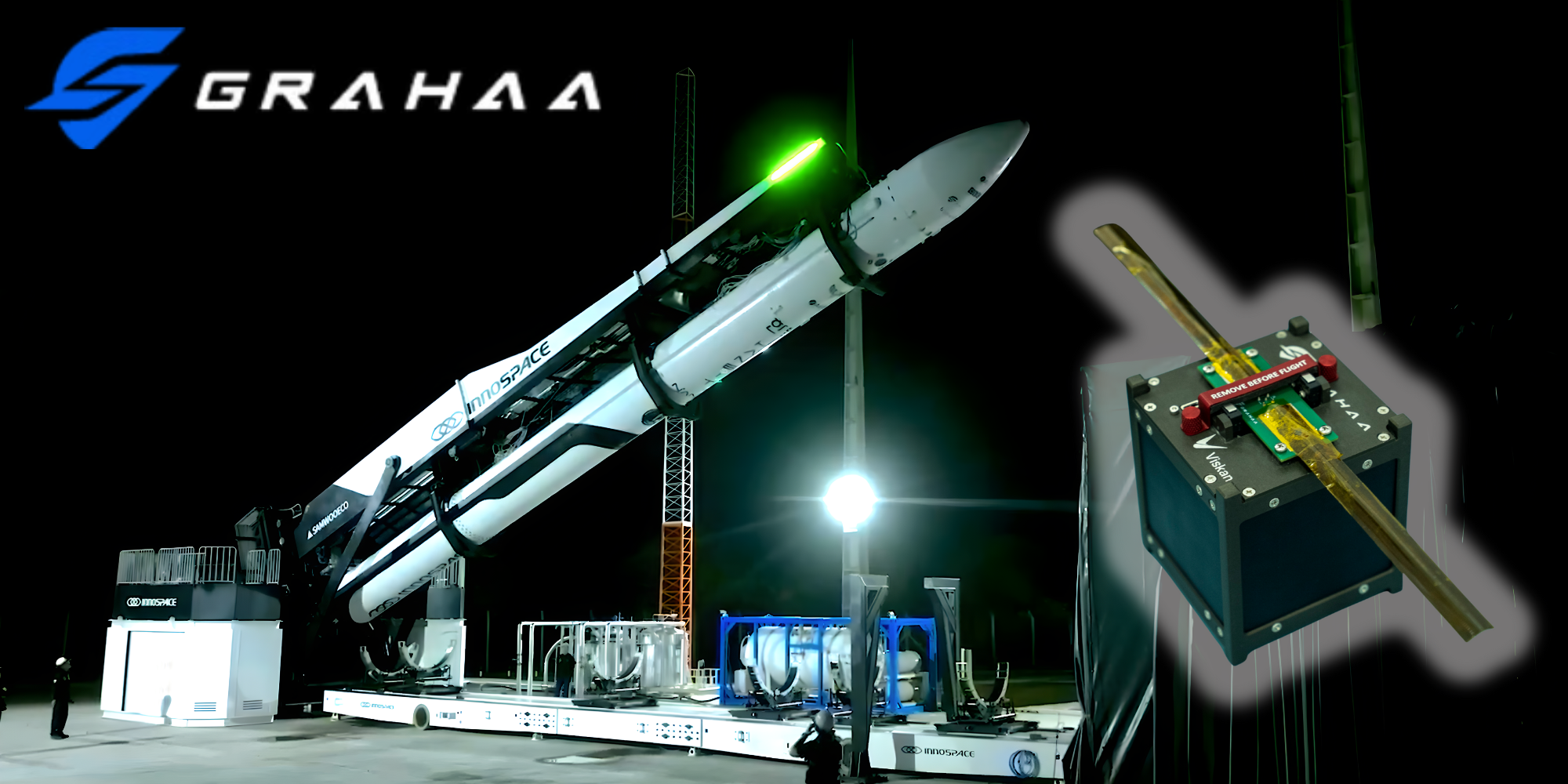
Bengaluru-based spacetech startup Grahaa Space is preparing for a major leap as it readies to launch its maiden nano-satellite mission, Solaras S2, by the end of December. The authorisation for the mission has been granted by the Indian National Space Promotion and Authorisation Centre (IN–SPACe). The launch will take place from the Alcântara Space Center (CEA) in Brazil aboard the Hanbit-Nano launch vehicle developed by South Korea-based Innospace.
Grahaa Space, incubated at STIIC–IIST and backed by IN-SPACe, is building an advanced constellation of nanosatellites to deliver near-real-time earth observation data. Its technology stack includes high-resolution optical payloads, inter-satellite links, and onboard processing designed for live streaming of geospatial intelligence.
A First Orbital Step for Grahaa Space
Co-founded by Ramesh Kumar V, former IBM executive, and M. Loganathan, a former ISRO scientist, Grahaa Space is among India’s emerging new-space companies specialising in near-real-time earth observation using a constellation of nanosatellites in Low Earth Orbit (LEO).
The Solaras S2 mission, signed with Innospace in 2024, will serve as a technology demonstration to validate Grahaa’s satellite bus, platform, and several critical subsystems. The mission marks the company’s transition from lab-scale development to in-orbit qualification an essential milestone before deploying a full constellation.
“The Solaras S2 mission will qualify our nano-satellite bus and platform and allows us to assess the performance. It is a focused technical step that confirms our readiness for the next phase,” said Ramesh Kumar V, Founder and CEO, Grahaa Space.
Backed by STIIC and Viskan Group
Grahaa Space is backed by the Viskan Group of Companies and has been incubated at the Space Technology Incubation and Innovation Center (STIIC) at the Indian Institute of Space Science and Technology (IIST), Trivandrum. Kumar acknowledged the ecosystem support, adding that collaborations with STIIC and IN-SPACe have been pivotal in accelerating mission readiness.
What Solaras S2 Will Validate
Solaras S2 will carry out several in-orbit validation functions, including:
- Qualification of the nano-satellite bus and platform
- Testing of key subsystems and satellite-to-ground communication links
- Assessment of initial data quality, a crucial component for Grahaa’s vision of delivering near-real-time geospatial video data
An early success metric for the mission includes establishing stable communication with ground stations and confirming subsystem performance during initial orbital operations.
What This Unlocks for 2026
Grahaa Space has lined up a second technology demonstration mission in early 2026, to be launched with Skyroot Aerospace. This next mission will validate the high-resolution optical payload and inter-satellite communications, forming the backbone of Grahaa’s planned nanosatellite constellation.
“These upcoming missions will allow us to qualify the communications module, gather geospatial data from the optical payload, and establish inter-satellite links. Our work is aimed at building a reliable nanosatellite capability that can support various on-ground applications using near-real-time geospatial data,” added Kumar.
Launch Window and Location
As per Innospace’s latest update, the Solaras S2 launch is expected between 16–22 December (BRT) from Alcântara Space Center, Brazil.
You May Also Like

Supported by hike speculation and PMIs – Danske Bank

The geopolitics of anti-corruption as global advisory firms face debarment in the Horn of Africa

