

Top Crypto Savings Accounts in Australia

Crypto savings accounts are a popular type of investment product that allow anyone to deposit crypto and earn interest on them over time.
Instead of earning a lower rate on cash like in a regular savings account in the bank, you can earn a higher yield on your crypto by depositing them into a yield-generating app.
Below, you’ll see what a crypto savings account is, the core mechanics behind the yields, and how these products run. Of course, you will also see specific sections and parts that relate to Australian users, alongside a few other factors to keep in mind.
What is a Crypto Savings Account?
A crypto savings account is a product that lets you deposit cryptocurrencies like Bitcoin (BTC), Ethereum (ETH), Solana (SOL), etc., and even stablecoins on a platform in exchange for interest, similar to how a bank savings account pays interest on cash.
Note that a crypto savings account is not a “savings account” in the traditional sense, but closer to a high-yield, high-risk investment product that happens to look a lot like a savings account in the UI.
The platform, which can be a single app like YouHodler or a crypto exchange product, lends out or deploys your crypto funds in various yield-generating activities that can include:
- Lending your crypto to traders, market makers, and institutions that want leverage or liquidity, who pay interest on those loans.
- Staking assets (directly or via staking pools) to help validate blocks on proof-of-stake (PoS) networks, earning protocol rewards plus transaction fees.
- Providing liquidity to DeFi protocols (AMMs, lending pools, etc.), where you earn trading fees or borrowing interest, and sometimes additional token incentives.
You earn interest in return, often at rates much higher than traditional savings accounts. That interest is usually paid in the same asset you deposited and may compound frequently (daily or weekly).
Key Characteristics of Crypto Savings Accounts
Keep in mind that crypto savings accounts are run by the company, not a decentralised protocol, so it’s different to DeFi lending. Here are some key characteristics:
- When you deposit, the company holds your coins, not you. You don’t control the private keys. If they freeze withdrawals, you can’t move your money.
- These platforms earn yield by taking your crypto and lending it out to traders and institutions. You don’t see exactly who they lend to or what risks they’re taking. You’re trusting their internal team.
- Because they’re centralised businesses, you may have to do KYC (ID, selfie, proof of address, etc). Your account is tied to your real identity and can be reported to tax authorities.
You may like: Crypto Debit Cards Available in Australia
Best Crypto Savings Account in Australia
With that information out of the way, let’s go through some of the best yield-generating platforms in the Australian market.
Nexo
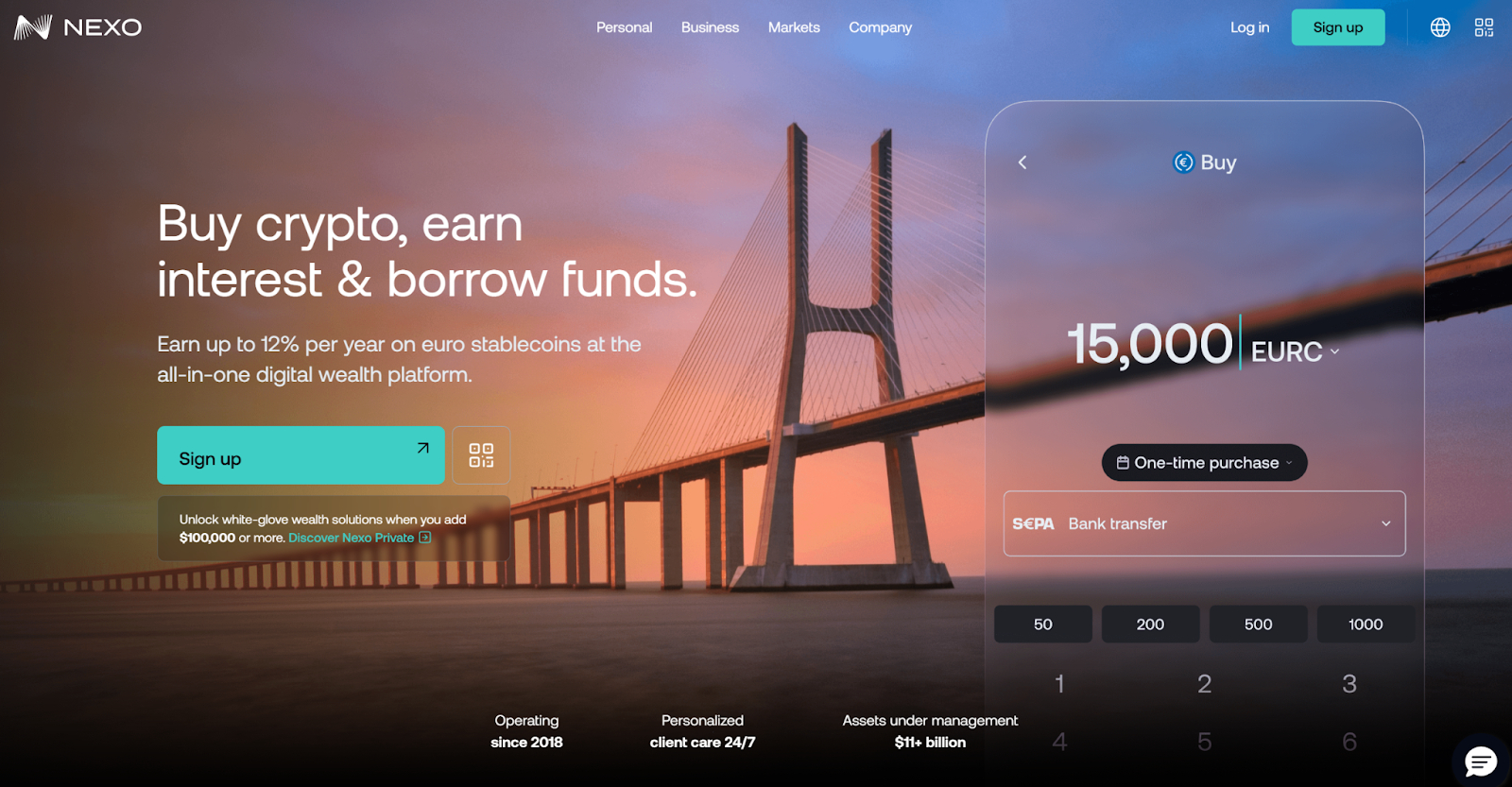
Nexo works like a crypto bank with savings, borrowing, debit card, and exchange features. It offers interest rates depending on a loyalty system tied to the NEXO token. It also provides a 2% cashback through the Nexo Card.
Supported Assets and Fees
The platform supports over 100 crypto assets:
- Stablecoins like USDT, USDC, DAI: Up to 14% with top tier and earning in NEXO (base closer to around 8%).
- Major cryptocurrencies like BTC, ETH, XRP, SOL, etc., roughly 4% to 8% depending on tier and fixed-term lockups.
- It also supports digital representations of fiat currencies: USDx, EURx, GBPx. These are high-yield fiat accounts within the platform (up to 15% annually with currencies like USDx).
Nexo does have a complex fee structure, hence why it’s important to check the general fee schedule. Fees and withdrawals depend on the loyalty tier. The platform offers around 5 free withdrawals per month.
Aave App
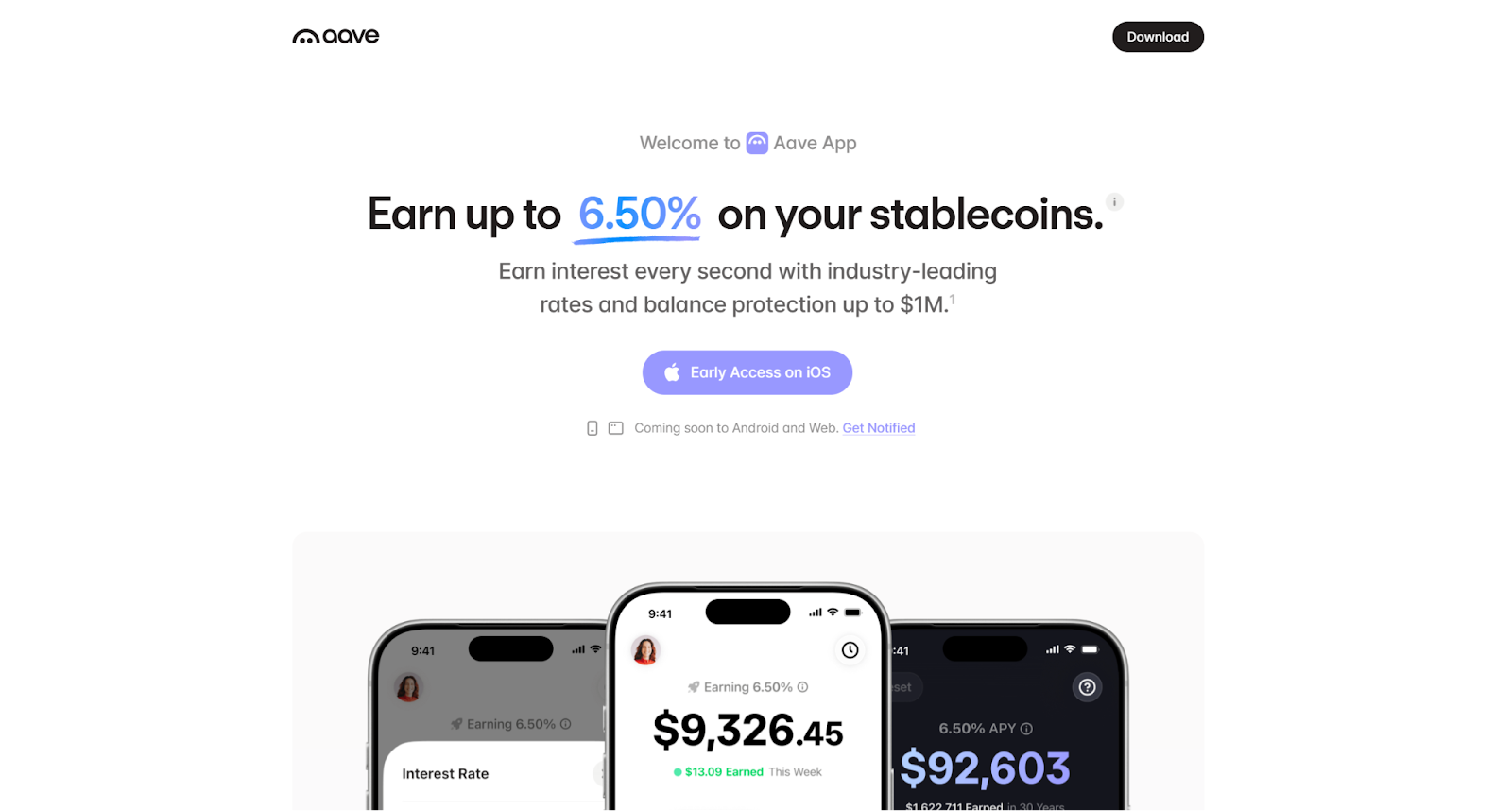
Aave App is the upcoming crypto savings-like app of the Aave protocol, the largest decentralised lending protocol that has generated billions of dollars in interest paid.
The Aave App Hybrid interface is an addition to the Aave DeFi protocol that adds KYC, a simplified UX, and a US$1 million (AU$1.53 million) insurance protection.
Supported Assets and Fees
Mostly stablecoins: USDC, USDT, and Aave’s GHO, typically averaging between 4% and 6%. Users can use ETH and wBTC for collateral for borrowing, not as primary yield assets.
Regarding fees, Aave app does not charge you any monthly subscription. Besides regular ETH-based gas fees, the only explicit fee comes from the spread. For example, if the Aave protocol is generating 7% APY on USDC from borrowers, the Aave App might pay you 6% APY.
Ledn

Ledn is a Bitcoin-focused lender based in the Cayman Islands and operates in over 100 countries, and now focuses only on Bitcoin-based loans and stablecoins.
Ledn separates balances into “held” (not lent) and “interest-earning” (lent) buckets to isolate risk, which can be explained as follows:
- Held Balances (not lent): These are standard custodial accounts. If a user simply stores their Bitcoin with Ledn without opting into an interest program, that crypto is kept in secure, segregated storage and is not used for lending purposes. This provides peace of mind that those specific assets are not subject to lending risk.
- Interest-Earning Balances (lent): Users who explicitly move funds into a “Growth Account” (for stablecoins) or participate in a B2X loan agreement consent to their funds being used in the lending pool. Funds in these accounts are used to generate yield paid to the user.
Supported assets and Fees
As stated, Ledn only supports BTC and stablecoins:
- Bitcoin: up 3% APY.
- Stablecoins like USDC and USDT, up to 8%-12% APY for balances over 100K.
Ledn has several fees that depend on the balance amount and APY. You can check the rates terms page here, but it can be summarised as:
- Stablecoin withdrawals: 10 USDC and USDT fixed fee (or equivalent).
- BTC withdrawals: 0.0005 BTC.
- In-app exchange from spread on each swap.
Youhodler

Youhodler is a EU-regulated yield platform that offers a wide range of crypto-based features, combining savings, lending, and leverage in a single app. It also provides crypto-backed loans, interest-earning accounts, and even a crypto card.
Supported Assets and Fees
Youhodler supports over 50 cryptocurrencies, including stablecoins, and provides weekly payouts and no lock periods. Users can gain up to 20% APY on their crypto funds. Some of the supported coins are:
- Major cryptocurrencies like BT, ETH, SOL, XRP, ADA, and more. The rewards are often tiered by trading activity or balance.
- Stablecoins like USDT, USDC, generally around 8%-12% APY.
Youholder charges several types of fees, so you might also want to look at their fees page, but generally, you will find the following:
- 1% for fiat withdrawals, 0.5% for deposits.
- Bank wire fee, depending on the currency.
- Possible inactivity fee if the account is dormant for months.
- Min. deposit for yield accounts in US$100 (AU$154).
Uphold
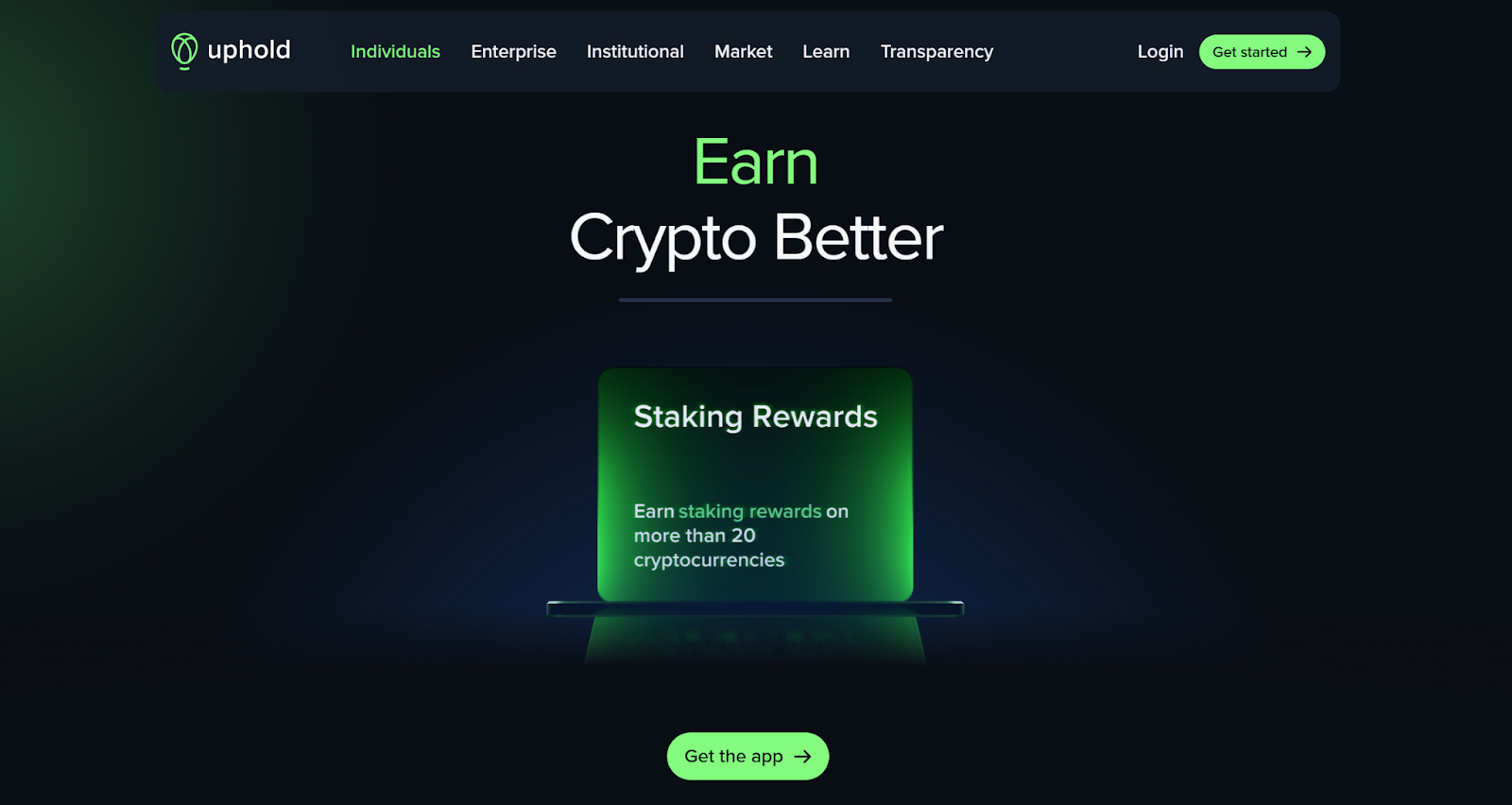
Uphold is available in Australia as a multi-asset brokerage with yield mainly from staking. It also allows users to trade across crypto, metals, and fiat in one app.
Supported Assets and Fees
There are several types of crypto assets (and commodities) that users can earn interests through Uphold, mainly staking: ETH, SOL, ADA, DOT, TEZOS, etc., roughly 3%–17% APY depending on asset.
Uphold staking fees can be a bit higher than most, around 20% of staking rewards, depending on the asset.
Pros and Cons of Crypto Savings Accounts
Crypto savings accounts can make sense for someone who already holds crypto and understands the risks.
Keep in mind the money earned through crypto savings accounts is taxable. There’s no special tax-advantaged treatment here; the Australian Taxation Office (ATO) treats crypto savings accounts, staking, lending, and other crypto products/investments as ordinary income, so you still need to pay income tax on the full amount of interest earned (at your marginal tax rate).
Pros explained:
- Higher potential yield than bank deposits.
- Passive income on crypto you already hold.
- Frequent compounding.
- Simple UX compared to DIY staking/DeFi (the platform does the staking for you in some cases).
- Flexible choice of assets and lock-up terms.
Cons explained:
- You can lose principal (what you deposit) due to market volatility, platform failure, hacks, smart contract bugs, or regulatory action.
- No government-backed insurance or guaranteed safety net (though depends on the app, some of them offer their own insurance funds).
- Be wary of products offering extremely high yields. Those are often a scam.
Closing Thoughts
Crypto savings accounts are typically yield products that facilitate lending, staking, and DeFi strategies, usually run by centralised companies that custody your assets and require full KYC.
While these products offer higher potential returns and convenience, users should be fully aware of the downsides, like market volatility, centralisation, the solvency and security of the platform, tax implications and no broad government guarantee.
The post Top Crypto Savings Accounts in Australia appeared first on Crypto News Australia.


You May Also Like

Analyst to XRP Investors: The Next Impulse Will Be Televised. Here’s the Meaning

Iran invites global powers to negotiate Strait of Hormuz transit

Best Free Social Media Tools for Growth & Engagement in 2026



