

Smarter payments, frictionless journeys: Inside PayU’s AI-led evolution
PayU has played a vital role in shaping India’s payments landscape, powering the adoption of innovations like UPI 2.0, tokenization, and embedded finance. As the payments industry continues to evolve, the organization is now harnessing the might of artificial intelligence, taking checkout experiences to the next level.
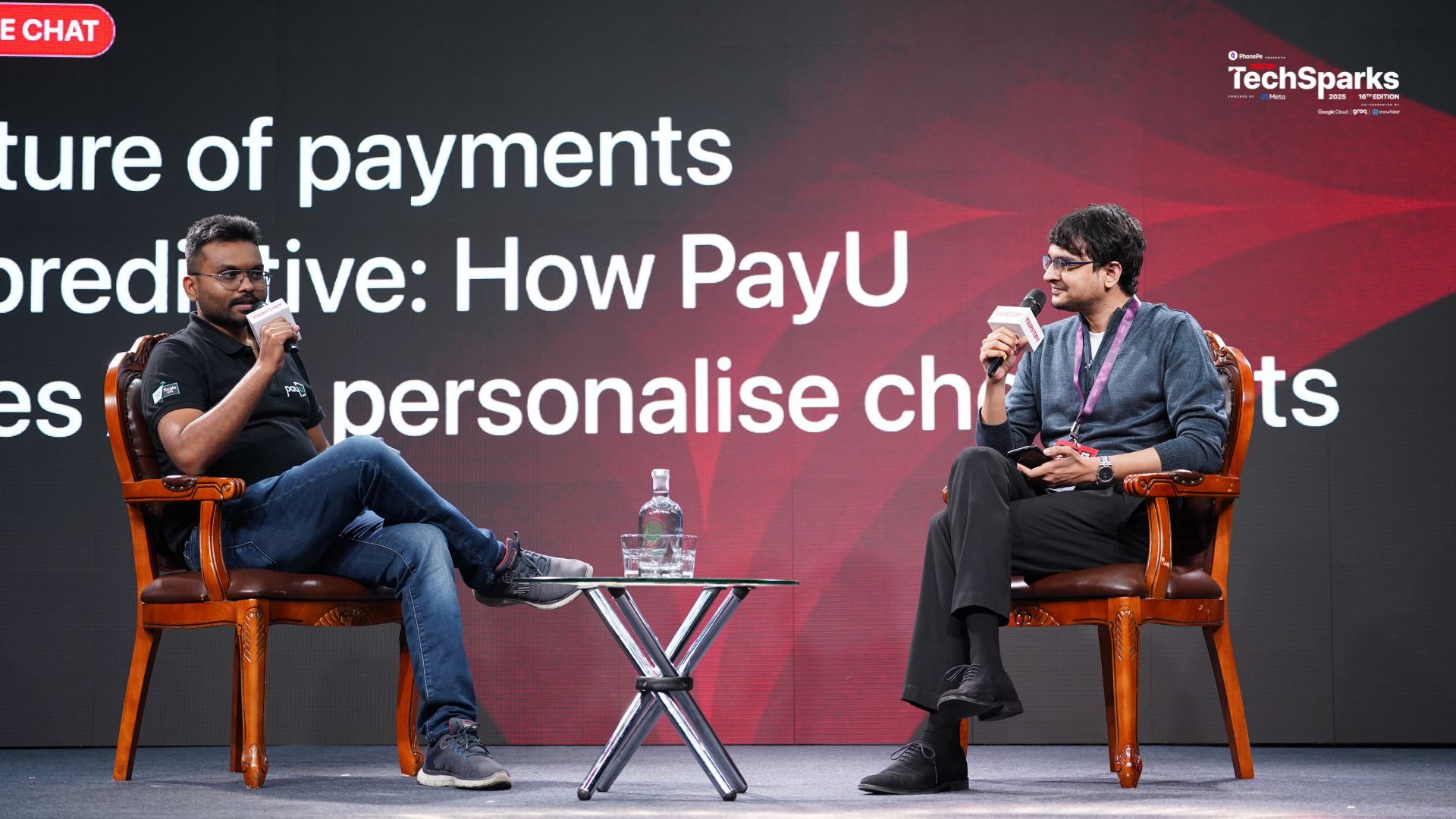
At TechSparks 2025, Sagar Kumar, Vice President - Engineering, PayU, joined Rishabh Mansur, Head - Content Categories, YourStory, for a fireside chat titled ‘Future of payments is predictive: How PayU uses AI to personalize checkouts’. He discussed how, by analyzing purchase intent, device behavior, and preferred payment methods, PayU is able to deliver personalized, context-aware checkout journeys that cater to the unique needs of millions of users.
From a payments platform to a data intelligence payment company
A few years ago, payment aggregators worked quite differently. Customers could choose from various payment options, while merchants relied on aggregator platforms to collect online payments. Funds moved from the customer to the issuing bank before finally reaching the merchant. Back then, the primary focus was simply on facilitating these money transfers — and PayU’s role was to provide a smooth checkout experience for users.
Aggregators have come a long way, especially PayU, Kumar shared. Today, payment services have transformed into rich, data-driven intelligence platforms. PayU’s checkout experiences have expanded, from completing transactions to creating fast, reliable, and seamless experiences that make payments almost invisible. Features like tokenization mean customers don’t need to enter card details every time, removing friction.
Kumar spoke at length about this transition, highlighting PayU’s complex recommendation engine that assists customers, particularly in India where there are over 150 payment options, by intelligently recommending the right payment methods based on customer and transaction context. He also spotlighted the checkout experience, which has evolved to handle management, freeing small businesses from logistics coordination that is already embedded in the checkout process. Once authenticated, customers’ addresses default automatically, with options to change them, saved cards are securely stored, and the best payment options are displayed. Payments can even be completed with one click or biometric authentication.
The road to AI
AI wasn’t a bolt-on at PayU; it was a strategic choice made after many years of observation, Kumar said. The shift toward AI started with a recommendation engine. "We didn’t start by putting AI directly into our checkout experience; it was an evolution. We observed that customers faced challenges navigating the many payment options, spending excessive time deciding. By capturing detailed behavioral analytics—like time spent on checkout, how often payment options were changed, and typing patterns—we identified pain points in discovery and affordability. This led us to develop a basic recommendation engine to help guide customers toward the right payment choices," he said.
Over the years, the team realized that this approach wasn’t sufficient and began to build a complex analytical engine, which analyzed factors such as the number of transactions, time of day, merchant MCC code (or merchant category), ticket size, past transaction history, latencies, and available gateways.
This analytical approach worked well for some time. However, growth brought merchants from diverse segments along with new and intriguing customer behaviours. That’s when PayU pivoted to machine learning (ML) models. “At any transaction point, the goal is to understand the customer's intent by using the metrics I mentioned earlier, but now integrated into a real-time model. During checkout, the models recommend the right payment options, though we don’t enforce them; we highlight the most suitable choices for the customer,” Kumar said.
PayU continuously tracks core metrics, including time spent on checkout, to ensure that customers spend as little time as possible while achieving a high transaction success. The company continues to fine-tune and adjust its models to match evolving customer, merchant, and business needs.
Keeping the checkout alive: dealing with drop-offs
Kumar said drop-offs were a significant problem statement for PayU. The company made a lot of effort, but then “there's no silver bullet to solve this”. “The challenge in the payment industry from a drop-off is the context window before the payment happens. This is invisible to an aggregator.”
Aggregators find it tough to identify the source of the drop-off. Is the customer hesitant about the product they selected? Are the payment options confusing? Was the customer expecting a discount? Do they trust that their card information will remain secure?
To address this, PayU collects data continuously throughout the checkout journey, tracking critical behaviors like time spent or the frequency of option changes. ML models use this data to classify potential issues for drop-offs. When the customer returns, this past behaviour will guide personalized UI adjustments. For instance, for those insecure about card information, the platform will prominently display trust badges. If discounts are a hurdle, the company will nudge pre-approved offers from banks. These context-rich actions help improve the payment experience and cut drop-off rates over time.
The future of the payments industry
Kumar sees a significant evolution in the payments industry in the next 5 years, with the involvement of generative and agentic AI. While agentic workflows are maturing, payment processes currently are not fully automated. But promising experiments and proof of concepts are under way, including efforts by organizations like National Payments Corporation of India (NPCI), as well as the potential of technologies like OpenAI. However, these are not in full production.
Kumar anticipates more maturity in autonomous payments. For instance, when booking a movie ticket, instead of handling the payment, a customer might delegate this task to a trusted person without worrying about which payment method they use, transaction latency, or fees. This delegation illustrates the potential of agentic payments—where routine, low-cognitive-load payments are fully delegated to AI agents to handle seamlessly on your behalf. This shift toward delegated, autonomous payments is where the industry is headed, Kumar said.


You May Also Like

XRP Price Prediction: XRP Trapped At $1.37 As Breakout Setup Tightens

Why Digital Banks Are Growing 3x Faster Than Traditional Banks

