UK Scraps DeFi Capital Gains Tax on Crypto Lending — “No Gain, No Loss” Until Sale
The U.K. government has moved a step closer to overhauling how decentralized finance activity is taxed, backing a new framework that would spare users from triggering capital gains each time they deposit tokens into lending protocols or liquidity pools.
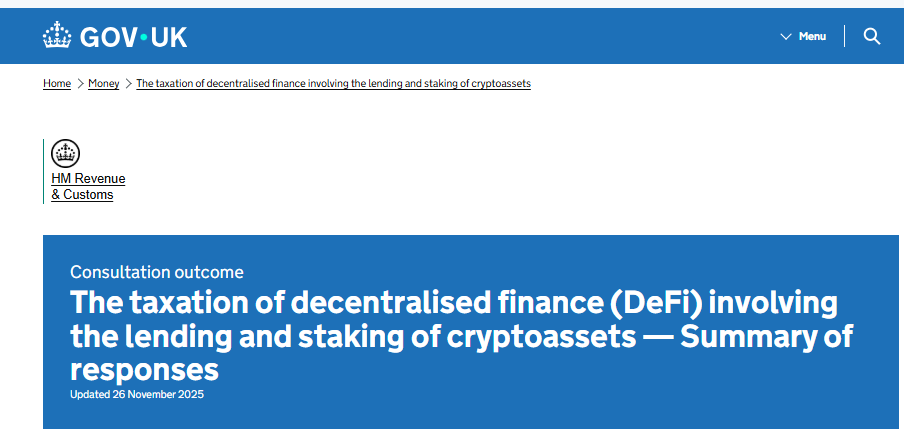
HM Revenue and Customs (HMRC) published its updated position this week, showing support for a “no gain, no loss” model that would align tax events with actual economic outcomes rather than every token movement.
 Source: HMRC
UK Proposes Taxing DeFi Gains Only at Withdrawal, Not at Deposit
Under the current system, DeFi users can incur a capital gains tax charge simply by depositing tokens into a protocol, even if they retain exposure to the same asset.
That interpretation treats deposits as disposals, forcing users into complex record-keeping and potential tax bills before any real profit is made.
The proposed change would defer tax until users eventually sell, swap, or otherwise dispose of their assets in a way that reflects a genuine gain or loss.
HMRC’s revised approach follows more than two years of consultations, including a public call for evidence in 2022 and a formal consultation in mid-2023.
A newly published summary shows that 32 organizations and individuals submitted detailed responses, including Aave, Binance, Deloitte, CryptoUK, and several major accounting firms.
Many respondents argued that the current rules distort economic reality and place disproportionate administrative burdens on everyday DeFi participants.
The “no gain, no loss” model would apply to both single-token lending arrangements and more complex multi-token setups such as automated market makers.
That means users supplying liquidity to pools would no longer be taxed at the point of deposit. Instead, tax would be calculated when tokens are withdrawn and ultimately sold.
If users receive more tokens back than they deposited, the excess would be taxable as a gain. If they receive fewer, it would be treated as a loss.
The framework would also apply to crypto borrowing arrangements. When users borrow tokens and later repay them, the disposal would be calculated only from the difference between what was borrowed and what is returned.
Notably, this will ensure the tax bill reflects real gains rather than notional movements between smart contracts.
Aave Founder Calls UK DeFi Tax Update a “Major Win” as HMRC Backs NGNL Model
Aave founder Stani Kulechov described the update as a “major win for U.K. DeFi users,” noting that HMRC’s willingness to treat deposits as non-disposals reflects how decentralized protocols function in practice.
Industry participants responding to the consultation consistently backed the NGNL model over alternatives, warning that repo-style rules or treating every token movement as a taxable event would introduce even more complexity, particularly for retail users.
The changes do not show a loosening of the U.K.’s overall crypto tax regime. Cryptoassets remain classified as property, and disposals such as selling, swapping, or spending tokens are still subject to capital gains tax.
Income from mining, staking rewards, airdrops, and employment-related crypto continues to fall under income tax rules.
HMRC emphasized that even under the revised framework, users may still be required to report high volumes of transactions, though the agency is working with software providers to assess the burden.
The updated DeFi tax approach comes as the U.K. steps up enforcement efforts across the crypto sector. HMRC issued 65,000 “nudge letters” to suspected under-reporters this year, a 134% increase from 2024, using exchange-supplied data to identify potential cases.
A broader crackdown is scheduled for 2026 when the global Crypto-Asset Reporting Framework comes into force, requiring platforms to collect and report customer tax reference numbers.
Treasury officials expect the initiative to generate more than £300 million in additional revenue by 2030.
Alongside tax reforms, the government is pushing ahead with broader digital-market restructuring. The U.K. recently lifted its four-year ban on crypto-based exchange-traded notes, opening the door for new listings in London. Officials are also preparing to appoint a “digital markets champion” to oversee the transition to blockchain-based financial infrastructure, including tokenized securities and digital gilts.


You May Also Like

Stakestone (STO) Soars: Token Surpasses $1.14 After Stunning 367% Rally

LIST: Bayanihan initiatives amid soaring oil prices