A pseudonymous analyst has set off a new narrative around Ethereum’s upcoming Fusaka upgrade, arguing it could be the most favorable event ever for ETH as an asset by finally turning Layer-2 networks into meaningful ETH burners. On X, crypto pundit Kira Sama framed Fusaka, scheduled for December 3, as a structural shift in Ethereum’s fee economics. The core of the thesis is a single change: EIP-7918. “Price wise, Ethereum Fusaka upgrade on december 3rd, will be the most bullish upgrade for eth the asset ever, why? One reason. ‘EIP 7918’,” Kira wrote, calling it “the next big catalyst for eth burn.” Ethereum L2 Will Burn ETH Kira’s argument rests on how Ethereum currently treats L2s. Since the rollup-centric roadmap took shape, Ethereum’s base layer has effectively subsidized L2 data availability. In his words, “for a long time, ETH L1 charged zero base fees to L2s, while L2 deployers made millions of profits. So L2s haven’t burnt any meaningful eth.” That subsidized regime has fueled explosive L2 growth but also limited how much L2 usage translates into ETH burn. Related Reading: Ethereum Is 58% ‘Undervalued’ Based On Intrinsic Metrics, Says Hashed CEO EIP-7918 is designed to change that by tying L2 data costs more tightly to mainnet gas prices. Kira summarizes it as follows: “L2 fees will be bounded by the execution cost which will help us reach L2 fees price discovery faster. It also helps maintain the fees during spikes so that L2 users won’t be rugged from absurd tx fees. Win-win.” In practice, that means rollups will face a non-trivial, protocol-enforced minimum on what they pay Ethereum for posting their batches. Crucially for ETH holders, those fees are paid in ETH and a portion is burned under the EIP-1559 mechanism. Kira argues that as L2 throughput scales, this will become a dominant driver of ETH’s burn dynamics: “They will just pay their fair share to Ethereum L1 and burn meaningful eth. It will be slow and steady at the beginning. This will eventually result in burning millions of dollars of eth long term and L2s will be main driving force of making eth deflationary.” Related Reading: Ethereum Price To Recover Or Crash? The Real ‘Leverage Point’ Investors Should Know About The narrative becomes more aggressive when Kira extrapolates to corporate and institutional rollups. He lists a series of existing and anticipated L2s and claims that “Coinbase’s base will burn eth, Robinhood’s L2 will burn eth, OpenAI’s Worlchain will burn eth, Sony’s Soneium will burn eth, Alibaba’s Jovay will burn eth, UAE’s ADI chain burn eth, Kraken’s Ink will burn eth, Lighter will burn eth, Deutsche Bank’s Memento chain will burn eth, Arbitrum will burn eth etc etc etc. Corporations will start burning eth.” From that, he extends the thesis to a broader, highly bullish vision: “Every company in the world will launch their own layer 2. Every alt-L1 will become L2 and start burning eth. Eth inflation will shrink.” While those universal claims go far beyond what the upgrade itself guarantees, they capture the heart of the bullish narrative: if enough economic activity migrates onto Ethereum-secured L2s that must pay non-negligible base fees, Ethereum becomes the settlement and value-capture layer beneath corporate and institutional chains. Kira explicitly compares Fusaka to the London hard fork that introduced EIP-1559 in 2021. “When Ethereum introduced burn through eip-1559 in 2021, it lifted the whole market up,” he wrote. “Everyone will be caught off guard this time as well. L2s burning eth incoming. Bullish eth. Bullish L2s.” For now, Kira is clear about his own conclusion: “December 3rd, tik-tok. The ticker is ETH.” At press time, ETH traded at $3,022. Featured image created with DALL.E, chart from TradingView.comA pseudonymous analyst has set off a new narrative around Ethereum’s upcoming Fusaka upgrade, arguing it could be the most favorable event ever for ETH as an asset by finally turning Layer-2 networks into meaningful ETH burners. On X, crypto pundit Kira Sama framed Fusaka, scheduled for December 3, as a structural shift in Ethereum’s fee economics. The core of the thesis is a single change: EIP-7918. “Price wise, Ethereum Fusaka upgrade on december 3rd, will be the most bullish upgrade for eth the asset ever, why? One reason. ‘EIP 7918’,” Kira wrote, calling it “the next big catalyst for eth burn.” Ethereum L2 Will Burn ETH Kira’s argument rests on how Ethereum currently treats L2s. Since the rollup-centric roadmap took shape, Ethereum’s base layer has effectively subsidized L2 data availability. In his words, “for a long time, ETH L1 charged zero base fees to L2s, while L2 deployers made millions of profits. So L2s haven’t burnt any meaningful eth.” That subsidized regime has fueled explosive L2 growth but also limited how much L2 usage translates into ETH burn. Related Reading: Ethereum Is 58% ‘Undervalued’ Based On Intrinsic Metrics, Says Hashed CEO EIP-7918 is designed to change that by tying L2 data costs more tightly to mainnet gas prices. Kira summarizes it as follows: “L2 fees will be bounded by the execution cost which will help us reach L2 fees price discovery faster. It also helps maintain the fees during spikes so that L2 users won’t be rugged from absurd tx fees. Win-win.” In practice, that means rollups will face a non-trivial, protocol-enforced minimum on what they pay Ethereum for posting their batches. Crucially for ETH holders, those fees are paid in ETH and a portion is burned under the EIP-1559 mechanism. Kira argues that as L2 throughput scales, this will become a dominant driver of ETH’s burn dynamics: “They will just pay their fair share to Ethereum L1 and burn meaningful eth. It will be slow and steady at the beginning. This will eventually result in burning millions of dollars of eth long term and L2s will be main driving force of making eth deflationary.” Related Reading: Ethereum Price To Recover Or Crash? The Real ‘Leverage Point’ Investors Should Know About The narrative becomes more aggressive when Kira extrapolates to corporate and institutional rollups. He lists a series of existing and anticipated L2s and claims that “Coinbase’s base will burn eth, Robinhood’s L2 will burn eth, OpenAI’s Worlchain will burn eth, Sony’s Soneium will burn eth, Alibaba’s Jovay will burn eth, UAE’s ADI chain burn eth, Kraken’s Ink will burn eth, Lighter will burn eth, Deutsche Bank’s Memento chain will burn eth, Arbitrum will burn eth etc etc etc. Corporations will start burning eth.” From that, he extends the thesis to a broader, highly bullish vision: “Every company in the world will launch their own layer 2. Every alt-L1 will become L2 and start burning eth. Eth inflation will shrink.” While those universal claims go far beyond what the upgrade itself guarantees, they capture the heart of the bullish narrative: if enough economic activity migrates onto Ethereum-secured L2s that must pay non-negligible base fees, Ethereum becomes the settlement and value-capture layer beneath corporate and institutional chains. Kira explicitly compares Fusaka to the London hard fork that introduced EIP-1559 in 2021. “When Ethereum introduced burn through eip-1559 in 2021, it lifted the whole market up,” he wrote. “Everyone will be caught off guard this time as well. L2s burning eth incoming. Bullish eth. Bullish L2s.” For now, Kira is clear about his own conclusion: “December 3rd, tik-tok. The ticker is ETH.” At press time, ETH traded at $3,022. Featured image created with DALL.E, chart from TradingView.com
Ethereum Fusaka Will Be ‘The Most Bullish Upgrade’ Ever, Pundit Claims

2025/11/29 03:00

A pseudonymous analyst has set off a new narrative around Ethereum’s upcoming Fusaka upgrade, arguing it could be the most favorable event ever for ETH as an asset by finally turning Layer-2 networks into meaningful ETH burners.

On X, crypto pundit Kira Sama framed Fusaka, scheduled for December 3, as a structural shift in Ethereum’s fee economics. The core of the thesis is a single change: EIP-7918.

“Price wise, Ethereum Fusaka upgrade on december 3rd, will be the most bullish upgrade for eth the asset ever, why? One reason. ‘EIP 7918’,” Kira wrote, calling it “the next big catalyst for eth burn.”

Ethereum L2 Will Burn ETH

Kira’s argument rests on how Ethereum currently treats L2s. Since the rollup-centric roadmap took shape, Ethereum’s base layer has effectively subsidized L2 data availability. In his words, “for a long time, ETH L1 charged zero base fees to L2s, while L2 deployers made millions of profits. So L2s haven’t burnt any meaningful eth.” That subsidized regime has fueled explosive L2 growth but also limited how much L2 usage translates into ETH burn.

EIP-7918 is designed to change that by tying L2 data costs more tightly to mainnet gas prices. Kira summarizes it as follows: “L2 fees will be bounded by the execution cost which will help us reach L2 fees price discovery faster. It also helps maintain the fees during spikes so that L2 users won’t be rugged from absurd tx fees. Win-win.” In practice, that means rollups will face a non-trivial, protocol-enforced minimum on what they pay Ethereum for posting their batches.

Crucially for ETH holders, those fees are paid in ETH and a portion is burned under the EIP-1559 mechanism. Kira argues that as L2 throughput scales, this will become a dominant driver of ETH’s burn dynamics: “They will just pay their fair share to Ethereum L1 and burn meaningful eth. It will be slow and steady at the beginning. This will eventually result in burning millions of dollars of eth long term and L2s will be main driving force of making eth deflationary.”

The narrative becomes more aggressive when Kira extrapolates to corporate and institutional rollups. He lists a series of existing and anticipated L2s and claims that “Coinbase’s base will burn eth, Robinhood’s L2 will burn eth, OpenAI’s Worlchain will burn eth, Sony’s Soneium will burn eth, Alibaba’s Jovay will burn eth, UAE’s ADI chain burn eth, Kraken’s Ink will burn eth, Lighter will burn eth, Deutsche Bank’s Memento chain will burn eth, Arbitrum will burn eth etc etc etc. Corporations will start burning eth.”

From that, he extends the thesis to a broader, highly bullish vision: “Every company in the world will launch their own layer 2. Every alt-L1 will become L2 and start burning eth. Eth inflation will shrink.” While those universal claims go far beyond what the upgrade itself guarantees, they capture the heart of the bullish narrative: if enough economic activity migrates onto Ethereum-secured L2s that must pay non-negligible base fees, Ethereum becomes the settlement and value-capture layer beneath corporate and institutional chains.

Kira explicitly compares Fusaka to the London hard fork that introduced EIP-1559 in 2021. “When Ethereum introduced burn through eip-1559 in 2021, it lifted the whole market up,” he wrote. “Everyone will be caught off guard this time as well. L2s burning eth incoming. Bullish eth. Bullish L2s.” For now, Kira is clear about his own conclusion: “December 3rd, tik-tok. The ticker is ETH.”

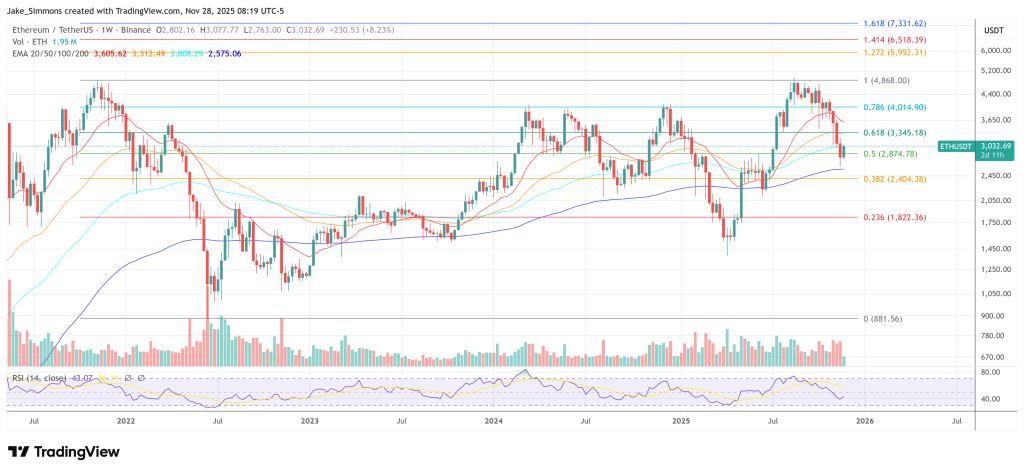
At press time, ETH traded at $3,022.

Ethereum price
Market Opportunity
Bullish Degen Logo
Bullish Degen Price(BULLISH)
$0.01772
$0.01772$0.01772
-10.14%
USD
Bullish Degen (BULLISH) Live Price Chart
Disclaimer: The articles reposted on this site are sourced from public platforms and are provided for informational purposes only. They do not necessarily reflect the views of MEXC. All rights remain with the original authors. If you believe any content infringes on third-party rights, please contact service@support.mexc.com for removal. MEXC makes no guarantees regarding the accuracy, completeness, or timeliness of the content and is not responsible for any actions taken based on the information provided. The content does not constitute financial, legal, or other professional advice, nor should it be considered a recommendation or endorsement by MEXC.

You May Also Like

WIF Price Prediction: Targeting $0.48 Recovery Within 2 Weeks as MACD Shows Bullish Divergence

WIF Price Prediction: Targeting $0.48 Recovery Within 2 Weeks as MACD Shows Bullish Divergence

The post WIF Price Prediction: Targeting $0.48 Recovery Within 2 Weeks as MACD Shows Bullish Divergence appeared on BitcoinEthereumNews.com. James Ding Dec 16
Share
BitcoinEthereumNews2025/12/17 17:32
IP Hits $11.75, HYPE Climbs to $55, BlockDAG Surpasses Both with $407M Presale Surge!

IP Hits $11.75, HYPE Climbs to $55, BlockDAG Surpasses Both with $407M Presale Surge!

The post IP Hits $11.75, HYPE Climbs to $55, BlockDAG Surpasses Both with $407M Presale Surge! appeared on BitcoinEthereumNews.com. Crypto News 17 September 2025 | 18:00 Discover why BlockDAG’s upcoming Awakening Testnet launch makes it the best crypto to buy today as Story (IP) price jumps to $11.75 and Hyperliquid hits new highs. Recent crypto market numbers show strength but also some limits. The Story (IP) price jump has been sharp, fueled by big buybacks and speculation, yet critics point out that revenue still lags far behind its valuation. The Hyperliquid (HYPE) price looks solid around the mid-$50s after a new all-time high, but questions remain about sustainability once the hype around USDH proposals cools down. So the obvious question is: why chase coins that are either stretched thin or at risk of retracing when you could back a network that’s already proving itself on the ground? That’s where BlockDAG comes in. While other chains are stuck dealing with validator congestion or outages, BlockDAG’s upcoming Awakening Testnet will be stress-testing its EVM-compatible smart chain with real miners before listing. For anyone looking for the best crypto coin to buy, the choice between waiting on fixes or joining live progress feels like an easy one. BlockDAG: Smart Chain Running Before Launch Ethereum continues to wrestle with gas congestion, and Solana is still known for network freezes, yet BlockDAG is already showing a different picture. Its upcoming Awakening Testnet, set to launch on September 25, isn’t just a demo; it’s a live rollout where the chain’s base protocols are being stress-tested with miners connected globally. EVM compatibility is active, account abstraction is built in, and tools like updated vesting contracts and Stratum integration are already functional. Instead of waiting for fixes like other networks, BlockDAG is proving its infrastructure in real time. What makes this even more important is that the technology is operational before the coin even hits exchanges. That…
Share
BitcoinEthereumNews2025/09/18 00:32
Tests upper descending wedge boundary near 1.3800

Tests upper descending wedge boundary near 1.3800

The post Tests upper descending wedge boundary near 1.3800 appeared on BitcoinEthereumNews.com. USD/CAD gains ground after registering modest losses in the previous
Share
BitcoinEthereumNews2025/12/17 17:37
