Bitcoin has managed to reclaim the $90,000 level after days of intense volatility, but upward momentum remains limited as the market continues to battle uncertainty and fear. While bulls have regained some ground, selling pressure is still dominating sentiment, and speculation about the start of a new bear market continues to grow. Many analysts warn that the recent bounce may not be enough to shift the broader trend unless stronger demand returns. Related Reading: XRP Reserves On Binance Collapse To Record Lows: Investors Move Toward Long-Term Holding According to fresh data from Darkfost, short-term stress among investors has eased slightly. The amount of BTC sent to exchanges at a loss has dropped sharply, now sitting around 11,600 BTC—significantly lower than the extreme 67,000 BTC capitulation spike recorded on November 22nd. This decline suggests that panic-driven selling may be cooling off, giving the market a temporary moment of stabilization. However, despite this improvement, Bitcoin still faces strong headwinds. Investors remain cautious, liquidity conditions are tight, and macro uncertainty continues to weigh on risk assets. For now, BTC must hold above the $90K region and show sustained strength to avoid renewed downside pressure. The coming sessions may determine whether this rebound marks the start of recovery—or just a pause before another leg lower. Short-Term Holders Face a Critical Decision Point Darkfost adds that the amount of BTC in profit being sent to exchanges by short-term holders remains relatively low at around 9,500 BTC. However, a slight increase has appeared as Bitcoin climbed back above $90K, showing that some STHs have begun testing the market to secure small gains or reduce their exposure. This subtle shift highlights a growing tension among recent buyers, who must choose between waiting for a full return to break even or selling now to minimize further losses. This situation creates a delicate environment. Even though selling pressure has eased, STHs remain highly sensitive to small price movements, and their behavior often dictates short-term market direction. The past few days have been unusually calm compared to the violent capitulation seen earlier in the month, and that calmness is actually constructive. It suggests that panic has temporarily subsided and the market is trying to find balance. What becomes critical now is monitoring how STHs react as Bitcoin approaches their realized price. If they hold and confidence increases, BTC could gain enough stability to push higher. If they sell aggressively, renewed downside pressure could quickly return. The next move from this cohort will likely set the tone for the coming weeks. Related Reading: Bitcoin Coinbase Premium Still Negative: US Institutions Keep Selling Despite Easing Pressure Bitcoin Attempts Recovery But Faces Heavy Overhead Resistance Bitcoin’s daily chart shows the asset attempting a recovery after reaching a capitulation low near $80K, but the structure remains fragile. Price has reclaimed the $90K area, yet momentum is limited as BTC trades below the 50-day and 100-day moving averages—both of which continue sloping downward, signaling sustained bearish pressure. The 200-day moving average sits higher, reinforcing the broader downtrend that has formed since early October’s $126K peak. Recent candles reflect a hesitant rebound: upward wicks show sellers defending every push toward $92K–$94K, while the tight body ranges highlight indecision. Volume has cooled significantly compared with the panic-driven sell-off earlier in November, suggesting that forced selling has eased but strong buy-side conviction is still missing. Related Reading: Major Bitcoin LTH Sell-Off Signals Cycle Exhaustion as Supply Drops to 13.6M BTC Structurally, BTC remains below key resistance clusters formed during its previous consolidation. Reclaiming these zones will be essential for invalidating the bearish trend. Until then, every bounce risks becoming a lower high within a broader corrective structure. On the downside, the $85K–$87K region remains the most important support. A breakdown below it could reopen the path toward deeper corrective targets. For now, Bitcoin is attempting to stabilize, but bulls must reclaim higher levels soon to shift market sentiment and avoid renewed downside pressure. Featured image from ChatGPT, chart from TradingView.comBitcoin has managed to reclaim the $90,000 level after days of intense volatility, but upward momentum remains limited as the market continues to battle uncertainty and fear. While bulls have regained some ground, selling pressure is still dominating sentiment, and speculation about the start of a new bear market continues to grow. Many analysts warn that the recent bounce may not be enough to shift the broader trend unless stronger demand returns. Related Reading: XRP Reserves On Binance Collapse To Record Lows: Investors Move Toward Long-Term Holding According to fresh data from Darkfost, short-term stress among investors has eased slightly. The amount of BTC sent to exchanges at a loss has dropped sharply, now sitting around 11,600 BTC—significantly lower than the extreme 67,000 BTC capitulation spike recorded on November 22nd. This decline suggests that panic-driven selling may be cooling off, giving the market a temporary moment of stabilization. However, despite this improvement, Bitcoin still faces strong headwinds. Investors remain cautious, liquidity conditions are tight, and macro uncertainty continues to weigh on risk assets. For now, BTC must hold above the $90K region and show sustained strength to avoid renewed downside pressure. The coming sessions may determine whether this rebound marks the start of recovery—or just a pause before another leg lower. Short-Term Holders Face a Critical Decision Point Darkfost adds that the amount of BTC in profit being sent to exchanges by short-term holders remains relatively low at around 9,500 BTC. However, a slight increase has appeared as Bitcoin climbed back above $90K, showing that some STHs have begun testing the market to secure small gains or reduce their exposure. This subtle shift highlights a growing tension among recent buyers, who must choose between waiting for a full return to break even or selling now to minimize further losses. This situation creates a delicate environment. Even though selling pressure has eased, STHs remain highly sensitive to small price movements, and their behavior often dictates short-term market direction. The past few days have been unusually calm compared to the violent capitulation seen earlier in the month, and that calmness is actually constructive. It suggests that panic has temporarily subsided and the market is trying to find balance. What becomes critical now is monitoring how STHs react as Bitcoin approaches their realized price. If they hold and confidence increases, BTC could gain enough stability to push higher. If they sell aggressively, renewed downside pressure could quickly return. The next move from this cohort will likely set the tone for the coming weeks. Related Reading: Bitcoin Coinbase Premium Still Negative: US Institutions Keep Selling Despite Easing Pressure Bitcoin Attempts Recovery But Faces Heavy Overhead Resistance Bitcoin’s daily chart shows the asset attempting a recovery after reaching a capitulation low near $80K, but the structure remains fragile. Price has reclaimed the $90K area, yet momentum is limited as BTC trades below the 50-day and 100-day moving averages—both of which continue sloping downward, signaling sustained bearish pressure. The 200-day moving average sits higher, reinforcing the broader downtrend that has formed since early October’s $126K peak. Recent candles reflect a hesitant rebound: upward wicks show sellers defending every push toward $92K–$94K, while the tight body ranges highlight indecision. Volume has cooled significantly compared with the panic-driven sell-off earlier in November, suggesting that forced selling has eased but strong buy-side conviction is still missing. Related Reading: Major Bitcoin LTH Sell-Off Signals Cycle Exhaustion as Supply Drops to 13.6M BTC Structurally, BTC remains below key resistance clusters formed during its previous consolidation. Reclaiming these zones will be essential for invalidating the bearish trend. Until then, every bounce risks becoming a lower high within a broader corrective structure. On the downside, the $85K–$87K region remains the most important support. A breakdown below it could reopen the path toward deeper corrective targets. For now, Bitcoin is attempting to stabilize, but bulls must reclaim higher levels soon to shift market sentiment and avoid renewed downside pressure. Featured image from ChatGPT, chart from TradingView.com

Bitcoin STH Loss Transfers Fall 80% From Peak – What Comes Next?

2025/11/29 06:00
4 min read
For feedback or concerns regarding this content, please contact us at crypto.news@mexc.com

Bitcoin has managed to reclaim the $90,000 level after days of intense volatility, but upward momentum remains limited as the market continues to battle uncertainty and fear. While bulls have regained some ground, selling pressure is still dominating sentiment, and speculation about the start of a new bear market continues to grow. Many analysts warn that the recent bounce may not be enough to shift the broader trend unless stronger demand returns.

According to fresh data from Darkfost, short-term stress among investors has eased slightly. The amount of BTC sent to exchanges at a loss has dropped sharply, now sitting around 11,600 BTC—significantly lower than the extreme 67,000 BTC capitulation spike recorded on November 22nd. This decline suggests that panic-driven selling may be cooling off, giving the market a temporary moment of stabilization.

However, despite this improvement, Bitcoin still faces strong headwinds. Investors remain cautious, liquidity conditions are tight, and macro uncertainty continues to weigh on risk assets. For now, BTC must hold above the $90K region and show sustained strength to avoid renewed downside pressure. The coming sessions may determine whether this rebound marks the start of recovery—or just a pause before another leg lower.

Short-Term Holders Face a Critical Decision Point

Darkfost adds that the amount of BTC in profit being sent to exchanges by short-term holders remains relatively low at around 9,500 BTC. However, a slight increase has appeared as Bitcoin climbed back above $90K, showing that some STHs have begun testing the market to secure small gains or reduce their exposure.

This subtle shift highlights a growing tension among recent buyers, who must choose between waiting for a full return to break even or selling now to minimize further losses.
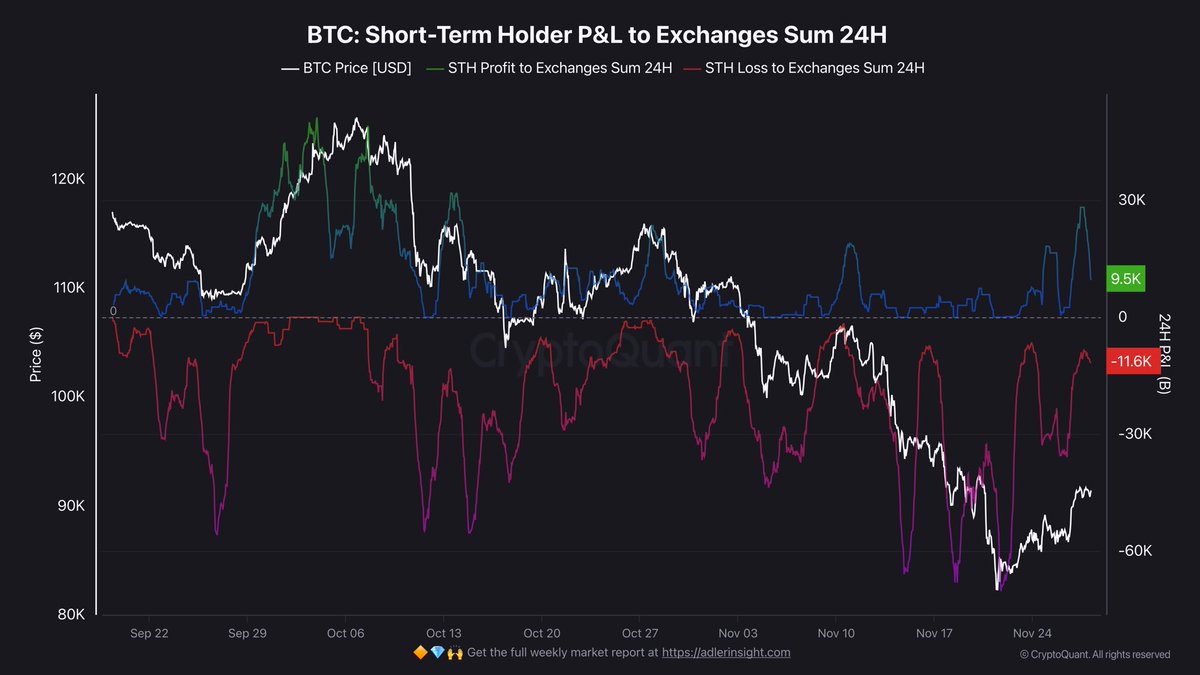
Bitcoin STH P&L To Exchanges | Source: Darkfost

This situation creates a delicate environment. Even though selling pressure has eased, STHs remain highly sensitive to small price movements, and their behavior often dictates short-term market direction. The past few days have been unusually calm compared to the violent capitulation seen earlier in the month, and that calmness is actually constructive. It suggests that panic has temporarily subsided and the market is trying to find balance.

What becomes critical now is monitoring how STHs react as Bitcoin approaches their realized price. If they hold and confidence increases, BTC could gain enough stability to push higher. If they sell aggressively, renewed downside pressure could quickly return. The next move from this cohort will likely set the tone for the coming weeks.

Bitcoin Attempts Recovery But Faces Heavy Overhead Resistance

Bitcoin’s daily chart shows the asset attempting a recovery after reaching a capitulation low near $80K, but the structure remains fragile. Price has reclaimed the $90K area, yet momentum is limited as BTC trades below the 50-day and 100-day moving averages—both of which continue sloping downward, signaling sustained bearish pressure.

The 200-day moving average sits higher, reinforcing the broader downtrend that has formed since early October’s $126K peak.

Recent candles reflect a hesitant rebound: upward wicks show sellers defending every push toward $92K–$94K, while the tight body ranges highlight indecision. Volume has cooled significantly compared with the panic-driven sell-off earlier in November, suggesting that forced selling has eased but strong buy-side conviction is still missing.

Structurally, BTC remains below key resistance clusters formed during its previous consolidation. Reclaiming these zones will be essential for invalidating the bearish trend. Until then, every bounce risks becoming a lower high within a broader corrective structure.

On the downside, the $85K–$87K region remains the most important support. A breakdown below it could reopen the path toward deeper corrective targets. For now, Bitcoin is attempting to stabilize, but bulls must reclaim higher levels soon to shift market sentiment and avoid renewed downside pressure.

Featured image from ChatGPT, chart from TradingView.com

Disclaimer: The articles reposted on this site are sourced from public platforms and are provided for informational purposes only. They do not necessarily reflect the views of MEXC. All rights remain with the original authors. If you believe any content infringes on third-party rights, please contact crypto.news@mexc.com for removal. MEXC makes no guarantees regarding the accuracy, completeness, or timeliness of the content and is not responsible for any actions taken based on the information provided. The content does not constitute financial, legal, or other professional advice, nor should it be considered a recommendation or endorsement by MEXC.

You May Also Like

What Is Jawboning? Jimmy Kimmel Suspension Sparks Legal Concerns About Trump Administration

What Is Jawboning? Jimmy Kimmel Suspension Sparks Legal Concerns About Trump Administration

The post What Is Jawboning? Jimmy Kimmel Suspension Sparks Legal Concerns About Trump Administration appeared on BitcoinEthereumNews.com. Topline Legal experts have raised concerns that ABC’s decision to pull “Jimmy Kimmel Live” from its airwaves following the host’s controversial comments about the death of Charlie Kirk, could be because the Trump administration violated free speech protections through a practice known as “jawboning.” Jimmy Kimmel speaks at Disney’s Advertising Upfront on May 13 in New York City. Disney via Getty Images Key Facts Disney-owned ABC announced Wednesday Kimmel’s show will be taken off the air “indefinitely,” which came after ABC affiliate owner Nexstar—which needs Federal Communications Commission approval to complete a planned acquisition of competitor Tegna Inc.—said it would not air the program due to Kimmel’s comments Monday regarding Kirk’s death and the reaction to it. The sudden move drew particular concern because it came only hours after FCC head Brendan Carr called for ABC to “take action” against Kimmel, and cryptically suggested his agency could take action saying, “We can do this the easy way or the hard way.” While ABC and Nexstar have not given any indication their decisions were influenced by Carr’s comments, the timing raised concerns among legal experts that the Trump administration’s threats may have unlawfully coerced ABC and Nexstar to punish Kimmel, which could constitute jawboning. Jawboning refers to “the use of official speech to inappropriately compel private action,” as defined by the Cato Institute, as governments or public officials—who cannot directly punish private actors for speech they don’t like—can use strongman tactics to try and indirectly silence critics or influence private companies’ actions. The practice is fairly loosely defined and there aren’t many legal safeguards dictating how violations of it are enforced, the Knight First Amendment Institute notes, but the Supreme Court has repeatedly ruled it can be unlawful and an impermissible First Amendment violation when it involves specific threats. The White…
Share
BitcoinEthereumNews2025/09/19 07:17
Why Fintech Platforms Are Growing Faster Than Traditional Banks

Why Fintech Platforms Are Growing Faster Than Traditional Banks

Fintech platforms are outpacing traditional banks in growth across nearly every measurable dimension. Customer acquisition rates, revenue growth, geographic expansion
Share
Techbullion2026/03/24 07:58
Japan’s CPI Reveals Critical 1.3% Inflation Rise in February as Core Pressure Eases Unexpectedly

Japan’s CPI Reveals Critical 1.3% Inflation Rise in February as Core Pressure Eases Unexpectedly

BitcoinWorld Japan’s CPI Reveals Critical 1.3% Inflation Rise in February as Core Pressure Eases Unexpectedly TOKYO, Japan — March 2025: Japan’s National Consumer
Share
bitcoinworld2026/03/24 08:10