From dominance to ban: The 2021 crackdown China played a pivotal role in global Bitcoin (BTC) mining, accounting for approximately 65% of the world’s hashing power in 2020, according to the Cambridge Bitcoin Electricity Consumption Index. However, in 2021, the Chinese government took decisive action to curb mining activities, citing concerns over financial risks, capital [...]From dominance to ban: The 2021 crackdown China played a pivotal role in global Bitcoin (BTC) mining, accounting for approximately 65% of the world’s hashing power in 2020, according to the Cambridge Bitcoin Electricity Consumption Index. However, in 2021, the Chinese government took decisive action to curb mining activities, citing concerns over financial risks, capital [...]

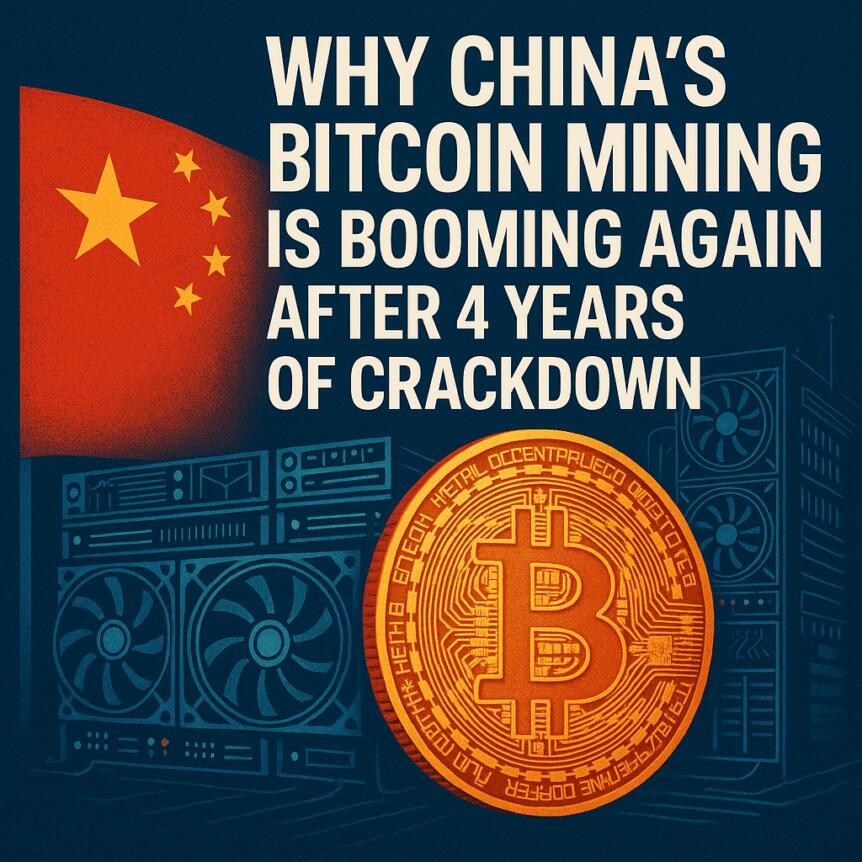
Why China’s Bitcoin Mining Is Booming Again After 4 Years of Crackdown
Why China's Bitcoin Mining Is Booming Again After 4 Years Of Crackdown

From dominance to ban: The 2021 crackdown

China played a pivotal role in global Bitcoin (BTC) mining, accounting for approximately 65% of the world’s hashing power in 2020, according to the Cambridge Bitcoin Electricity Consumption Index. However, in 2021, the Chinese government took decisive action to curb mining activities, citing concerns over financial risks, capital flight, and high electricity consumption. In September of that year, the People’s Bank of China officially declared all cryptocurrency transactions illegal, reinforcing a nationwide ban on mining operations.

The immediate fallout was a significant drop in the global Bitcoin hash rate, as many Chinese miners shuttered operations or relocated their hardware to countries like the United States, Kazakhstan, and Russia. Despite China’s ban, overall electricity consumption by Bitcoin miners continued to climb, driven by a surge in mining activity elsewhere. Global electricity usage for Bitcoin mining increased from 89 terawatt-hours (TWh) in 2021 to roughly 121.13 TWh in 2023, reflecting a resilient and expanding industry.

Total Bitcoin electricity consumption

The 2024-2025 recovery of mining operations

Recent developments indicate a resurgence of Bitcoin mining activities in China, albeit on a smaller scale compared to the early days of large-scale farms. Data from Hashrate Index reports that as of October 2025, China now accounts for about 14% of global Bitcoin mining capacity, making it the third-largest mining country after the United States and Kazakhstan. Further estimates by CryptoQuant suggest that the actual share could be between 15% and 20%.

Industry indicators support this resurgence, including increased sales from Canaan, one of China’s leading manufacturers of Bitcoin mining hardware. The company’s revenue share from China grew from a mere 2.8% in 2022 to over 30% in 2023, with industry sources estimating it surpassed 50% in the second quarter of 2025.

Underlying reasons for China’s mining resurgence

According to a Reuters report, mining operations have restarted in regions like Xinjiang and Sichuan, which are rich in energy resources. Xinjiang benefits from abundant coal and wind power, often producing more electricity than it can transmit to coastal cities, making surplus energy readily available for mining. Similarly, Sichuan’s low-cost hydropower during the rainy season provides an attractive environment for mining companies.

Local governments have also developed large-scale data centers, which, during periods of low demand, can rent out space and power to miners. The combination of rising Bitcoin prices since 2024 and surplus energy availability has further fueled this activity. Key contributing factors include:

  • Availability of inexpensive or underutilized power: Regions like Xinjiang and Sichuan offer surplus energy suitable for mining.
  • Excess capacity in data centers: Overbuilt infrastructure seeks operational clients, including miners.
  • Favorable Bitcoin price environment: Rising prices, supported by policy shifts in the US, enhance mining profitability.

Geographically, the mining resurgence is concentrated in power-rich areas such as Xinjiang, known for its coal and wind resources, and Sichuan, famed for its hydroelectric capacity. As the cycle of Bitcoin halving—occurring every four years—approaches, affecting miner rewards and supply, the industry remains adaptable and resilient, navigating political and market shifts.

Did you know? Bitcoin undergoes halving every four years, reducing miner rewards by 50%. This built-in scarcity mechanism is a key driver of long-term market cycles and supply dynamics.

This article was originally published as Why China’s Bitcoin Mining Is Booming Again After 4 Years of Crackdown on Crypto Breaking News – your trusted source for crypto news, Bitcoin news, and blockchain updates.


Market Opportunity
WHY Logo
WHY Price(WHY)
$0.00000001619
$0.00000001619$0.00000001619
0.00%
USD
WHY (WHY) Live Price Chart
Disclaimer: The articles reposted on this site are sourced from public platforms and are provided for informational purposes only. They do not necessarily reflect the views of MEXC. All rights remain with the original authors. If you believe any content infringes on third-party rights, please contact service@support.mexc.com for removal. MEXC makes no guarantees regarding the accuracy, completeness, or timeliness of the content and is not responsible for any actions taken based on the information provided. The content does not constitute financial, legal, or other professional advice, nor should it be considered a recommendation or endorsement by MEXC.

You May Also Like

Shocking OpenVPP Partnership Claim Draws Urgent Scrutiny

Shocking OpenVPP Partnership Claim Draws Urgent Scrutiny

The post Shocking OpenVPP Partnership Claim Draws Urgent Scrutiny appeared on BitcoinEthereumNews.com. The cryptocurrency world is buzzing with a recent controversy surrounding a bold OpenVPP partnership claim. This week, OpenVPP (OVPP) announced what it presented as a significant collaboration with the U.S. government in the innovative field of energy tokenization. However, this claim quickly drew the sharp eye of on-chain analyst ZachXBT, who highlighted a swift and official rebuttal that has sent ripples through the digital asset community. What Sparked the OpenVPP Partnership Claim Controversy? The core of the issue revolves around OpenVPP’s assertion of a U.S. government partnership. This kind of collaboration would typically be a monumental endorsement for any private cryptocurrency project, especially given the current regulatory climate. Such a partnership could signify a new era of mainstream adoption and legitimacy for energy tokenization initiatives. OpenVPP initially claimed cooperation with the U.S. government. This alleged partnership was said to be in the domain of energy tokenization. The announcement generated considerable interest and discussion online. ZachXBT, known for his diligent on-chain investigations, was quick to flag the development. He brought attention to the fact that U.S. Securities and Exchange Commission (SEC) Commissioner Hester Peirce had directly addressed the OpenVPP partnership claim. Her response, delivered within hours, was unequivocal and starkly contradicted OpenVPP’s narrative. How Did Regulatory Authorities Respond to the OpenVPP Partnership Claim? Commissioner Hester Peirce’s statement was a crucial turning point in this unfolding story. She clearly stated that the SEC, as an agency, does not engage in partnerships with private cryptocurrency projects. This response effectively dismantled the credibility of OpenVPP’s initial announcement regarding their supposed government collaboration. Peirce’s swift clarification underscores a fundamental principle of regulatory bodies: maintaining impartiality and avoiding endorsements of private entities. Her statement serves as a vital reminder to the crypto community about the official stance of government agencies concerning private ventures. Moreover, ZachXBT’s analysis…
Share
BitcoinEthereumNews2025/09/18 02:13
Top political stories of 2025: The Villar family’s business and political setbacks

Top political stories of 2025: The Villar family’s business and political setbacks

Rappler's Dwight de Leon recaps the challenges faced in 2025 by one of the Philippines' wealthiest families
Share
Rappler2025/12/25 09:00
Nvidia Absorbs Another Rival for $20B, Boosting Decentralized AI

Nvidia Absorbs Another Rival for $20B, Boosting Decentralized AI

The post Nvidia Absorbs Another Rival for $20B, Boosting Decentralized AI appeared on BitcoinEthereumNews.com. NVIDIA has agreed to pay approximately $20 billion
Share
BitcoinEthereumNews2025/12/25 09:16