Digital Nomads: How Amaka Amaku travelled to 27 countries with a Nigerian passport
Since 2021, Amaka Amaku, a social media-loving travel influencer, has not spent more than three consecutive months at her apartment in Lagos, Nigeria, where she’s based. On a call on November 17, 2025, she was in Berlin, Germany, taking a break between work meetings and executive MBA classes while scrolling through flight options for her next trip.
“Lagos is my base, my home, but I barely spend up to three months at a stretch there,” said Amaku. “And if you don’t spend more than three months in a place, you can’t really say you live there. I’ve realised that my lifestyle is practically nomadic.”
The bus trip to Accra
All it took to set her off on this path was one impromptu bus trip to Accra, Ghana. In 2019, Amaku worked at a publishing house in Lagos. Some authors she was promoting planned a book chat and panel in Accra; the company was paying for their hotel, so she volunteered, paid for a bus ticket and joined the trip. The journey took more than 24 hours by road, and by the time she arrived in Ghana—tired, frazzled, and already checking flight prices back to Lagos—something had shifted.
“When I went to Ghana, I knew that the life I knew before was never going to remain the same,” said Amaku. “That one stressful trip opened my mind in a way it never would have if I’d stayed home; I knew I would chase this and travel a lot more.”
From that first trip, she began setting herself quiet challenges: one more country, then another, each destination proof that travel was not reserved for richer, more powerful passports. She has now visited 28 countries in total, though she insists the count is 27 because she only passed through Dubai’s airport on a long layover and refuses to claim a place she has not properly explored.
Her passport tells the real story: stamps from West African road trips, Schengen hops that string ten countries into a single itinerary, and journeys to places like Lebanon, Qatar, Singapore and Turkey, where she says she learned as much about community as she did about herself.
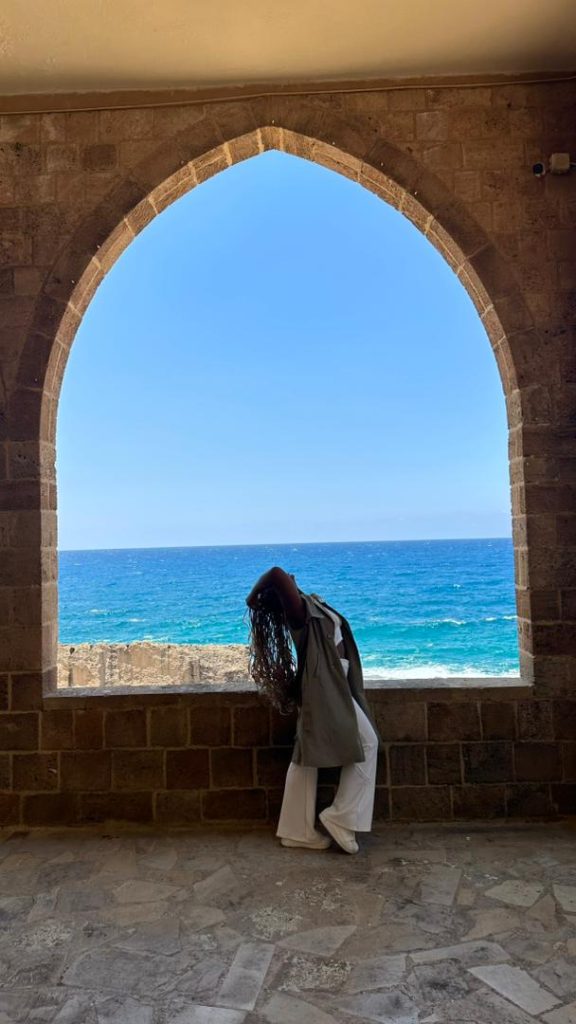 Amaku at the Phoenician wall, Batroun, Lebanon
“I’ve learned about sharing and community from Asian countries like Lebanon and Singapore,” said Amaku. “People there have this sense of togetherness; you feel how much they believe in people, and it changes how you see the world.”
How Amaku travels on a Nigerian passport
For many Nigerians, the first question about travel is not where to go, but how to get there when your passport is one of the weakest in the world. Amaku does not soften that reality; she leans into it, treating access as a problem to be solved repeatedly rather than a wall to turn back from. She still travels on a Nigerian passport, but layers it with every advantage she can find: residency, visa strategy, obsessive research and a work life built around flexibility.
“Every year, I spend thousands and thousands of dollars on visa applications,” said Amaku. “I get some, I get denied for some, but the world is mine for exploration, so a visa denial will not stop me.”
Her first structural hack was a residency in Benin Republic, a status she picked up after overhearing a casual conversation and deciding on the spot to pursue it.
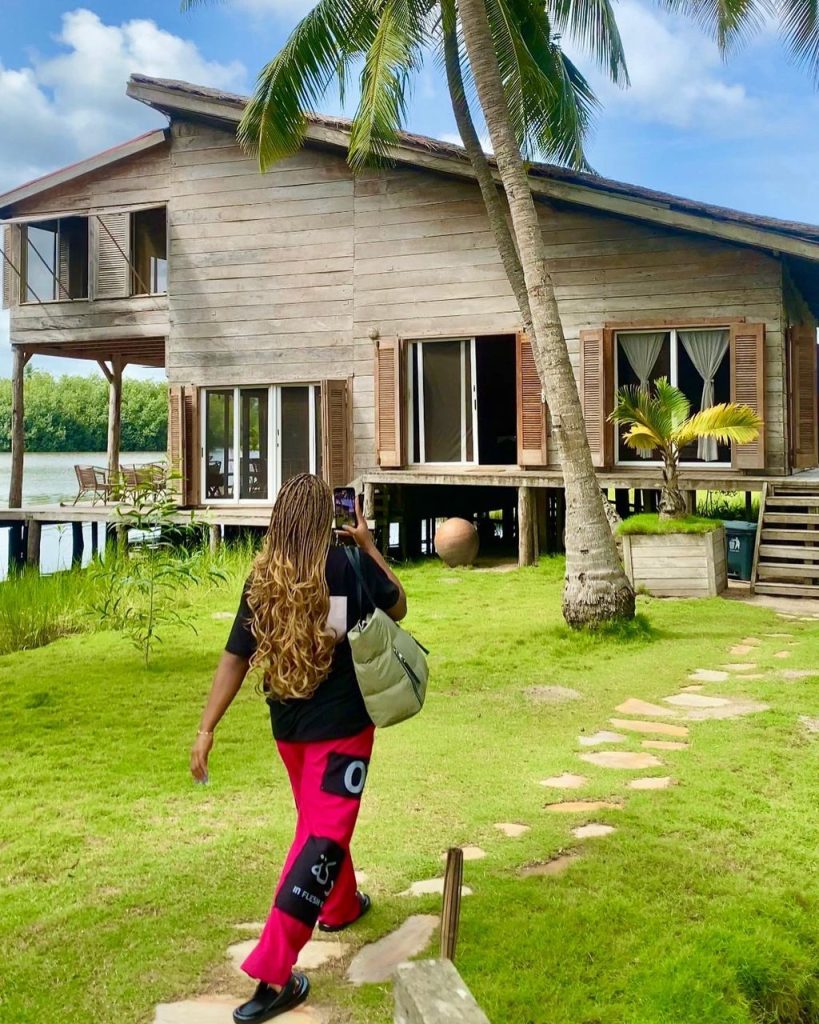 Amaku at Ouidah, Benin Republic in 2023
That residency makes it easier to apply for visas to some francophone African countries, giving her more straightforward access to parts of West Africa and beyond.
On top of that, she has learned to maximise every visa she secures. A UK visa, for example, has taken her not just to England but also to Scotland, Montenegro, Albania, Jersey and even as far as Mexico, Turks and Caicos Islands, and the Bahamas, destinations many Nigerians do not realise are accessible with that single sticker in their passports.
“People don’t know the access is that broad,” said Amaku. “That’s why I still apply even after denials; I hate the documentation, but I love what the access lets me do.”
Building this life required money, earned slowly, then all at once. Before social media became her full-time lane, she worked in publishing and then in corporate communications, running a small hair business on the side and quietly gaining a reputation for being good at social media. When the COVID-19 lockdown hit in 2020, the demand for online creators exploded, and so did her workload.
At the time, she was the head of corporate communications at a home automation company, but referrals continued to pour in for her to handle social media and content for small brands. By mid-lockdown, she was working three roles from her bedroom in Lagos: attending corporate communications, contracting as a social media manager and content creator for a fintech, and managing social media for a fashion business, all while running her hair brand.
“At some point in 2020, I was earning three salaries and living at home,” said Amaku. “I wasn’t paying rent or spending on food, so after the grind and the exhaustion, I looked up and realised I had this financial buffer—and that’s when I started travelling.”
Those months built more than savings; they built credibility. Every campaign, every brand recommendation, every successful experiment with social content made it easier for future employers and clients to trust her, which, in turn, made it easier to insist on remote or flexible work. Today, she leads social media and marketing efforts for a Nigerian fintech unicorn in a largely remote role, with occasional in-person time in Lagos during event-heavy seasons.
“Marketing is mostly online now,” said Amaku. “I can press go on a campaign here in Germany, and it starts converting in Lagos; I don’t have to be there except during event season.”
That flexibility is what lets her line up flights with classes, work calls, and group trips for the travel business she co-founded in 2022 after a trip to Kigali, Rwanda. On that trip, she realised how neatly her strengths fit with those of a university friend: he loved logistics and admin, from negotiating hotel discounts to finalising flight details, while she thrived at marketing and community building, keeping people engaged, informed and excited about the experience. By the time their first trip ended, they had a name, a brand, an Instagram account, and a flyer for their next destination, Senegal.
“He told me, ‘I’m brilliant at operations, and you’re brilliant at marketing—why don’t we bring our brilliance together and do this as a business?’” said Amaku. “Before that conversation was over, I had created the Instagram account, named the business, and designed the flyer for our next group trip.”
Their travel agency has since helped over 100 people travel, many of them leaving Nigeria for the first time on curated trips to Benin Republic, Togo, and other West African destinations. Amaku designs these trips to be both affordable and strategically useful: a two-country Benin and Togo road trip, which costs around ₦750,000 ($518.20) in recent years, can yield up to eight passport stamps, nearly two pages of travel history that make future visa applications stronger.
“For a first-time traveller, a Benin and Togo trip for 750k is one of the most valuable things you can do,” said Amaku. “You come back with eight stamps—almost two full pages of your passport—and that’s powerful when you start applying for visas.”
She applies the same step-by-step logic to her own finances. Rather than waking up one day and paying for a six-country Europe trip in one lump sum, she spreads the cost over months: flights booked four or five months ahead, hotels locked in closer to departure, and other expenses mapped out in phases. This is partly a response to how expensive travel can be—a Lagos-to-Zanzibar flight can cost around ₦1.2 million ($829.11), excluding accommodation—and a way to make a demanding lifestyle sustainable.
“The easiest way to save for travel is to do it small,” said Amaku. “By the time you’ve paid for the ticket in June, the hotel in September, and a few other things in between, you won’t even realise when you’ve pulled the whole trip together.”
 Amaku at Villagio Mall, Doha Qatar
‘Cheap’ isn’t just about when she pays, it’s also about how she searches. She uses flight aggregators to compare routes and prices, runs searches through VPNs that make it look like she’s booking from other countries, and always checks booking platforms in mobile view because she has learned that the same hotel often shows cheaper rates on a phone than on a laptop.
“I’ll put myself in Cotonou or Cameroon with a VPN to see if I can get a cheaper flight deal,” said Amaku. “On booking sites, I always use mobile view because it gives you a cheaper price than desktop—you’d be shocked how much difference that makes.”
Then there are the tools that keep her safe and oriented when she is moving constantly. For language barriers, she leans on Google Translate—tapping quick phrases back and forth across counters, turnstiles, and ticket booths—and for navigation, she starts with Google Maps before switching to country-specific apps once she lands. In Switzerland, she relies on SBB Mobile to find the right platforms and trains; in Berlin, she uses Deutsche Bahn’s app; in Italy, yet another system she had to learn after getting repeatedly lost.
“Moving around Europe is so hard if you’re not a local or someone who lives here,” said Amaku. “You don’t just hop into a bus and say ‘stop me here’ like in Lagos; you need to know the stations, the platforms, the exact times, or you’ll miss everything.”
To manage risk across borders, she buys travel medical insurance through Safety Wing, a provider she prefers because its policies explicitly cover medical emergencies, as opposed to generic travel insurance products she’s seen. The choice is informed by stories like that of a client who developed an eye infection in South Africa and had to pay a $100 fee before the provider covered the rest of the treatment—an experience that taught Amaku to scrutinise what ‘coverage’ really means.
A moving train with a classroom
In spite of her constant travels, Amaku still wants anchors. Lagos remains home, the place she returns to after long stretches on the road, and lately, Barcelona, where she is currently enrolled in a hybrid executive MBA programme.
“Every three months, I go in for a week to learn in person,” Amaku said, “Then everything else—classes, assignments—is online, which is one big reason I’m in Europe so often.”
The programme shapes her travel calendar in practical and personal ways. She often builds an entire multi-country route around that one required week, scheduling work shoots, travel business trips, and personal exploration on either side of her classes. She admits, however, that she sometimes feels tired of the repeated trips to Europe and longs for Asia, where visas are harder to stack, but the cultures feel fresh.
“Asia is my next big target,” said Amaku. “The only thing that’s stopping me is the fact that, unlike Europe, where one Schengen visa can unlock ten countries in one swoop, Asia often needs separate visas for each country; once I have the extra money for all those expensive visas, that continent will be seeing me a lot.”
Her days on the road are not balanced in any conventional sense; they are managed, one necessary task at a time. Some days, “necessary” means sitting in an eight-hour class for her MBA; on others, it means spending 18 hours commuting between countries, or leading a brainstorming call with her marketing team, or hosting a group of first-time travellers in a coastal Benin Republic town.
It helps that every strand of her life feeds into the others. Work and business pay for travel and allow it to stay flexible; the MBA deepens her business skills and networks; the travel agency turns her expertise and curiosity into a product for other Nigerians who never thought travel was for them. She has watched couples who once told her they could never afford to travel now plan honeymoons in East Africa after a first road trip with her to Benin and Togo.
“The mission has always been to show Nigerians that travel is possible,” said Amaku. “In three years of running this business, I’ve seen over a hundred people leave the country for the first time and come back already planning where to go next.”
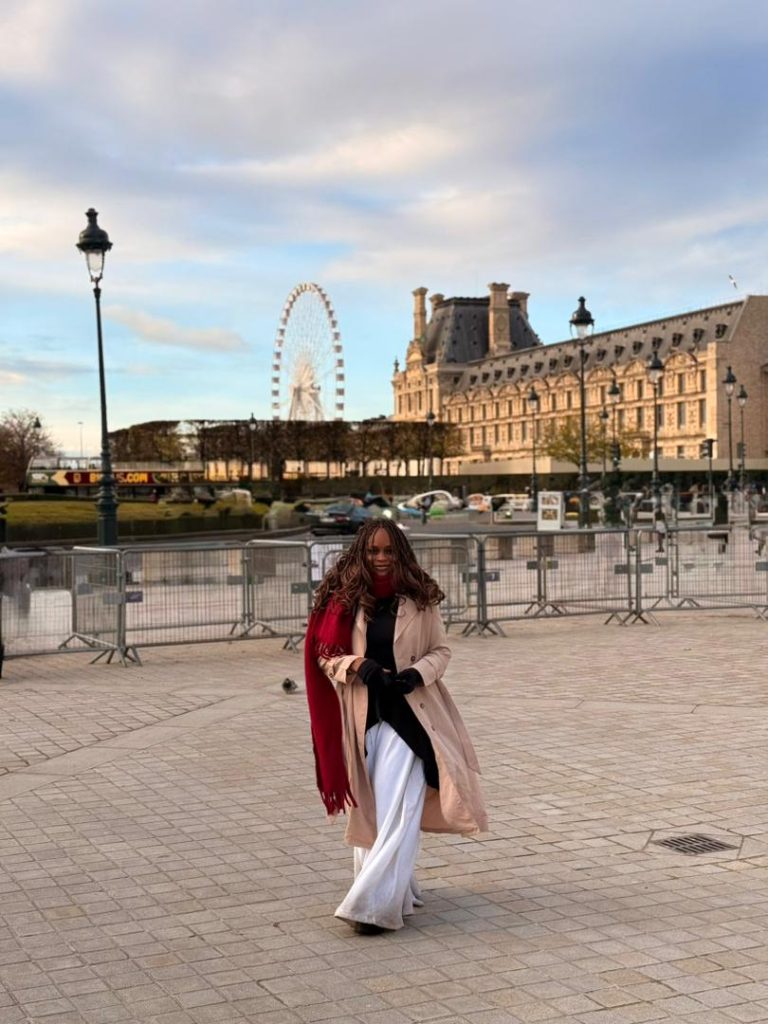 Amaku at Musée du Louvre, Paris, France
What worries her now is not whether more people will want to travel, but whether the world will make it harder for them to do so. She tracks immigration news almost obsessively, monitoring everything from the UK’s new income thresholds for sponsored work routes to Qatar’s restrictions on solo Nigerian male visitors, to Southeast Asian countries tightening entry rules for Nigerians. In her view, the borders of the “Global North” are closing more tightly with each year, and the only defence is information.
“People are not curious enough when these travel policy changes come out,” said Amaku. “The first question should be: what does this mean for me and the future I’m planning?”
This curiosity is what turned one underpaid publishing staffer into a woman who strings Europe together like a neighbourhood and treats airports as extended living rooms. It is what pushed her to sit through a miserable 24-hour bus ride to Ghana and what now sends her across continents to attend a week of classes in Spain. And it is what she hopes to pass on to every young person who texts her to say they love her travel videos and wish it could be them someday.
For Amaku, being a self-described “digital nomad” is not about never having a home; it is about refusing to accept that a green passport should decide how much of the world you get to see.
You May Also Like

From Early Trading Losses to Global Impact: Somesh’s Journey to Building an Int’l Trading Community
Ethereum koers toont zeldzaam dubbel koopsignaal en richt zich op $4.550