Bitcoin Magazine Bitcoin Price Plunges 8% to $84,000 as December Opens With More Market Jitters The Bitcoin price fell to the mid-$84,000s early Monday, sliding 8% over the past 24 hours. This post Bitcoin Price Plunges 8% to $84,000 as December Opens With More Market Jitters first appeared on Bitcoin Magazine and is written by Micah Zimmerman.Bitcoin Magazine Bitcoin Price Plunges 8% to $84,000 as December Opens With More Market Jitters The Bitcoin price fell to the mid-$84,000s early Monday, sliding 8% over the past 24 hours. This post Bitcoin Price Plunges 8% to $84,000 as December Opens With More Market Jitters first appeared on Bitcoin Magazine and is written by Micah Zimmerman.

Bitcoin Price Plunges 8% to $84,000 as December Opens With More Market Jitters

Bitcoin Magazine

Bitcoin Price Plunges 8% to $84,000 as December Opens With More Market Jitters

Bitcoin price fell sharply to the mid-$84,000s early Monday, sliding 8% over the past 24 hours as a wave of macro anxiety, thin liquidity and fresh crypto-native stress hit markets simultaneously. 

The world’s largest digital asset traded between a 24-hour high of $91,866 and a low of $84,722, extending a two-month drawdown that has now erased more than 30% from October’s record highs, according to Bitcoin Magazine Pro data. 

The downturn marks a swift reversal from last week’s tentative recovery. After plunging below $81,000 on Nov. 21, the Bitcoin price steadily climbed into the end of November and briefly pushed above $92,500 during Black Friday’s morning session. 

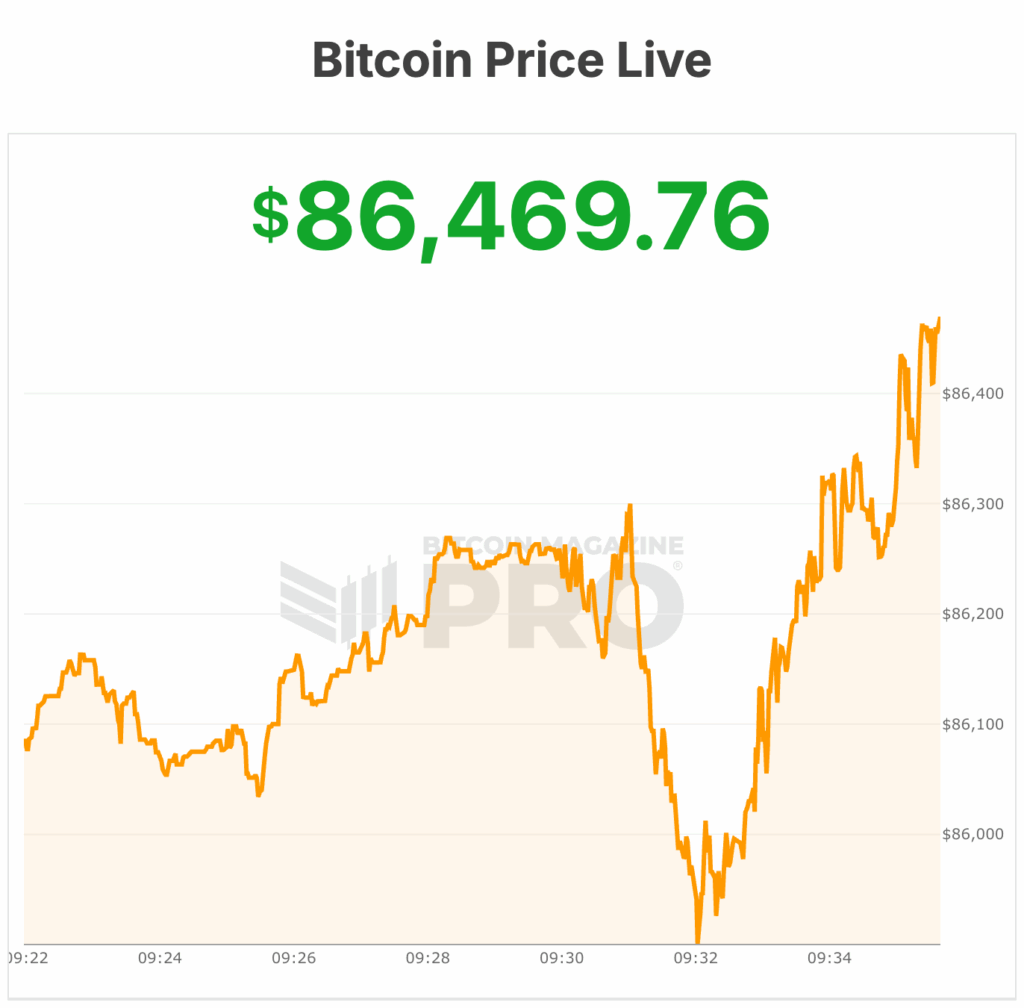
But momentum reversed again Sunday evening, with BTC slipping back below $85,000 early Monday. At the time of writing, the bitcoin price is $86,469.  

Why is Bitcoin price dipping? 

Multiple forces might be behind the renewed selloff. The most immediate shock could be from a security incident at Yearn Finance, where a flaw in the protocol’s yETH pool allowed an attacker to mint an abnormally large amount of tokens. 

The exploit flooded the pool with invalid supply and triggered a rush for the exits across DeFi —  spilling over into majors like BTC and ETH.

But macro pressure has been building in parallel. A sharp spike in Japanese government bond yields — part of a broader global repricing of interest-rate expectations—sparked a risk-off move in Asia trading hours, hitting an already fragile, low-volume crypto market.

Comments from Bank of Japan Governor Kazuo Ueda signaled the possibility of a December rate hike — an event that would be Japan’s first move away from negative interest rate policy in years. 

The remarks sent Japan’s 30-, 10-, and 2-year government bond yields to their highest levels since 2008. A stronger yen could force hedge funds that borrow cheaply in Japan to unwind carry trades, adding fresh pressure to bitcoin and other risk assets.

According to 10x Research, last week marked one of the lowest-liquidity stretches since July, leaving order books thin and amplifying the impact of institutional selling.

The result was a deeper drawdown than fundamentals alone might suggest. Bitcoin’s market depth evaporated over the weekend, turning what might have been a modest correction into a full-scale liquidity event. 

More than 220,000 traders were liquidated over 24 hours, with total losses exceeding $630 million.

The derivatives picture underscores the imbalance: Bitcoin price futures open interest fell by $1.1 billion leading into the decline, suggesting traders had already started de-risking. 

Monetary policy uncertainty remains at the center of investors’ anxiety. Markets now assign an 80%–87% probability that the Federal Reserve will cut rates by 25 basis points at its Dec. 9–10 meeting.

Rate cuts would be supportive for the Bitcoin price, boosting liquidity and risk appetite. But if the Fed opts to hold steady, traders fear a sharper unwind across risk assets.

Corporate developments added another wrinkle. Strategy Inc. (formerly MicroStrategy) said Monday it created a $1.4 billion reserve—funded by common-stock sales—to cover at least 21 months of preferred-stock dividend payments amid Bitcoin’s slide. 

The company, which now holds 650,000 BTC, also reported purchasing another 130 BTC last week for $11.7 million.

Last week, fresh disclosures showed BlackRock ramping up its exposure to its own spot Bitcoin ETF while JPMorgan rolled out a high-stakes structured note tied to the fund.

Bitcoin price briefly dipped to $86,129 before rebounding above $90,300 amid ongoing Q4 volatility. BlackRock’s Strategic Income Opportunities Portfolio now holds 2.39 million IBIT shares worth $155.8 million, up 14% from June, signaling deeper internal allocation to BTC-linked assets.

Meanwhile, JPMorgan’s new derivative-style note lets institutions bet on IBIT’s future price, offering a 16% fixed return if targets are met next year, and up to 1.5x upside by 2028 if Bitcoin surges.

At the time of writing, the bitcoin price is rebounding up to $86,469.  
bitcoin price

This post Bitcoin Price Plunges 8% to $84,000 as December Opens With More Market Jitters first appeared on Bitcoin Magazine and is written by Micah Zimmerman.


Market Opportunity
Moonveil Logo
Moonveil Price(MORE)
$0,003758
$0,003758$0,003758
-6,79%
USD
Moonveil (MORE) Live Price Chart
Disclaimer: The articles reposted on this site are sourced from public platforms and are provided for informational purposes only. They do not necessarily reflect the views of MEXC. All rights remain with the original authors. If you believe any content infringes on third-party rights, please contact service@support.mexc.com for removal. MEXC makes no guarantees regarding the accuracy, completeness, or timeliness of the content and is not responsible for any actions taken based on the information provided. The content does not constitute financial, legal, or other professional advice, nor should it be considered a recommendation or endorsement by MEXC.

You May Also Like

Optum Golf Channel Games Debut In Prime Time

Optum Golf Channel Games Debut In Prime Time

The post Optum Golf Channel Games Debut In Prime Time appeared on BitcoinEthereumNews.com. FARMINGDALE, NEW YORK – SEPTEMBER 28: (L-R) Scottie Scheffler of Team
Share
BitcoinEthereumNews2025/12/18 07:21
Google's AP2 protocol has been released. Does encrypted AI still have a chance?

Google's AP2 protocol has been released. Does encrypted AI still have a chance?

Following the MCP and A2A protocols, the AI Agent market has seen another blockbuster arrival: the Agent Payments Protocol (AP2), developed by Google. This will clearly further enhance AI Agents' autonomous multi-tasking capabilities, but the unfortunate reality is that it has little to do with web3AI. Let's take a closer look: What problem does AP2 solve? Simply put, the MCP protocol is like a universal hook, enabling AI agents to connect to various external tools and data sources; A2A is a team collaboration communication protocol that allows multiple AI agents to cooperate with each other to complete complex tasks; AP2 completes the last piece of the puzzle - payment capability. In other words, MCP opens up connectivity, A2A promotes collaboration efficiency, and AP2 achieves value exchange. The arrival of AP2 truly injects "soul" into the autonomous collaboration and task execution of Multi-Agents. Imagine AI Agents connecting Qunar, Meituan, and Didi to complete the booking of flights, hotels, and car rentals, but then getting stuck at the point of "self-payment." What's the point of all that multitasking? So, remember this: AP2 is an extension of MCP+A2A, solving the last mile problem of AI Agent automated execution. What are the technical highlights of AP2? The core innovation of AP2 is the Mandates mechanism, which is divided into real-time authorization mode and delegated authorization mode. Real-time authorization is easy to understand. The AI Agent finds the product and shows it to you. The operation can only be performed after the user signs. Delegated authorization requires the user to set rules in advance, such as only buying the iPhone 17 when the price drops to 5,000. The AI Agent monitors the trigger conditions and executes automatically. The implementation logic is cryptographically signed using Verifiable Credentials (VCs). Users can set complex commission conditions, including price ranges, time limits, and payment method priorities, forming a tamper-proof digital contract. Once signed, the AI Agent executes according to the conditions, with VCs ensuring auditability and security at every step. Of particular note is the "A2A x402" extension, a technical component developed by Google specifically for crypto payments, developed in collaboration with Coinbase and the Ethereum Foundation. This extension enables AI Agents to seamlessly process stablecoins, ETH, and other blockchain assets, supporting native payment scenarios within the Web3 ecosystem. What kind of imagination space can AP2 bring? After analyzing the technical principles, do you think that's it? Yes, in fact, the AP2 is boring when it is disassembled alone. Its real charm lies in connecting and opening up the "MCP+A2A+AP2" technology stack, completely opening up the complete link of AI Agent's autonomous analysis+execution+payment. From now on, AI Agents can open up many application scenarios. For example, AI Agents for stock investment and financial management can help us monitor the market 24/7 and conduct independent transactions. Enterprise procurement AI Agents can automatically replenish and renew without human intervention. AP2's complementary payment capabilities will further expand the penetration of the Agent-to-Agent economy into more scenarios. Google obviously understands that after the technical framework is established, the ecological implementation must be relied upon, so it has brought in more than 60 partners to develop it, almost covering the entire payment and business ecosystem. Interestingly, it also involves major Crypto players such as Ethereum, Coinbase, MetaMask, and Sui. Combined with the current trend of currency and stock integration, the imagination space has been doubled. Is web3 AI really dead? Not entirely. Google's AP2 looks complete, but it only achieves technical compatibility with Crypto payments. It can only be regarded as an extension of the traditional authorization framework and belongs to the category of automated execution. There is a "paradigm" difference between it and the autonomous asset management pursued by pure Crypto native solutions. The Crypto-native solutions under exploration are taking the "decentralized custody + on-chain verification" route, including AI Agent autonomous asset management, AI Agent autonomous transactions (DeFAI), AI Agent digital identity and on-chain reputation system (ERC-8004...), AI Agent on-chain governance DAO framework, AI Agent NPC and digital avatars, and many other interesting and fun directions. Ultimately, once users get used to AI Agent payments in traditional fields, their acceptance of AI Agents autonomously owning digital assets will also increase. And for those scenarios that AP2 cannot reach, such as anonymous transactions, censorship-resistant payments, and decentralized asset management, there will always be a time for crypto-native solutions to show their strength? The two are more likely to be complementary rather than competitive, but to be honest, the key technological advancements behind AI Agents currently all come from web2AI, and web3AI still needs to keep up the good work!
Share
PANews2025/09/18 07:00
Read Trend And Momentum Across Markets

Read Trend And Momentum Across Markets

The post Read Trend And Momentum Across Markets appeared on BitcoinEthereumNews.com. Widely used in technical analysis, the MACD indicator helps traders read trend
Share
BitcoinEthereumNews2025/12/18 07:14