The post Ethereum (ETH) Price Slides; Mirrors 2017 & 2020 Patterns—Is a Breakout Ahead? appeared first on Coinpedia Fintech News Following the Bitcoin price plunge below the crucial support at $84,000, driven by bid-side liquidity collapse, the crypto markets have shaken. The ripple effects spread to other altcoins such as Ethereum and Solana, whose prices fell more than Bitcoin’s. ETH price slipped sharply this week, falling back toward the mid-$2,700 range as broader crypto market volatility pushed investors into risk-off mode. While the short-term technicals look fragile, deeper analysis of staking flows, historical price structure, and long-term accumulation zones suggests the latest decline may be less about weakness and more about opportunity for long-horizon players. ETH Returns to Its ‘Discount Zone’—A Level Where Major Rallies Historically Begin Ethereum has re-entered a major multi-year “discount zone”—a price region that has consistently acted as a long-term accumulation range. The chart shows the ETH price still moving inside an ascending parallel channel that dates back to early 2022. Source: X Previous dips into this lower band (late-2022, mid-2023, and early-2025) all triggered strong rallies, often marking the beginning of multi-month uptrends. The current return to the discount zone mirrors those earlier setups, suggesting the downside may be more limited than the recent market sentiment implies. This structural trend remains intact despite the pullback, offering a key insight: ETH’s macro uptrend is unbroken. Whales Are Staking More ETH — Even During the Correction While spot price weakness might suggest fading confidence, on-chain data shows the opposite. Large validators—typically whales or institutions—continue sending repeated batches of 32 ETH to the Ethereum Deposit Contract. The above data suggest an early Ethereum whale just staked 40,000 ETH worth $120 million after 10 years of inactivity. This behavior indicates sustained accumulation and long-term commitment. When whales increase staking during market drawdowns, it often signals they see the move as temporary, not structural. Historically, aggressive staking inflows have aligned with major cycle expansions, as they reduce liquid supply and tighten exchange reserves. The pattern appears to be repeating. Ethereum’s Current Structure Mirrors the 2017 and 2020 Accumulation Phases Zooming out, Ethereum’s current consolidation zone looks strikingly similar to previous cycle setups in 2017 and 2020 — both of which ended in explosive breakouts. Source: X Each cycle followed a repeated behavior pattern: Long consolidation near the midpoint of the macro trend A final shakeout or drop toward support A rapid expansion phase once liquidity returned In the chart, 2025’s price action is mimicking this same structure, suggesting ETH could be nearing the end of its consolidation rather than beginning a deeper downtrend. What Comes Next for ETH Price? Ethereum’s latest correction has pushed the asset back into a historical “value zone,” but on-chain data suggests the pullback may be more of an opportunity than a setback. Whales continue to accumulate, staking deposits remain strong, and ETH’s broader market structure still resembles previous pre-breakout phases. While short-term volatility may persist, the underlying fundamentals point to a network that is strengthening beneath the surface—setting the stage for a potential recovery once market sentiment stabilizes. If ETH can reclaim the $3,100–$3,250 band with strong volume, the next major leg toward the $3,800–$4,200 region becomes increasingly likely. And if history continues to rhyme, Ethereum may be positioning for a much larger move later in 2025.The post Ethereum (ETH) Price Slides; Mirrors 2017 & 2020 Patterns—Is a Breakout Ahead? appeared first on Coinpedia Fintech News Following the Bitcoin price plunge below the crucial support at $84,000, driven by bid-side liquidity collapse, the crypto markets have shaken. The ripple effects spread to other altcoins such as Ethereum and Solana, whose prices fell more than Bitcoin’s. ETH price slipped sharply this week, falling back toward the mid-$2,700 range as broader crypto market volatility pushed investors into risk-off mode. While the short-term technicals look fragile, deeper analysis of staking flows, historical price structure, and long-term accumulation zones suggests the latest decline may be less about weakness and more about opportunity for long-horizon players. ETH Returns to Its ‘Discount Zone’—A Level Where Major Rallies Historically Begin Ethereum has re-entered a major multi-year “discount zone”—a price region that has consistently acted as a long-term accumulation range. The chart shows the ETH price still moving inside an ascending parallel channel that dates back to early 2022. Source: X Previous dips into this lower band (late-2022, mid-2023, and early-2025) all triggered strong rallies, often marking the beginning of multi-month uptrends. The current return to the discount zone mirrors those earlier setups, suggesting the downside may be more limited than the recent market sentiment implies. This structural trend remains intact despite the pullback, offering a key insight: ETH’s macro uptrend is unbroken. Whales Are Staking More ETH — Even During the Correction While spot price weakness might suggest fading confidence, on-chain data shows the opposite. Large validators—typically whales or institutions—continue sending repeated batches of 32 ETH to the Ethereum Deposit Contract. The above data suggest an early Ethereum whale just staked 40,000 ETH worth $120 million after 10 years of inactivity. This behavior indicates sustained accumulation and long-term commitment. When whales increase staking during market drawdowns, it often signals they see the move as temporary, not structural. Historically, aggressive staking inflows have aligned with major cycle expansions, as they reduce liquid supply and tighten exchange reserves. The pattern appears to be repeating. Ethereum’s Current Structure Mirrors the 2017 and 2020 Accumulation Phases Zooming out, Ethereum’s current consolidation zone looks strikingly similar to previous cycle setups in 2017 and 2020 — both of which ended in explosive breakouts. Source: X Each cycle followed a repeated behavior pattern: Long consolidation near the midpoint of the macro trend A final shakeout or drop toward support A rapid expansion phase once liquidity returned In the chart, 2025’s price action is mimicking this same structure, suggesting ETH could be nearing the end of its consolidation rather than beginning a deeper downtrend. What Comes Next for ETH Price? Ethereum’s latest correction has pushed the asset back into a historical “value zone,” but on-chain data suggests the pullback may be more of an opportunity than a setback. Whales continue to accumulate, staking deposits remain strong, and ETH’s broader market structure still resembles previous pre-breakout phases. While short-term volatility may persist, the underlying fundamentals point to a network that is strengthening beneath the surface—setting the stage for a potential recovery once market sentiment stabilizes. If ETH can reclaim the $3,100–$3,250 band with strong volume, the next major leg toward the $3,800–$4,200 region becomes increasingly likely. And if history continues to rhyme, Ethereum may be positioning for a much larger move later in 2025.

Ethereum (ETH) Price Slides; Mirrors 2017 & 2020 Patterns—Is a Breakout Ahead?
2025/12/02 01:52
3 min read
For feedback or concerns regarding this content, please contact us at crypto.news@mexc.com
Ethereum Crashes to $2,700, 10x Research Warns the Real Problem Is On-Chain

The post Ethereum (ETH) Price Slides; Mirrors 2017 & 2020 Patterns—Is a Breakout Ahead? appeared first on Coinpedia Fintech News

Following the Bitcoin price plunge below the crucial support at $84,000, driven by bid-side liquidity collapse, the crypto markets have shaken. The ripple effects spread to other altcoins such as Ethereum and Solana, whose prices fell more than Bitcoin’s. ETH price slipped sharply this week, falling back toward the mid-$2,700 range as broader crypto market volatility pushed investors into risk-off mode. While the short-term technicals look fragile, deeper analysis of staking flows, historical price structure, and long-term accumulation zones suggests the latest decline may be less about weakness and more about opportunity for long-horizon players.

ETH Returns to Its ‘Discount Zone’—A Level Where Major Rallies Historically Begin

Ethereum has re-entered a major multi-year “discount zone”—a price region that has consistently acted as a long-term accumulation range. The chart shows the ETH price still moving inside an ascending parallel channel that dates back to early 2022.
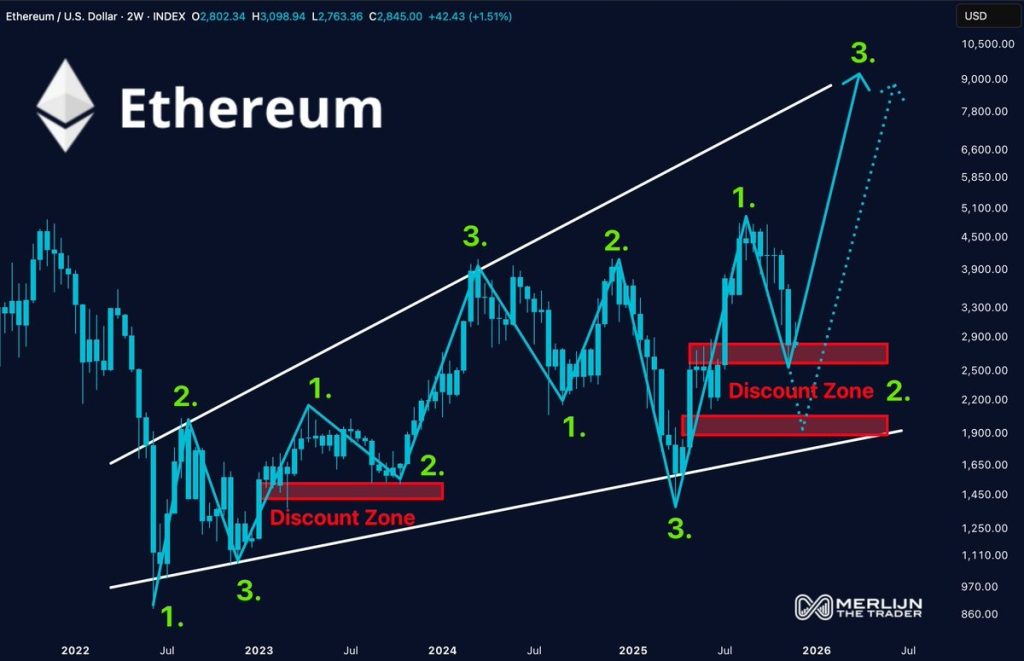
eth priceSource: X

Previous dips into this lower band (late-2022, mid-2023, and early-2025) all triggered strong rallies, often marking the beginning of multi-month uptrends. The current return to the discount zone mirrors those earlier setups, suggesting the downside may be more limited than the recent market sentiment implies.

This structural trend remains intact despite the pullback, offering a key insight: ETH’s macro uptrend is unbroken.

Whales Are Staking More ETH — Even During the Correction

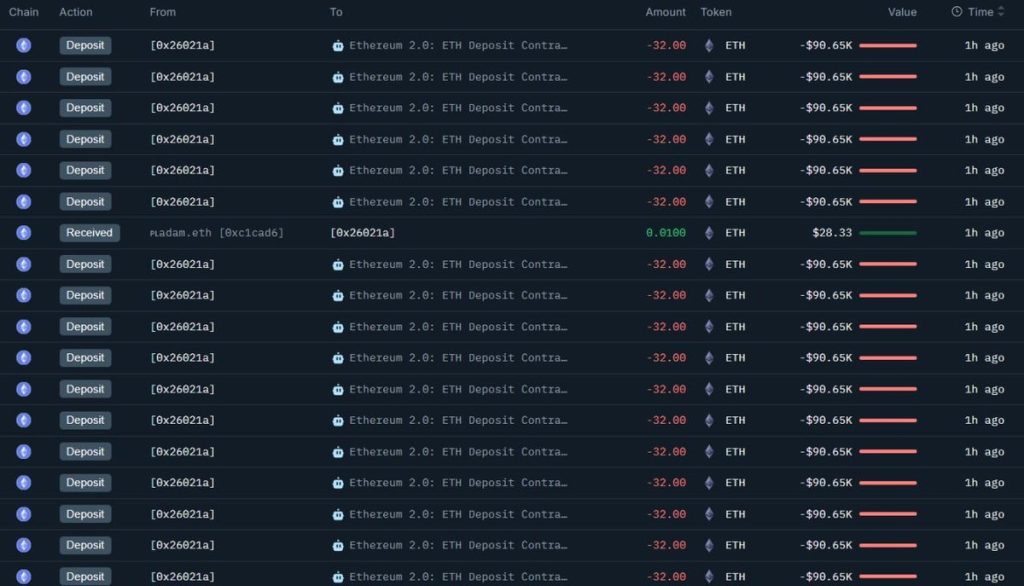
While spot price weakness might suggest fading confidence, on-chain data shows the opposite. Large validators—typically whales or institutions—continue sending repeated batches of 32 ETH to the Ethereum Deposit Contract.
eth price

The above data suggest an early Ethereum whale just staked 40,000 ETH worth $120 million after 10 years of inactivity. This behavior indicates sustained accumulation and long-term commitment. When whales increase staking during market drawdowns, it often signals they see the move as temporary, not structural.

Historically, aggressive staking inflows have aligned with major cycle expansions, as they reduce liquid supply and tighten exchange reserves. The pattern appears to be repeating.

Ethereum’s Current Structure Mirrors the 2017 and 2020 Accumulation Phases

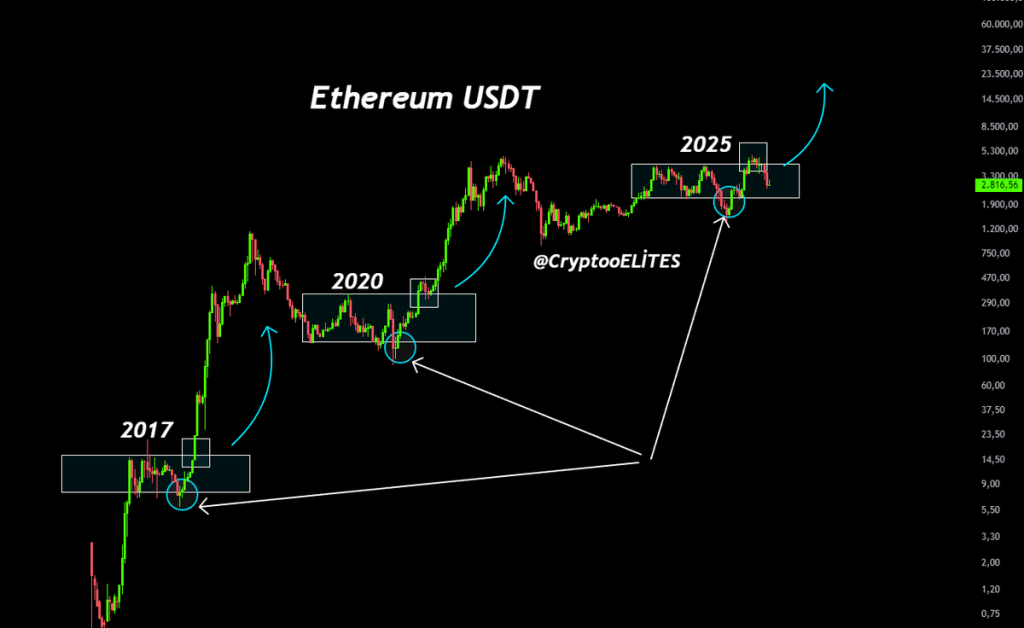
Zooming out, Ethereum’s current consolidation zone looks strikingly similar to previous cycle setups in 2017 and 2020 — both of which ended in explosive breakouts.
eth priceSource: X

Each cycle followed a repeated behavior pattern:

  • Long consolidation near the midpoint of the macro trend
  • A final shakeout or drop toward support
  • A rapid expansion phase once liquidity returned

In the chart, 2025’s price action is mimicking this same structure, suggesting ETH could be nearing the end of its consolidation rather than beginning a deeper downtrend.

What Comes Next for ETH Price?

Ethereum’s latest correction has pushed the asset back into a historical “value zone,” but on-chain data suggests the pullback may be more of an opportunity than a setback. Whales continue to accumulate, staking deposits remain strong, and ETH’s broader market structure still resembles previous pre-breakout phases. While short-term volatility may persist, the underlying fundamentals point to a network that is strengthening beneath the surface—setting the stage for a potential recovery once market sentiment stabilizes.

If ETH can reclaim the $3,100–$3,250 band with strong volume, the next major leg toward the $3,800–$4,200 region becomes increasingly likely. And if history continues to rhyme, Ethereum may be positioning for a much larger move later in 2025.

Market Opportunity
Ethereum Logo
Ethereum Price(ETH)
$2,156.28
$2,156.28$2,156.28
+0.97%
USD
Ethereum (ETH) Live Price Chart
Disclaimer: The articles reposted on this site are sourced from public platforms and are provided for informational purposes only. They do not necessarily reflect the views of MEXC. All rights remain with the original authors. If you believe any content infringes on third-party rights, please contact crypto.news@mexc.com for removal. MEXC makes no guarantees regarding the accuracy, completeness, or timeliness of the content and is not responsible for any actions taken based on the information provided. The content does not constitute financial, legal, or other professional advice, nor should it be considered a recommendation or endorsement by MEXC.

You May Also Like

Circle Expands USDC Into Africa Through Sasai Deal, Targeting Cross-Border Payments Boom

Circle Expands USDC Into Africa Through Sasai Deal, Targeting Cross-Border Payments Boom

USDC integration into Sasai signals rising stablecoin demand for cross-border trade and FX stability in Africa. Circle Internet Group agreed to a landmark partnership
Share
LiveBitcoinNews2026/03/25 06:39
Hoskinson to Attend Senate Roundtable on Crypto Regulation

Hoskinson to Attend Senate Roundtable on Crypto Regulation

The post Hoskinson to Attend Senate Roundtable on Crypto Regulation appeared on BitcoinEthereumNews.com. Hoskinson confirmed for Senate roundtable on U.S. crypto regulation and market structure. Key topics include SEC vs CFTC oversight split, DeFi regulation, and securities rules. Critics call the roundtable slow, citing Trump’s 2025 executive order as faster. Cardano founder Charles Hoskinson has confirmed that he will attend the Senate Banking Committee roundtable on crypto market structure legislation.  Hoskinson left a hint about his attendance on X while highlighting Journalist Eleanor Terrett’s latest post about the event. Crypto insiders will meet with government officials Terrett shared information gathered from some invitees to the event, noting that a group of leaders from several major cryptocurrency establishments would attend the event. According to Terrett, the group will meet with the Senate Banking Committee leadership in a roundtable to continue talks on market structure regulation. Meanwhile, Terrett noted that the meeting will be held on Thursday, September 18, following an industry review of the committee’s latest approach to distinguishing securities from commodities, DeFi treatment, and other key issues, which has lasted over one week.  Related: Senate Draft Bill Gains Experts’ Praise for Strongest Developer Protections in Crypto Law Notably, the upcoming roundtable between US legislators and crypto industry leaders is a continuation of the process of regularising cryptocurrency regulation in the United States. It is part of the Donald Trump administration’s efforts to provide clarity in the US cryptocurrency ecosystem, which many crypto supporters consider a necessity for the digital asset industry. Despite the ongoing process, some crypto users are unsatisfied with how the US government is handling the issue, particularly the level of bureaucracy involved in creating a lasting cryptocurrency regulatory framework. One such user criticized the process, describing it as a “masterclass in bureaucratic foot-dragging.” According to the critic, America is losing ground to nations already leading in blockchain innovation. He cited…
Share
BitcoinEthereumNews2025/09/18 06:37
USDC Treasury mints 250 million new USDC on Solana

USDC Treasury mints 250 million new USDC on Solana

PANews reported on September 17 that according to Whale Alert , at 23:48 Beijing time, USDC Treasury minted 250 million new USDC (approximately US$250 million) on the Solana blockchain .
Share
PANews2025/09/17 23:51