

The Day Trading Died: Why AGI Might Be the Last Market Maker
A growing wave of research and market data is reshaping long-held assumptions about the future of trading.
Analysts across traditional finance and crypto markets are now debating a possibility once considered far-fetched: the gradual disappearance of day trading as Artificial General Intelligence (AGI) moves closer to reality.
AGI does not yet exist, but progress in advanced multimodal systems and autonomous trading agents is pushing markets toward an environment where machines dominate price discovery and leave little room for human reactions.
Current trading automation already shows how quickly edges evaporate when machines take over.
As Algorithms Dominate 70% of Crypto Trading, Analysts Say AGI Could End Retail Alpha
High-frequency trading transformed equities years ago, and its logic expanded into crypto markets with the rise of firms such as Jump, Wintermute, and GSR.
By 2024, Kaiko reported that more than 70% of trading flow on exchanges like Binance and Coinbase was generated by algorithms rather than humans.
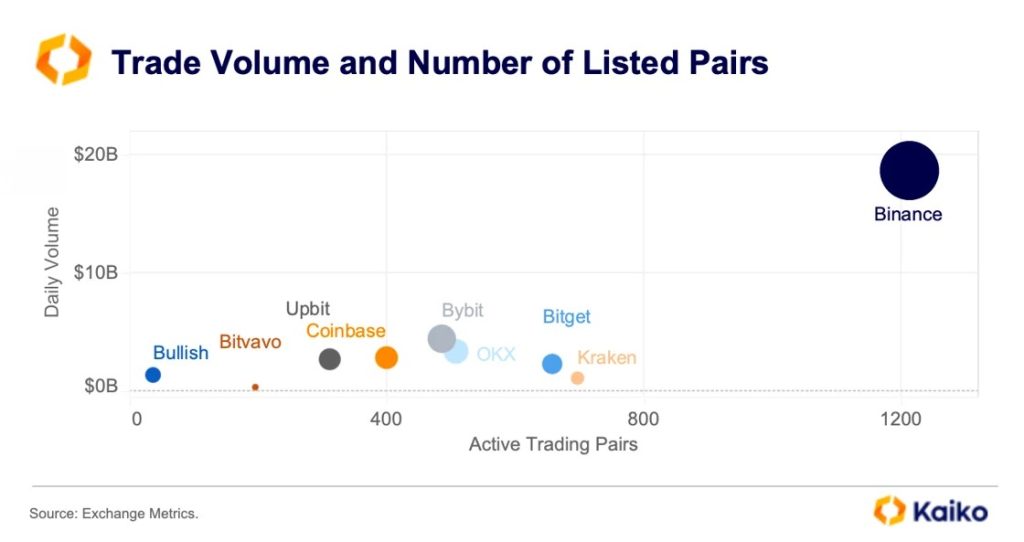 Source: Kaiko
This shift has reshaped market structure from the bottom up, reducing spreads and accelerating execution speed while also making it harder for retail traders to profit during high-volatility periods.
Researchers point to these trends as early evidence of rising efficiency.
During the Solana memecoin surge in 2024, trading bots, particularly “sniper” and “AI” bots, generally outperformed human traders due to their superior speed, automation, and lack of emotional bias.
Small AI systems designed to detect whale behavior and monitor blockchain flows reacted faster than discretionary traders and often positioned themselves before human participants understood what was happening.
Each advance in automation has consistently reduced the opportunities available to retail participants, and analysts argue that AGI would push this pattern to its logical endpoint.
The difference between today’s narrow AI and future AGI sits at the center of this debate.
Current models excel at specific tasks such as scanning order books, reading market sentiment, or identifying arbitrage. They cannot generalize across domains or apply human-like reasoning.
AGI, by contrast, is expected to learn new tasks with minimal instruction, adapt to unfamiliar environments, and combine information from many unrelated sources.
In financial markets, this would mean reading blockchain flows, interpreting global macro signs, assessing political risk, identifying whale movements, and evaluating supply-chain disruptions, all within a unified system capable of producing real-time forecasts.
Market theorists describe the potential outcome as the “Perfect Efficiency Paradox.” If an AGI system becomes capable of predicting price direction with near-perfect accuracy, the market adjusts instantly.
When every market participant is guided by the same level of intelligence, traditional trading behavior collapses.
Prices move faster than humans can react, volatility falls, arbitrage disappears, and liquidity provision becomes a machine-driven process rather than a competitive strategy.
Analysts warn that this dynamic could create what they call a liquidity black hole, where trading continues but the edge that once made day trading viable no longer exists.
AI Market Makers Move From Theory to Practice as Automation Surges
Warnings about this shift have circulated for years. DWF Labs noted in July that AI-driven market makers will increase liquidity, especially in smaller crypto assets with historically thin order books and wide spreads.
Economist Alex Krüger described a future of hyper-efficient markets with little room for mistakes.
BitMEX founder Arthur Hayes wrote that AI would eventually trade better than any human, while Ethereum co-founder Vitalik Buterin expressed concern that advanced systems could dominate MEV extraction and reduce human participation in core market functions.
These observations were treated as hypotheticals at the time, but rising levels of automation have since given them more weight.
As automation accelerates, the human role on trading desks is already changing.
Experts argue that humans will not disappear completely but will shift toward risk supervision, regulatory oversight, and interpreting unusual events that fall outside model expectations.
Execution itself moves to autonomous systems. The growth of AI trading agents reflects this transition.
These tools can research markets, choose strategies, adjust risk parameters, execute trades through APIs, and learn from outcomes without manual input. Forecasts suggest the AI trading bot market could reach approximately $75.5 billion by 2034.
You May Also Like
Why Localization Services Matter for Software Companies

₹71L CoinDCX Fraud Case Turns, Court Finds No Link to Founders

