Coinbase Warns Bitcoin Under Pressure, Citing ETF Outflows and Whales Exit
Coinbase Institutional has issued a stark warning to investors as Bitcoin breaks through critical support levels, citing multiple bearish indicators, including massive ETF outflows, whale distribution, and compressed valuations of digital asset treasuries.
The assessment comes as BTC trades decisively below its 200-day moving average following a 32% drawdown from recent highs above $126,000, with the crypto now testing support near $93,000.
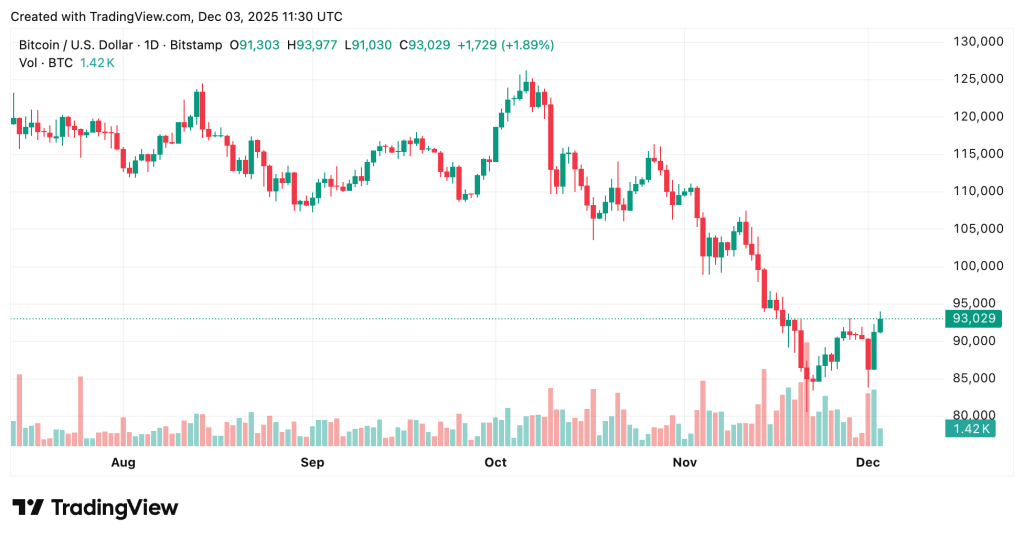 Source: TradingView
The exchange’s latest market analysis reveals a confluence of negative factors weighing on Bitcoin’s price action.
“In this environment, we think higher probability setups favor breakout trades over knife-catching,” Coinbase stated in a recent post, advising caution even as quantitative tightening ends and the Federal Reserve re-enters bond markets.
Critical Support Levels Shattered Across Multiple Metrics
Bitcoin has systematically broken through every major technical and on-chain support band that has historically anchored bull-market rallies.
According to Coinbase November report, the crypto now trades below its short-term holder cost basis and the 75% profit threshold that provided support in previous cycles, leaving no obvious floor for prices.
The $98,000-$100,000 battleground, which previously represented a thick band of holders anchored to that level, collapsed as the price sliced through with minimal rebound attempts.
 Source: Coinbase
Recent buyers are underwater, with realized losses spiking to levels last seen during the November 2022 FTX collapse.
This creates elevated capitulation risk as short-term holders rush to cut losses rather than hold through the downturn.
The swift drop through the $90,000-$85,000 range showed the lack of organic demand to mitigate declines, with cost-basis distribution thinning out below current levels.
Options markets have also shifted from cautious to outright defensive, with the Bull-Bear Index turning firmly negative across short and mid-term tenors.
Traders are paying premiums for downside protection rather than upside exposure, while long-dated options hover near neutral, suggesting structural uncertainty rather than deep pessimism.
Source: Coinbase
Meanwhile, long-term holder net position changes have turned decidedly negative on a 30-day basis, with market intelligence firm Arkham identifying at least one early Bitcoin whale who fully exited an 11,000 BTC position worth approximately $1.3 billion between late October and November.
ETF and Treasury Demand Evaporates
Spot ETF flows, previously a dominant incremental buyer, have reversed course dramatically.
November 2025 posted record cumulative net outflows as the trailing seven-day sum turned markedly negative after the price broke key levels.
Source: Coinbase
When allocators redeem ETF shares, issuers must sell spot Bitcoin or reduce hedges, amplifying broader risk-off episodes.
US spot Bitcoin ETFs now manage $168 billion in assets, holding approximately 1.36 million BTC, representing 6.9% of the circulating supply.
Digital asset treasury demand has similarly cooled, with companies’ market value over net asset value compressing below parity for the first time since 2024.
Multiple treasury vehicles now trade at discounts to their Bitcoin holdings, creating latent risk as shareholders may pressure management to slow purchases, hedge exposure, or monetize holdings.
This pressure manifests as companies, including Strategy, establish cash reserves, with Strategy announcing a $1.44 billion reserve covering 21 months of obligations while updating fiscal guidance to project operating results ranging from a $7 billion loss to a $9.5 billion gain, depending on year-end Bitcoin prices.
The shift comes ahead of MSCI’s January 15, 2026, decision on whether to exclude companies holding more than half their assets in crypto from global indices.
JPMorgan estimates this could trigger forced institutional selling between $2.8 billion and $8.8 billion.
Stablecoin Liquidity Contracts
Crypto-native dollar liquidity is rolling over as aggregate stablecoin supply contracts following steady growth through October.
The 30-day momentum has posted its weakest reading since 2023, with shrinking supply reflecting deleveraging and capital leaving on-chain rails for fiat or safer assets.
While stablecoins reached a record of over $300 billion in circulation, the recent contraction signals reduced “dry powder” available to chase rallies despite stablecoins processing $225.6 billion in daily transfer volume.
Source: Coinbase
Despite these headwinds, Grayscale Research has recently challenged widespread pessimism, arguing that Bitcoin’s current market structure fundamentally differs from previous cycles.
The asset manager contends that dominance by exchange-traded products and corporate treasuries rather than retail exchanges means Bitcoin won’t follow historical patterns of deep, prolonged declines.
Source: Grayscale
Technical indicators, including elevated put option skew and on-chain trader capitulation, suggest bottom formation may be underway, with accumulation patterns continuing among large holders.


You May Also Like

Why Businesses Need Professional Machine Design and Development Services

From Telegram to Terminal: Banana Gun’s Pro Platform Hits Ethereum as User Base Surpasses One Million