

How to Turn Year-End Reflections into Q1 Content Gold
December is here, and if your team is anything like most tech companies, you're knee-deep in retrospectives, post-mortems, and year-end reviews. Your engineers are documenting what worked (and what spectacularly didn't). Your product team is analyzing user behavior trends. Your leadership is synthesizing lessons learned from 2025's wins and failures.
Here's the thing: all of that internal reflection? It's not just useful for planning, it's pure content gold that your audience actually wants to read. And if you play it right, you can transform those year-end insights into Q1 thought leadership that positions your brand as the go-to voice in your space.
\
:::tip Want to skip the strategy and start publishing? Book a meeting with our team to discuss how HackerNoon can amplify your technical content.
:::
\
Why Year-End Content Hits Different
Q4 is when most brands get lazy. Generic year-end listicles, safe updates that say nothing, rinse and repeat. Everyone does it, which means nobody stands out.
But year-end content works when it's authentic and specific. Your team knows what really happened, from which technical decision saved the day, to which assumption bombed and which customer insight changed everything. That's what developers and decision-makers actually want to read.
The timing works in your favor too. Late December and early January? Most competitors are on autopilot, posting generic holiday content. But developers with downtime, technical leaders planning their year, and founders strategizing are still reading. You're not fighting the usual noise—you're speaking directly to engaged people looking for substance.
Plus, when everyone floods back in Q1, your content is already indexed and building authority.
\ 
\
The Content Goldmine You're Sitting On
Your retrospectives are full of story ideas. Here are five content formats that work with technical audiences:
\
The Technical Post-Mortem
Take a project that didn't go according to plan and write about it transparently. What assumptions were wrong? What would you do differently? Technical readers love this stuff because it's educational and rare - most companies only publish their successes.
Example angle: "We thought our caching strategy would scale to 10M users. Here's what broke at 500K and how we fixed it."
\
The Pivot Story
Did your team change direction this year based on user feedback, market shifts, or technical constraints? Document the decision-making process. What data informed the pivot? What internal debates happened? What did you learn? This type of content is gold because it shows how good teams actually work: messy, iterative, and focused on outcomes over ego.
\
The "What We Got Wrong" List
Pick 3-5 assumptions or predictions your team made at the start of 2025 that turned out to be completely off-base. Explain why you thought what you thought, what changed, and what you'd tell your past selves. Vulnerability is magnetic, especially in a space where everyone's pretending they knew it all along.
\
The Technical Deep-Dive on a Breakthrough
Did your team solve a gnarly technical problem this year? Turn it into a detailed technical write-up. Show the journey from problem identification to solution implementation. Include code samples, architecture diagrams, performance metrics - the works. This is evergreen content that'll drive organic traffic for months.
\
The Trend Analysis from the Trenches
You've been building in this space all year. What patterns did you spot that others missed? What's overhyped? What's underrated? Developers trust people who've actually built things over people who just watch from the sidelines.
\
How to Actually Execute This (Without Burning Out Your Team)
- Start with what already exists. You're probably already doing retrospectives, sprint reviews, and year-end assessments. Don't create new work, just redirect existing conversations. Designate someone (doesn't have to be marketing) to flag compelling stories as they emerge in internal discussions.
- Make documentation part of your culture. The best technical content comes from teams that already document their work well. If your engineers are writing internal docs about architecture decisions or problem-solving approaches, you're 70% of the way to a publishable article. It just needs context, cleanup, and polish.
- Set a low barrier to entry. Not every piece needs to be a 3,000-word masterpiece. A 600-word post about a specific technical decision can be just as valuable, sometimes more so, because people will actually finish it. Focus on substance over length.
- Find your internal storytellers. Not everyone on your team loves writing, but someone does. Find the engineers, product managers, or technical leaders who actually enjoy synthesizing and sharing what they've learned. Give them the space and support to do it.
- Batch your effort. Block off a day or two in late December or early January specifically for content creation. Get a few key people in a room (virtual or physical) and bang out 3-5 pieces in one focused session. It's way more efficient than trying to squeeze writing into regular sprints.
\ 
\
:::tip Want more tips on setting up your 2026 content strategy? Here are 10 year-end moves that actually work!
:::
\
Why HackerNoon Makes This Easier
Here's where HackerNoon becomes relevant. While other platforms are either too corporate (think LinkedIn's algorithm favoring executive thought leadership over technical substance) or too generalist, HackerNoon is purpose-built for exactly this type of content:
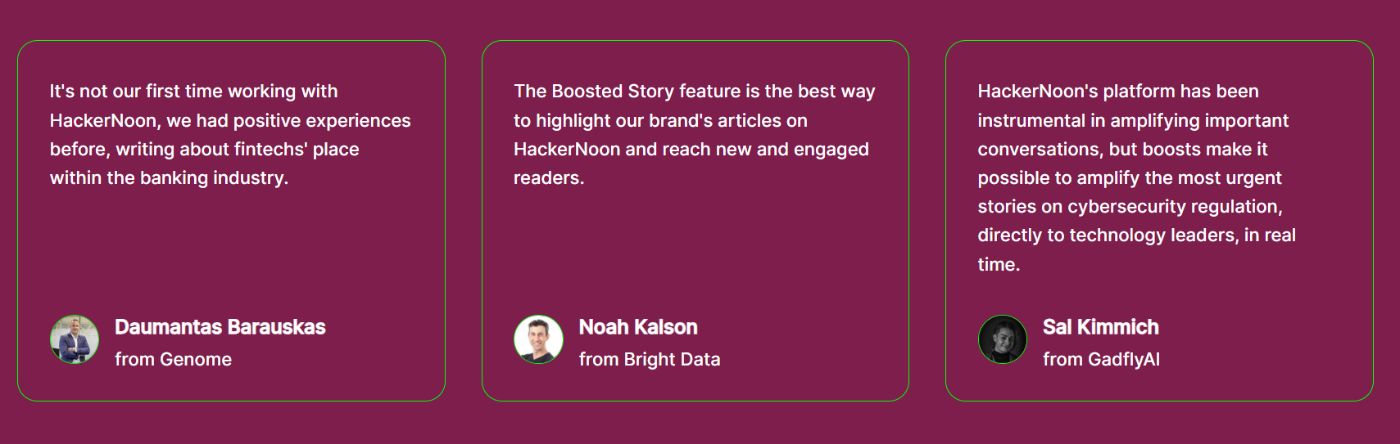
- The audience is already there. Over 4 million monthly readers who specifically come to HackerNoon to read technical content, dev stories, and insights from people building real things. You're not fighting for attention against lifestyle bloggers and motivational quotes - you're reaching developers, technical leaders, and decision-makers who actually care about what you learned.
- The editorial process adds value. HackerNoon's human editors review every piece, but they're not rewriting your voice into corporate-speak. They're helping you clarify, strengthen, and sharpen your message while keeping it authentically yours.
- Distribution that actually works. Your post doesn't just sit on a blog somewhere hoping for organic traffic. HackerNoon distributes content across social channels, newsletters, and a network of engaged readers. More importantly, their domain authority (DA 87) means your content ranks in search results, driving compounding traffic over time.
- Multiple formats for maximum reach. Every story published on HackerNoon is automatically available as audio, backed up on the blockchain, and translated into multiple languages. You write it once, and it reaches audiences in formats they actually want to consume.
\ Whether you're building credibility or showcasing technical depth, HackerNoon helps you turns your reflections into content that moves the needle.
\
:::info Learn more about HackerNoon Business Blogging here.
:::
\ 
\
The Real Win: Setting Yourself Up for 2026
This approach builds a content muscle that compounds over time. When you document what you learned in 2025, you're creating:
- Search-optimized evergreen content that drives traffic for months or years
- Social proof that your team is thoughtful, transparent, and worth paying attention to
- Recruiting collateral that shows prospects what it's actually like to work with you
- Customer confidence that you're the kind of company that learns, adapts, and improves
- A content backlog for future newsletters, social posts, and conversations
More importantly, you train your team to see their work as shareable. When engineers know their problem-solving might become a blog post, they think differently. That cultural shift from "we build things" to "we build AND share what we learn" separates companies that dominate the conversation from those that stay invisible.
Your team has insights worth sharing.
The question is whether you'll turn those insights into content your audience can use, or let them die in Slack threads.
\
Ready to start?
Use code HACKTHEDEAL10 for 10% off HackerNoon Business Blogging (Black Friday extended - limited time).
\
:::tip Start publishing with HackerNoon today!
:::
\ Your year-end reflections are too valuable to waste.
You May Also Like

Markets await Fed’s first 2025 cut, experts bet “this bull market is not even close to over”

The GOP’s secret weapon: A ‘known unknown’ that could swing the midterms

