NEAR Foundation launched NEAR AI Cloud and Private Chat to bring verifiable, hardware-backed privacy to AI applications. Brave, OpenMind AGI, and Phala Network integrated the tools, expanding NEAR’s confidential AI reach to more than 100 million users. NEAR Foundation has launched NEAR AI Cloud and Private Chat, two linked products designed to bring verifiable privacy [...]]]>NEAR Foundation launched NEAR AI Cloud and Private Chat to bring verifiable, hardware-backed privacy to AI applications. Brave, OpenMind AGI, and Phala Network integrated the tools, expanding NEAR’s confidential AI reach to more than 100 million users. NEAR Foundation has launched NEAR AI Cloud and Private Chat, two linked products designed to bring verifiable privacy [...]]]>

NEAR Protocol Launches NEAR AI Cloud and Private Chat With Verifiable Privacy

2025/12/04 17:28
  • NEAR Foundation launched NEAR AI Cloud and Private Chat to bring verifiable, hardware-backed privacy to AI applications.
  • Brave, OpenMind AGI, and Phala Network integrated the tools, expanding NEAR’s confidential AI reach to more than 100 million users.

NEAR Foundation has launched NEAR AI Cloud and Private Chat, two linked products designed to bring verifiable privacy to AI usage. The tools are already active within Brave Nightly, OpenMind AGI, and Phala Network suites, placing the technology in front of more than 100 million users. 

According to NEAR Foundation, both products operate on the principle that users should own their interactions with AI. They rely on hardware-backed protections and cryptographic verification, offering privacy assurances that differ from mainstream AI systems that run on centralized data models.

NEAR AI Expands User-Controlled Intelligence

Additionally, Near noted that its AI Cloud processes every request through Intel TDX and NVIDIA Confidential Computing chips, which act as trusted execution environments to isolate sensitive inputs. Every interaction can be verified by a cryptographic attestation confirming that the model executed in a protected environment. As a result, users gain transparency into how their data is handled during AI queries.

Private Chat builds on the same infrastructure. It functions like a major AI assistant but removes the data-harvesting component typically tied to centralized providers. According to the announcement, the application is designed to facilitate daily research and ensure that user data is not disclosed to operators or third parties.

Brave’s integration on Nov. 20 marked one of the most visible implementations, and additional adoption from OpenMind AGI and Phala Network broadened the reach of the technology. The foundation argues that the early partnerships demonstrate the system’s readiness, given that the workloads involved sensitive queries and large-scale traffic.

Market Conditions Challenge Short-Term Momentum

The technical progress arrives as its token trades near multi-month lows. The token broke under the $1.80 range after a long time of decline and heavy selling volume. The price had previously held at the level for several months before slipping further. The resistance in the $3.00-$3.60 range has served as a constant ceiling for analysts, redirecting many attempts at recovery in 2024 and 2025.
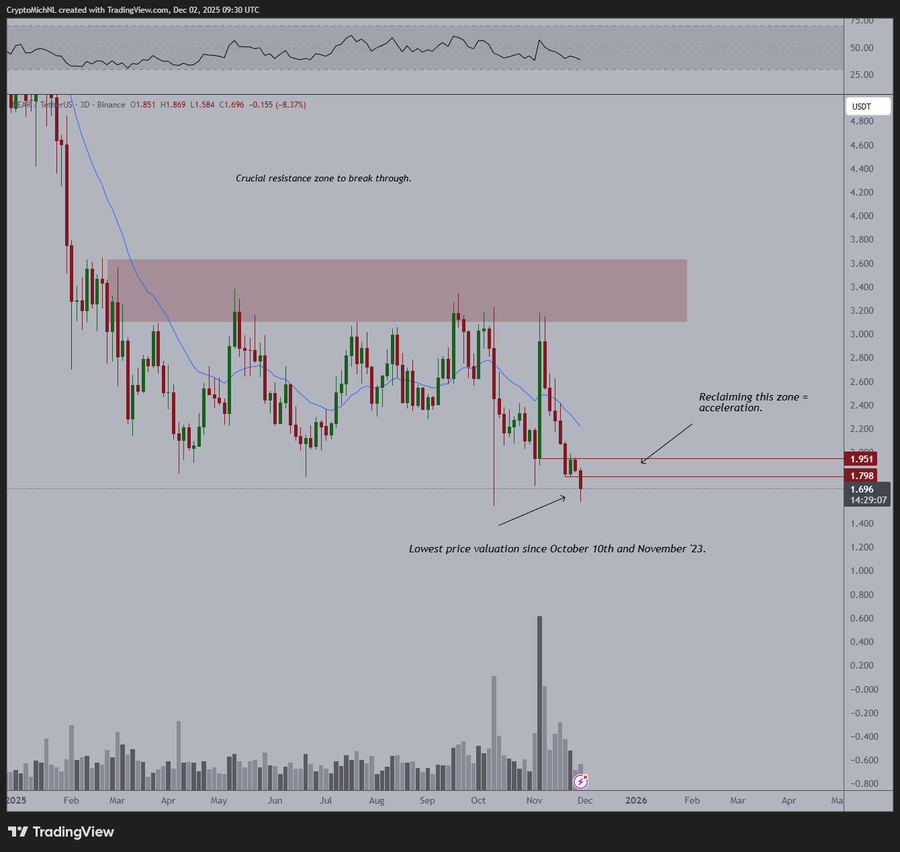
Image3-day NEAR/USDT Chart | Source: @CryptoMichNL on X

Momentum now depends on whether the token can reclaim $1.80 and advance toward $1.95, a zone that historically supported continuation during prior rebounds. According to the analyst, ‘Break through $1.80 & $1.95 and then we should be good to go upwards from here.” The breakdown from the $2.20 to $2.40 range in November intensified the decline, and large-volume sessions around the $2.00 breach suggested heavy supply pressure.

Network Activity Builds Under the Surface

The fundamentals continue to advance despite near-term market weakness. NEAR Intents, the project’s cross-chain automation system, has generated over $7 billion in lifetime volume with more than 12 million swaps and $11.68 million in fees. Unique addresses surged past 800,000 in the past 30 days, according to Dune Analytics data.

Interest also increased after the U.S. prediction market Kalshi added NEAR support on November 25. Additionally, validators voted to reduce inflation on October 28, lowering the tail emission rate from 5% to 2.5%.

]]>


Disclaimer: The articles reposted on this site are sourced from public platforms and are provided for informational purposes only. They do not necessarily reflect the views of MEXC. All rights remain with the original authors. If you believe any content infringes on third-party rights, please contact service@support.mexc.com for removal. MEXC makes no guarantees regarding the accuracy, completeness, or timeliness of the content and is not responsible for any actions taken based on the information provided. The content does not constitute financial, legal, or other professional advice, nor should it be considered a recommendation or endorsement by MEXC.

You May Also Like

Spot XRP ETFs Nears $1B AUM Milestone as Streak of No Outflows Continues

Spot XRP ETFs Nears $1B AUM Milestone as Streak of No Outflows Continues

The post Spot XRP ETFs Nears $1B AUM Milestone as Streak of No Outflows Continues appeared on BitcoinEthereumNews.com. The U.S. Spot XRP ETFs is now near the $1 billion mark of assets under management in less than a month since their launch. This follows from the product maintaining consistent inflows with no single outflow recorded yet. XRP ETFs See Continuous Inflows Since Launch Since its first launch on November 14, spot XRP funds have seen continued inflows. According to data from SoSoValue, the total inflows into these funds have now risen to $881.25 million. The funds attracted $12.84 million of new money yesterday. The daily trading volumes remained stable at $26.74 million. Source: SoSoValue Reaching nearly $1 billion in less than 30 days makes the product among the fastest growing crypto investment products in the United States. Notably, Spot Solana ETFs also accumulated over $600 million since their launch. On the other hand, Bitcoin and Ethereum ETFs are holding about $58 billion and about $13 billion in assets under management respectively. Much of the early growth traces back to the first Canary Capital’s XRP ETF. Its opening on November 13 brought one of the strongest crypto ETF openings to date. It saw more than $59 million in first-day trading volume and $245 million in net inflows. Shortly after Canary’s launch, firms like Grayscale, Bitwise, and Franklin Templeton introduced their own XRP products. Bitwise’s fund also did well on its launch, recording over $105 million in early inflows. Meanwhile, the market is getting ready for yet another addition. 21Shares’ U.S. spot XRP fund also got the green light from the SEC. It will trade under the ticker TOXR on the Cboe BZX Exchange. XRP Products Keep Gaining Momentum in the Market The token’s funds continued to expand this week. REX Shares and Tuttle Capital have launched the T-REX 2X Long XRP Daily Target ETF. This new ETF allows traders…
Share
BitcoinEthereumNews2025/12/05 14:11
Headwind Helps Best Wallet Token

Headwind Helps Best Wallet Token

The post Headwind Helps Best Wallet Token appeared on BitcoinEthereumNews.com. Google has announced the launch of a new open-source protocol called Agent Payments Protocol (AP2) in partnership with Coinbase, the Ethereum Foundation, and 60 other organizations. This allows AI agents to make payments on behalf of users using various methods such as real-time bank transfers, credit and debit cards, and, most importantly, stablecoins. Let’s explore in detail what this could mean for the broader cryptocurrency markets, and also highlight a presale crypto (Best Wallet Token) that could explode as a result of this development. Google’s Push for Stablecoins Agent Payments Protocol (AP2) uses digital contracts known as ‘Intent Mandates’ and ‘Verifiable Credentials’ to ensure that AI agents undertake only those payments authorized by the user. Mandates, by the way, are cryptographically signed, tamper-proof digital contracts that act as verifiable proof of a user’s instruction. For example, let’s say you instruct an AI agent to never spend more than $200 in a single transaction. This instruction is written into an Intent Mandate, which serves as a digital contract. Now, whenever the AI agent tries to make a payment, it must present this mandate as proof of authorization, which will then be verified via the AP2 protocol. Alongside this, Google has also launched the A2A x402 extension to accelerate support for the Web3 ecosystem. This production-ready solution enables agent-based crypto payments and will help reshape the growth of cryptocurrency integration within the AP2 protocol. Google’s inclusion of stablecoins in AP2 is a massive vote of confidence in dollar-pegged cryptocurrencies and a huge step toward making them a mainstream payment option. This widens stablecoin usage beyond trading and speculation, positioning them at the center of the consumption economy. The recent enactment of the GENIUS Act in the U.S. gives stablecoins more structure and legal support. Imagine paying for things like data crawls, per-task…
Share
BitcoinEthereumNews2025/09/18 01:27