Bitwise Chief Investment Officer, Matt Hougan, has firmly rejected growing claims that the company may be forced to sell its Bitcoin holdings.Bitwise Chief Investment Officer, Matt Hougan, has firmly rejected growing claims that the company may be forced to sell its Bitcoin holdings.

Bitwise CIO Rejects Claims of Bitcoin Selloff Amid MSCI Index Removal Risk
For feedback or concerns regarding this content, please contact us at crypto.news@mexc.com
Bitwise Cio Rejects Claims Of Bitcoin Selloff Amid Msci Index Removal Risk

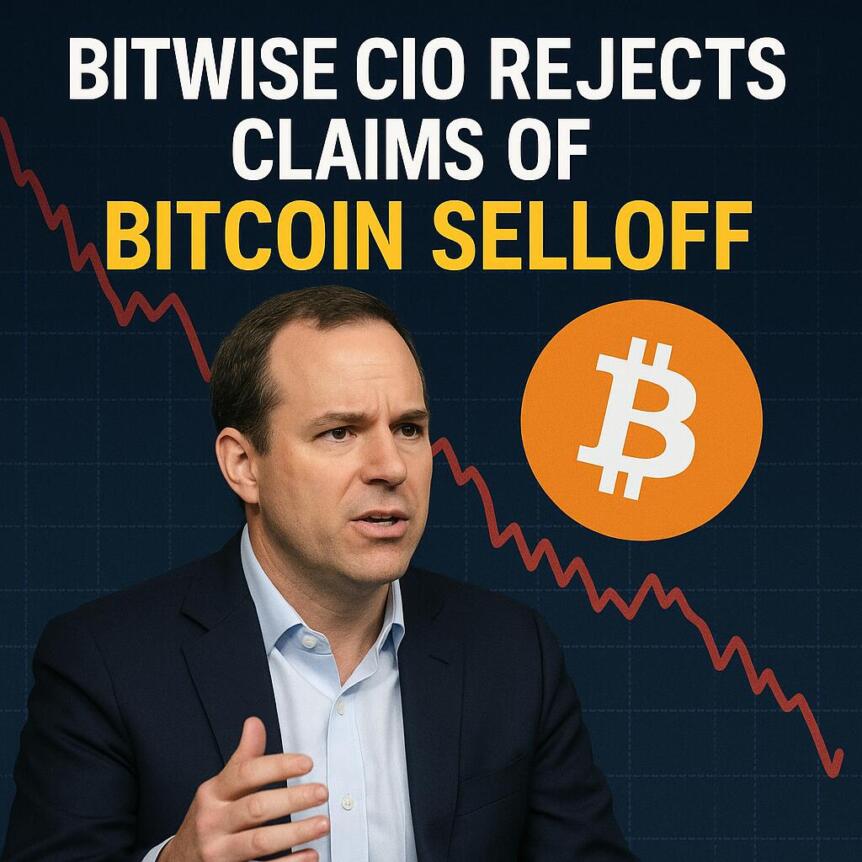
Bitwise Chief Investment Officer, Matt Hougan, has firmly rejected growing claims that the company may be forced to sell its Bitcoin holdings. In a recent client note titled “No, Virginia, Strategy Is Not Going To Sell Its Bitcoin,” Hougan addressed two primary concerns. First, the potential removal of Bitwise from MSCI’s index, and second, the idea that such an exclusion could force the firm to liquidate its Bitcoin position.

MSCI, a prominent global index provider, is considering the removal of digital asset treasury companies from its investable indexes, with a decision expected by January 15. If Bitwise were excluded, JPMorgan estimates it could trigger up to $2.8 billion in passive selling of its stock. However, Hougan placed a 75% probability on the company’s removal. This reassured investors that index changes rarely result in significant market disruptions.

Liquidity and Cash Reserves Ensure Stability

Hougan emphasized that while market jitters over MSCI’s decision have impacted Bitwise’s stock price since October 10. He pointed out that the company’s Bitcoin holdings, valued at roughly $60 billion, remain unaffected by stock price fluctuations. Additionally, Bitwise’s liquidity buffer stands at $1.4 billion, sufficient to cover its obligations for the next 18 months.

The firm has also provided greater clarity on its strategy for managing liquidity. This reveals its plan to maintain a reserve capable of covering at least 12 months of dividends. Over time, Bitwise aims to build this reserve to withstand even longer periods. By ensuring ample liquidity, the company minimizes the risk of being forced into Bitcoin sales.

A Long-Term Strategy Focused on BTC Growth

Hougan further explained that Bitwise’s approach includes selling Bitcoin only when it is overvalued. using proceeds to cover dividends while increasing the company’s BTC holdings over time. This long-term strategy counters concerns that payouts could diminish exposure to Bitcoin.

Ultimately, Hougan believes that the current financial structure and market conditions do not support the idea of a forced liquidation. While acknowledging ongoing challenges in the cryptocurrency market, including slow progress on regulatory frameworks. However, he remains confident that Bitwise’s position is secure and well-funded.

This article was originally published as Bitwise CIO Rejects Claims of Bitcoin Selloff Amid MSCI Index Removal Risk on Crypto Breaking News – your trusted source for crypto news, Bitcoin news, and blockchain updates.


Disclaimer: The articles reposted on this site are sourced from public platforms and are provided for informational purposes only. They do not necessarily reflect the views of MEXC. All rights remain with the original authors. If you believe any content infringes on third-party rights, please contact crypto.news@mexc.com for removal. MEXC makes no guarantees regarding the accuracy, completeness, or timeliness of the content and is not responsible for any actions taken based on the information provided. The content does not constitute financial, legal, or other professional advice, nor should it be considered a recommendation or endorsement by MEXC.

You May Also Like

OpenVPP accused of falsely advertising cooperation with the US government; SEC commissioner clarifies no involvement

OpenVPP accused of falsely advertising cooperation with the US government; SEC commissioner clarifies no involvement

PANews reported on September 17th that on-chain sleuth ZachXBT tweeted that OpenVPP ( $OVPP ) announced this week that it was collaborating with the US government to advance energy tokenization. SEC Commissioner Hester Peirce subsequently responded, stating that the company does not collaborate with or endorse any private crypto projects. The OpenVPP team subsequently hid the response. Several crypto influencers have participated in promoting the project, and the accounts involved have been questioned as typical influencer accounts.
Share
PANews2025/09/17 23:58
Trump's allegation against Noem would constitute a federal crime: analyst

Trump's allegation against Noem would constitute a federal crime: analyst

President Donald Trump caught everyone off guard by suddenly firing Homeland Security Secretary Kristi Noem — but being out of a job could just be the start of
Share
Rawstory2026/03/06 04:49
Aave DAO to Shut Down 50% of L2s While Doubling Down on GHO

Aave DAO to Shut Down 50% of L2s While Doubling Down on GHO

The post Aave DAO to Shut Down 50% of L2s While Doubling Down on GHO appeared on BitcoinEthereumNews.com. Aave DAO is gearing up for a significant overhaul by shutting down over 50% of underperforming L2 instances. It is also restructuring its governance framework and deploying over $100 million to boost GHO. This could be a pivotal moment that propels Aave back to the forefront of on-chain lending or sparks unprecedented controversy within the DeFi community. Sponsored Sponsored ACI Proposes Shutting Down 50% of L2s The “State of the Union” report by the Aave Chan Initiative (ACI) paints a candid picture. After a turbulent period in the DeFi market and internal challenges, Aave (AAVE) now leads in key metrics: TVL, revenue, market share, and borrowing volume. Aave’s annual revenue of $130 million surpasses the combined cash reserves of its competitors. Tokenomics improvements and the AAVE token buyback program have also contributed to the ecosystem’s growth. Aave global metrics. Source: Aave However, the ACI’s report also highlights several pain points. First, regarding the Layer-2 (L2) strategy. While Aave’s L2 strategy was once a key driver of success, it is no longer fit for purpose. Over half of Aave’s instances on L2s and alt-L1s are not economically viable. Based on year-to-date data, over 86.6% of Aave’s revenue comes from the mainnet, indicating that everything else is a side quest. On this basis, ACI proposes closing underperforming networks. The DAO should invest in key networks with significant differentiators. Second, ACI is pushing for a complete overhaul of the “friendly fork” framework, as most have been unimpressive regarding TVL and revenue. In some cases, attackers have exploited them to Aave’s detriment, as seen with Spark. Sponsored Sponsored “The friendly fork model had a good intention but bad execution where the DAO was too friendly towards these forks, allowing the DAO only little upside,” the report states. Third, the instance model, once a smart…
Share
BitcoinEthereumNews2025/09/18 02:28