Ethereum ETFs record $75.21M outflow with zero inflows as price stalls at $3K
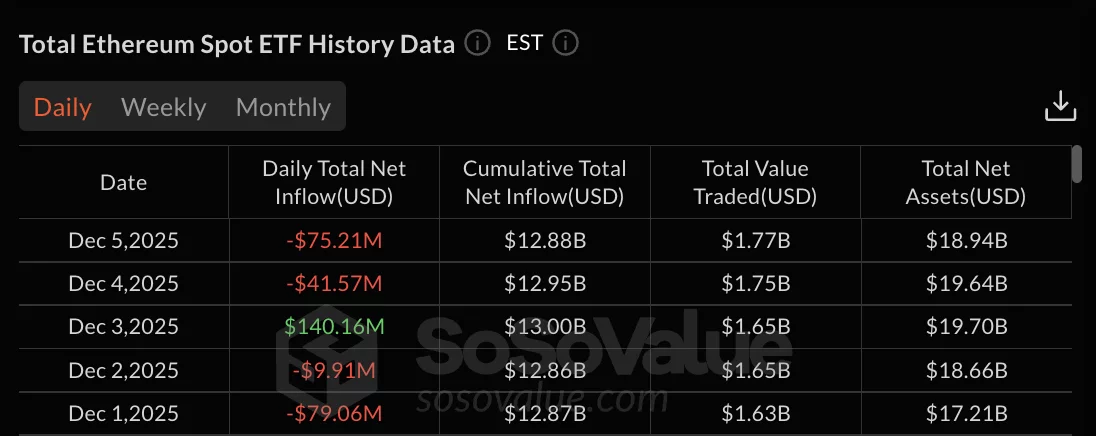
Ethereum spot ETFs recorded $75.21 million in outflows on December 5, with all nine funds posting zero inflows.
- Ethereum ETFs lost $75.21M on Dec 5, marking four straight days of outflows.
- BlackRock’s ETHA drove the entire withdrawal as sentiment weakened.
- ETH supply on exchanges hit a record low despite negative market mood.
BlackRock’s ETHA accounted for the entire withdrawal and was the fourth consecutive day of net redemptions for Ethereum (ETH) ETFs.
ETH traded at $3,030 with a 24-hour range of $2,995.50 to $3,146.10. The token has dropped 2.7% over the past 24 hours and 10.3% over the past 30 days.
BlackRock drives fourth straight day of outflows
Ethereum ETFs have bled capital since December 2, posting $79.06 million, $9.91 million, and $41.57 million in outflows before Thursday’s $75.21 million withdrawal.
December 3 provided the only respite with $140.16 million in inflows, driven by Fidelity’s FETH.
BlackRock’s ETHA remains the largest Ethereum ETF with $13.09 billion in cumulative net inflows. Grayscale’s ETHE holds -$4.99 billion in net outflows since converting from a trust structure. Fidelity’s FETH has accumulated $2.62 billion in total inflows.
Total net assets under management for Ethereum ETFs stood at $18.94 billion as of December 5. Cumulative total net inflow across all funds reached $12.88 billion.
Total value traded hit $1.77 billion on December 5, up from $1.75 billion the previous day.
Bitcoin ETFs posted a contrasting picture with $54.79 million in inflows on December 5. Total net assets for Bitcoin funds reached $117.11 billion, with cumulative inflows at $57.62 billion.
Exchange supply hits record low amid weak sentiment
ETH exchange balances fell to 8.84% of total supply, the lowest level on record. The metric compares to Bitcoin’s 14.8% exchange balance, suggesting tighter ETH supply conditions.
“ETH keeps getting pulled into places that don’t sell: staking, restaking, L2 activity, DA layers, collateral loops, long term custody,” Milk Road posted on X. The X accounted noted that while sentiment feels heavy, supply dynamics don’t change based on market mood.
“ETH supply is tightening in the background while the market decides its next move. When that gap closes, price follows,” the post stated.
You May Also Like

The Evolution of Blockchain Ecosystems

Why Blockchain Is Transforming Financial Infrastructure