Cake Wallet, Vikrant Sharma: “we’re investing heavily in privacy”
The Cryptonomist interviewed Vikrant Sharma, CEO at Cake Wallet.
Your personal experience with Coinbase clearly shaped the creation of Cake Wallet. Looking back, what was the most powerful realization that drove you to turn that frustration into innovation?
When that happened in 2015, it honestly caught me off guard. In 2015 I tried buying antibiotics on a dark-web market. I sent Bitcoin from my centralized exchange address, and my account was instantly closed. That moment really woke me up, and I suddenly realized how transparent everything on the blockchain is and how little control you actually have when someone else is holding your keys and monitoring your activity.
I thought I was using Bitcoin freely, but in reality it only took one transaction for a third party to decide what I was “allowed” to do with my own money.
That frustration slowly turned into motivation. It made me realize how important privacy and self-custody really are if crypto is going to fulfill the promise of financial freedom. Cake Wallet was born from that idea that people should be able to use crypto privately, safely, and without asking permission from anyone.
Privacy and self-custody are often seen as complex topics for mainstream users. How did you approach making them simple and intuitive in Cake Wallet’s design philosophy?
Cake was literally born from the idea of making crypto “a piece of cake.” From day one the focus was on making privacy and self-custody feel simple and intuitive for everyone.
Our approach has always been to find what do users find the most difficult, and figure how do we remove that friction. Seed phrases are a good example. Managing one seed phrase for Bitcoin, another for Ethereum, another for Monero, it’s overwhelming. So we created a way to manage everything with one master seed. Same with addresses. No one wants to memorize or constantly check long strings of characters, so now you can receive money using something as simple as your Twitter handle.
People also told us they wanted to use crypto easily in real life. So we integrated debit cards and gift cards where you can load crypto and just use it wherever you want.
At the end of the day, it’s about listening to your users, and those who are brand new to crypto, and we focus on whatever they’re struggling with the most. If we can make privacy and self-custody feel effortless, then we’re doing our job.
Cake Wallet has consistently been ahead of the curve — from integrating Bitcoin Silent Payments to Payjoin v2. What drives your team’s innovation, and how do you decide which privacy features are worth implementing first?
Prioritizing privacy features is a difficult thing to do right, since there’s theoretically no limit to how private you can make a system. Our ultimate goal is to make crypto easy for people, while giving them next-gen privacy features they may not even be aware they’re using.
When we look back at new technologies, we ask ourselves two things:
1. Will this meaningfully upgrade users’ privacy in the real world?
2. Can we implement it in a way that feels effortless for the user?
That mindset is what pushed us to integrate things like Litecoin MWEB, Tor, Bitcoin Silent Payments, and PayJoin V2. These are powerful technologies but they weren’t used by everyday users, so we decided to take these innovations out of GitHub repos and put them in the hands of normal people who just want safe, private transactions without needing a degree in tech.
The idea of turning any spare phone into an air-gapped cold wallet is revolutionary. What inspired this feature, and how do you see it changing the way people think about personal crypto security?
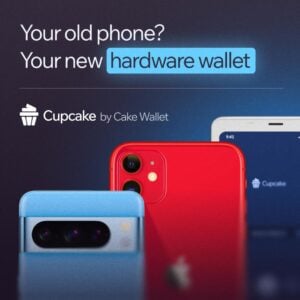
Cupcake came from the idea that advanced security shouldn’t be something only tech experts can access. A lot of people already have an old phone or tablet sitting in a drawer, so why can’t that become a hardware wallet for free? That was the inspiration. With Cupcake, anyone can turn a spare device into an air-gapped cold wallet in about five minutes.
What I really love about Cupcake is that it gives you the exact same core security model as traditional hardware wallets, your keys never touch the internet, but without cost or complexity. No shipping, no waiting, no personal information, no addresses on a package, no paper trail. It just looks like an old phone, but it’s actually keeping your keys offline permanently. And because it pairs with Cake Wallet using view-only mode, your day-to-day wallet stays easy to use, while your long-term funds remain completely offline.
I think this changes the way people think about crypto security because it removes the intimidation factor, it isn’t a luxury product anymore. You don’t need to spend money or wait for deliveries or trust a closed box. You can secure your savings with something you already have at home and you can verify every line of code because it’s fully open source.
You’ve unified multiple coins under one seed phrase, and even enabled users to send to any address using different cryptos. How challenging was it to build this level of interoperability, and what does it mean for the future of multi-coin wallets?
Interoperability sounds easy but in reality every blockchain speaks a completely different “language” so unifying multiple coins under one seed phrase and letting users send across different cryptos was a challenge, but that’s exactly why we did it. Most people don’t want to think in terms of blockchains, they just want to use their crypto.
Having one seed phrase for Bitcoin, Ethereum, Monero and more makes self-custody feel as natural as having one login for a banking app. And being able to send to any address regardless of which crypto the other person holds removes friction in everyday transactions.
For us, it is always about hiding the technical complexities for our users.If interoperability is done right, the user shouldn’t even notice it’s happening. They just open their wallet, choose the asset they want, and transact.
I think this is the future of multi-coin wallets not “more features,” but fewer challenges for the user. The easier it becomes for people to manage different assets, the faster mainstream adoption will happen. And privacy and self-custody become much more realistic when everything feels simple instead of technical.
Sending crypto using just a Twitter handle removes a major barrier for everyday users. How do you balance this convenience with privacy and security concerns?
It’s true that in crypto there’s a common belief that privacy and security always come at the expense of convenience, but we don’t think that has to be a permanent trade-off. One of our goals at Cake Wallet is to prove that you can have all three at the same time.
Our X feature is a great example, we don’t do any hosting within Cake Wallet, we’re not hosting anything or storing user data. People voluntarily post their public addresses in their X bios, and we simply use X’s API to fetch whatever they’ve chosen to make public.
This means there’s a verifiable address for each user (security), it makes it easy for our users to pay anyone with a handle, and many of our users put their Monero, BTC Silent Payment, or LTC MWEB addresses, which overall makes crypto more private, secure, and convenient.
This is the trifecta we try to strike across our entire app experience and you can find it in features like PayJoin v2 which gives better privacy with no loss of security and can even result in cheaper fees, and AnyPay lets you pay anyone even if you’re using different cryptos, which massively improves privacy and ease of use.
Cake Wallet’s xStocks integration allows users to buy tokenized shares like Google or Nvidia directly with crypto. Do you see tokenized assets as the next frontier for crypto adoption?
A big factor with stocks is accessibility. In some countries, investing in equities is complicated and a lot of people who already hold crypto don’t want to go through a bank or a brokerage just to get exposure to stocks. We wanted to give that accessibility to our users so they could essentially be their own brokerage. Now all they need is crypto in Cake Wallet. No bank account, no brokerage approval. That’s a huge shift in who gets to participate in the financial system.
Do I think tokenized assets are the next frontier? I think they’re definitely one of them, but not the only one. It’s true that not everyone wants to trade crypto for the sake of crypto. Many people just want access to global markets in a simple, borderless way. Tokenization makes that possible because it brings traditional assets into the same ecosystem where crypto already operates.
So for us, xStocks is becoming a gateway to more financial freedom, more choice and more access. And the more people can actually do with their crypto send it, save it, invest it, spend it the closer we get to true mainstream adoption.
In Switzerland, users can pay with Monero at SPAR supermarkets — a remarkable real-world use case. What lessons have you learned from this deployment, and could we see similar integrations elsewhere?
One of the biggest lessons is that merchants care less about the word “crypto” and more about practical benefits: low fees, instant settlement, no fraud chargebacks, and no sensitive customer data to store. And for customers, it’s the privacy and convenience of paying without linking their identity to their shopping habits. It’s a win on both sides.
Could we see this elsewhere? Absolutely. Every region is different in terms of regulation and merchant culture, but the interest is there. The success in Switzerland has made it clear that real-world adoption doesn’t require forcing merchants to become “crypto experts.” It just requires making payments as simple and reliable as the systems they already use.
Our role at Cake Wallet is to keep pushing for that kind of practicality.
With increasing regulatory pressure around privacy coins like Monero, how do you see the balance evolving between privacy rights and compliance?
There’s definitely a lot of attention on privacy coins right now, and we understand why. Regulators want safe financial systems, and users want control over their personal information, those two goals don’t have to cancel each other out. At Cake Wallet we focus on self-custody tools that don’t collect personal data. We don’t hold funds, and we don’t track users. Our job is simply to give people secure technology to manage their own money.
Going forward, we think the industry will continue moving toward solutions that respect both sides, responsible use of crypto while still protecting everyday people from unnecessary data exposure.
Finally, what’s next for Cake Wallet? Are there any upcoming features or long-term goals that you’re particularly excited about — perhaps something that could redefine how we think about financial freedom?
What’s next for Cake Wallet is all about expanding financial freedom while keeping privacy and self-custody at the core. The feature I am most excited about right now is the Bitcoin Lightning integration. Lightning opens the door to everything from tiny micropayments to large transfers with near-instant settlement. But we’re doing it the Cake way, privacy-first and fully self-custodial. Some Lightning implementations today introduce trade-offs around privacy or rely on hosted services. We’re building it so users stay in control and their transaction privacy remains protected end-to-end.
We also have a lot of work happening on the hardware wallet side, supporting more devices and giving people multiple ways to secure funds, whether it’s a commercial hardware wallet or a spare phone turned into an air-gapped cold wallet with Cupcake.
Another area we’re investing heavily in is intuitive coin management. Advanced privacy features like coin control have traditionally been difficult or intimidating for newcomers. We’re making easy tagging, bulk actions, smarter organization of your coins, and spending controls designed so users get strong privacy without needing to think like a developer or auditor.


You May Also Like

Strait of Hormuz Crisis: Macron’s Stark Warning Against Military Action

United Airlines (UAL) Stock Falls After Slashing 2026 Earnings Forecast