The crypto market is always full of excitement and anxiety. Prices can soar in the morning and tumble by the evening. These shifts are not just about numbers or charts. They are about emotions: confidence, hesitation, and sometimes panic. Understanding them helps us see why investors behave the way they do.The crypto market is always full of excitement and anxiety. Prices can soar in the morning and tumble by the evening. These shifts are not just about numbers or charts. They are about emotions: confidence, hesitation, and sometimes panic. Understanding them helps us see why investors behave the way they do.

Educational Byte: Bulls, Bears, and Fear Index in the Crypto Market

2025/12/08 07:03
4 min read
For feedback or concerns regarding this content, please contact us at crypto.news@mexc.com

\ The crypto market is always full of excitement and anxiety. Prices can soar in the morning and tumble by the evening, leaving everyone wondering what happened. These shifts are not just about numbers or charts. They are about emotions: confidence, hesitation, and sometimes panic. 

Just like traditional markets, crypto has its moods, and understanding them helps us see why investors behave the way they do. Let’s learn a bit about this.

\

What Are Bulls and Bears?

When people talk about bull and bear markets, they’re describing two opposite emotional climates. A bull market happens when investors feel confident, so they buy more, and prices rise steadily over time. It’s a period of optimism when most traders expect that coins or tokens will keep climbing. In contrast, a bear market appears when confidence fades, investors sell en masse, and prices drop for an extended period. Everyone is fearing further losses.

These terms come from how the mentioned animals attack: bulls thrust upward with their horns, while bears swipe downward with their paws. The imagery fits perfectly with price movements. A bull market can lift projects and drive innovation, while a bear market often exposes weak foundations or overhyped tokens.

Crypto’s youth and volatility make these cycles sharper than in traditional markets. For example, Bitcoin’s surge to nearly $68,000 in 2021 was a clear bull phase, followed by a bear market when prices fell below $20,000 in 2022. Of course, the price didn’t stay like that, and today it’s around $90,000.
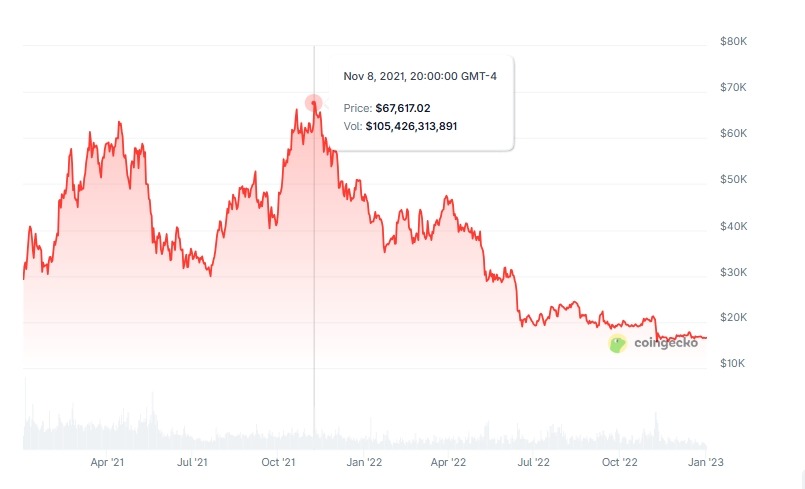
BTC Price 2021-2023 by CoinGecko \n

Recognizing which mood dominates the market can help us avoid emotional decisions. Instead of panicking when prices fall, we can see it as part of a recurring pattern and be aware that these are only temporary phases. \n

The Crypto Fear & Greed Index

Emotions move markets, but how can we measure something as intangible as fear? Well, the Crypto Fear & Greed Index, created by Alternative.me, attempts to capture that feeling in a single number between 0 and 100. Zero means extreme fear, suggesting that investors are anxious and selling, while 100 signals extreme greed, meaning investors are confident and eager to buy.

The index looks at several factors to produce its daily score. Volatility shows how nervous the market is, since sudden price drops can reflect fear. Market momentum and trading volume reflect whether investors are entering or leaving. Social media activity, mainly from X (formerly Twitter) and Reddit, reveals what the crowd is discussing. Bitcoin’s dominance is another key factor, as a high dominance can mean less risk-taking in altcoins. Search trends, like spikes in “Bitcoin crash,” also add to the sentiment mix.

Each indicator receives a score that’s adjusted to fit the same scale and be combined into the final number. The index focuses heavily on Bitcoin because its movements tend to lead the broader crypto market. A reading near 25 often suggests widespread fear, while values around 75 point to growing greed. 

The concept isn’t perfect. Sudden news, like a major exchange hack or ETF approval, can move the score sharply. It’s best used as a reflection of mood, not as a trading signal. When combined with other analysis methods, it helps us understand when emotions might be overpowering logic.

\

Keeping Calm When the Market Isn’t

The crypto world rewards patience more than panic. Watching the Fear & Greed Index can remind us how emotional the market is, but it shouldn’t control our decisions. Whether prices rise or fall, a long-term view and solid understanding of our goals make all the difference. 

When fear is high, it can be a time to study and learn. When greed dominates, it’s wise to stay alert and avoid rushing in. In the end, understanding how emotions shape the market helps us trade less from impulse and more from awareness.

Besides, speculation will always exist, but it should come second to purpose. Crypto was born as a decentralized tool for freedom, not just “easy” profit. Over time, the projects that stay true to their mission tend to endure. Obyte, a decentralized DAG running since 2016, is one of them —still working toward a freer, more resilient future for everyone.

\n


Featured Vector Image by starline / Freepik

\n

\

Market Opportunity
BULLS Logo
BULLS Price(BULLS)
$318.57
$318.57$318.57
-3.06%
USD
BULLS (BULLS) Live Price Chart
Disclaimer: The articles reposted on this site are sourced from public platforms and are provided for informational purposes only. They do not necessarily reflect the views of MEXC. All rights remain with the original authors. If you believe any content infringes on third-party rights, please contact crypto.news@mexc.com for removal. MEXC makes no guarantees regarding the accuracy, completeness, or timeliness of the content and is not responsible for any actions taken based on the information provided. The content does not constitute financial, legal, or other professional advice, nor should it be considered a recommendation or endorsement by MEXC.

You May Also Like

U.S. Moves Grip on Crypto Regulation Intensifies

U.S. Moves Grip on Crypto Regulation Intensifies

The post U.S. Moves Grip on Crypto Regulation Intensifies appeared on BitcoinEthereumNews.com. The United States is contending with the intricacies of cryptocurrency regulation as newly enacted legislation stirs debate over centralized versus decentralized finance. The recent passage of the GENIUS Act under Bo Hines’ leadership is perceived to skew favor towards centralized entities, potentially disadvantaging decentralized innovations. Continue Reading:U.S. Moves Grip on Crypto Regulation Intensifies Source: https://en.bitcoinhaber.net/u-s-moves-grip-on-crypto-regulation-intensifies
Share
BitcoinEthereumNews2025/09/18 01:09
TradFi Giant Deutsche Börse Taps Circle for Major European Stablecoin Push

TradFi Giant Deutsche Börse Taps Circle for Major European Stablecoin Push

Deutsche Börse Group has signed a Memorandum of Understanding (MoU) with Circle Internet Financial to integrate regulated stablecoins into European capital markets. According to the announcement, the collaboration will focus on Circle’s USDC and EURC, connecting token-based payment networks with traditional financial infrastructure. The partnership marks the first time a major European market infrastructure provider has formally teamed up with a global stablecoin issuer. Both parties said the initiative represents a milestone for regulated digital finance in Europe, made possible by the EU’s Markets in Crypto-Assets Regulation (MiCA), the bloc’s new comprehensive framework for digital assets. Partnership Bridges Traditional Finance and Crypto Settlement in Europe Under the agreement, the initial rollout will take place through Deutsche Börse’s subsidiaries. Trading will be facilitated on 360T’s digital exchange, 3DX, and through the institutional crypto provider Crypto Finance. Custody services will be provided via Clearstream, Deutsche Börse’s post-trade business, with Crypto Finance’s German entity serving as sub-custodian. Jeremy Allaire, Circle’s co-founder and CEO, said the collaboration would reduce settlement risk, lower costs, and improve efficiency across banks, asset managers, and other market participants. “As clear rules take hold across Europe, aligning our regulated stablecoins, EURC and USDC, with trusted venues will unlock new products and streamline workflows across trading, settlement, and custody,” Allaire said. Executives at Deutsche Börse noted the potential of stablecoins to reshape European finance. Stephanie Eckermann, who oversees post-trading at the group, said the deal advances the company’s ambition to digitize securities issuance and post-trade processes. Thomas Book, who is responsible for trading and clearing, added that the partnership positions Deutsche Börse to bridge traditional and digital markets by providing an integrated value chain across execution, settlement, and custody. The agreement follows Circle’s regulatory breakthrough earlier this year. On July 1, Circle became the first global stablecoin issuer to secure an Electronic Money Institution (EMI) license under MiCA, issued by French regulators. The license allows the company to issue both USDC and EURC across the European Union. Circle described the approval as a major milestone for mainstream adoption, noting that MiCA sets the conditions for long-term growth in digital finance by ensuring stablecoin issuers meet strict consumer protection and reserve requirements. The MiCA framework, passed by the European Parliament in April 2023, has been gradually implemented since June. Circle’s head of policy, Dante Disparte, said the regulation closes the door on unregulated operations, while Allaire noted that it legitimizes the sector after years of skepticism from mainstream finance. European Banking Giants Form Consortium for Euro Stablecoin Amid Deutsche Börse Group’s efforts, nine of Europe’s largest lenders are joining forces to launch a euro-backed stablecoin in the second half of 2026, seeking to challenge the dominance of U.S. dollar-pegged tokens. The consortium, which includes ING, UniCredit, CaixaBank, Danske Bank, KBC, DekaBank, SEB, Raiffeisen Bank International, and Italy’s Banca Sella, has set up a new company in the Netherlands to oversee the project. It plans to seek a license from the Dutch Central Bank as an e-money institution under the European Union’s MiCA framework. According to a joint statement, the stablecoin will provide near-instant cross-border payments, lower transaction costs, and round-the-clock access to settlements. “This development requires an industry-wide approach, and it’s imperative that banks adopt the same standards,” said Floris Lugt, digital assets lead at ING. The move shows growing European efforts to reduce reliance on dollar-based stablecoins, which currently account for 99% of global supply.Source: ECB Euro-pegged tokens remain a small fraction of the market, with less than €350 million in circulation, European Central Bank (ECB) data shows. The initiative comes as the ECB advances its digital euro project, with Executive Board member Piero Cipollone suggesting a rollout could happen by mid-2029. EU lawmakers are expected to weigh in on the legal framework later this year. Together, the bank-led stablecoin and the ECB’s digital euro mark Europe’s bid to secure greater autonomy in digital payments and limit the influence of non-EU issuers in the region’s financial system
Share
CryptoNews2025/10/01 01:51
Smart investors earn $6,875 daily on ProfitableMining, the leading cloud mining platform.

Smart investors earn $6,875 daily on ProfitableMining, the leading cloud mining platform.

In the volatile cryptocurrency market, price fluctuations are becoming increasingly severe. Simply holding onto your coins and waiting for them to rise is no longer a safe strategy. More and more experienced investors are turning to a more stable approach—ProfitableMining cloud mining, with becoming their preferred platform. They aren’t waiting for market fluctuations; they’re generating […]
Share
Cryptopolitan2025/09/18 01:00
