NEAR Protocol reached 1 million transactions per second in benchmark tests using 70 shards, demonstrating sharding's scalability potential far beyond Visa's peak capacity. The post NEAR Achieves 1M Transactions Per Second in Sharded, Test Environment appeared first on Coinspeaker.NEAR Protocol reached 1 million transactions per second in benchmark tests using 70 shards, demonstrating sharding's scalability potential far beyond Visa's peak capacity. The post NEAR Achieves 1M Transactions Per Second in Sharded, Test Environment appeared first on Coinspeaker.

NEAR Achieves 1M Transactions Per Second in Sharded, Test Environment

2025/12/09 03:13

NEAR Protocol NEAR $1.75 24h volatility: 1.1% Market cap: $2.24 B Vol. 24h: $188.81 M has achieved a significant milestone of 1 million transactions per second (TPS) in a benchmark test environment created to simulate a real-world scenario. This development helps to demonstrate sharding is an efficient method for high scalability and throughput capacity for high-performance blockchains—surpassing Visa’s peak capacity of around 65,000 transactions per second.

The NEAR Foundation reported this recent achievement in a blog post on Dec. 8, explaining the benchmark’s methodology in “a publicly verifiable benchmark using real code, realistic workloads, and cost-effective and performant Google Compute Engine C4D machines across 70 shards,” as described.

Results are available in three Grafana dashboards that achieved 1,029,497, 1,037,334, and 1,037,495 transactions per second peaks, followed by a constant one million TPS performance for nearly one hour each.
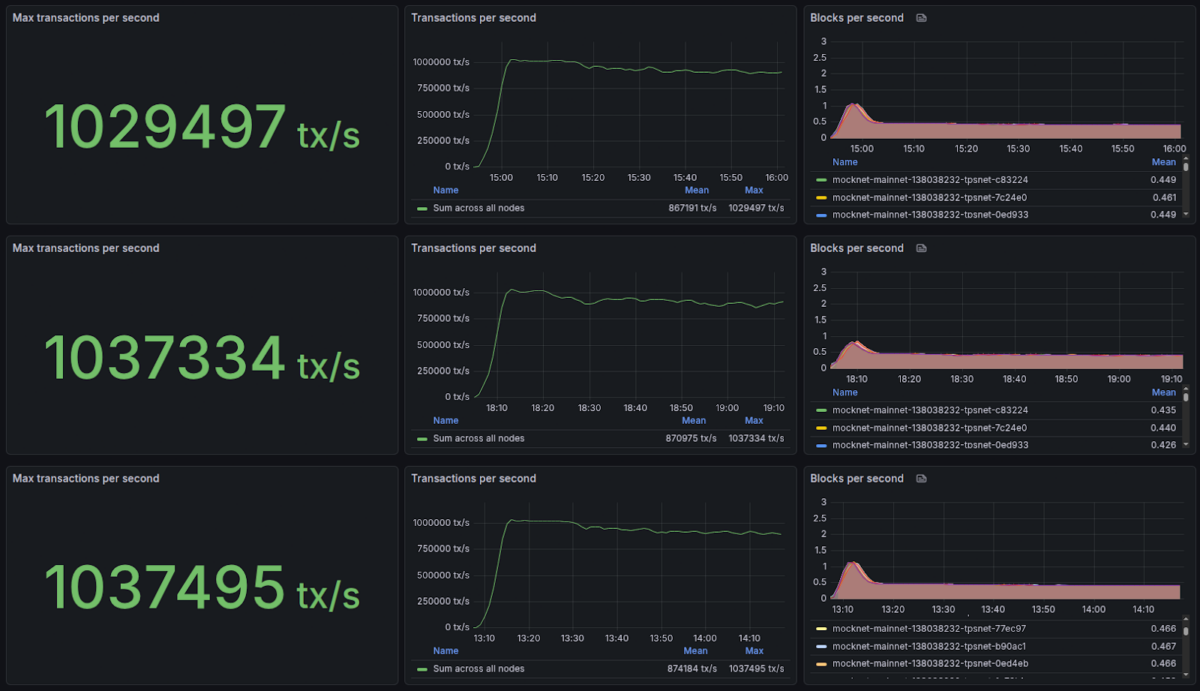
Grafana dashboards for three NEAR Protocol 1M-TPS tests | Source: NEAR Foundation/Grafana

Grafana dashboards for three NEAR Protocol 1M-TPS tests | Source: NEAR Foundation/Grafana

As described in the blog post, this benchmark had validators split in 70 shards, running commercial-grade hardware from Google Cloud, with an approximate cost of $900 per month. While accessible, this cost is significantly higher than the minimum required to run chunk validators on NEAR—currently estimated at $15 per month, according to Meta Pool’s Node Studio.

This test used only native token transfers, not broadcasting smart contract executions that require more network gas and computational power, which could reduce the overall capacity per second. Moreover, the NEAR blockchain currently has nine shards and not the 70 shards used for the tests, meaning the current mainnet capacity is likely orders of magnitude below the achieved one million transactions per second.

Nevertheless, it suggests NEAR Protocol is ready, with enough optimizations, to scale at any moment to something close to 1 million TPS with consistency and network reliability as adoptions and demand for block space grows.

How Many TPS Other Blockchains and Payment Processors Can Achieve?

Interestingly, Visa (NYSE: V) can scale to 65,000 transactions per second, according to The Banking Scene. In 2024, Visa processed an average of approximately 25,091 transactions per second globally, based on the total of roughly 293 billion payment transactions handled that year.

Data Coinspeaker gathered from Chainspect on Dec. 8 shows the theoretical maximum TPS other blockchains can achieve, based on benchmark tests like the one provided by NEAR, or rough calculations by the Chainspect analysts.

When comparing with some of the largest cryptocurrencies by market cap, Sonic, ICP, and Aptos have the largest maximum theoretical TPS after NEAR, with nearly 400,000, 210,000, and 160,000 transactions per second, respectively.

Sui SUI $1.61 24h volatility: 0.9% Market cap: $6.01 B Vol. 24h: $995.44 M , TON TON $1.63 24h volatility: 1.4% Market cap: $3.98 B Vol. 24h: $135.10 M , Polkadot DOT $2.12 24h volatility: 0.7% Market cap: $3.49 B Vol. 24h: $192.42 M , and Solana SOL $134.4 24h volatility: 1.0% Market cap: $75.38 B Vol. 24h: $5.34 B follow suit, with approximately 120,000, 105,000, 100,000, and 65,000 TPS, respectively. However, SOL is the one with the highest “Real-Time TPS” across all blockchains on Chainspect—at 1,238 transactions per second by the time of this writing.
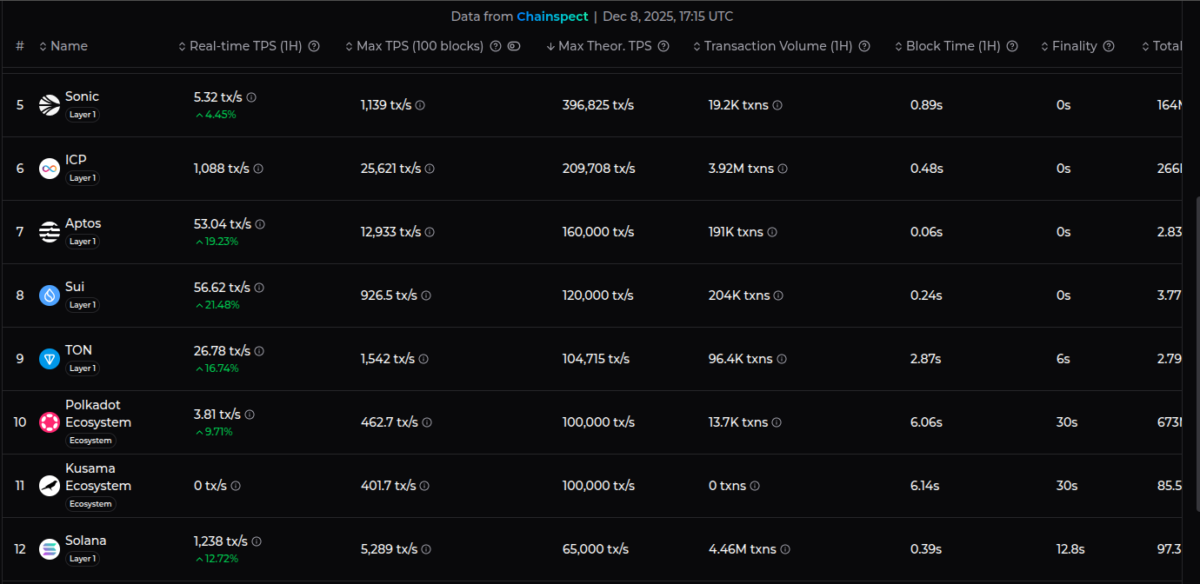
Fastest blockchains by transactions per second (TPS), as of Dec. 8 | Source: Coinspect

Fastest blockchains by transactions per second (TPS), as of Dec. 8 | Source: Coinspect

Therefore, this recent achievement positions NEAR as one of the layer-one blockchain networks with the highest theoretical capacity and scalability. This adds up to recent positive developments in the NEAR ecosystem, as Coinspeaker has covered and reported about.

On Dec. 5, NEAR launched TravAI, together with ADI Chain, where AI agents handle complete travel booking workflows from search to payment using crypto. On Dec. 3, the foundation announced NEAR AI Cloud and Private Chat, two related products that were already integrated by relevant players like the Brave Browser. Kalshi also recently added support to NEAR’s native token and NEAR Intents surpassed the $7 billion mark for its chain-abstracted swaps all-time volume.

next

The post NEAR Achieves 1M Transactions Per Second in Sharded, Test Environment appeared first on Coinspeaker.

Disclaimer: The articles reposted on this site are sourced from public platforms and are provided for informational purposes only. They do not necessarily reflect the views of MEXC. All rights remain with the original authors. If you believe any content infringes on third-party rights, please contact service@support.mexc.com for removal. MEXC makes no guarantees regarding the accuracy, completeness, or timeliness of the content and is not responsible for any actions taken based on the information provided. The content does not constitute financial, legal, or other professional advice, nor should it be considered a recommendation or endorsement by MEXC.

You May Also Like

Pepeto vs Blockdag Vs Layer Brett Vs Remittix and Little Pepe

Pepeto vs Blockdag Vs Layer Brett Vs Remittix and Little Pepe

The post Pepeto vs Blockdag Vs Layer Brett Vs Remittix and Little Pepe appeared on BitcoinEthereumNews.com. Crypto News 18 September 2025 | 05:39 Hunting the best crypto investment in 2025? Presales can flip a portfolio fast and sometimes change a life overnight when you choose well, which is why we start with receipts instead of slogans and cut straight to what’s live, audited, and usable today, not vague aspirations likely to drift as cycles turn and narratives fade for months. In this head-to-head we put Pepeto (PEPETO) up against Blockdag, Layer Brett, Remittix, and Little Pepe using simple yardsticks, team intent and delivery, on-chain proofs, tokenomics clarity, DEX and bridge readiness, PayFi rails, staking, and listing prep, so you can act on facts, not hype, and decide confidently before the next leg higher catches you watching from the sidelines. Pepeto’s Utility Play: Zero-Fee DEX, Bridge, And StrongPotential Pepeto treats the meme coin playbook like a platform brief, not a joke. The team ships fast, polishes details, and shows up weekly, aiming for staying power rather than a momentary pop. A hard-capped design anchors PepetoSwap, a zero-fee exchange where every trade routes through PEPETO for built-in usage instead of buzz. Already 850+ projects have applied to list, fertile ground for volume if listings follow. A built-in cross-chain bridge adds smart routing to unify liquidity, cut extra hops, and reduce slippage, turning activity into steady token demand because every swap touches PEPETO. Pepeto is audited by independent experts Solidproof and Coinsult, a trust marker reflected in more than $6,7 Million already raised in presale. Early momentum is visible. The presale puts early buyers at the front of the line with staking and stage-based price increases, and that line is getting long. Utility plus purpose, culture plus tools, the combo that tends to run farther than hype alone. Translation for you: Pepeto is graduating from noise to usage. If…
Share
BitcoinEthereumNews2025/09/18 10:41
OCC Confirms Banks Can Facilitate No-Risk Crypto Transactions

OCC Confirms Banks Can Facilitate No-Risk Crypto Transactions

The post OCC Confirms Banks Can Facilitate No-Risk Crypto Transactions appeared on BitcoinEthereumNews.com. U.S. national banks have been passed by the Office of the Comptroller of the Currency (OCC) to enable their customers perform instant crypto trades with no risk. This decision has cleared a significant obstacle in the way of banks that desire to be part of the expanding digital assets market. Banks Receive Clarity on Crypto Trading Authority  Interpretive Letter 1188 states that a bank can be an intermediary in crypto transactions without having digital assets in its possession. The OCC clarified that one client may sell a crypto asset to one bank and that bank will sell the asset to the other client at the same time. Since the two trades take place virtually at the same time the bank does not have an exposure to the market. The license provides banks with a regulated structure to provide crypto trading services. This is in line with preceding actions like enabling banks to hold major crypto assets. Another explanation that OCC provides is that the role of the bank is not to trade digital assets. Instead, the only responsibility of the bank is linking the sellers and the buyers. OCC Reinforces Bank’s Crypto Oversight The regulator mentioned that such transactions carry a limited amount of settlement risk. The decision is an update of a previous guidance that permitted crypto custody and some stablecoin transactions. The latest clarification strengthens the same allowances but indicates continued regulation of responsible crypto services in the banking space. With this, the banks are now enabled to provide customers with a secure means of accessing digital assets in compliance with federal regulations. The OCC stressed that institutions need to continue having robust risk controls, such as cybersecurity controls and compliance programs. Hence, all their operations can be safe and in line with current rules. How Institutions Might…
Share
BitcoinEthereumNews2025/12/10 07:46