Crypto Companies Should Be Treated Equally Under Federal Banking Laws, Says OCC Jonathan Gould, head of the Office of the Comptroller of the Currency (OCC), emphasized that crypto firms seeking a US federal bank charter should be subject to the same regulatory standards as traditional financial institutions. Speaking at a recent blockchain conference, Gould highlighted [...]Crypto Companies Should Be Treated Equally Under Federal Banking Laws, Says OCC Jonathan Gould, head of the Office of the Comptroller of the Currency (OCC), emphasized that crypto firms seeking a US federal bank charter should be subject to the same regulatory standards as traditional financial institutions. Speaking at a recent blockchain conference, Gould highlighted [...]

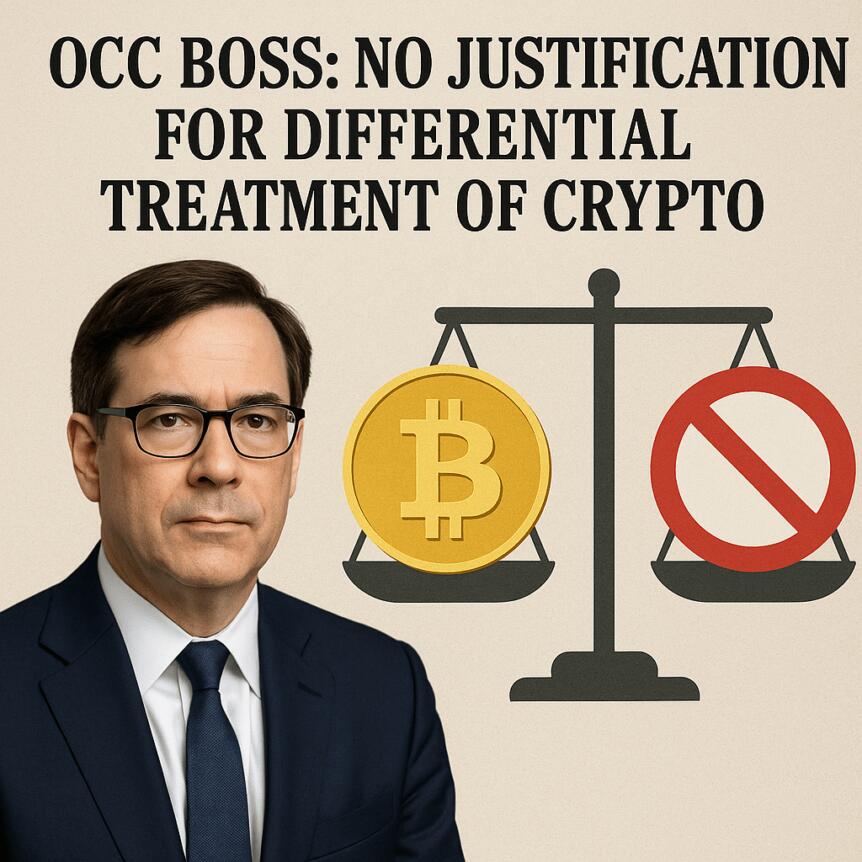
OCC Boss: No Justification for Differential Treatment of Crypto
2025/12/09 11:28
Occ Boss: No Justification For Differential Treatment Of Crypto

Crypto Companies Should Be Treated Equally Under Federal Banking Laws, Says OCC

Jonathan Gould, head of the Office of the Comptroller of the Currency (OCC), emphasized that crypto firms seeking a US federal bank charter should be subject to the same regulatory standards as traditional financial institutions. Speaking at a recent blockchain conference, Gould highlighted that the activities involved in custody and safekeeping of digital assets have been electronically managed for decades, making it unjustifiable to treat digital assets differently from conventional banking services.

Key Takeaways

  • Gould advocates for equal treatment of crypto companies under banking regulations.
  • The OCC recognizes digital assets’ longstanding electronic custody services.
  • Only two crypto-focused banks—Anchorage Digital and Erebor—hold OCC charters.
  • The regulator has seen increasing applications from entities involved in innovative digital asset activities.

Tickers mentioned: none

Sentiment: Neutral

Price impact: Neutral. The comments reflect a balanced stance aiming to integrate crypto into existing financial frameworks without immediate regulatory upheaval.

Trading idea (Not Financial Advice): Hold. The regulatory landscape remains dynamic as authorities seek an appropriate balance between innovation and oversight.

Market context: The growing interest from crypto firms in establishing federally regulated banks indicates mainstream acceptance, amid ongoing regulatory discussions.

Regulatory Perspective on Crypto Banking

Gould reaffirmed that the OCC considers the evolution of banking—from the telegraph to blockchain—as a natural progression. He mentioned that 14 applications to establish new banks, including those engaged in digital assets, have been received so far this year, almost matching the total received over the past four years. This surge underscores the industry’s drive toward official recognition and safe regulatory pathways.

“Chartering helps ensure that the banking system keeps pace with financial innovation and supports our modern economy,” Gould stated. “Entities involved with digital assets should have a clear pathway to become federally supervised banks.”

Addressing Industry Concerns

Despite some banking and trade group concerns over OCC oversight of crypto-focused banks, Gould dismissed fears that increased regulation might hinder innovation. He highlighted that the OCC has years of supervisory experience with crypto-native national trust banks, including Anchorage Digital, which has held a charter since 2021, and Erebor, which received a preliminary banking charter in October.

Gould emphasized that ongoing discussions and daily interactions with existing banks demonstrate the OCC’s openness to innovative banking initiatives. “This ongoing dialogue reinforces our confidence in the OCC’s ability to oversee both new entrants and expanded activities within the banking sector fairly and effectively,” he concluded.

This article was originally published as OCC Boss: No Justification for Differential Treatment of Crypto on Crypto Breaking News – your trusted source for crypto news, Bitcoin news, and blockchain updates.


Disclaimer: The articles reposted on this site are sourced from public platforms and are provided for informational purposes only. They do not necessarily reflect the views of MEXC. All rights remain with the original authors. If you believe any content infringes on third-party rights, please contact service@support.mexc.com for removal. MEXC makes no guarantees regarding the accuracy, completeness, or timeliness of the content and is not responsible for any actions taken based on the information provided. The content does not constitute financial, legal, or other professional advice, nor should it be considered a recommendation or endorsement by MEXC.

You May Also Like

Taiko Makes Chainlink Data Streams Its Official Oracle

Taiko Makes Chainlink Data Streams Its Official Oracle

The post Taiko Makes Chainlink Data Streams Its Official Oracle appeared on BitcoinEthereumNews.com. Key Notes Taiko has officially integrated Chainlink Data Streams for its Layer 2 network. The integration provides developers with high-speed market data to build advanced DeFi applications. The move aims to improve security and attract institutional adoption by using Chainlink’s established infrastructure. Taiko, an Ethereum-based ETH $4 514 24h volatility: 0.4% Market cap: $545.57 B Vol. 24h: $28.23 B Layer 2 rollup, has announced the integration of Chainlink LINK $23.26 24h volatility: 1.7% Market cap: $15.75 B Vol. 24h: $787.15 M Data Streams. The development comes as the underlying Ethereum network continues to see significant on-chain activity, including large sales from ETH whales. The partnership establishes Chainlink as the official oracle infrastructure for the network. It is designed to provide developers on the Taiko platform with reliable and high-speed market data, essential for building a wide range of decentralized finance (DeFi) applications, from complex derivatives platforms to more niche projects involving unique token governance models. According to the project’s official announcement on Sept. 17, the integration enables the creation of more advanced on-chain products that require high-quality, tamper-proof data to function securely. Taiko operates as a “based rollup,” which means it leverages Ethereum validators for transaction sequencing for strong decentralization. Boosting DeFi and Institutional Interest Oracles are fundamental services in the blockchain industry. They act as secure bridges that feed external, off-chain information to on-chain smart contracts. DeFi protocols, in particular, rely on oracles for accurate, real-time price feeds. Taiko leadership stated that using Chainlink’s infrastructure aligns with its goals. The team hopes the partnership will help attract institutional crypto investment and support the development of real-world applications, a goal that aligns with Chainlink’s broader mission to bring global data on-chain. Integrating real-world economic information is part of a broader industry trend. Just last week, Chainlink partnered with the Sei…
Share
BitcoinEthereumNews2025/09/18 03:34
Superstate Launches SEC‑Approved Tokenized Share Issuance on Ethereum and Solana

Superstate Launches SEC‑Approved Tokenized Share Issuance on Ethereum and Solana

Superstate introduced a new pathway that brings public equity issuance onto blockchain networks through a regulated structure. The firm now enables SEC-registered companies to sell new tokenized shares directly to investors on Ethereum and Solana. The move signals a shift toward faster capital formation as firms search for more efficient fundraising channels. Moreover, the development arrives as U.S. regulators accelerate experiments that merge traditional finance with blockchain infrastructure. Consequently, the launch positions Superstate at the center of efforts to modernize how public companies raise money and maintain shareholder records.Direct Issuance Targets Faster Funding and Instant SettlementThe Direct Issuance Program lets issuers receive capital in stablecoins while investors receive tokenized shares in real time. This structure allows companies to manage shareholder updates instantly through Superstate’s regulated transfer agent system. Additionally, the program supports existing share classes or new digital-only classes, giving companies more flexibility in how they engage investors.Superstate expects the first offerings to launch in 2026. The firm argues that companies need issuance rails that match global capital flows and deliver immediate settlement. Hence, the appeal of stablecoin-based transactions grows as markets demand more certainty and speed. The approach may also help smaller issuers reach investors who prefer blockchain-based assets with transparent lifecycle tracking.Regulators Accelerate Blockchain ExperimentsRegulators under the Trump administration encourage more crypto-financial innovation, which strengthens interest in tokenized securities. Both the SEC and CFTC now advance guidelines that reduce uncertainty around digital issuance. Moreover, large issuers and fintech firms continue to test onchain models that integrate with compliance tools and custodial systems.Earlier efforts by Galaxy and Sharplink involved tokenizing existing shares for onchain holding. However, those initiatives did not raise new capital. Superstate now extends that foundation by enabling primary issuance that interacts directly with blockchain liquidity.Programmable Securities Unlock New Use CasesTokenized shares issued through the program can include programmable features that update governance or distribution rules automatically. Besides, the digital structure allows integrations with onchain settlement, portfolio management, and institutional custody providers. These features may attract investors seeking assets that combine regulatory protection with efficient blockchain execution.Superstate intends to open its offering to both retail and institutional buyers after KYC checks. Consequently, the initiative may reshape how issuers approach capital formation and how investors access regulated digital securities.
Share
Coinstats2025/12/11 03:16