

Privacy Coin Zcash Exposed – Half of All Transactions Now Tracked
Blockchain intelligence firm Arkham announced on Tuesday that it has labeled over 53% of Zcash transactions, linking approximately $420 billion in volume to identifiable individuals and institutions, despite Zcash’s reputation as a privacy-focused cryptocurrency.
The platform’s new tracking capability covers both shielded and transparent transactions, with 48% of transaction inputs and outputs and 37% of total balances, roughly $2.5 billion, now attributed to specific entities.
The disclosure sparked immediate controversy within the crypto community, with critics accusing Arkham of making misleading claims about its ability to track truly private transactions.
Zcash founder Zooko Wilcox clarified that the firm “didn’t actually deanonymize any ZEC that was held at rest in the shielded pool,” noting such tracking would be “impossible because the information just isn’t there.“
Tracking Claims Draws Sharp Industry Backlash
Blockchain developers quickly challenged Arkham’s announcement, pointing out fundamental limitations in tracking shielded Zcash transactions.
Multiple industry figures noted that Arkham can only trace transparent-to-transparent, shielded-to-transparent, and transparent-to-shielded movements.
At the same time, fully shielded transactions remain cryptographically protected through zero-knowledge proofs that make deanonymization technically impossible.
Mert from Helius Labs called the announcement a “scummy clickbait title,” arguing Arkham deliberately included references to shielded transactions “for a few clicks” despite being unable to track them.
He added that “for a data org, that’s as scammy as it gets” and suggested the move prioritized “clicks over truth,” potentially damaging the firm’s credibility in blockchain analytics.
Saad El Kouari from AWB noted that the platform failed to identify major holders, including Grayscale, Electric Coin Company, and Shielded Labs, suggesting that its tracking capabilities remain limited to transparent wallet activity.
He emphasized that Arkham “can’t identify a single whale” and “0 individuals, not even very clear targets” like Wilcox himself, demonstrating the significant gaps in the firm’s surveillance reach.
Dynamic Fee Proposal Addresses Network Congestion
Beyond the privacy debate, Zcash developers advanced a separate initiative to overhaul the network’s fee structure.
Shielded Labs released a detailed blueprint Monday proposing a shift from static fees, originally 10,000 zatoshi, later reduced to 1,000, to a dynamic model based on median transaction activity across 50-block periods.
The proposal addresses recurring “sandblasting” spam episodes that previously clogged wallets and congested the chain under fixed-fee structures.
An earlier ZIP-317 proposal introduced action-based accounting, treating every transaction component as a uniform “action,” fixing abuse vectors while maintaining predictable, low fees that don’t adjust to network usage.
Developers emphasized that with ZEC’s recent price surge and increasing institutional interest, the current system has become unsustainable.
Some users have reported edge cases where shielding small transactions costs double-digit ZEC amounts.
The dynamic fee mechanism introduces a stateless design using “comparables” to establish standard fees while maintaining privacy protections.
Under network stress, a temporary priority lane at 10× the standard fee would allow users to compete for block space without requiring protocol redesign or risking the complexity of EIP-1559-style mechanisms that could compromise Zcash’s privacy constraints.
Institutional Adoption Drives Token Performance
ZEC surged nearly 5% today, trading above $400 and vastly outperforming the broader market.
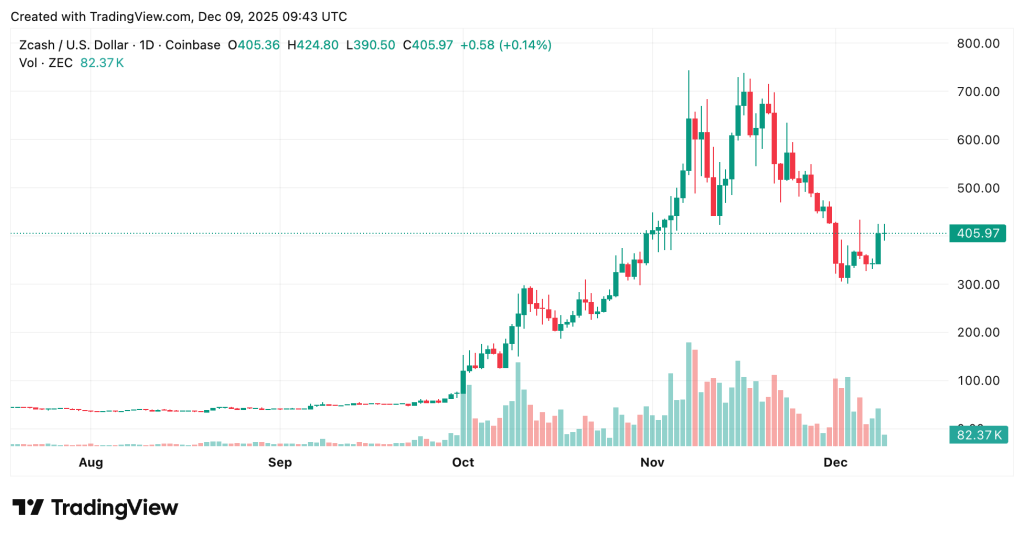 Source: TradingView
Last month, Zcash received significant institutional validation. The Winklevoss twins’ treasury vehicle has acquired 200,000 ZEC since November, worth over $80 million, targeting eventual ownership of roughly 5% of the circulating supply.
Similarly, Reliance Global recently liquidated all other digital asset positions to focus exclusively on Zcash.
Grayscale also filed with regulators to convert its existing Zcash Trust into a spot ETF tracking the CoinDesk Price Index, potentially opening new access channels for institutional investors.
So far, the token’s share of supply held in shielded addresses has climbed to approximately 30% from an average of 10% in 2024, according to Grayscale Research.
Looking forward, as Carter Feldman, Founder and CEO of Psy Protocol, told Cryptonews, we are seeing a surge in demand for onchain privacy, and “not just at the base layer, but also with the emergence of next-generation blockchains designed for privacy-preserving smart contracts, like Psy, Miden, and Aztec.”


You May Also Like

Hyperliquid ramps up Washington lobby as Wall Street applies regulatory pressure

Critical USDT0 Response to Drift Hack Exposes Stark Contrast in Stablecoin Security Protocols




